
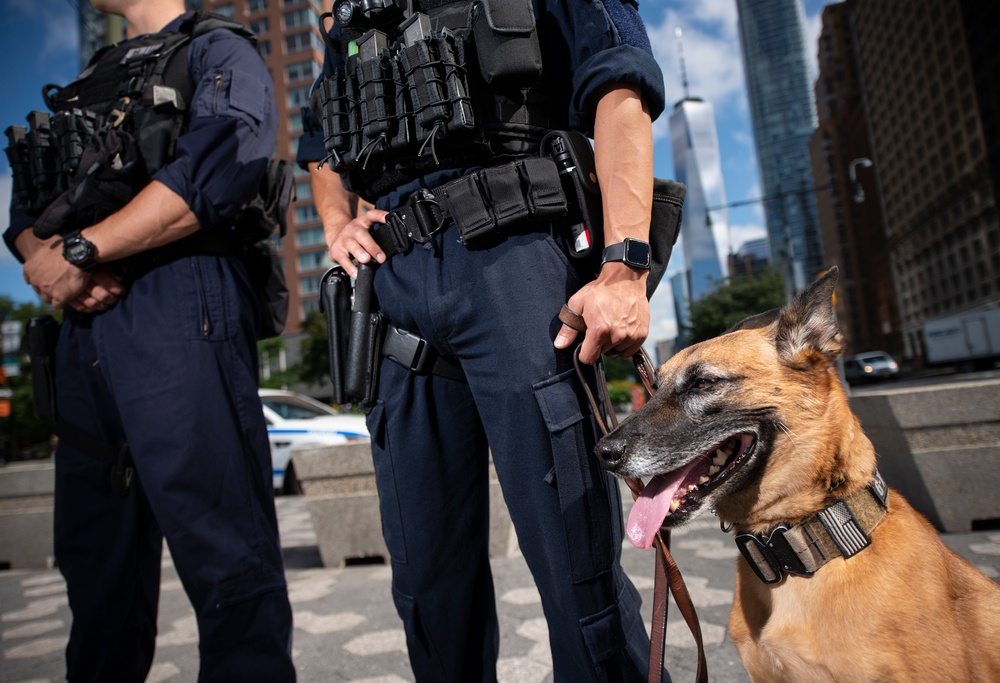
Each year, Homeland Security Today honors shining stars in the community who are making their own unique, invaluable contributions to advance the mission of keeping America safer from myriad threats. Their strong commitment to mission touches every part of their work, from day-to-day operations to special projects and work in the community.
Greg Bird, Mission Systems Branch Chief, Office of Infrastructure Assessments and Analysis, Infrastructure Security Division, Cybersecurity and Infrastructure Security Agency
 The CISA Gateway is the technical evolution of the IP Gateway, a complex collection of approximately 25 mission systems and capabilities integrated to provide support to infrastructure protection, assessment, and analysis partners across the homeland security mission space. Over time, the CISA Gateway has expanded in capability, gained mission and stakeholder criticality, and absorbed several other legacy systems and applications. As directed by the Homeland Security Act of 2002, Homeland Security Presidential Directive 7 (HSPD-7), Presidential Policy Directive 21 (PPD-21), Executive Order 13636, the Critical Infrastructure Act of 2002, and the 2013 National Infrastructure Protection Plan (NIPP), the mission of Infrastructure Assessment and Analysis (IAA) within the Cybersecurity and Infrastructure Security Agency (CISA) of the Department of Homeland Security (DHS) is to lead the national effort to secure critical infrastructure from all hazards by managing risk and enhancing resilience through collaboration with the critical infrastructure community. The CISA Gateway provides the suite of tools that allows this community to execute this mission.
The threats to critical infrastructure that drive the mission include terrorist attacks, natural disasters, and other manmade threats such as accidents and insider threats. IAA through the CISA Gateway allows DHS and mission partners to better prepare, assess, respond to, and analyze these threats.
CISA Gateway System Owner Greg Bird has been a knowledgeable, supportive, driven, and technical partner to industry in this mission. His understanding of the Gateway, its mission, cybersecurity and the migration process allowed him to deconflict and prioritize competitive tasks, keeping all on track and making it easy for partners to direct resources. He created a team environment in which industry truly worked side-by-side with government counterparts, collectively solving problems and accomplishing tasks. He was driven to getting the migration done as quickly as possible but also understanding risks. Bird in one weekend developed a script that generated 650,000 test facilities with associated taxonomy that adequately represented sectors, states, ZIP codes, and longitude and latitude coordinates, in a file corresponding to the Bulk Upload requirements for one of the CISA Gateway Applications. This greatly helped with the ability to build, test and train in the non-production environments.
Sheriff Mike Chapman, Loudoun County, Va.
 Mike Chapman was elected sheriff of Loudoun County, Va., in 2011 and took office in January 2012. He was reelected in 2015 and again in 2019. He directs a $97M budget and operations for the largest sheriff’s office in the Commonwealth of Virginia, which handles countywide law enforcement, the jail and the courts. The Sheriff’s Office employs approximately 800 — more than 600 sworn deputies and 200 civilian personnel. The Loudoun County Sheriff’s Office serves a population of 400,000 and an area of 519 square miles.
During his terms in office, Chapman has expanded the Drug Abuse Resistance Education (DARE) to include both Elementary and Middle Schools (named DARE Executive of the Year), established a Cold Case squad, enhanced media outreach through integrated technology and proactive social media, introduced online reporting, professionalized the Human Resources and hiring processes and, through his Step Up initiative, improved service, technology, efficiency and professionalism. Chapman also initiated a countywide internet safety training program for parents, added prescription drug awareness with assistance from the Drug Enforcement Administration (DEA), partnered with county schools for the “No Texting and Driving” campaign, and initiated Crisis Intervention Team (CIT) Training for deputies and dispatchers. With myriad stakeholders, he initiated the Heroin Operations Team (HOT) in response to the rapidly growing national and local heroin and opioid problem. HOT addresses drug abuse through targeted enforcement, education, training, prevention, and treatment.
Chapman is Vice President of Homeland Security for the Major County Sheriffs of America (MCSA) and serves on the Board of Directors for the National Sheriffs Association. He also serves on the DARE Law Enforcement Advisory Board and serves as the Co-Chair on the Department of Justice President’s Commission on Law Enforcement Homeland Security Working Group. He previously served on the Virginia Sheriffs’ Association’s Congressional and Legislative Committees. Sheriff Chapman graduated from the FBI National Executive Institute (NEI) and Law Enforcement Executive Development Association (LEEDA), the U.S. Army War College – National Security and Strategy Seminar (Certificate of Leadership Development), the National Sheriffs’ Institute, the Virginia Sheriffs’ Institute, and Virginia Commonwealth University’s Sheriffs’ Institute, and earned the Virginia Department of Criminal Justice Services’ executive certification.
Chapman formerly worked for the Howard County Maryland Police Department in the Divisions of Patrol, SWAT and Criminal Investigations, and for the DEA where he directed all operations throughout the Far East, served as the Assistant Special Agent in Charge in San Francisco, as DEA’s Chief of Public Affairs, as the Country Attaché for South Korea, as a supervisor in McAllen, Texas, and in field assignments in Miami, Tampa, and Pakistan. In the private sector, Chapman worked as a Subject Matter Expert on the Global Security/Law Enforcement team with Booz Allen Hamilton.
Boyd Dixon, Director of Emergency Management, Bellevue Hospital, NYC Health + Hospitals System
 Boyd Dixon has worked for New York City Health + Hospitals/Bellevue hospital for the past 20 years as Director of Disaster Preparedness and Bioterrorism. Bellevue hospital is the No. 1 rated trauma center public hospital in NYC and NYCH+H is the largest public healthcare system in the country. Dixon has implemented one of the strongest and most resounding emergency management programs in the city and has been incident commander during all major disasters that have befallen Bellevue Hospital since Superstorm Sandy, when 730 patients including 120 prisoners were safely evacuated without loss of life. Dixon has also implemented a robust emergency preparedness plan to respond when the president of the United States visits New York City and has conducted full-scale drills with the U.S. Secret Service in preparation for any incident.
Dixon has created a truly remarkable and safe environment for patients, staff and visitors and has trained staff on how to respond to active shooters, bomb threats and suspicious packages. He has also created one of the largest hospital decontamination teams in New York City with more than 200 staff members trained and certified by FEMA. Bellevue Hospital was ready and well equipped for the COVID-19 pandemic due to Dixon’s quick response with preparing the hospital to receive an influx of patients with respiratory illness. Bellevue Hospital conducted drills two months prior to receiving the first COVID patient and was able to surge up to 300 extra negative- pressure rooms.
This response was indicative of Bellevue’s response to receiving and caring for New York City’s first Ebola patient. Once again, Dixon prepared hospital leadership and staff months ahead of time with countless trainings and creating a biocontainment lab to prepare for just the chance that Bellevue would eventually receive an Ebola patient. He has given presentations around the United States and Canada on Ebola preparation and hurricane preparations and patient evacuations. He has been instrumental in making New York City’s public healthcare system safer and has collaborated with other city healthcare systems on their own preparedness measures.
FEMA COVID-19 Vaccination Team
 In January 2021, the Federal Emergency Management Agency (FEMA) was charged by the National Strategy for COVID-19 Response and Pandemic Preparedness with establishing Community Vaccination Centers (CVC) across the United States to administer these vaccines. These CVCs were staffed with over 5,000 federal personnel, oftentimes working 6 days a week, 12 hours per day. The FEMA team needed to award vaccination support contracts that would provide relief to these overworked personnel. However, there were challenges that would need to be overcome. First, the administration had set a very robust timeline of awarding these two $1.6 billion IDIQs in just a few months. Second, the coverage had to include the entire U.S. population across all 50 states and overseas territories. Third, because the pandemic was approaching the one-year mark, there was a lot of strain on the temporary medical personnel marketplace. Across the United States, intensive care units (ICUs) were overwhelmed and had been hiring traveling medical staff at alarming rates, but even this normally resilient group was beginning to feel burnout. As a result, temporary medical personnel were difficult to hire and much more expensive than normal. The FEMA team overcame all of these challenges by working together!
The FEMA team knew that there was a lot about procuring medical staff that it didn’t know and so it partnered early with the Department of Health and Human Services (HHS) and the U.S. Public Health Services (UPHS) to better understand the market. This new team performed robust market research, speaking with many vendors, to understand the current state of the medical staffing market and how to best procure vaccination support services. This resulted in dividing the country into two zones (East and West) based on the current FEMA regions, thus allowing more vendors to submit proposals. It also expanded the medical professionals who could provide a vaccine to include paramedics, emergency medical technicians (EMTs), dentists, and student physicians.
Using a single solicitation to award two IDIQs, solicitation release to award was only 79 days. The team used a two-phased advisory down-select approach to streamline the procurement process. During Phase 1, the team evaluated one Factor, Corporate Experience, in just five days. This was an incredible feat considering that they evaluated 52 vendors in the first phase. The team advised four vendors to proceed to the next phase but experienced a challenge when 18 responded that they intended to proceed. The team worked together to come up with a strategy to address this, eventually providing more information to these vendors, resulting in just 11 vendors actually submitting a Phase 2 response. This second phase was a hybrid written submission and oral presentation on technical and management approach, which the team was able to evaluate in just 19 days. Since award, there have been a combined 96 task orders, with over $80 million obligated, and 10,000 federal and contractor staff cycled through CVCs.
Cody Hogeboom, Chief, Counterterrorism and Special Training Branch, Federal Protective Service and Professional Development Directorate, U.S. Department of Homeland Security
 Cody Hogeboom is chief of the Counterterrorism and Specialized Training Branch for the Federal Protective Service (FPS). He leads FPS’ training and equipment preparedness, and often the operational tactics used to implement such to provide for officer safety. This includes managing FPS’ respiratory protection program, personal protective equipment acquisition, logistics, and public order policing changes in philosophy and deployment. All the while, he serves as a leader and supervisor for his team, bringing organization and inspiration to the many others in the department nationwide who are essential to informing and executing these training and preparedness programs, exercises, and operations.
Hogeboom recently led a task force for FPS to manage and oversee personal protective equipment (PPE) procurement and deployment. The task force began as the then-novel coronavirus spread across Europe and Asia, indicating that the virus would eventually hit the United States. Working with colleagues from FPS and across DHS, the team was able to deliver PPE to FPS’ 37 distribution centers throughout the homeland. His leadership and tenacity helped his team put needed PPE – including N95 masks, gloves, and hand sanitizer – into the hands of FPS’ 900-plus law enforcement officers from the central warehouse at FPS’ Consolidated Training Center in Alexandria, Va. In 2020, FPS experienced unprecedented violence directed at federal facilities in the Pacific Northwest. This violence injured more than 300 DHS law enforcement officers and agents; most notable were injuries to officers due to the use of lasers by unlawful demonstrators. Identifying this new threat, Hogeboom initiated work with DHS science and research teams along with the private sector to develop laser protection to protect the DHS workforce. This unique one-of-a-kind protection provides a high level of laser protection while allowing officers to be able to still see in low-light conditions. Once fully implemented for the department, Hogeboom is looking to share these lessons learned and new protection tools with the larger protection community.
Hogeboom’s dedication to specialized training, not only as an instructor for the more than 900 officers in his agency but for his own professional qualifications, recently resulted in an official commendation for lifesaving activities. On Jan. 6, 2021, Hogeboom and his team were deployed to downtown Washington, D.C., following an unlawful entry of the U.S. Capitol by a large number of protesters. The team overheard a radio transmission that a subject had been stabbed and was “bleeding out” on Pennsylvania Avenue. Hogeboom, a trained Tactical Emergency Casualty Care responder, responded along with his team. Upon arrival, they observed a male sitting on the sidewalk, bleeding profusely. The victim had lost a significant amount of blood due to stab wounds to his head and face. Hogeboom and team worked quickly to maintain the patient’s body temperature and control bleeding from multiple sites to prevent the patient from decompensating further. Due to large crowds in the area, it was too difficult for D.C. Fire and EMS to reach the patient in a timely manner. If it were not for Hogeboom’s proactive response to the transmission, the patient’s chances of survival would have been minimal; DC Fire and EMS recorded that the actions of the chief’s team saved the life of the patient.
Heather Lynch, Branch Chief, Office of the Chief Information Officer, Immigration and Customs Enforcement, Department of Homeland Security
 Heather Lynch has excelled in establishing a “security first” campaign in the ICE Office of the Chief Information Officer that keeps cybersecurity at the forefront of protecting critical systems that support the agency’s many missions. She’s established a team whose purview is to shift security left by introducing security tools throughout the system development life cycle. As an example, the team uses a DevSecOps Infrastructure as Code approach to automate configuration and deployment of IT infrastructure that is fully compliant with DISA STIGs and that proactively remediates vulnerabilities up front. This allows application teams to deploy critical functionality to the mission quickly and securely.
Lynch has also instituted in-depth reporting and trend analysis through data visualization and predictive analytical functions by building a platform with over 80 tools available that ingests data “just-in-time” to support the agency’s continued commitment in making data-driven decisions. Finally, she’s stood up a vulnerability elimination team whose primary purpose is to remediate system security issues to protect the agency’s mission data and capabilities. A Vulnerability Remediation Knowledge Base has been established that contains an ever-growing list of security solutions and mitigations for the benefit of all of OCIO to improve efficiencies and sharing of lessons learned.
Anita Minaei, Federal Security Director, Burbank-Glendale-Pasedena Airport (BUR), SBA, SMX and SBP Airports, Department of Homeland Security
 Federal Security Director Anita Minaei is an exceptional voice for TSA. Her leadership, voice and vision are an example of the best type of beacon in a storm. She has constantly worked on behalf of her team, heralding accomplishments, gaining positive visibility, and communicating with industry and the public on issues that impact the mission. Her forward-leaning approach to communication boosts both employee and public confidence in TSA and her leadership has developed a strong and vibrant team working on behalf of safe and pleasant travel.
Minaei oversees federal security operations at Burbank-Glendale-Pasadena Airport (BUR), Santa Barbara Airport, Santa Maria and San Luis Obispo with an emphasis on threat mitigation and response planning. She serves as the primary TSA point of contact for all four Airport Authorities, the Airport Board of Commissioners, the Airport Chief of Police and other Law Enforcement Agencies, airline Station Managers, numerous other TSA stakeholders and other entities in the entire area of responsibility. Minaei enforces federal security regulations and provides regulatory oversight for all Aviation and Cargo operation within the AOR. She also served as the Acting Federal Security Director (FSD) at San Diego International Airport in San Diego, California from Jan-April 2015, and leads FSD executive staff members, regulatory inspectors, security managers and frontline staff of approximately 700. Minaei has been recognized by TSA for her continued efforts to improve the organization, her proactive anticipation of challenges, and passionate coaching and mentoring to help her employees achieve their true potential. In keeping with her commitment to TSA’s strategic priorities, Minaei has dedicated herself to improving the agency’s operations and caring for her staff. Among her many accomplishments, she has worked to increase FSD delegations of authority in screening procedures to streamline operations within the agency, she worked to ensure her employees in the San Luis Obispo area received a much needed cost-of-living adjustment, and she played a prominent role in traveling mentoring panels in support of TSA’s “Why Not You?” initiative to cultivate, develop and retain female talent within the agency.
Chris Moore, Chief, Distance Learning and Multimedia Branch, Federal Protective Service, U.S. Department of Homeland Security
 Chris Moore is Chief, Distance Learning and Multimedia Branch for the Federal Protective Service (FPS). In 2018, FPS recognized the need to create a division for distance learning. FPS is a small agency of approximately 1,500 government employees stationed throughout the U.S. and its territories. It has a fixed, non-congressionally appropriated budget funded through the collection of security fees from the agencies they serve. Thus, justifying and carving out the resources to stand up this capability was going to be a challenge, but it is a challenge Moore readily undertook because he recognized this as the future of learning. The creation of the Distance Learning and Multimedia Branch in 2019 was fortuitous because it was fully operational when the COVID-19 pandemic struck. As a result of Moore’s foresight and dedication, and the support of leadership, FPS was able to continue to provide essential training of law enforcement officers. The agency successfully held annual in-service training for all FPS officers utilizing multimedia and virtual classrooms when many organizations waived their requirement. This achievement was made possible by the planning conducted by Moore and the support and subsequent allocation of scarce resources by FPS leadership. All involved recognized the emerging need and the impact this development did, and would, have for all FPS employees. What they came to find out was their forward thinking would have positive results well beyond FPS.
Over the past two years, the Distance Learning Multimedia Team has been involved with assisting many organizations within DHS including Customs and Border Protection, Transportation Security Administration, Immigration and Customs Enforcement, Office of the Chief Human Capital Officer, and the Office of the Secretary. In addition to partnerships with DHS, the team assisted the Department of Defense, the United States Air Force, and the Atlanta Federal Executive Board. When the U.S. Public Health Service needed help creating training and informational videos during the pandemic, they reached out to FPS to create training videos that were distributed throughout the federal government. To produce these videos, FPS worked with the U.S. Public Health Service on all aspects of video production, from storyboarding and voiceover to recording and presentation of the final videos. Following the 2020 murder of George Floyd, federal buildings around the country were the focus for social justice protests. In several locations around the nation, peaceful protests became violent. This resulted in FPS requesting the assistance of other federal law enforcement agencies to protect the federal buildings. Moore quickly responded to support the FPS effort. He led his team in developing and implementing a hybrid distance learning solution to solve the problem of training other federal agencies and cross-designating them with the FPS law enforcement authority, overcoming time restraints and geographic dispersion. These classes were usually given in person to a limited number of students. However, given the exigent circumstances and pandemic limitations, the distance learning solution was used to train more than 7,000 federal law enforcement officers via virtual classrooms in a year. This virtual training is still being used today to help prepare federal law enforcement officers supporting Operation Allies Welcome and the resettlement of Afghan migrants to the U.S. These accomplishments are just some of the solutions among many that would not have come to fruition if not for the efforts of Moore in spearheading the establishment of FPS’s Distance Learning and Multimedia Branch. His efforts have demonstrated excellence in providing enterprise-wide distance learning solutions to the federal government.
Melynda Moran, Regional Training and Exercise Coordinator, Region 9, Cybersecurity and Infrastructure Security Agency (CISA), U.S. Department of Homeland Security
 Melynda Moran currently serves as the Regional Training and Exercise Coordinator (RTEC) for the Cybersecurity and Infrastructure Security Agency (CISA) in Region 9. This October, Moran was nominated by her management and peers for the 2021 CISA Workforce Recognition Awards. For this award, RTEC Moran was nominated for her leadership and dedication to planning and executing two successful Counter Unmanned Aircraft System (C-UAS) Tabletop Exercises (TTX) throughout CISA Region 9.
The first exercise took place in Hawaii in September and was a collaboration between CISA, the Transportation Security Administration (TSA), and the Hawaii Office of Homeland Security. The event was well attended and was considered a huge success as it brought together multiple state, local, and federal emergency management and homeland security organizations throughout Region 9 to address the threat of drones to our nation’s critical infrastructure. Due to the success of the Honolulu TTX, Moran has been asked to replicate her exercise program for the Reno/Lake Tahoe Airport through a C-UAS Table-Top Exercise (TTX) in December 2021.
Scott Nance, Former Senate Appropriations Subcommittee on Homeland Security Staff Director, Vice President at A1.9 Strategies LLC
 Scott Nance recently retired from Capitol Hill having served as a professional staff member for nearly 23 years. Nance was on the House Appropriations Committee on 9/11 and he helped stand up both DHS and the House Appropriations Subcommittee on Homeland Security. Nance retired as Clerk of the Senate Appropriations Subcommittee on Homeland Security, where he served for 18 years. From January 2017 through September 2021, Nance served as the subcommittee’s staff director under Sens. Jon Tester (D-Mont.) and Chris Murphy (D-Conn.).
While in the Senate, Nance oversaw the ever-expanding scope of homeland security funding and policy issues with particular expertise in the areas of transportation security, maritime security, border security, cybersecurity and disaster response and recovery. He maintained specific oversight of Coast Guard issues for his entire Senate career and received the Distinguished Public Service Award from the Commandant of the Coast Guard in 2021. As a key staffer in negotiations with the House of Representatives and White House, Nance played a significant role in carrying out annual bipartisan and bicameral agreements. He also served on President Obama’s transition team for the Department of Homeland Security following the 2008 presidential election. This fall, he joined A1.9 Strategies LLC as vice president.
Nance has been a critical part of DHS since its inception, helping to guide — and fund –the DHS mission over the past 19 years.
John Picarelli, Director, Center for Prevention Programs and Partnerships (CP3), U.S. Department of Homeland Security
 John Picarelli serves as the Director of the Center for Prevention Programs and Partnerships (CP3) at the Department of Homeland Security. Domestic terrorism and targeted violence is an exceptionally complex mission space to work. Combating domestic terrorism requires a carefully nuanced approach that helps to identify and mitigate threats, while at the same time protecting the privacy, civil rights and civil liberties that all Americans cherish. Picarelli is at the forefront of DHS’ efforts to prevent and protect from domestic violent extremism and targeted violence. He does this by taking a whole-of-society approach, building productive programs and trusted, collaborative partnerships with a broad range of stakeholders, including state, local, federal, tribal and private sector organizations. His steadfast and collaborative leadership approach has yielded significant progress in a broad range of programs to combat domestic violent extremism, including:
- Establishing local prevention frameworks in communities all across the United States to raise awareness and understanding of factors that contribute to radicalizing toward violence, as well as understanding risk factors and programs to prevent individuals from radicalizing toward violence.
- Undertaking threat assessments and other activities to engage multi-disciplinary teams that can intervene with an individual radicalizing to violence at the earliest moment. Teams may include educators, psychologists, faith leaders, medical personnel, law enforcement, and others.
- Administering Targeted Violence and Terrorism Prevention Grants to support state and local organizations in developing capabilities that prevent targeted violence and terrorism. DHS awards grants on a competitive basis to state, local, tribal, and territorial governments; nonprofits; and institutions of higher education, resulting in the creation of sustainable prevention capabilities.
- Combating terrorist use of the internet and combating disinformation by engaging and educating the technology industry and providing digital literacy education and awareness activities.
Picarelli’s impactful accomplishments include:
- Working with Congress and OMB to grow his office’s grants program from $10 million and 29 grantees in FY21 to $20 Million in FY22.
- Leading expansion in grants communications outreach to underserved communities, while providing enhanced technology tools for grants application and management.
- Spearheading CP3’s rapid growth in field and headquarters delivery capability by leading efforts to grow staff by approximately 350 percent in just over 18 months.
- Leading CP3’s external and internal engagement to include stakeholders in all 50 U.S. states, 1 U.S. territory, and 17 countries.
- Since October 2020, CP3 has identified 2,791 contacts from 1,560 organizations that have begun work with CP3 to build Local Prevention Frameworks.
- He co-led the Global Internet Forum on Countering Terrorism (GIFCT) Content-Sharing Algorithms, Processes, and Positive Interventions (CAPPI) Working Group.
- Stood up and co-led the intra-agency Open-Source Information Working Group to collaborate and share best practices.
- Hosted multiple digital forums on prevention with more than 1,300 attendees from 48 states and 12 different countries.
While each of these highly impactful accomplishments are noteworthy in and of themselves, what really distinguishes Picarelli is his unbridled passion for the mission and his leadership style. He is a tireless coach and mentor who takes the time, no matter how busy he is, to focus on the growth and development of his team. He puts their needs ahead of his own, building an environment of trust and collaboration that leads to a high-performing team. He is a highly inclusive leader who values the insights and perspectives from internal and external team members and partners, and leverages those insights to strengthen the effectiveness of CP3’s programs and initiatives. Equally important, leadership at state, local, tribal and federal organizations, including DHS’ top leadership, place strong trust and confidence in Picarelli as he leads CP3’s efforts to prevent and protect against violent domestic extremism and targeted violence.
Excelling Through Challenging Times: 2021 Homeland Security Today Awards
Leaders in Homeland Partnerships: The 2021 GTSC Award Winners