


As I write this, Hurricane Genevieve strengthened into a Category 5 hurricane over the Pacific. Fortunately, forecasters do not expect it to make landfall. That’s good news. But every time I hear the words Category 5, my thoughts return to another hurricane.
Hurricane Katrina.
On August 29, 2026, our nation will mark the twenty first anniversary of Katrina’s landfall along the Gulf Coast. Last year, many thoughtful articles reflected on its twentieth anniversary. But emergency management should never reserve its lessons for milestone anniversaries. Hurricanes don’t wait for round numbers, and neither should we. Every hurricane season is another opportunity to remember what experience has already taught us.
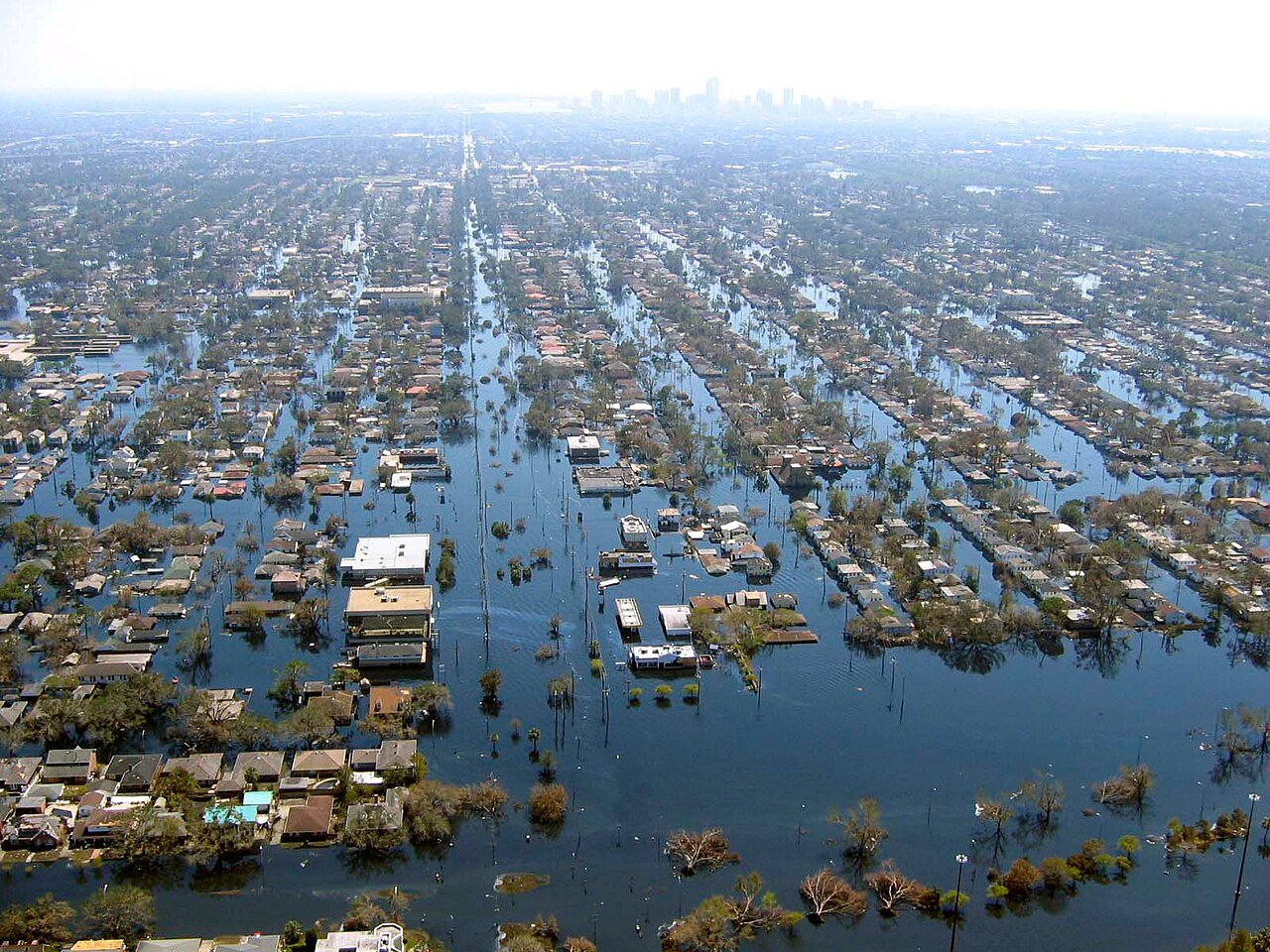
Most people remember Katrina as the defining disaster of a generation. What many forget is that Katrina came ashore as a Category 3 hurricane. The category described the wind speed. It did not capture the catastrophic flooding, the breakdown of critical infrastructure, the human suffering, or the communications challenges that followed.
I arrived in Baton Rouge late on the night Katrina made landfall to support National Guard public affairs operations. I was there to assist a Louisiana National Guard public affairs colleague who had already been working around the clock. Our introduction was anything but warm.
“The National Guard Bureau is here to help?” he asked, lingering on the last word with understandable skepticism.
Within days, we had developed complete trust in one another. While he coordinated media operations from the Emergency Operations Center, I spent my days flying reporters over New Orleans in Black Hawk helicopters, helping them witness both the devastation and the extraordinary response unfolding below.
Twenty one years later, three memories remain especially vivid.
The first was speaking with a young National Guard sergeant who had entered a nursing home after the floodwaters rose. He quietly described finding elderly residents who had died where they had sat or slept, seemingly without an opportunity to escape. He had served in Iraq the previous year. He looked at us with distant eyes and said what he witnessed in New Orleans was worse than anything he had experienced in combat.
The second memory came about a week later when my colleague and I returned to Louisiana National Guard headquarters. The floodwaters had finally receded enough to access the parking lot. His truck sat where he had left it, battered and ruined. Deep gouges marked the roof where rescue boat propellers had struck it while it was submerged beneath the floodwaters. He quietly gathered a few personal belongings, smiled, and asked, “Want to go see what my office looks like?”
There was no self-pity. No complaint. Just another task to accomplish.
The third memory is one television cameras could never fully capture.
I remember the smell.
One afternoon I walked across a grassy field hundreds of yards from the nearest water. Dead fish lay scattered where floodwaters had carried them before receding. The smell of decay filled the air. Images fade over time. Smells often do not. Even today, that memory returns instantly whenever I think about Katrina.
Lessons That Endure
Those experiences shaped me personally, but they also reinforced lessons that continue to guide effective crisis communications.
Communications is an operational function, not a support function. Public information cannot be an afterthought delegated until operational decisions are complete. People make life safety decisions based on what they hear, what they understand, and whether they trust the information they receive.
Relationships matter before disasters occur. Trust cannot be improvised during a crisis. The initial skepticism between my Louisiana National Guard colleague and me disappeared because we quickly learned we shared the same mission. That trust made both of us more effective.
Go where the story is. Public affairs professionals develop credibility by understanding operations firsthand. Situational awareness does not come solely from briefings. It comes from standing beside responders and survivors.
Logistics matter. During Katrina, success often depended on seemingly mundane details like communications equipment, transportation, work schedules, workspace, information sharing, and organizational structure. Effective communications requires operational discipline.
Never lose sight of the people behind the statistics. We naturally measure disasters in fatalities, damaged homes, and billions of dollars. Those numbers matter. But it is the soldier, the flooded truck, and the lingering smell of decay that remind us why emergency management exists in the first place.
How Katrina Changed Emergency Management
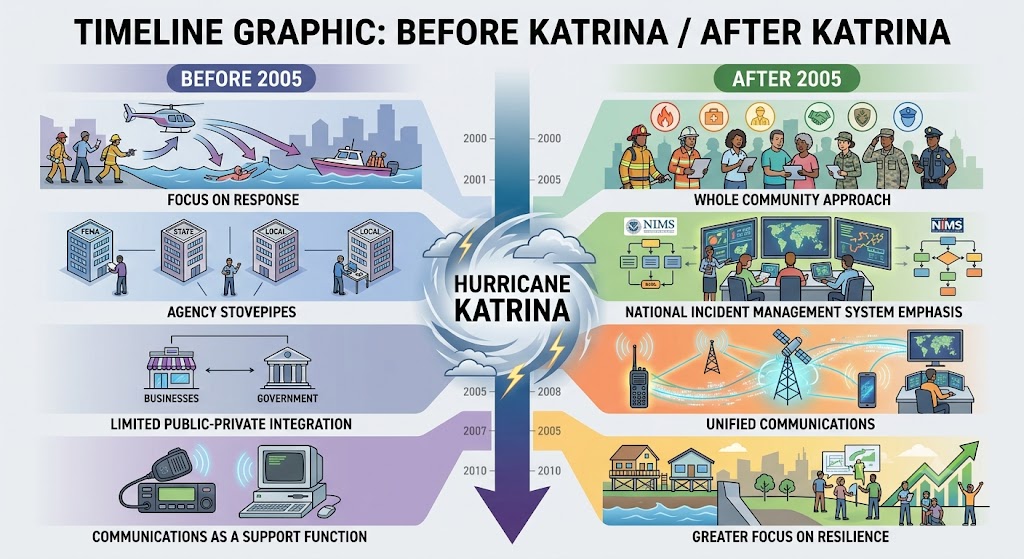
Katrina did not simply leave scars on the Gulf Coast. It reshaped emergency management across the nation.
In 2006, Congress enacted the Post-Katrina Emergency Management Reform Act (PKEMRA), one of the most significant reforms of FEMA in its history. Among its many provisions, the law strengthened FEMA’s preparedness mission, enhanced catastrophic planning requirements, expanded logistics capabilities, improved evacuation planning, increased attention to individuals with disabilities and others with access and functional needs, and reinforced FEMA’s leadership role during catastrophic incidents.
But Katrina’s impact extended beyond legislation. It accelerated a broader evolution in how the emergency management community prepares for, responds to, and communicates during disasters.
The National Incident Management System (NIMS) and the National Response Framework (NRF) became more firmly established as the foundation for coordinated response, emphasizing common terminology, scalable organizational structures, and unity of effort across federal, state, local, tribal, territorial, private sector, and nonprofit partners. Katrina reinforced that no single organization could manage a catastrophic incident alone. Effective response required shared doctrine, interoperable systems, and clearly defined roles before the next crisis occurred.
Public affairs evolved as well.
Communications became more integrated into incident management rather than being viewed primarily as media relations. Joint Information Centers became more robust, and the broader concept of a Joint Information System (JIS) became increasingly important. The goal was not simply to issue press releases or conduct interviews, but to establish coordinated processes that allowed all response partners to provide accurate, timely, and consistent information to the public.
Social media later transformed that environment even further, requiring emergency managers to communicate not only accurately, but rapidly, transparently, and empathetically. The expectation changed. The public no longer waited for a scheduled briefing or evening news broadcast. They expected information where they already were, often in real time.
Those improvements have been tested repeatedly through disasters ranging from Hurricanes Sandy, Harvey, Ian, and Helene to catastrophic wildfires, floods, tornadoes, and the COVID-19 pandemic. While no response is ever perfect, the profession has evolved because of hard lessons learned.
Today, emergency management finds itself at another crossroads. Serious discussions are underway about FEMA’s future, the appropriate balance between federal and state responsibilities, and how our nation should prepare for and respond to disasters in the years ahead. Those conversations are healthy and necessary. Every generation should challenge itself to improve.
But regardless of how organizational charts evolve or authorities shift, the enduring lessons Katrina taught us should remain firmly intact.
Looking Ahead
Every hurricane season introduces new storm names. Some make landfall. Some remain far offshore. Some will eventually be forgotten.
Katrina is different.
Not because it was the strongest hurricane our nation has experienced, but because it exposed enduring truths about preparedness, leadership, communications, and human resilience.
Twenty one years later, I still remember the young soldier’s distant eyes. I still remember my colleague quietly surveying his flooded truck before asking if I wanted to see what remained of his office. And, perhaps most vividly of all, I still remember the smell that no television camera could capture.
Those memories remind me that behind every after-action report, every statistic, every policy debate, and every lesson learned are people.
Anniversaries simply give us a reason to pause.
The lessons themselves belong to every hurricane season that follows.
My colleague’s truck has long since disappeared.
The lessons it represented never should.
Dan Stoneking is the Owner and Principal of Stoneking Strategic Communications, the Author of Crisis Communications and Emergency Management, the Founder and Vice President of the Emergency Management External Affairs Association, the Founder of Message Prism, and an Adjunct Professor in the Communications Department at West Chester University.