Disasters do not unfold in neat lines of authority.
They unfold in chaos, urgency, uncertainty, and public scrutiny. In those moments, two roles become essential to the outcome: the emergency manager coordinating the response and the public information officer communicating with the public.
Yet too often these two professions operate in parallel rather than in true alignment.
Together we save lives.
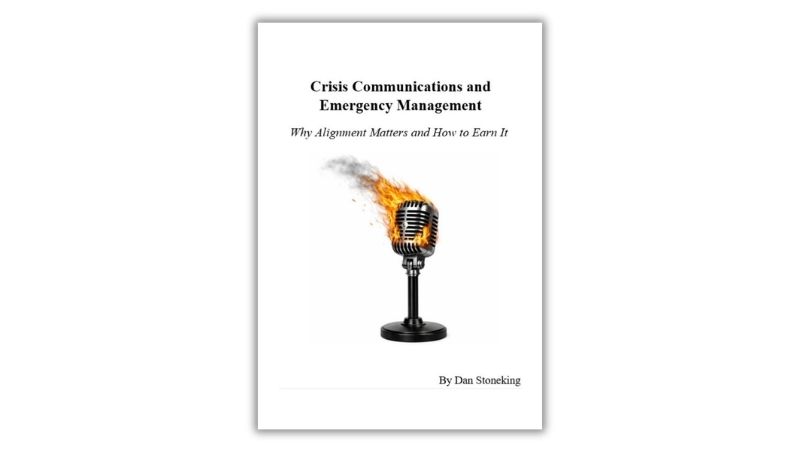
This week I published my second book, Crisis Communications and Emergency Management: Why Alignment Matters and How to Earn It.
This book makes the case that emergency managers and crisis communicators must work as strategic partners before, during, and after disasters. When they do, operations move faster, information flows more clearly, and communities are better protected.
Drawing on decades of experience across government, emergency management, and crisis communications, I explore the operational relationship between emergency managers and public information officers and explains why their alignment is essential in the modern risk environment.
Inside this book you will discover:
- How emergency managers and public information officers can align before a crisis begins
- Why communication failures often stem from structural and cultural gaps
- The role of leadership, trust, and humility in crisis response
- How artificial intelligence is beginning to reshape emergency communications
- Why emergency management leadership must be elevated at the executive level
- Practical insights for improving coordination, messaging, and decision making
This is not a technical manual. It is a practical conversation about leadership, communication, and the realities of disaster response.
Written for emergency managers, public information officers, government leaders, and anyone responsible for communicating during a crisis, this book offers both a strategic perspective and real-world lessons from the field.
Because when emergency managers and public information officers move in alignment, the entire system becomes stronger.
And when the system is stronger, communities are safer.
Emergency managers save lives.
Communicators do too.
I wrote this book for both.
Communication is not a support function in emergency management. It is a life safety function.
Both professions must adapt.
Both will benefit.
Dan Stoneking is the Owner and Principal of Stoneking Strategic Communications, the Author of Crisis Communications and Emergency Management and Cultivate Your Garden, the Founder and Vice President of the Emergency Management External Affairs Association, and an Adjunct Professor in the Communications Department at West Chester University