


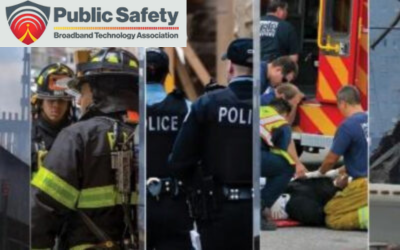
When disaster strikes, America turns to public safety: the firefighters rushing toward flames, police securing a scene, EMTs delivering care, and the hospital staff preparing for an unknown surge of patients. For these first responders, communication isn’t a convenience; it’s vital. That is the promise of FirstNet.
Communication is the lifeline that connects first responders to one another, to the communities they serve, and to the information that helps them make rapid, life-saving decisions. For far too long, that lifeline was fragile. Today, thanks to the First Responder Network Authority (FirstNet), America’s public safety community has a dedicated, interoperable communications network that saves lives every day.
For decades, public safety agencies across the country called for a single communications network that would allow seamless interoperability from coast to coast. The vision began forming in the wake of the September 11, 2001, attacks, when overwhelmed commercial networks left police, firefighters, and emergency medical personnel struggling to connect when every second counted.
Responding to that urgent need, Congress established the First Responder Network Authority in 2012 through bipartisan legislation. It allocated $7 billion and 20 megahertz of prime broadband spectrum to develop a nationwide public safety broadband network. The Authority’s mandate was ambitious: build, operate, and maintain a self-sustaining network serving all 50 states and territories, exclusive to public safety personnel.
Through a competitive procurement process inviting all major carriers, the Authority selected AT&T to build and operate the network. The result was one of the most effective public-private partnerships.
Delivered on time and on budget, FirstNet today represents the single largest interoperable digital platform built since the creation of the Internet. What began as a concept in 2012 has grown into a vital asset supporting over 30,000 agencies and more than 7 million active connections.
The strength of FirstNet is not merely in its size, but in its reach and reliability. The network covers more than 2.99 million square miles (an area 250,000 square miles larger than commercial networks) ensuring that even rural and remote regions have access to dependable connectivity. During large-scale events, natural disasters, and everyday operations, FirstNet provides preemption and priority services, ensuring that first responders stay connected even when commercial networks are congested.
It is a network built specifically for mission-critical operations. As Oregon State Fire Marshal Gert Zoutendijk noted in describing FirstNet’s role during the 2024 Lees Fall Fire, “Without FirstNet, our incident commanders would not have been able to communicate vital information on the scene.” That sentiment is echoed across the country. In Lakewood, Colorado, Fire Chief Don Lombardi explained that “FirstNet provided us with that reliability, that robustness… we could do a lot more than just make telephone calls. The fact that FirstNet could do this was instrumental to our success.”
FirstNet’s value is best measured by its impact on those who depend on it. From urban centers to tribal lands, it is now a critical component of modern emergency response.
Ian Parkinson, Sheriff of San Luis Obispo County (Calif.) shares, “You have to rely on FirstNet to communicate and make sure you do not lose that communication, because that is their lifeline and your means of preventing something else tragic from happening.”
That reliability has translated into real operational gains for responders in the field. Whether coordinating wildland firefighting operations, managing evacuation routes, or conducting urban search-and-rescue missions following hurricanes, FirstNet’s mission-critical technology is a necessity.
One of the most significant aspects of FirstNet’s success is its funding structure. FirstNet is self-sustaining, primarily through user fees and fees from its contractual leasing/public-private partnership arrangements, not through annual congressional appropriations. That revenue is then reinvested through the FirstNet Authority’s Reinvestment Program, ensuring that improvements are continuous, sustainable, and cost-neutral to the taxpayer.
The collaboration between the FirstNet Authority and AT&T remains a model of public-private efficiency and accountability. The Authority provides oversight to ensure contractual compliance, while AT&T maintains and upgrades the core infrastructure. This approach has fostered innovation while maintaining the integrity of a system whose users cannot afford downtime. Every improvement, upgrade, and expansion is evaluated through the lens of operational reliability for public safety.
As Congress looks toward February 2027, the case for reauthorization is clear. FirstNet has delivered precisely what Congress envisioned in 2012: a robust, nationwide broadband network purpose-built for public safety, operating efficiently through a public-private model, and achieving nationwide participation from all 50 states.
As the Public Safety Broadband Technology Association (PSBTA) emphasizes, reauthorizing the First Responder Network Authority is the only way to ensure the continuity of this vital system. Our first responders deserve stability, reliability, and technology that evolves with their needs.