
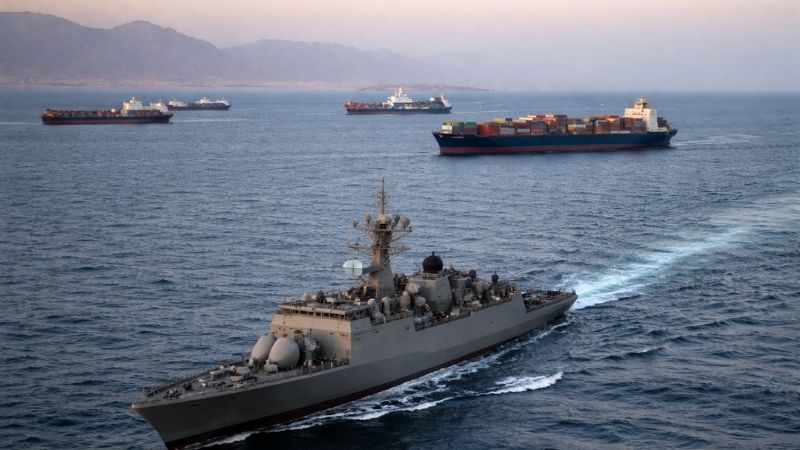
In the evolving landscape of Middle Eastern security, Iran’s kinetic posture is no longer defined solely by the targets it engages, but by the spaces through which those engagements occur. The region’s air and maritime corridors—many of them neutral, shared, or functionally indispensable to global commerce—have become unintended theaters of risk transfer. As Iran’s operational reach expands, so does the exposure of states that are neither adversaries nor participants in the conflict, yet find themselves absorbing the secondary effects of actions they did not provoke.
This dynamic challenges one of the most fundamental assumptions in international security: that the consequences of a kinetic operation are confined to the belligerents involved. In reality, the geography of modern conflict has shifted. Neutral corridors now serve as the connective tissue of the global system, and any military action conducted within them carries the potential to impose costs on states that have chosen neutrality as a strategic posture, not as a vulnerability.
Understanding this shift is essential. It forces a reassessment of what constitutes a hostile act, and of how responsibility should be assigned when the burden of conflict is displaced onto nonbelligerent states. Iran’s recent operational patterns offer a clear lens through which to examine this emerging problem—and to question whether existing norms are sufficient to protect states that never elected to be part of the battlefield.
Author’s Note: Analytical Rationale and Methodological Framing
This article adopts a deliberately depersonalized analytical framework to examine how modern kinetic operations generate systemic risk beyond their intended targets. By shifting the focus from specific European incidents to broader concepts such as hazmat logistics and Iran’s regional kinetic posture, the analysis avoids ideological polarization and centers the discussion on structural security dynamics.
Two principles guide this approach:
- DePersonalizing the Mechanism of Risk
By reframing the issue through Middle Eastern transit corridors, the analysis isolates the operational and legal consequences of extraterritorial strikes. This allows the reader to focus on the burden shift imposed on neutral states—environmental hazards, debris fallout, and civil disruption—without the emotional weight that typically accompanies other conflict zones.
- Neutrality as a Structural Vulnerability
Neutral corridors are not passive voids; they are functional arteries that sustain regional and global stability. When a belligerent actor conducts a strike within these spaces, it effectively imposes a kinetic tax on the state that guarantees the corridor. Using established geopolitical precedents—such as Oman’s experience—ensures that the principle of Kinetic Accountability is treated as a universal security standard rather than a politically charged argument.
This methodological framing enables a clear, nonideological assessment of how modern conflicts displace risk onto neutral actors, and why this dynamic requires a redefinition of hostile action in contemporary security environments.
The Strategic Function of Neutral Corridors
Neutral corridors—whether aerial or maritime—are not passive voids between competing spheres of influence. They are functional arteries of the international system, enabling commercial continuity, humanitarian access, and regional stability. Their neutrality is not merely a legal designation; it is a structural requirement for the safe movement of people, goods, and information across contested geographies.
In the Middle East, these corridors carry an additional weight. They sit at the intersection of rival security architectures, overlapping threat perceptions, and asymmetric capabilities. As Iran expands its operational reach, these shared spaces increasingly become the medium through which kinetic actions reverberate far beyond their intended targets.
This shift forces a reconsideration of how responsibility is assigned when military operations intersect with neutral environments. The traditional assumption—that the consequences of force are confined to the belligerents—no longer holds. Modern engagements generate predictable spillover effects that can impose real costs on states that have deliberately chosen nonalignment as a stabilizing posture.
It is within this context that the concept of hostile action must be reassessed. When a kinetic operation conducted inside a neutral corridor foreseeably transfers risk onto nonbelligerent states, the neutrality of the space does not shield the actor from responsibility. Instead, it heightens the obligation to prevent the displacement of conflict burdens onto states that neither initiated nor benefit from the engagement.
Redefining Hostile Action in Neutral Corridors
The growing use of neutral corridors as transit zones for military engagements exposes a critical gap in how the international community defines hostile action. Traditional frameworks assume that the legality and hostility of a kinetic strike depend primarily on the identity of the target and the intent of the actor. Yet this approach fails to account for the predictable displacement of risk onto states that have no role in the conflict.
Neutral corridors are not empty spaces; they are functional environments whose stability depends on the consent and security of the states that surround them. When a belligerent actor conducts a strike within these corridors—whether in the air or at sea—the consequences do not remain confined to the intended target. Debris, disruption, and secondary effects can fall squarely on nonbelligerent states, transforming them into involuntary recipients of kinetic fallout.
This dynamic requires a fundamental reassessment of what constitutes a hostile act. Hostility cannot be evaluated solely by examining the target or the declared intent. It must also account for the foreseeable impact on states that neither initiated nor benefit from the engagement. In this sense, the use of neutral corridors for kinetic operations introduces a new category of responsibility: the obligation to prevent the transfer of conflict burdens onto neutral actors.
It is within this conceptual space that a new principle emerges—one that reframes the boundaries of responsibility in modern conflict and challenges longstanding assumptions about the neutrality of shared transit zones.
Case Study I: Neutral Airspace and the Oman Precedent
Oman occupies a unique position in the regional security architecture: a neutral state with balanced diplomatic relations, no permanent U.S. military bases, and a longstanding policy of nonalignment. Its airspace functions as a stabilizing buffer between competing regional powers, and its neutrality is widely recognized and respected.
Yet recent events have demonstrated how quickly this neutrality can be compromised. As Iran’s long-range capabilities expand, missiles and drones transiting toward distant targets have crossed or approached Omani airspace, prompting formal protests from Muscat. Even when Omani territory was not the intended target, the predictable risk imposed on a neutral state—ranging from debris to emergency responses—illustrates the core problem: neutral airspace is not immune to the spillover of kinetic operations.
This scenario underscores the principle that the use of neutral airspace for military engagements cannot be evaluated solely by the identity of the target. When the foreseeable consequences of a strike fall on a nonbelligerent state, the action acquires a hostile dimension toward that state, regardless of the actor’s declared intent. Oman’s experience demonstrates how easily a neutral corridor can become an involuntary extension of a conflict it did not choose to enter.
Case Study II: Maritime Neutrality in the Gulf of Oman and the Arabian Sea
The maritime domain presents a parallel challenge. The Gulf of Oman and the northern Arabian Sea are among the most heavily trafficked international waters in the world, serving as essential corridors for global energy flows and commercial shipping. These waters are not contested battlefields; they are functional transit zones whose stability underpins regional and international economic security.
Yet they are increasingly exposed to kinetic activity. As Iran and other regional actors operate in proximity to these corridors, the risk of miscalculation, debris fallout, or collateral disruption becomes a structural feature of the environment. A strike conducted in international waters may not target a neutral coastal state, but the predictable consequences—navigation hazards, forced rerouting, or the presence of military debris—can impose real costs on states that rely on these corridors for economic survival.
This maritime dynamic mirrors the aerial one: neutrality does not shield a state from the spillover of nearby kinetic operations. Instead, it heightens the vulnerability of states that depend on stable transit zones to maintain their economic and security posture. The Gulf of Oman and the Arabian Sea illustrate how maritime neutrality can be compromised not through direct attack, but through the predictable displacement of conflict burdens.
Synthesis: Neutrality as a Structural Vulnerability
Taken together, the aerial and maritime examples reveal a consistent pattern: neutral corridors in the Middle East are increasingly exposed to the predictable spillover of kinetic operations conducted by regional actors, including Iran. These corridors—once assumed to be insulated from the consequences of conflict—now function as inadvertent receivers of risk, even when no hostile intent is directed toward the states that depend on them.
This pattern underscores a critical shift in the nature of modern conflict. The boundaries of hostility can no longer be defined solely by the identity of the target or the declared objectives of the actor. Instead, they must account for the foreseeable impact on states that occupy the periphery of the engagement but bear the consequences of its execution. Neutrality, in this context, becomes a structural vulnerability: a condition that exposes nonbelligerent states to risks they did not generate and cannot fully mitigate.
The principle that emerges from this analysis is clear. When a kinetic operation conducted within a neutral corridor foreseeably transfers risk onto nonbelligerent states, the action acquires a hostile dimension toward those states, regardless of intent. This reframing is essential for understanding Iran’s evolving operational posture—and for assessing the broader implications of conflict spillover in a region where neutrality is both a strategic choice and a fragile asset.
Conclusion: Toward a New Framework of Accountability
Iran’s expanding operational reach highlights a broader truth about modern conflict: the geography of warfare no longer aligns neatly with the geography of responsibility. Neutral corridors—once assumed to be safe, predictable, and insulated from the consequences of regional rivalries—now sit at the intersection of competing security logics. They have become the spaces where the burdens of conflict are most easily displaced and least formally acknowledged.
This reality demands a recalibration of how the international community interprets hostile action. A kinetic strike cannot be evaluated solely by its intended target or declared purpose. It must also be assessed through the lens of foreseeable impact on states that have deliberately chosen neutrality as a stabilizing posture. When nonbelligerent states absorb the fallout of operations they neither initiated nor influenced, the traditional boundaries of hostility fail to capture the full scope of responsibility.
Recognizing this shift is not merely an academic exercise. It is a prerequisite for building norms that protect neutral states from becoming inadvertent participants in conflicts they sought to avoid. As Iran continues to operate across shared air and maritime spaces, the need for a more precise framework—one that accounts for the predictable transfer of risk onto neutral actors—becomes increasingly urgent.
Redefining hostile action through the prism of neutral corridors is a necessary step toward that framework. It acknowledges the realities of contemporary conflict, clarifies the obligations of regional powers, and reinforces the principle that neutrality is not a vulnerability to be exploited, but a stabilizing asset that must be preserved.
Implications for Regional Security and International Norms
The exposure of neutral corridors to kinetic spillover carries significant implications for regional stability and the evolution of international norms. In the Middle East—where airspace, maritime routes, and strategic chokepoints intersect with overlapping spheres of influence—the ability of neutral states to remain insulated from conflict is increasingly constrained. This erosion of neutrality has three major consequences.
First, it destabilizes the regional security architecture.
When neutral states are forced to absorb the secondary effects of nearby kinetic operations, they face pressure to recalibrate their posture—whether by enhancing air and maritime defenses, revising diplomatic alignments, or adopting more assertive risk-mitigation measures. These shifts can alter longstanding balances and introduce new sources of friction in an already volatile environment.
Second, it challenges the adequacy of existing international norms.
Traditional frameworks governing the use of force were built on assumptions that no longer reflect the operational realities of modern conflict. The predictable displacement of risk onto nonbelligerent states exposes a normative gap: the absence of clear standards for assessing responsibility when kinetic actions intersect with neutral corridors. Without updated norms, neutral states remain vulnerable to becoming inadvertent participants in conflicts they sought to avoid.
Third, it creates incentives for strategic exploitation.
If the international community fails to recognize the hostile dimension of operations that impose foreseeable burdens on neutral actors, belligerent states may view neutral corridors as convenient buffers—spaces where the costs of conflict can be externalized with limited accountability. This dynamic risks normalizing a pattern in which neutrality becomes a liability rather than a stabilizing asset.
Addressing these implications requires a shift in how responsibility is conceptualized and assigned. The principle of kinetic accountability in neutral corridors offers a foundation for this shift, providing a framework that aligns legal interpretation with operational reality and reinforces the rights of states that choose neutrality as a deliberate strategy for stability.