
Click here to read Part I of this 2 Part series.
Sean Plankey is well qualified for the role of CISA Director. His confirmation was derailed by political issues that have nothing to do with his competence or conduct. Congress is literally playing politics with national security. Senators of both parties now routinely use holds to try to force the administration to take actions that have nothing to do with the nominee and are frequently vaguely or not at all related to the nominee’s role.
If the hold were related to a nominee’s role, Senators would be more effective in obtaining results by extracting a promise from the nominee to resolve the issue once they are confirmed. This would have been a reasonable approach for Senator Wyden to take. He could have extracted a promise from Mr. Plankey that the report he wanted published would be reviewed for declassification.
However, as noted, many holds have nothing to do with the nominee’s role or even the organization they are nominated to run. They are simply an attempt to use the nomination process as a political tool.
While cabinet nominations are infrequently held for extended periods of time, nominations below the cabinet level are frequently subject to lengthy procural holds. While holds from the minority party can typically be overcome through procedures that eat up precious floor time, holds from the majority party are generally respected and frequently signal the death knell of a confirmation bid.
Holds are just one source of politically motivated actions that are increasing both overall confirmation time and the number of failed nominations.
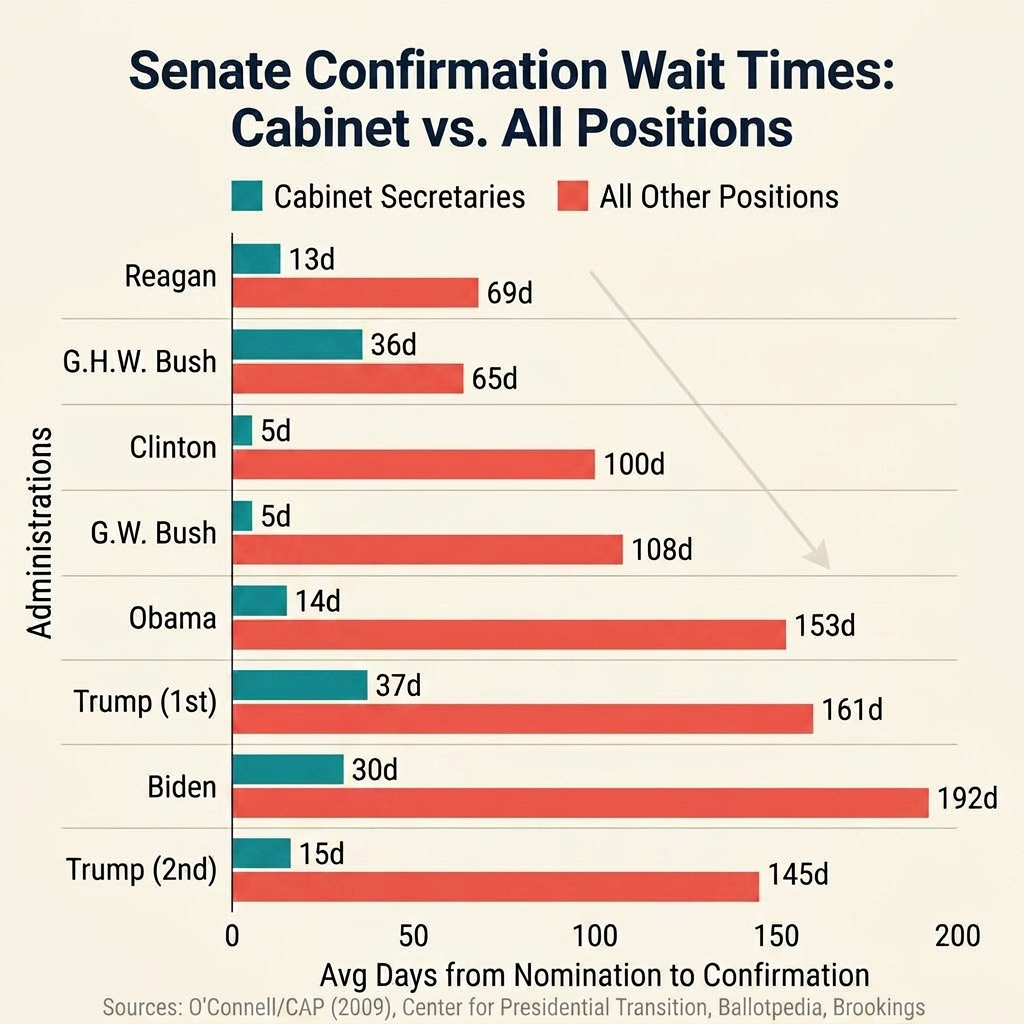
Figure 1 (above) shows the dramatic increase in the time to confirm nominees from the Reagan administration to the second Trump administration, and Figure 2 (below) shows the increasing number of nominations withdrawn or returned to the President by the Senate over that same period.
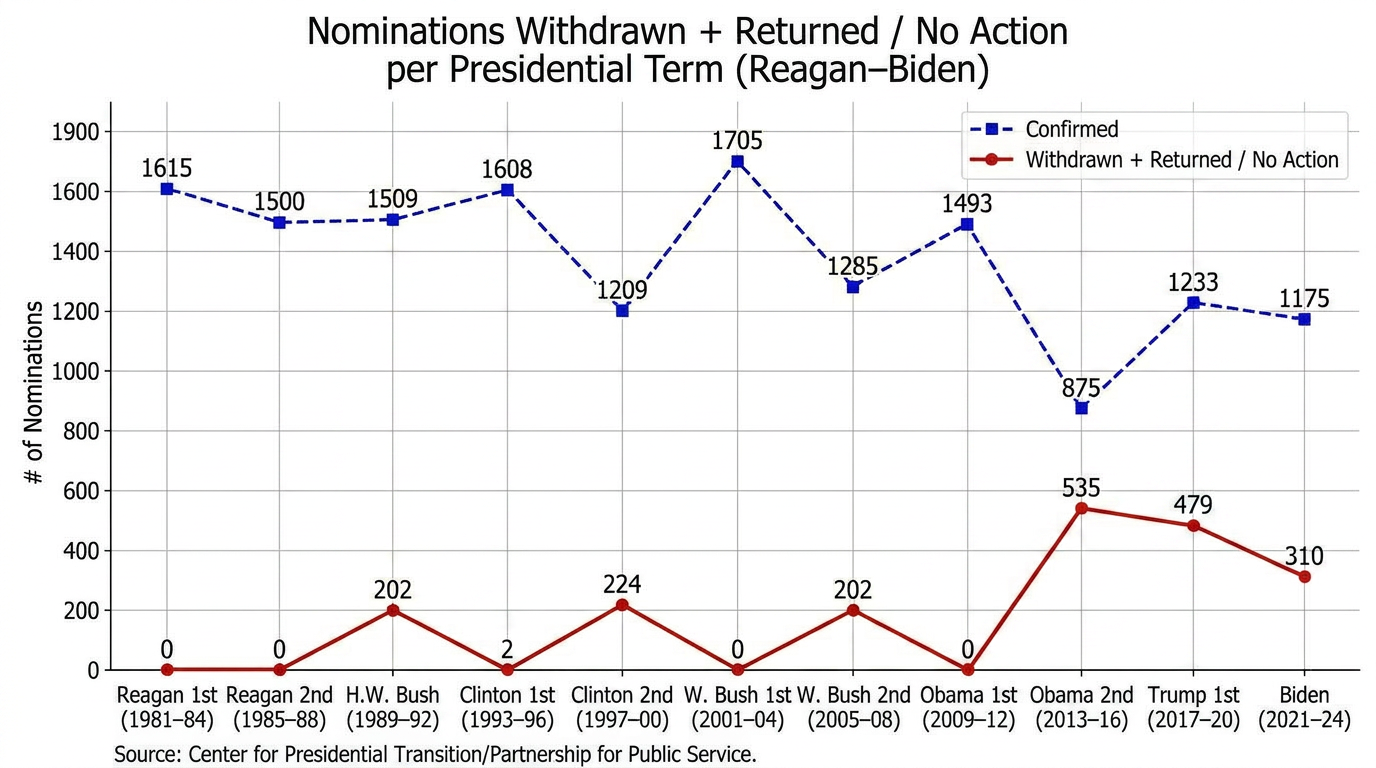
Both figures show an inefficient process, with nominees below the cabinet level languishing for nearly half a year before confirmation and many nominees being withdrawn or returned without action.
In some cases, wait times have become extreme with Cathy Harris waiting 986 days from June 2021 until March of 2024 to be confirmed as the Merit System Protection Board Chair and Douglas Manchester waiting for 913 days before withdrawing his nomination for Ambassador to the Bahamas. In the national security realm, Ravi Chaudhary waited 571 days to be confirmed as Biden’s Secretary of the Air Force and Adam Szubin’s nomination was stalled for 628 days after he was nominated by President Obama as Under Secretary of Treasury for Terrorism and Financial Intelligence before his nomination was returned at the end of the administration. Szubin was renominated by President Trump and quickly confirmed in 2017.
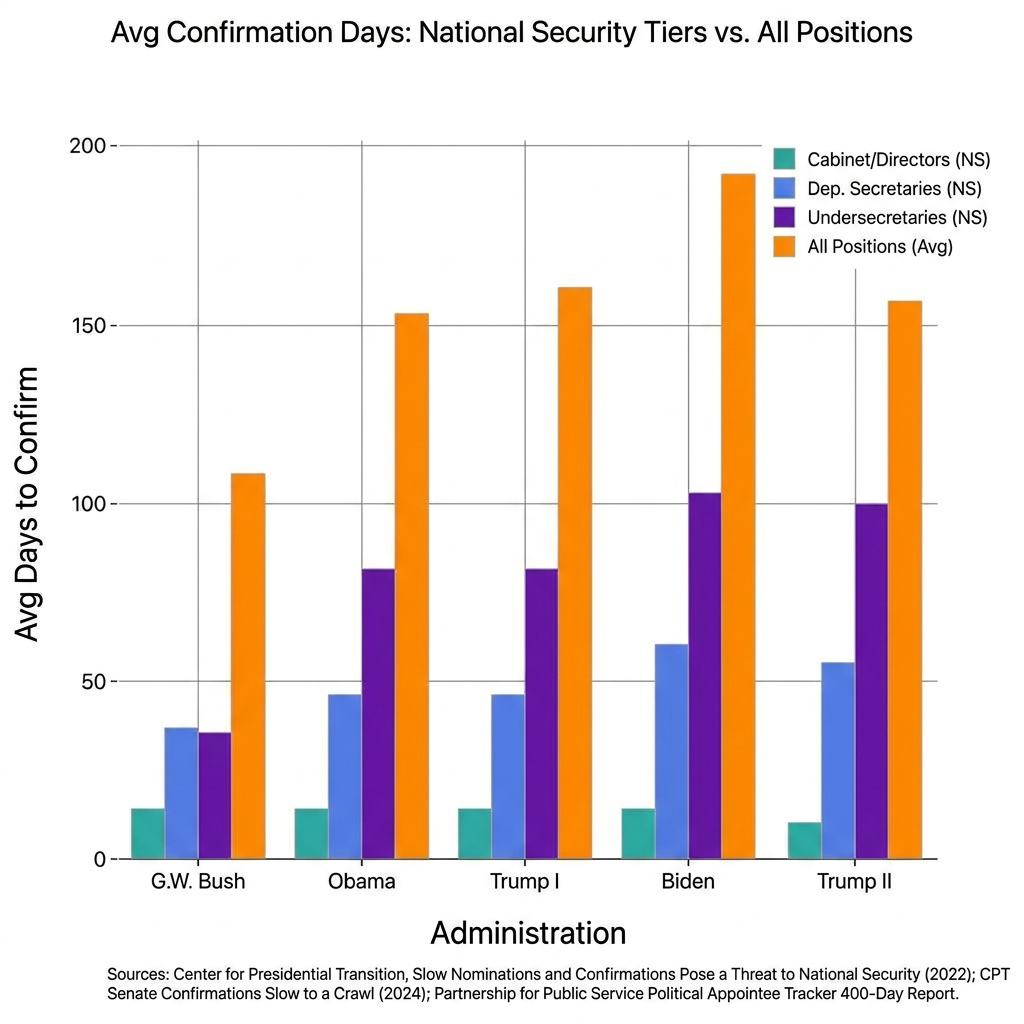
Confirmation delays have real consequences on individual lives, the effectiveness of the executive branch and our national security apparatus. The recognition of the importance of confirmed national security leadership is why the Intelligence Reform and Terrorism Prevention Act of 2004 required the Senate to confirm the top 46 national security nominees within 30 days of inauguration. Figure 3 (below) confirms that the target has never been met.
Confirmation delays also lead to so-called headless agencies, where a career official is acting as the agency head. In addition to the consequences that have already been identified, without an agency head, SES promotions and transfers are frozen, further hobbling the organization’s effectiveness.
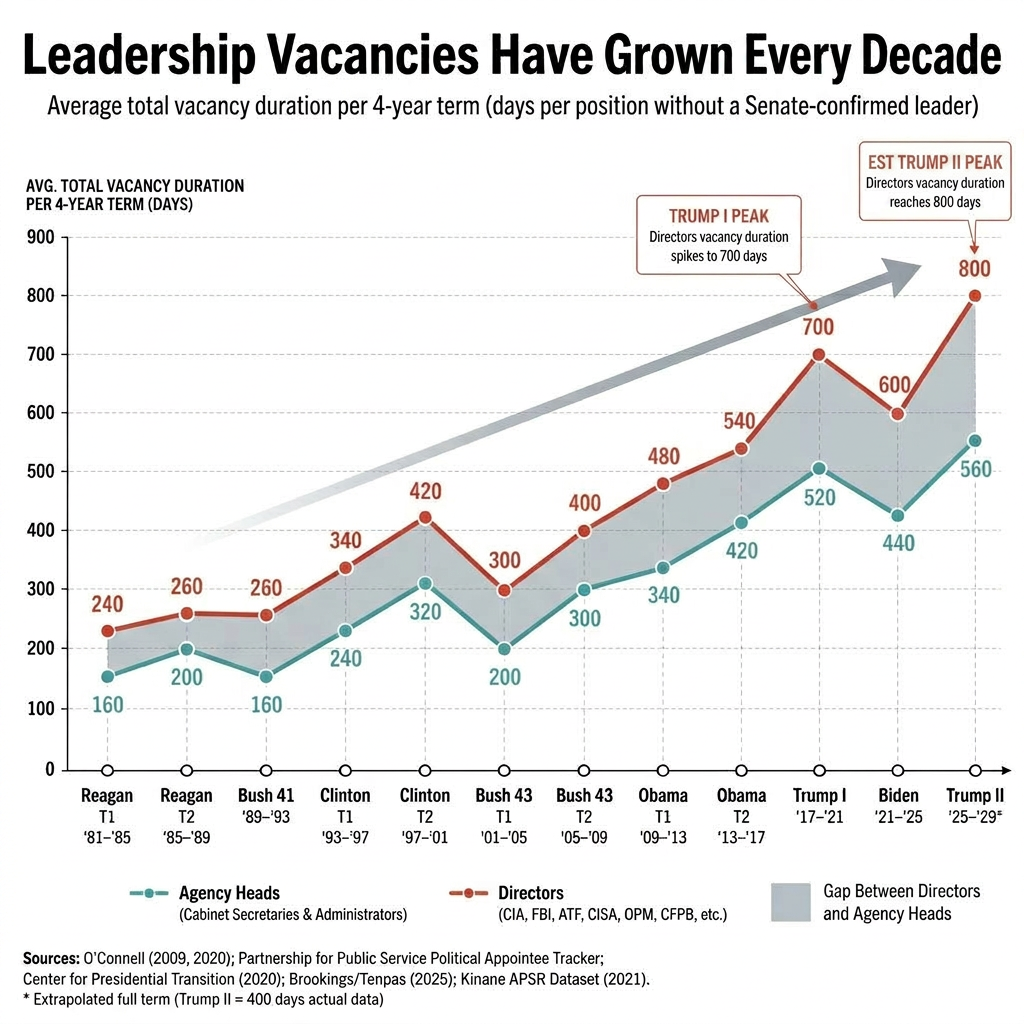
Figure 4 (above) demonstrates the alarming trend towards increasingly long vacancies at the tops of agencies as confirmation delays accrue. If the current trend continues for the rest of the second Trump administration, the top spots at independent agencies will be vacant for an average of 800 days or nearly half of the term. While these numbers are skewed by some exceedingly long vacancies, such as the seven-year vacancy at the ATF, the trend remains concerning.
Groups like the Partnership for Public Service have long been vocal that a cadre of approximately 1,200 Senate-confirmed (this excludes judges and military officers above O-7) and approximately 4,100 total appointees (2024 Plum Book) is too large and creates too much churn every four years. They suggest that the number of appointees in total, as well as those that are Senate-confirmed, should be reduced. The Partnership has specifically recommended that the number of Senate-confirmed appointees should be cut in half and that the total number of appointees should be reduced to a few hundred, in line with other democracies globally.
The Partnership made these recommendations to address two problems: the churn of 4,000 departures with every Administration and the chronic vacancies at all levels of appointees caused by confirmation delays.
Many senior and mid-level appointee roles are not filled until well into the second year of a President’s term, as most appointed positions are held open until the Senate-confirmed positions above them are filled. This creates a large power vacuum and loss of productivity in departments and agencies that have large numbers of appointees.
The current administration has moved in the opposite direction from the Partnership’s recommendation by creating Schedule F, which provides a path to convert traditional career SES positions to political positions, increasing the churn and vacancies that can be expected at the end of this term, while simultaneously reducing the number of experienced career employees that will be available to fill those positions as acting officials.
The vacancy at CISA is simply one manifestation of a systemic problem that has resulted in increasingly lengthy vacancies among both Senate- confirmed and appointed officials across the executive branch. A long-term solution to the problem is needed. But CISA can’t afford to wait for that long-term solution. It’s time for the Senate to put aside politics and confirm a CISA Director. It won’t be Sean Plankey, but CISA needs a leader. Our national security depends on it.
Note for Figure 2: This data is slightly skewed by the fact that in both Obama’s second term and Trump’s first term, Congress returned nominations mid-term, elevating their totals.