
Key Takeaways
- FEMA provided over $3 billion to over 1 million survivors affected by recent disasters. However, these individuals and households faced challenges communicating with FEMA, such as long wait times when calling FEMA’s helpline.
- There has been recent interest in reviewing the federal role in disaster response. Federal and state officials emphasized that state and local governments would need time to prepare for any changes since they currently rely on significant federal support.
- This is the third report in a series on disaster response. The second was on state and local response capabilities, and the first was on the federal response workforce.
What GAO Found
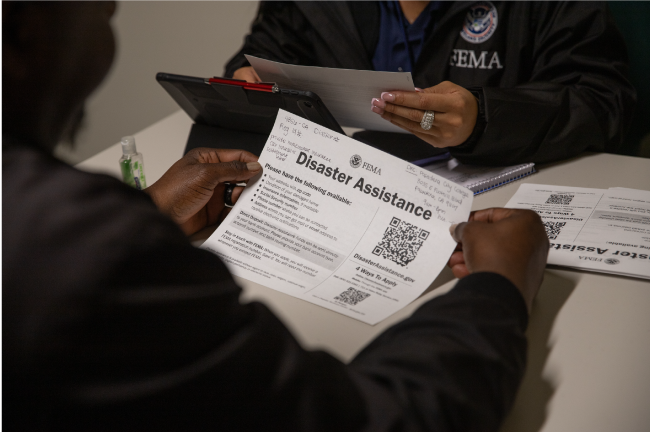
The Federal Emergency Management Agency’s (FEMA’s) Individual Assistance helps survivors of major disasters cover necessary expenses and serious needs that insurance or low-interest loans do not cover. This may include reimbursing survivors for temporary lodging or providing assistance with rental housing and home repairs. In response to Hurricanes Helene and Milton, the 2025 Los Angeles (LA) wildfires, and the 2025 Texas floods, FEMA provided over $3 billion to 1.2 million individuals and households, according to agency data.
FEMA has made changes to improve the implementation of its assistance to survivors. For example, FEMA has simplified application requirements and increased eligibility for certain assistance. However, GAO found that survivors continued to face challenges communicating with FEMA and securing post-disaster housing. For example:
- Reaching FEMA’s helpline. FEMA data show that most survivors affected by Hurricanes Helene and Milton and the Texas floods faced long wait times and could not reach a representative when trying to apply for assistance through FEMA’s helpline.
- Understanding FEMA’s letters. Some survivors faced challenges interpreting letters from FEMA regarding their eligibility for assistance. For example, some survivors thought letters requesting more information were denial letters, according to FEMA and state officials. FEMA revised its letters in 2024 and 2025 to incorporate more plain language and clearer instructions.
- Securing post-disaster housing. Survivors of recent disasters and officials from all levels of government experienced long-standing housing challenges. For example, FEMA officials said that it was challenging for the agency to support post-disaster housing for survivors after Hurricane Helene destroyed many of the housing resources that were already constrained before the storm hit. Additionally, FEMA officials reported issues that delayed the agency’s ability to provide direct housing—such as needing to set up septic tanks and energy meters before making manufactured housing units available.
At the direction of the current administration, FEMA made recent changes that affect its delivery of assistance to survivors. This includes focusing on providing support at state or local centers, thereby reducing the need for FEMA to establish its own Disaster Recovery Centers where applicants can obtain information and apply for benefits. In addition, FEMA has discontinued its door-to-door canvassing efforts. However, some FEMA and state officials expressed concerns about how this could affect their ability to support survivors who may not be able to access an in-person recovery center, including those who are older, have disabilities, live in rural areas, or lack phone or internet access.
State and local capacity to provide assistance to survivors will significantly impact the implementation of these and other potential changes to FEMA’s delivery of assistance. For example, officials from four states affected by Hurricanes Helene and Milton told GAO they do not have their own individual assistance programs for survivors after a disaster. In addition, federal and state officials emphasized the need for adequate time for state and local governments to prepare for any changes in disaster response roles since they currently rely on significant federal support.
Why GAO Did This Study
The extensive damage caused by recent natural disasters, including Hurricanes Helene and Milton in 2024, the LA wildfires in 2025, and the July 2025 floods in Texas, demonstrates the need for government-wide action to deliver assistance efficiently and effectively.
GAO has previously reported that disaster survivors have faced numerous challenges receiving aid from FEMA—the lead agency for federal disaster response. This includes challenges understanding and navigating the assistance process that may have prevented survivors from receiving assistance for which they may have otherwise been eligible. Further, improving processes for assisting survivors is one of the key challenges identified in GAO’s High-Risk List on Improving the Delivery of Federal Disaster Assistance.
Congress and the President have signaled an interest in enacting reforms to FEMA. For example, in January 2025, the President established a FEMA Review Council to assess FEMA’s disaster response efforts, recommend improvements to the agency, and review existing reform proposals. GAO was asked to review long-standing challenges and emerging issues in federal response efforts for recent disasters. This report, the third in a series, provides information on FEMA’s assistance to disaster survivors and related challenges.
GAO reviewed FEMA information on Individual Assistance—including data on the amount of assistance provided and the number of calls to FEMA’s helpline, and eligibility letters to survivors. GAO also analyzed information from 56 interviews and written responses from FEMA and state and local governments impacted by disasters in recent years.
Read the full GAO report here.