
On Thursday, July 23, a 51-year-old man allegedly stabbed two strangers on Manhattan’s Upper West Side – one of them a Jewish man leaving services at an Orthodox synagogue, the other an Asian man walking near Central Park – while shouting “Allahu Akbar.” Both men survived. Police have not yet determined a motive, and officials say the suspect, Raul Morales, may have a history of mental illness. But the attack, which took place a block from one of the largest Jewish communities in New York and on one of the most solemn days on the Jewish calendar, Tisha B’av, landed in a country where federal statistics, watchdog groups and law enforcement agencies all say the same thing: attacks on Jews are not an isolated news cycle. They are a sustained, measurable trend.
What the numbers show
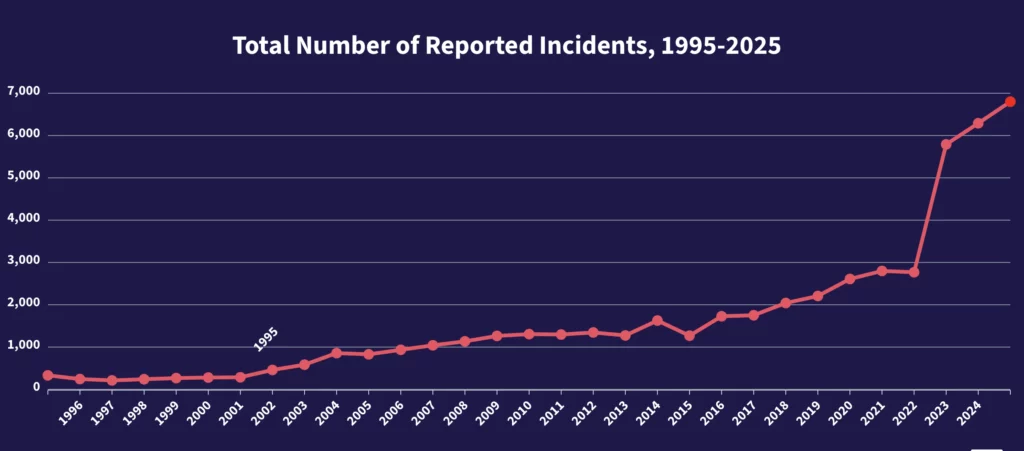
Antisemitic incidents and attacks worldwide have surged to historic highs since Hamas’s October 7, 2023, attack on Israel, in which more than 1,200 civilians were massacred, hundreds more brutalized, and 251 people were taken hostage. That date has since been repeatedly invoked online to spread and normalize antisemitic content, and watchdog groups say the elevated rate of incidents has not meaningfully receded in the nearly three years since.
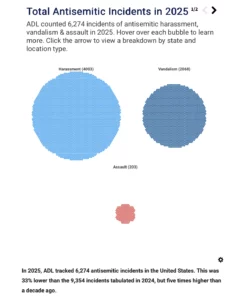
The Anti-Defamation League’s (ADL) 2025 audit – it has been tracking antisemitic incidents since 1979 – found that last year was the third-highest on record for antisemitic incidents in the United States, at roughly 17 incidents a day. While harassment and vandalism eased somewhat from the record highs of 2023 and 2024, the ADL reported that physical assaults climbed to their highest level ever recorded, and that three people were killed in antisemitic attacks in 2025, the first time Jews had been murdered in such attacks in the U.S. since 2019. The ADL counted 32 antisemitic assaults involving a deadly weapon last year, up from 23 the year before, including the Capital Jewish Museum shooting in Washington, DC, a Molotov-cocktail attack in Boulder, Colorado, on a group walking to raise awareness and support for Israeli hostages, and the firebombing of Pennsylvania Governor Josh Shapiro’s residence.
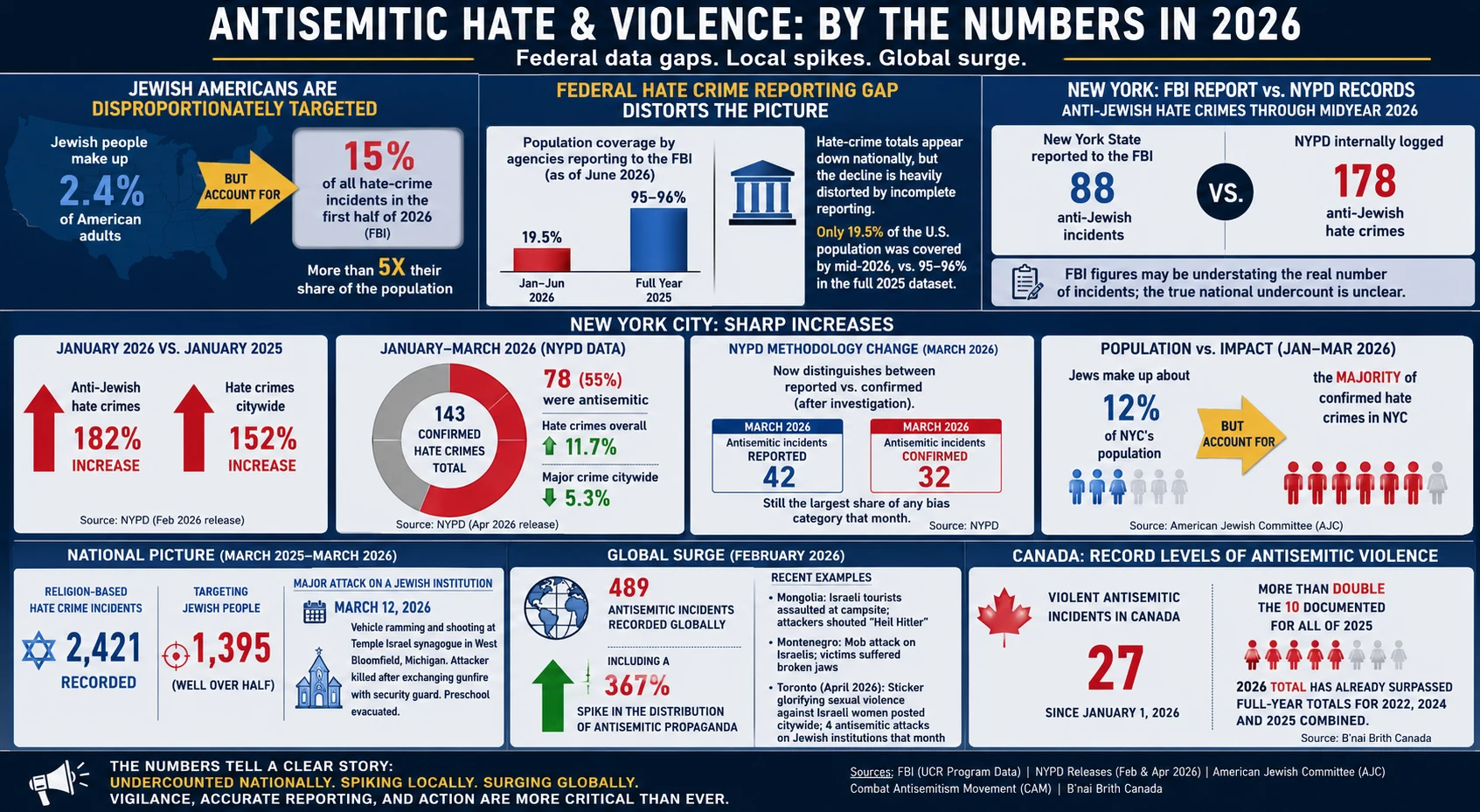
The national numbers for 2026 tell a more complicated story, and expose a widening gap between what’s recorded federally and what’s happening on the ground. Jewish people, who make up roughly 2.4% of American adults, accounted for 15% of hate-crime incidents tracked by the Federal Bureau of Investigation (FBI) in the first half of the year, a rate more than five times their share of the population. Overall hate-crime totals reported to the FBI appear to be down sharply, but that decline is heavily distorted by incomplete reporting: participating agencies covered only about 19.5% of the U.S. population by June, compared with 95-96% coverage in the FBI’s full 2025 dataset. New York state’s own submission to the FBI – 88 anti-Jewish incidents reported through midyear – is a fraction of the 178 anti-Jewish hate crimes the New York Police Department (NYPD) says it logged internally in the same period. That gap suggests the national figures may be understating the real number of incidents, rather than reflecting an actual decline, though the scale of that undercount nationally isn’t yet clear.
Locally, the numbers have moved sharply. NYPD statistics released in February showed anti-Jewish hate crimes up 182% in January 2026 compared with January 2025, part of a broader 152% jump in hate crimes citywide that month. NYPD data released in April confirmed that pattern held through the first quarter: of 143 confirmed hate crimes across New York City from January through March, 78 of those (55%) were antisemitic, even as hate crimes overall rose 11.7% and major crime citywide fell 5.3%.
NYPD Police Commissioner Jessica Tisch used that release to announce a methodology change, with the department now distinguishing between hate crimes that are merely reported and those the Hate Crimes Task Force and legal bureau formally confirm after investigation; in March alone, 42 antisemitic incidents were reported and 32 were confirmed under the new standard, still the largest share of any bias category that month. The American Jewish Committee (AJC) has separately noted that while Jews make up about 12% of New York City’s population, they accounted for the majority of hate crimes confirmed in that same January–March window.
Nationally, FBI data shows 2,421 religion-based hate crime incidents were recorded between March 2025 and March 2026, with 1,395 of them – well over half – targeting Jewish people. Those numbers include one of the year’s most serious attacks on a Jewish institution: on March 12, 2026, a 41-year-old Lebanon-born American drove his explosive-laden vehicle into Temple Israel, a large Reform synagogue in West Bloomfield, Michigan, then got out with a rifle and exchanged gunfire with a security guard, who shot and killed him. The synagogue’s early childhood center was in session at the time but was evacuated safely.
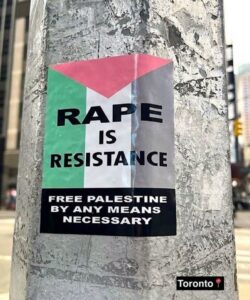
Internationally, the Combat Antisemitism Movement’s research arm tracked 489 antisemitic incidents in February 2026 alone – including a 367% spike in the distribution of antisemitic propaganda – and has reported on Israeli tourists physically attacked abroad in recent weeks, including an assault by men shouting “Heil Hitler” at a campsite in Mongolia, a mob attack in Montenegro that left victims with broken jaws, and, throughout Toronto in April, a sticker glorifying sexual violence against Israeli women – “RAPE IS RESISTANCE / FREE PALESTINE BY ANY MEANS NECESSARY” – posted the same month that city recorded four antisemitic attacks on Jewish institutions.
The April Toronto incidents are one sample of a much larger national trend across Canada: B’nai Brith Canada has recorded 27 violent antisemitic incidents nationwide since January 1, 2026 – more than double the 10 documented for all of 2025 – and says the 2026 total has already surpassed full-year totals for 2022, 2024 and 2025 combined.
Law enforcement’s response
Federal and city officials describe an active, escalating response rather than a passive one. The Department of Justice’s (DOJ) Task Force to Combat Anti-Semitism, chaired by Leo Terrell, announced in May that it would form a new Anti-Semitism Advisory Committee and launch a 15-city “National Awareness & Action Tour” aimed at improving incident reporting and coordination between local police and Jewish communities. Combating antisemitism has become a national priority for the administration, and the department points to two executive orders – 13899 (Combating Anti-Semitism) and 14188 (Additional Measures to Combat Anti-Semitism) – as the legal architecture behind its enforcement push. In individual cases, DOJ has moved quickly to bring federal hate-crime charges, including in the 2025 Colorado firebombing attack, which then-Attorney General Pamela Bondi’s office charged within a day.
In New York, police leadership has treated the Thursday stabbing as an active hate-crime investigation from the outset. Police Commissioner Jessica Tisch confirmed both victims were expected to survive and said detectives were examining whether the attack should be classified as a bias crime; the NYPD’s Hate Crimes Task Force has similarly been called in on a string of recent cases, including a car rammed into Chabad-Lubavitch headquarters in Crown Heights, 57 swastikas found on a Borough Park playground, and a Queens teenager charged with sending a mass threat against Jewish students. Governor Kathy Hochul said the state would meet anyone targeting New Yorkers over their faith with “the full force of the law,” while City Council Speaker Julie Menin called Thursday’s stabbing an antisemitic attack and said fear in the Jewish community is real.
A story the press is not letting go
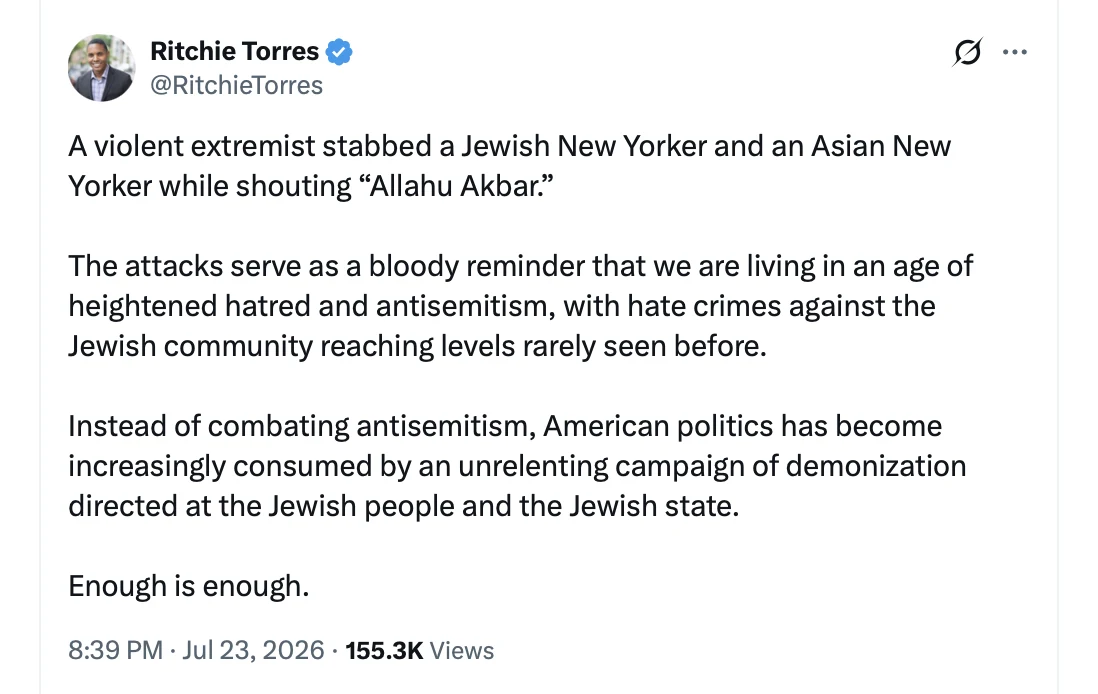
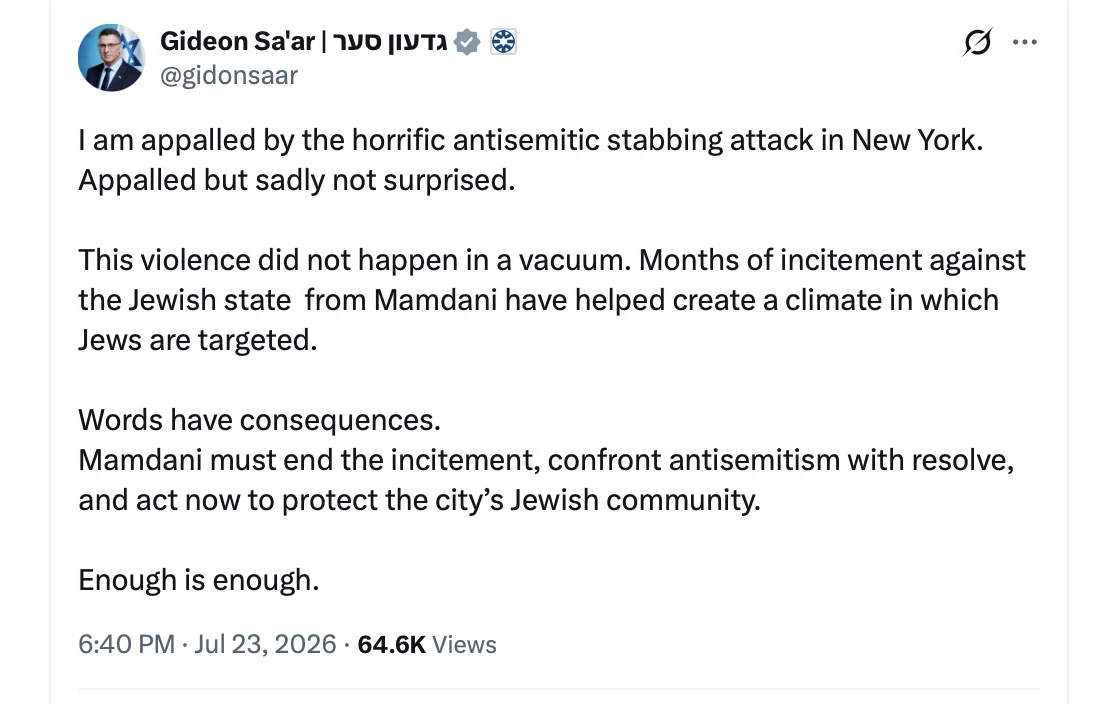
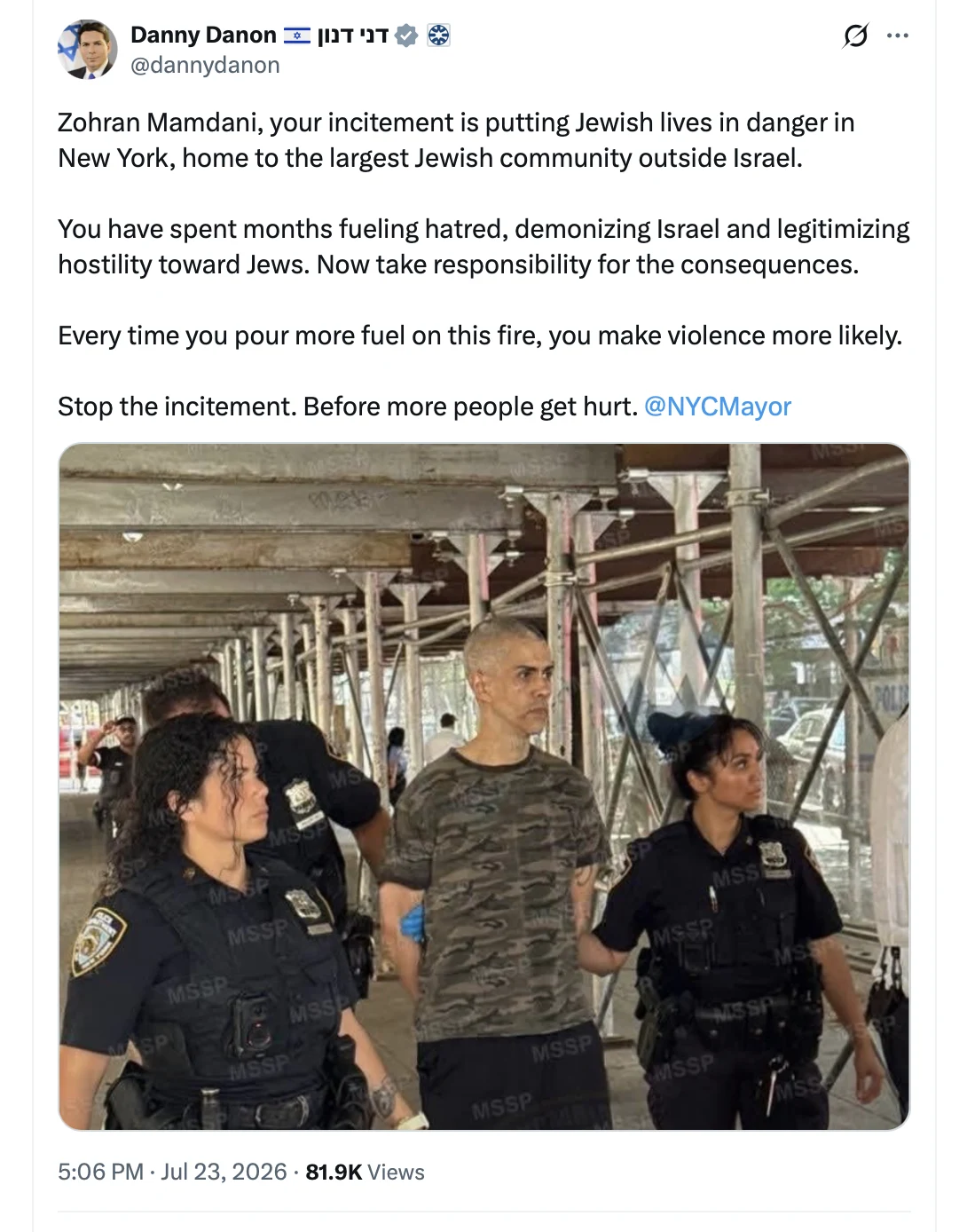
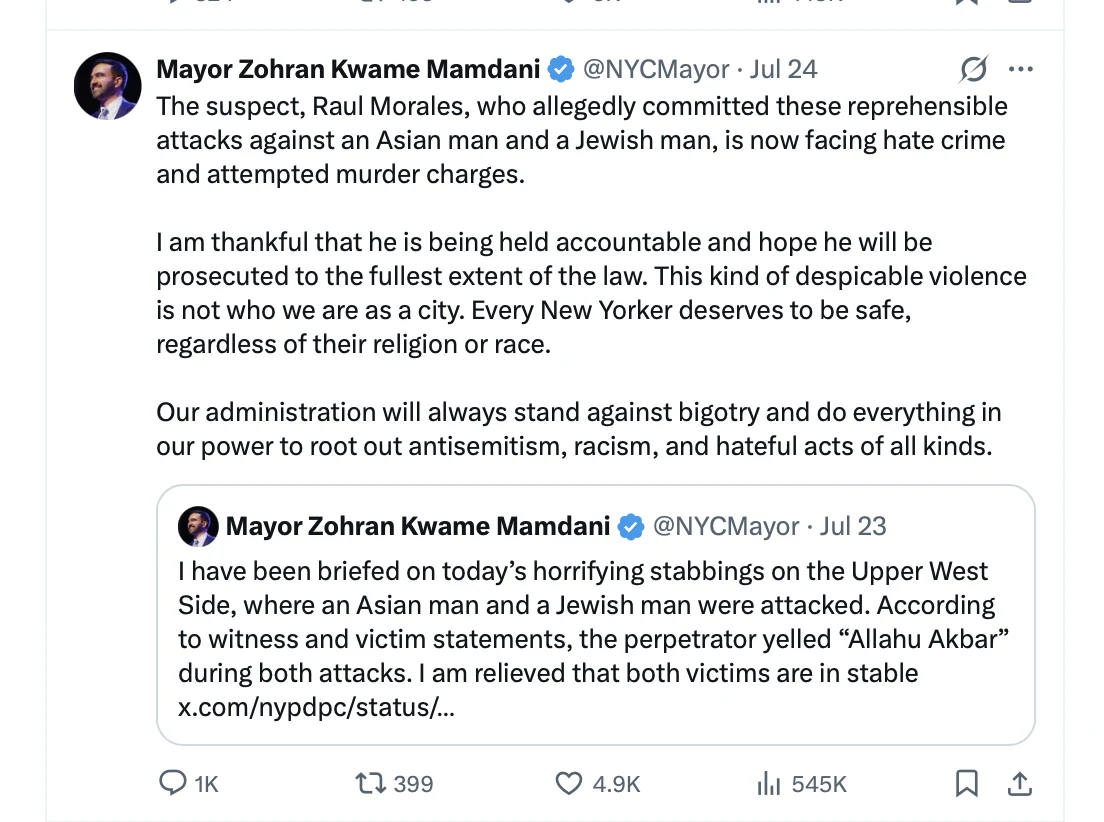
The Thursday stabbing was covered within hours by numerous media outlets and it immediately drew responses from Representative Ritchie Torres, who called it a reminder that hate crimes against the Jewish community was reaching levels rarely seen before, and from Israeli officials, including Foreign Minister Gideon Sa’ar and Israel’s Ambassador to the United Nations Danny Danon, who tied the attack to what they described as months of anti-Israel rhetoric from New York City Mayor Zohran Mamdani. Mamdani, for his part, called the attack “despicable” and said he was grateful for police officers’ swift response. The public reaction has not been uniform sympathy. Beneath social media posts about the Tottenham assault on a father and his three-year-old son, some commenters suggested the victims bore responsibility simply for being visibly Jewish in public, a version of victim-blaming that advocacy groups say has become more common, and more openly stated, since October 7.

That mix of daily incident coverage, competing political narratives, and hard statistics has become close to routine: on Capitol Hill, Senators Jacky Rosen and James Lankford have been pushing the bipartisan Jewish American Security Act, which would direct roughly $1 billion toward security grants for synagogues and other at-risk nonprofits and require the Department of Education to build a Title VI framework for campus antisemitism.
A transatlantic reckoning
The pattern is not confined to the United States. Britain’s government announced on July 13 that it would spend more than £251 million over three years to expand police protection for the country’s roughly 290,000 Jews, after a spate of attacks pushed the UK’s national terror threat level from “substantial” to “severe.” The announcement, made jointly by the Home Office, Policing Minister Sarah Jones, Chancellor Rachel Reeves and Prime Minister Keir Starmer, followed a month in which the UK recorded 255 antisemitic hate crimes, a 72% jump from April. It came after a series of attacks that included the October 2025 Yom Kippur attack on Heaton Park Hebrew Congregation in Manchester, in which a man drove a car into the synagogue’s gates and stabbed congregants, killing two; an April 2026 firebombing attempt at Finchley Reform Synagogue in London; and the stabbing of two Jewish men in Golders Green later that month in what police called a suspected terrorist attack. The UK funding is intended to sharply expand police presence and training around Jewish communities nationwide. (For a full breakdown of the funding allocation and community reaction, see our earlier report, “UK Commits £251 Million to Protect Jewish Communities as Antisemitic Attacks Rise Across Britain and US.“)

The UK response is unfolding alongside a parallel American reckoning that goes beyond the incidents touched on above. In May 2025, two Israeli Embassy staffers – Yaron Lischinsky and Sarah Milgrim – were shot and killed outside the Capital Jewish Museum in DC. Milgrim was shot multiple times, even as she attempted to crawl away, with the shooter expending a total of 21 rounds according to the affidavit. The following month, the Boulder, Colorado attack left more than a dozen injured, including 82-year-old Karen Diamond, who later died, after the suspect threw two Molotov cocktails. In that affidavit, he also had 14 more unlit Molotov cocktails and carried a makeshift flamethrower.
A separate global tracking effort found that 2025 was the deadliest year for Jews killed in antisemitic attacks worldwide in three decades. In May 2026, DOJ announced the arrest of an Iraqi national accused of leading elements of Kataib Hezbollah, an Iran-linked militant group, alleging he was plotting attacks on synagogues and Jewish centers in Arizona, Los Angeles and New York and linking him to earlier arson attacks on Jewish sites in Europe, a case that moved the domestic threat picture beyond lone-actor violence toward organized, foreign-linked plotting.
On Capitol Hill, that has translated into a more detailed legislative push than the Senate bill described above. Representatives Dan Goldman (D-NY) and Mike Lawler (R-NY) introduced a companion Jewish American Security Act (H.R. 9211) in the House on June 10 with 28 co-sponsors. Its six-point plan would reauthorize Federal Emergency Management Agency’s Nonprofit Security Grant Program at $1 billion through 2031; authorize $9 billion annually through 2031 for DOJ support to local law enforcement at religious institutions; require the FBI, the Department of Homeland Security, and the National Counterterrorism Center to jointly produce an annual threat assessment on antisemitic violent extremism, including its online origins and any foreign state involvement; direct the Department of Education to name an antisemitism coordinator; and require major online platforms to file public transparency reports on antisemitic content. The bill has drawn endorsements spanning the ADL, AJC, the Orthodox Union, and Jewish Federations of North America alongside the Republican Jewish Coalition and the Jewish Democratic Council of America, a rare point of bipartisan alignment on an otherwise politically fractious issue.
Hate Crime or Terrorism?
The attacks catalogued above raise a definitional question that researchers and legal scholars continue to debate: When does a hate crime become terrorism, and does the distinction even matter in practice?
The evidence is mixed. An analysis by the University of Maryland’s National Consortium for the Study of Terrorism and Responses to Terrorism (START), examining U.S. data from 1992 to 2008, found no evidence at the time that hate crimes reliably precede terrorist attacks. If anything, the relationship often runs the other way: hate crimes frequently spike after terrorist incidents, particularly attacks carried out by non-right-wing extremists on symbols of American identity, suggesting some hate crimes function as retaliation rather than as a warm-up act for larger violence.
British policing takes a different emphasis. The UK’s College of Policing advises officers that while not every hate crime is connected to extremism, most terrorist acts are motivated by some form of hatred – personal, ideological, or the product of manipulation by others – and that some offenders who start with lower-level hate crimes go on to escalate. The practical challenge for law enforcement, in this framing, is identifying which offenders are on that trajectory before they do.
In the case of the March 2026 Michigan attack on Temple Israel, when announcing that the crime would be labeled an act of terrorism, the U.S. Attorney for the Eastern District of Michigan, Jerome Gorgon, explained, “He [the suspect] committed the terrorism crime of providing material support to Hezbollah.” FBI investigators had uncovered his apparent motive: revenge for the death of his brothers in Lebanon, as members of Hezbollah’s rocket unit, during strikes by Israel Defense Forces.
Legal scholars, meanwhile, caution that the choice between the two labels is not a neutral one. A California Law Review analysis argues that “hate crime” and “terrorism” emerged from distinct political and historical origins, and that each framing carries different legal consequences: hate-crime law tends to be reactive, addressing harm after the fact, while terrorism law is built to be preventative. The review also notes that the terrorism label has at times been applied unevenly, including efforts by some officials to attach it to pipeline protesters, such as the Standing Rock Sioux Tribe or advocacy groups like the National Rifle Association (NRA) rather than to violent extremists.
None of that resolves whether any specific attack in this timeline should be called terrorism, a hate crime, or both. But it does explain why officials, victims’ advocates and headline writers reach for different words to describe the same violence, and why that choice, however it’s made, comes with real legal and political stakes attached.
The bottom line
Whatever the final classification of Thursday’s stabbing, it arrived inside a documented pattern, not as an anomaly, and not only as a domestic issue. ADL’s tracking shows assault levels at historic highs; FBI data shows Jewish people accounting for well over half of religion-based hate crimes and more than five times their population share; NYPD’s own confirmed-case data, under its new stricter reporting standard, shows antisemitic incidents making up the majority of the city’s hate crimes even as overall crime falls; and Britain has just raised its national terror threat level and committed a quarter-billion pounds in response to its own wave of attacks.
Federal, state, city and now foreign law enforcement agencies have all opened or expanded task forces in direct response, and lawmakers on both sides of the Atlantic – and both sides of the aisle in Washington – are moving bills rather than just statements. What remains genuinely contested is not whether the violence is real, but how to name and respond to it. Politically, that means disputes over who bears responsibility for the climate producing these attacks. Legally and academically, it means an unresolved argument over whether “hate crime” or “terrorism” is the right frame, a choice that shapes whether the response is reactive or preventative, and who gets treated as a threat to be stopped versus an offender to be punished after the fact. The data settles the first question. It does not settle the second.
A Timeline of Antisemitic Attacks
The incidents below are a selected sample of notable attacks since April 2025, not a comprehensive record.
July 23, 2026 — Manhattan, New York: A man allegedly stabbed a Jewish man leaving Tisha B’av services and an Asian man near Central Park while shouting “Allahu Akbar.”
July 21, 2026 — Brooklyn, New York: Police say a man shoved a 64-year-old man to the ground without provocation, telling him “that’s what Jews deserve.” The suspect remains at large.
July 13, 2026 — Northern Mongolia: Six Israeli tourists were attacked at a campsite by assailants carrying axes and knives who shouted “Heil Hitler.”
July 11, 2026 — Budva, Montenegro: More than 10 men surrounded, kicked and beat a group of Israeli tourists, leaving one with a broken jaw.
July 4, 2026 — Tottenham, London: A man in his 20s and his three-year-old son were assaulted in Markfield Park; the suspect made threatening remarks about the victims and the wider Jewish community.
June 22, 2026 — Côte-des-Neiges, Montreal: A 25-year-old Canadian man opened fire in the neighborhood, killing two people and injuring one before police killed him. A manifesto attributed to the shooter, analyzed by the ADL, blended antisemitism, incel-linked ideas and anti-capitalist beliefs, including calls to “liquidate” what he called Zionist-linked corporate targets.
May 14, 2026 — Golders Green, London: A 22-year-old Israeli man was chased and beaten near unconsciousness by five masked men after being overheard speaking Hebrew outside his apartment. The attackers shouted in Arabic and fled before police arrived.
May 2026 — United States: The Justice Department announced the arrest of an Iraqi national accused of leading elements of Kataib Hezbollah and plotting attacks on synagogues and Jewish centers in Arizona, Los Angeles and New York.
April 29, 2026 — Golders Green, London: Two Jewish men, in their 30s and 70s, were seriously wounded in a stabbing attack. An Iran-linked group calling itself Ashab al-Yamin al-Islamia claimed responsibility, saying its “lone wolves” had targeted “Zionists.” Britain’s head of counter-terrorism policing, Laurence Taylor, formally declared it a terrorist incident.
April 2026 — London, England: Two masked assailants threw a brick and suspected petrol bombs at Finchley Reform Synagogue in the early morning hours.
April 10, 2026 — Munich, Germany: Explosive devices struck Eclipse Grillbar, Munich’s first Israeli restaurant and a Jewish-owned business open more than 20 years, in an overnight bombing that shattered windows and damaged the interior. No one was injured.
April 3, 2026 — Toronto, Ontario: A Jewish-owned restaurant, Old Avenue, was shot at 14 times around 1 a.m., about one month after its other location was struck by gunfire the previous month.
March 24, 2026 — Antwerp, Belgium: A car was torched overnight in a suspected antisemitic attack, for which two minors were arrested. Belgium responded by deploying soldiers to bolster security at synagogues and Jewish schools in its largest cities, after the string of attacks across Belgium and the Netherlands that month. In Britain, counter-terrorism officers separately opened an investigation into an attack on Jewish community ambulances.
March 14, 2026 — Amsterdam, Netherlands: An explosion struck a Jewish school.
March 13, 2026 — Rotterdam, Netherlands: A synagogue was targeted in an arson attack.
March 12, 2026 — West Bloomfield, Michigan: A man allegedly drove his vehicle into Temple Israel and exchanged gunfire with a security guard, who shot and killed him. The synagogue’s preschool was evacuated.
March 9, 2026 — Liège, Belgium: An explosive device was used in an attack on a synagogue.
February 2026 — Jackson Heights, New York: A 17-year-old student allegedly emailed a mass threat to kill Jewish people to 300 classmates at a Queens charter school.
January 2026 — Borough Park, New York: 57 swastikas were found drawn on a neighborhood playground.
January 2026 — Crown Heights, New York: A driver repeatedly rammed his car into Chabad-Lubavitch world headquarters on Eastern Parkway.
December 14, 2025 — Bondi Beach, Sydney, Australia: A shooting at a Jewish community Hanukkah event killed 15 people and injured dozens more, the deadliest antisemitic attack of 2025.
October 2025 — Manchester, England: A man drove a car into the gates of Heaton Park Hebrew Congregation and stabbed congregants during Yom Kippur services, killing two worshippers and seriously wounding three others.
June 2025 — Boulder, Colorado: A man used Molotov cocktails to attack a “Run for Their Lives” demonstration supporting Israeli hostages while shouting pro-Palestinian slogans. More than a dozen people were injured, including an 82-year-old woman who later died.
May 2025 — Washington, D.C.: Two Israeli Embassy staffers, Yaron Lischinsky and Sarah Milgrim, were shot and killed outside the Capital Jewish Museum, the first Jewish fatalities from an antisemitic attack on U.S. soil since 2019.
April 2025 — Harrisburg, Pennsylvania: Pennsylvania Governor Josh Shapiro’s residence was set on fire while he and his family slept inside, hours after they had marked Passover there.