

The Kurdistan Workers’ Party (Partiya Karkerên Kurdistanê – PKK) has laid down its weapons following negotiations with Turkiye’s ruling Justice and Development Party (Adalet ve Kalkınma Partisi – AKP). In his speech last week, President Recep Tayyip Erdoğan highlighted the disarmament ceremony held at the Casene Cave in Sulaymaniyah, where 30 PKK members surrendered their weapons. The ceremony, coordinated by the National Intelligence Organization (MIT) and overseen by both Iraq and the Kurdish Regional Government, has been portrayed as a potential turning point in efforts to resolve this long-standing conflict. While these negotiations have sparked some hope for the possible dissolution of the PKK, they have also raised questions about how such a process compares to other international models of negotiating with terrorist groups, and whether this is ultimately a genuine peace effort or a calculated political maneuver by the AKP regime in Turkiye.
By placing the PKK case within a comparative framework, this article also considers the experiences of other countries that have faced long-term terrorism and engaged in negotiations with violent non-state actors, such as the IRA in Northern Ireland, ETA in Spain, and FARC in Colombia. Using this perspective, the article highlights both common patterns and unique challenges in conducting negotiations with groups like the PKK. This analysis is divided into two parts: Part I examines terrorism in Türkiye, the PKK’s impact, and the role of negotiations in a comparative context, while Part II focuses on the specific factors driving the AKP regime’s and the PKK’s engagement in negotiations, potential PKK responses, and an evaluation of the prospects for success.
Terrorism in Turkiye and the PKK’s Impact
Turkiye has recorded terrorist activities carried out by various groups, including left-wing extremist organizations, religious-jihadist terror groups, Iran-backed terror groups, as well as ethno-nationalist and separatist factions. Left-wing terrorist groups were particularly active in Turkiye during the 1990s, many of which were influenced by Cold War-era Marxist and Leninist ideologies. Notably, the Revolutionary People’s Liberation Party/Front (DHKP-C) remains designated as a foreign terrorist organization by the U.S. government. However, these groups are less active today compared to their prominence in the 1990s.
The second category consists of Salafi-jihadist terrorist attacks carried out by organizations such as ISIS and Al-Qaeda. Al-Qaeda was responsible for the 2003 synagogue bombings in Istanbul, while its affiliated group, the Al-Nusra Front, was linked to the 2016 assassination of the Russian ambassador to Turkiye by an off-duty police officer. Between 2015 and 2024, ISIS perpetrated a series of high-profile attacks within Turkiye, including an assault on Istanbul’s main airport in 2016. The most recent significant incident occurred in 2024, when two ISIS militants targeted a Catholic church in Istanbul. An essential aspect of ISIS-related activity in Turkiye concerns the considerable number of Turkish nationals who joined the organization during its peak in Syria and Iraq around 2015, when Turkiye was among the countries with one of the highest numbers of foreign fighters joining ISIS. Following the collapse of ISIS’s territorial control, many of these individuals returned to Turkiye. However, the AKP regime has been widely criticized for paying no heed to the whereabouts and activities of these returnees, raising concerns about the long-term security implications of such inaction.
A third category consists of Iran-backed terrorist activities in Turkiye, which primarily targeted secular individuals during the 1990s. One of the most notable incidents was the assassination of Cumhuriyet daily columnist Uğur Mumcu in 1994, an attack reportedly planned and sponsored by Iran’s Islamic Revolutionary Guard Corps (IRGC). In addition, the Salam Tawhid Quds Force, a terrorist group established and supported by the IRGC, planned attacks against strategic targets in Turkiye, including the U.S. Consulate and a nuclear research facility in Istanbul in 2011 and 2012.
Among these categories, the PKK has been the most persistent and active terrorist organization in Turkiye’s recent history. The PKK was founded in 1974 and aimed to establish an independent Kurdistan, based on Marxist-Leninist ideologies, in southeast Turkiye and northeast Iraq. The group began its attacks in 1978 and expected support from Kurdish groups; however, the Kurds disapproved of the PKK’s leftist ideology. Since the 1990s, the organization has focused on developing chameleon-like characteristics that reflect the languages of Marxism, nationalism, and religion, and has selectively targeted Turkiye’s military and state institutions. To date, the PKK has killed more than 35,000 civilians and destroyed many public facilities. Suicide bombings were among the PKK’s most widely used tactics. The organization was officially designated as a terrorist organization by the United States in 1997.
According to data from the Global Terrorism Trends and Analysis Center (GTTAC), terrorism in Turkiye has shown a consistent downward trend in recent years. In 2018, the number of recorded terrorist incidents stood at 182, decreasing to 151 in 2019, 50 in 2020, 21 in 2021, 18 in 2022, 18 in 2023, and only four incidents in 2024.

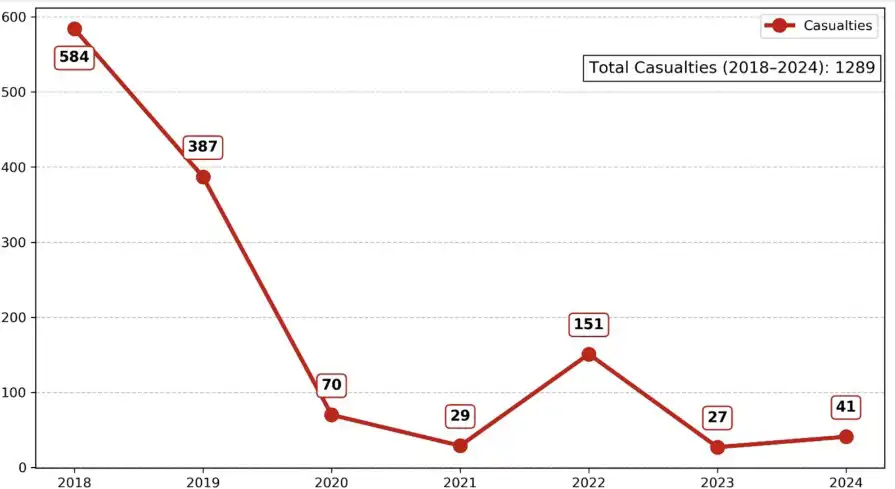
Figure 2 illustrates the number of casualties, including both fatalities and injuries, resulting from terrorist attacks in Turkiye. Consistent with the overall decline in the frequency of terrorist incidents between 2018 and 2024, the number of casualties has also markedly decreased during this period. In 2018, the total number of casualties stood at 584, whereas by 2024, this figure had fallen to 41.
According to data from the GTTAC, the PKK has been the most active terrorist organization in Turkiye. In 2018, the PKK was responsible for more than 80 percent of all terrorist attacks, carrying out 147 incidents, as illustrated in Figure 3 below. The frequency of the group’s attacks closely mirrored the overall declining trend in terrorist incidents within the country. Specifically, the number of PKK attacks decreased sharply from 89 in 2019 to 31 in 2020. In subsequent years, the group conducted only a limited number of attacks, reaching its lowest point in 2024 with a single recorded incident. Notably, in 2025, the PKK has maintained a period of violent silence, with GTTAC data showing no recorded attacks within the first five months of the year.

Figure 4 below presents the number of individuals killed and wounded as a result of PKK attacks in Turkiye. These attacks have been responsible for a significant proportion of the total casualties from terrorist incidents in the country. In 2018, 2019, and 2020, PKK attacks resulted in more fatalities than injuries. However, in the subsequent years of 2022 and 2024, the number of individuals wounded exceeded the number of fatalities. Overall, the trend in casualties attributed to the PKK closely aligns with the broader decline in the number of casualties from terrorist attacks in Turkiye, reflecting the general reduction in the group’s operational capacity and the overall decrease in terrorist violence within the country.

The significant decline in PKK-related attacks and casualties in recent years prompts important questions about the causes of this change. One possible explanation, based on an interview with a former police chief involved in counterterrorism against the PKK, is a strategic shift by the organization. Specifically, the PKK has reportedly redirected substantial resources—including personnel, recruitment efforts, and logistical support—toward Syria, especially to support its ideological allies there. The main ally is the People’s Protection Units (YPG), the military branch of the Democratic Union Party (PYD), which has become a key player in the Syrian civil war. This shift in focus could explain the decrease in PKK activity within Turkiye.
Countering Terrorism and the Role of Negotiations
The history of terrorism demonstrates that there are generally six pathways through which terrorist organizations come to an end: decapitation, success, failure, defeat through force, reorientation, and negotiation. Decapitation refers to the capture or assassination of a terrorist group’s leadership, often weakening the organization’s ability to coordinate or sustain operations. Success occurs when a terrorist group achieves its strategic objectives and voluntarily disbands or ceases violent activities. Failure describes the internal collapse of a group due to a loss of public support, internal divisions, burnout, or widespread public backlash. Defeat through force typically involves a state’s use of military or police power to suppress or eliminate a terrorist threat, either domestically or abroad. Reorientation refers to instances where terrorist groups abandon their ideological objectives and transition into criminal enterprises, primarily focused on illicit activities. Lastly, negotiation entails a political process through which state actors engage directly with terrorist organizations to bring about the cessation of violence through dialogue, compromise, and the promise of political or material concessions.
Negotiations may involve ceasefire agreements, offers of amnesty, political participation, or the integration of former combatants into civilian life. However, this approach remains controversial. While it has shown success in particular historical cases, negotiation often faces significant limitations. Governments may be reluctant to legitimize terrorist groups through dialogue, and such efforts can fail if the group in question lacks internal cohesion, has been active for an extended period, or retains unrealistic or maximalist demands. Moreover, negotiation strategies often require sustained political will and patience, as the process is typically protracted and fraught with setbacks.
Engaging in negotiations with terrorist organizations is a complicated and demanding process; however, it may be essential for resolving disputes, averting violence, and possibly securing lasting peace. The likelihood of success relies on multiple elements, including the characteristics of the group, the circumstances of the conflict, and the ability to identify shared interests.
Robust legal and institutional frameworks underpinned successful negotiations with terrorist organizations. For example, the Irish Republican Army (IRA) reached a historic settlement through the Good Friday Agreement, Euskadi Ta Askatasuna (ETA) declared a formal ceasefire, and the Revolutionary Armed Forces of Colombia (FARC) concluded negotiations with the Havana Peace Agreement. These processes involved multifaceted participation by state actors, including intelligence agencies, political parties, military forces, and law enforcement institutions from Colombia, the United Kingdom, and Spain. The post-agreement arrangements facilitated the institutionalization or continuation of political participation by affiliated entities, such as Sinn Féin in Northern Ireland and EH Bildu in Spain, which embodied the political ideologies of the IRA and ETA, respectively. Similarly, the Colombian government sanctioned the FARC’s transformation into a legally recognized political party, retaining its original acronym (Fuerza Alternativa Revolucionaria del Común), which translates to ‘Common Alternative Revolutionary Force’. Negotiations also encompassed provisions for the conditional release of incarcerated members.
International stakeholders played a significant role in monitoring and supporting these negotiations, including the United States government and the European Union in the case of the IRA, an international observatory committee in the ETA negotiations, and the United Nations, Norway, and Cuba as guarantors during the FARC peace process. Civil society engagement was prominent, evidenced by widespread social endorsement and formal mechanisms of consent, such as the constitutional referendum held in Colombia following the FARC agreement. Significantly, these organizations confined their armed operations within their national borders, although FARC’s involvement in narcotics trafficking linked it to broader transnational criminal networks. Ultimately, the states involved demonstrated a willingness to implement democratic reforms aimed at accommodating the political integration and reconciliation of these former insurgent groups.
Unlike the cases of the IRA, ETA, and FARC, negotiations with the PKK have been notably deficient in several critical aspects. While the PKK has been engaged in prolonged armed conflict with the Turkish state, efforts to reach a durable peace agreement have lacked a comprehensive and viable legal framework comparable to those underpinning successful negotiations elsewhere. State involvement, although extensive—encompassing Turkish intelligence services, the military, law enforcement, and political actors—has been characterized by intermittent ceasefires and sporadic dialogue rather than sustained and inclusive negotiation processes.
Furthermore, provisions for the release or reintegration of detained members have been limited or absent, undermining trust-building measures. The international community’s role in facilitating or monitoring the negotiation process has been minimal compared to the active involvement of actors such as the United States, the European Union, and the United Nations in other contexts. Civil society participation and public consensus around peace efforts have been fragmented and contentious within Turkiye. Additionally, the PKK’s designation as a terrorist organization by multiple states and its transnational activities have complicated diplomatic efforts. Crucially, the Turkish government has been reluctant to enact substantial democratic reforms aimed at addressing the political and cultural grievances at the core of the conflict.
Unlike Sinn Féin, EH Bildu, or the FARC’s political successors, the PKK has not been fully integrated into the formal political system, receiving neither official recognition nor the establishment of a corresponding political party. The Kurdish political movement, which began with the establishment of the People’s Labor Party (HEP) in 1990, witnessed the dissolution of seven parties by court order and the voluntary closure of two others by 2009. Following the closure of the Democratic Society Party (DTP) in 2009, a similar legal process was initiated against the Peoples’ Democratic Party (HDP – Halkların Demokratik Partisi) after it secured 11.7% of the national vote and 67 parliamentary seats in the 2018 general elections. The closure case was largely based on the claim that the HDP was a continuation of previously banned Kurdish-oriented parties. In response to increasing political and legal pressures, the Peoples’ Equality and Democracy Party (DEM Party) was founded in 2023, with the aim of advancing various political and social objectives within a pluralistic framework.
Selahattin Demirtaş, the former co-chair of the HDP, and Figen Yüksekdağ, also a former co-chair, were detained in 2016 and remain incarcerated. One of the reasons brought against Demirtaş involved allegations related to his growing popularity as a presidential candidate, along with his public assertion that President Recep Tayyip Erdoğan had prior knowledge of the 15 July 2016 suspicious coup attempt and strategically exploited its aftermath for political gain.
Many Turkish citizens see Selahattin Demirtaş’s rising popularity as the leader of a pro-Kurdish political party as a serious threat to the AKP regime, especially in Kurdish-majority areas. His outspoken criticism of President Erdoğan, including his widely publicized statement that “we will not allow you to become president,” increased political tensions. Additionally, Demirtaş’s claims that Erdoğan had prior knowledge of the July 15, 2016, suspicious coup attempt and intentionally let it happen to gain political advantage further deepened his opposition. These factors are seen as key reasons why Demirtaş became a political target and ultimately was imprisoned. In the most recent development, judicial authorities once again denied the appeals for their release last week.
Despite these political setbacks, the HDP performed notably in the 2019 local elections, winning 58 municipalities, including three metropolitan cities (Diyarbakır, Mardin, and Van), five provincial centers, and 50 district municipalities. However, shortly after the elections, government-appointed trustees (commonly referred to as kayyums) replaced the elected mayors in the three major metropolitan municipalities, marking the beginning of a second wave of state intervention. In total, trustees have been assigned to 49 HDP-administered municipalities. These developments reflect a broader pattern wherein political parties perceived as ideologically aligned with the PKK have been subjected to legal restrictions, institutional suppression, and the imprisonment of their leadership. The ongoing negotiations with the PKK continue to raise critical questions regarding the future of party closures and the practice of appointing trustees in place of elected officials.
In conclusion, Türkiye has experienced terrorist activity from various organizations, with the Kurdistan Workers’ Party (PKK) remaining the most active actor. While the overall number of terrorist attacks has declined in recent years, the ruling Justice and Development Party (AKP) has continued to instrumentalize the issue of terrorism, labeling hundreds of thousands of opposition members as terrorists as part of a broader strategy to suppress dissent. Although the PKK has carried out fewer attacks within Türkiye’s borders, it remains active through operations targeting Turkish military forces in northern Syria and northern Iraq. However, efforts to initiate negotiations between the state and the PKK fall significantly short when compared to internationally recognized peace processes, such as those involving the IRA in Northern Ireland, ETA in Spain, and FARC in Colombia. These cases were marked by transparency, the involvement of international committees and neutral observers, legal and constitutional amendments to accommodate former combatants, and, most critically, substantive democratic reforms addressing the root ideological and political grievances. Part II of this article will explore the underlying factors driving both the AKP government’s and the PKK’s approaches to negotiation, assess the potential responses from the PKK, and evaluate the overall prospects for a sustainable and credible resolution.
Click here to read Part II: Negotiating with the PKK: Political Drivers, Prospective Responses, and the Question of Success