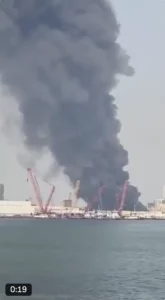
U.S. forces patrol the Arabian Sea after firing upon the Iranian-flagged vessel M/V Touska on April 20, 2026. The U.S. accused it of attempting to violate the U.S. naval blockade of Iranian ports near the Strait of Hormuz. (Source: CENTCOM)
Nearly two months into Operation Epic Fury, diplomatic efforts to end the war have stalled. Trump cancelled his envoys’ trip to Pakistan hours after Iran’s foreign minister left Islamabad, the full scope of Iranian damage to U.S. military assets has come into public view for the first time, and both sides remain locked in a standoff over the Strait of Hormuz and Iran’s nuclear program.
Ceasefire Talks Fall Apart in Islamabad
Attempts at ceasefire negotiations between the United States and Iran collapsed this weekend after Tehran’s top diplomat left Pakistan and Trump pulled his envoys before they could travel. Iranian Foreign Minister Abbas Araghchi had arrived in Islamabad following a stop in Oman, held talks with Pakistani officials, and said he had shared Iran’s position on ending the war, but had yet to see whether the United States was “truly serious about diplomacy.”
Trump cancelled the trip of special envoy Steve Witkoff and Jared Kushner on Saturday, April 25, posting on Truth Social:
Source: Truth Social @realDonaldTrump
Trump confirmed the ceasefire would hold despite the collapse of the talks. Iran’s foreign minister is expected back in Islamabad on Sunday, Pakistani officials said, and is expected to travel to Moscow afterward. Pakistan continues to position itself as the primary mediator working to bring both sides back to the table.
The diplomatic standoff centers on two core issues: control of the Strait of Hormuz, which Iran had restricted since the opening of the war, and Tehran’s nuclear ambitions. The United States has significantly increased its naval presence in the strait to block Iranian oil exports.
The Strait of Hormuz has shown tentative signs of movement returning, though the waterway remains far from normal operations. On April 25, 19 vessels transited the strait, with 14 heading outbound and five inbound. The numbers are modest by historical standards for one of the world’s most critical shipping corridors, where normal daily traffic can run into the dozens, with vessels carrying roughly a fifth of globally traded oil. U.S. naval enforcement operations and continued sanctions pressure are keeping a ceiling on recovery, even as some commercial traffic cautiously resumes.
Iranian Damage to U.S. Bases: Up to $5 Billion
The full scope of Iranian strikes on U.S. military assets in the Gulf region is emerging publicly for the first time. It was disclosed that runways, high-end radar systems, dozens of aircraft, warehouses, command headquarters, aircraft hangars, and satellite communications infrastructure were all struck by Iranian forces across multiple countries. Repairs could cost up to $5 billion, and that figure does not include radar systems, weapons systems, aircraft, and other equipment that were impaired or deemed unsalvageable. Repairs to the U.S. Navy Fifth Fleet headquarters in Bahrain alone could total $200 million, according to a congressional official following a Pentagon assessment.
The damage figures arrive alongside separate cost reporting from the war’s opening phase: the Pentagon estimated in March that the first six days of the war cost more than $11.3 billion, not including repair costs. Munitions expenditure alone totaled $5.6 billion in the first two days of the operation.
Nearly seven weeks after the opening strikes of Operation Epic Fury, ceasefire diplomacy is intensifying on multiple fronts while the U.S. has launched a naval blockade of Iranian ports, and House Democrats have introduced articles of impeachment against Secretary of War Pete Hegseth.
Ceasefire Diplomacy: Pakistan, Israel, Lebanon
Pakistan’s army chief is set to meet with Iranian officials in Tehran today, April 16, in a bid to extend the April 8 ceasefire that paused the conflict. Uncertainty remains whether the diplomatic push can produce a lasting agreement.
President Trump separately announced that the leaders of Israel and Lebanon also are set to speak Thursday, April 16 about halting the fighting between them, which would be the first direct conversation between the two countries’ leaders in more than 30 years. Neither the Israeli nor the Lebanese government have yet confirmed the conversation has been scheduled.
U.S. Blockade of Iranian Ports, Secondary Sanctions Threatened
Source: X @CENTCOM
The U.S. military has turned back 10 ships since launching a naval blockade of Iranian ports on April 13. At his Pentagon press conference, Hegseth described the blockade as “the polite way this can go,” adding that while Iran claims to control the Strait of Hormuz, the regime no longer has “a navy or real domain awareness.” He characterized Iran’s repeated threats to strike ships transiting international waters as “piracy” and “terrorism, not control.”
Tehran responded by threatening to block shipping from the Persian Gulf, the Sea of Oman, and the Red Sea if the blockade continues.
U.S. Treasury Secretary Scott Bessent added an economic dimension Wednesday, April 15, warning that the U.S. is preparing to levy secondary sanctions on financial institutions that do business with Iran, calling the measure the “financial equivalent” of a bombing campaign.
Death Toll at Nearly Seven Weeks
The cumulative human cost of the conflict now stands at:
Iran: More than 3,300 killed, according to Iran’s forensics chief
Lebanon: More than 2,100 killed
Gulf states: 32 killed
Israel: 23 killed
United States: 13 service members killed in combat; 2 additional deaths from non-combat causes
House Democrats Introduce Impeachment Articles Against Hegseth
House Democrats unveiled six articles of impeachment against War Secretary Pete Hegseth on Wednesday, April 15, led by Rep. Yassamin Ansari of Arizona. The seven-page resolution alleges Hegseth engaged in high crimes and misdemeanors and “demonstrated a willful disregard for the Constitution, abused the powers of his office, and acted in a manner grossly incompatible with the rule of law.”
The six articles are:
Unauthorized war against Iran and reckless endangerment of U.S. service members
Violations of the law of armed conflict and targeting of civilians, including a strike on a girls’ primary school in Minab, Iran on February 28 that killed at least 170 people
Negligence and reckless handling of sensitive military information, referencing Hegseth’s use of the commercial messaging app Signal to discuss strikes on Yemen
Obstruction of congressional oversight
Abuse of power and politicization of the armed forces
Conduct bringing disrepute upon the U.S. and its armed forces
“Only Congress can declare war; his actions demand immediate removal,” Ansari wrote on X.
The resolution has little realistic path to passage given the Republican majority in the House. Democratic sponsors have indicated they may renew the effort if the party takes control of the chamber following the midterm elections.
Update: Second F-15 Crew Member Rescued From Inside Iran
April 5, 2026, at 7:00 AM
U.S. special operations forces successfully rescued the second crew member of the downed F-15E Strike Eagle from inside Iran late Saturday, ending a nearly 48-hour search and rescue operation that officials described as complex and high-risk.
The rescued airman – a weapons systems officer and highly respected Colonel, according to President Trump – was wounded after ejecting from the aircraft Friday but was able to walk and evade capture. The pilot had been rescued shortly after the initial shootdown.
Iran Conflict Update: U.S. F-15 Shot Down Over Iran, Missing Crew Member Rescued, Army Chief Fired Mid-War
April 4, 2026, at 7:30 AM
Five weeks into Operation Epic Fury, an American F-15E Strike Eagle was shot down over Iranian territory, one crew member remains missing as Tehran offers rewards for their capture, a second U.S. aircraft was struck the same day, and the Army Chief of Staff was fired with no explanation while tens of thousands of American troops remain in theater.
F-15E Shot Down Over Iran, One Crew Member Missing
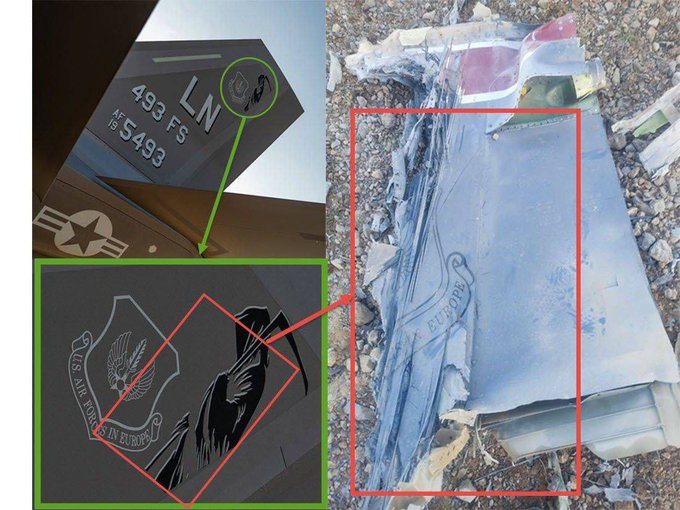
A U.S. F-15E Strike Eagle was shot down over Iran on Friday, April 3. One of the two crew members has been rescued, is in U.S. custody, and is receiving medical attention. U.S. forces have launched search and rescue operations for the second crew member. Tehran has simultaneously promised rewards to Iranian citizens who locate and hand over any American personnel.
Images of reported F-15 wreckage
1 of 2
Image released by IRGC claiming to be U.S. F-15 (Source: X @iahmedsalih)
Images of wreckage published by Iranian state media (Source: X/Press TV)
The F-15E is a dual-role fighter capable of air-to-air and air-to-ground missions, typically crewed by a pilot and a weapons systems officer. The fate of the missing crew member — now potentially on the ground inside Iran with a government-organized search underway — is among the most urgent developments of the war to date.
A second U.S. military aircraft, an A-10 Thunderbolt II, was struck by Iranian fire on Friday. The pilot navigated out of Iranian territory before ejecting and was subsequently rescued. The U.S. has now lost at least seven manned aircraft during the course of the war.
Army Chief of Staff Removed Mid-War, No Explanation Given
Defense Secretary Pete Hegseth called Army Chief of Staff Gen. Randy George on Thursday, April 2 and told him to retire immediately. The Pentagon confirmed the dismissal within hours but no reason was given: no misconduct finding, no operational failure, no policy disagreement on the record. Just a phone call ending a career in the middle of the most significant American combat operation in two decades.
George is the 24th general or admiral Hegseth has removed since taking office. His replacement is Vice Chief of Staff Gen. Christopher LaNeve, who previously served as Hegseth’s senior military aide.
The timing is notable. The 82nd Airborne is currently deploying. The 31st Marine Expeditionary Unit – 3,500 sailors and Marines – is staged aboard USS Tripoli. JSOC operators are positioned at forward bases in Israel, Jordan, Saudi Arabia, and the UAE. Kharg Island, through which approximately 90 percent of Iranian oil exports flow, sits 16 kilometers off a coast that remains a potential operational objective. The Army Chief of Staff whose job it was to advise on decisions of that magnitude was removed 48 hours after Trump told the nation the war would continue for two to three more weeks.
U.S. Destroys Iran’s Largest Bridge
The B1 suspension bridge – a newly completed $400 million, 136-meter-high structure connecting Tehran and Karaj – was struck twice on April 2 and collapsed onto the causeway below. Iran’s state media reported eight people killed and 95 wounded. President Trump claimed responsibility on Truth Social and issued a direct ultimatum:
The strike came one day after Trump threatened to bomb Iran “back to the stone ages” if a deal was not reached, and signals an expanding target set beyond military and nuclear assets to include civilian and economic infrastructure.
CENTCOM: “Undeniable Progress”
CENTCOM Commander Adm. Brad Cooper issued his operational assessment this week:
“Now in our 5th week of the campaign, it is my operational assessment that we are making undeniable progress. We don’t see their navy sailing. We don’t see their aircraft flying, and their air and missile defense systems have largely been destroyed.”
The cumulative operational scorecard as of April 1 stands at 12,300-plus targets struck, 13,000-plus combat flights conducted, and more than 155 Iranian vessels damaged or destroyed. Cooper visited Israel March 29-30, meeting with Israel Defense Forces (IDF) Chief of Staff Lt. Gen. Eyal Zamir to discuss progress in eliminating Iran’s ability to project power beyond its borders, and recognized more than 40 U.S. service members with medals for their performance in the operation’s first weeks.
Operation Epic Fury Overview as of April 1, 2026 (Source: X @CENTCOM)
Iran Strikes Kuwait’s Oil Refinery and Water Supply
Iran launched fresh strikes on Israel and Gulf nations following the U.S. and Israeli escalation against Iranian infrastructure.
In Kuwait, Iranian drones struck the Mina al-Ahmadi oil refinery – one of the largest in the Middle East, capable of refining up to 346,000 barrels of oil per day – setting it on fire. No injuries were reported. It was the third Iranian drone attack on the same refinery since the war began. Kuwaiti officials separately confirmed that an Iranian drone struck a water desalination plant. The Middle East depends on desalination for approximately 90 percent of its drinking water.
In Israel, the IDF confirmed missiles were launched from Iran overnight, with defensive systems operating to intercept them. A Tel Aviv train station sustained damage from shrapnel.
U.N. Security Council Vote on Hormuz Delayed
The United Nations Security Council vote on a resolution to secure the Strait of Hormuz was initially scheduled for Friday, then rescheduled for Saturday, and has since been postponed until at least next week. The resolution itself was significantly weakened before reaching a vote: Bahrain’s original draft authorizing “all necessary means,” including potential military force, was stripped of that language following opposition from Russia, China, and France. The final version authorizes only defensive action to protect vessels transiting the strait.
In a separate development, a French-owned container ship became the first vessel with ties to Western Europe known to have successfully transited the Strait of Hormuz since Iran began blocking the waterway at the start of the war.
Iran Conflict Update: Americans Wounded at Saudi Base, Iranian Commander Killed as War Enters Second Month
March 28, 2026, at 8:45 AM
Operation Epic Fury has now run for one month and shows no sign of resolution. Iran struck a major U.S. air base in Saudi Arabia this week, Houthi rebels fired on Israel for the first time since the war began, more than 300 American service members have been wounded, and a senior Iranian naval commander was killed in a precision Israeli strike.
Iranian Strike Hits Prince Sultan Air Base, Wounds 12 Americans
Twelve U.S. service members were wounded when Iran struck Prince Sultan Air Base in Saudi Arabia on Friday, March 27, with a combined missile and drone attack. Two of the wounded were reported in serious condition. The attack damaged several additional U.S. refueling aircraft at the base, and it was reported that at least one KC-135 air refueling aircraft was hit and caught fire.
The strike is notable on multiple levels. Prince Sultan Air Base is where Army Sgt. Benjamin Pennington – the seventh American killed in the war – died from wounds sustained in a previous attack on the same installation. The KC-135 is also the same aircraft type lost in the non-hostile crash in western Iraq earlier this month. The U.S. military’s aerial refueling capacity, critical to sustaining the pace of strikes over Iran, has now been hit directly on multiple occasions.
The Pentagon confirmed that more than 300 U.S. service members have been wounded since February 28, and stated that additional forces continue to move into the region.
Iranian Naval Commander Killed at Bandar Abbas
Statement from Adm. Brad Cooper, CENTCOM commander, on the killing of IRGC Navy Commander Alireza Tangsiri (Source: X @CENTCOM)
Israel’s Defense Forces confirmed Thursday, March 26, that IRGC Navy commander Alireza Tangsiri was killed in a precision strike on the port city of Bandar Abbas. The IDF stated that Tangsiri “oversaw maritime terrorism carried out against countries in the Middle East, as well as against U.S. and other nations’ energy infrastructure,” and directly accused him of directing efforts to close the Strait of Hormuz. U.S. Central Command (CENTCOM) Commander Adm. Brad Cooper said Tangsiri’s death “makes the region safer” and stated that strikes on the Iranian navy would continue. Tangsiri had commanded the IRGC Navy for eight years, during which the force harassed and attacked hundreds of merchant vessels and killed civilians across the region.
Missile Capability Claims Disputed
The Trump administration has repeatedly cited the destruction of Iranian missile capability as a central war objective, but it has been reported that the U.S. has only been able to confirm the elimination of around one-third of Iran’s missile capabilities, well short of the near-total degradation suggested in public statements. Secretary of State Marco Rubio addressed the objectives Friday, March 27, from Paris: “We are going to basically destroy their ability to make missiles and drones in their factories. And we’re going to substantially — and I mean dramatically — reduce the number of missile launchers so that they cannot hide behind these things to build a nuclear weapon and threaten the world.”
Houthis Fire on Israel for First Time in This War
Israel’s military confirmed Saturday, March 28, it intercepted a missile launched from Yemen toward Israel, the first time during Operation Epic Fury that Israel has faced fire from Houthi rebels. The Iranian-backed group claimed responsibility for the attack. The development extends the conflict’s active fronts further, with Iran’s proxy network in Yemen now directly engaged alongside Hezbollah in Lebanon.
Strikes Continue on Both Sides
Iran continued striking Israel and Gulf neighbors through the weekend. Eight impact sites were reported in Tel Aviv on Saturday, including a university. One person was killed and two injured. Bahrain and the UAE confirmed they intercepted Iranian drones overnight. A worker in Oman was injured after being struck by a drone.
U.S. and Israeli strikes on Iran continued in parallel. Israel’s military confirmed it struck a heavy water reactor in Iran on Friday, which it described as part of Iran’s nuclear enrichment program. Residents who managed to circumvent Iran’s internet blackout sent videos to Iranian diaspora websites showing strikes hitting steel and cement factories across southern and central Iran, including in the Isfahan region. Iran also reported strikes on multiple industrial production facilities.
Iran Conflict Update: Old Jerusalem Hit, Oil At $111, Both Sides Signal They’re Not Done In Week Three
March 20, 2026, at 8:45 PM
As Operation Epic Fury completes its third week, President Trump signaled his end game while simultaneously deploying thousands more Marines, Iran struck the Old Quarter of Jerusalem and shut down Kuwaiti oil refineries, and oil hit $111 a barrel. The U.S. casualty count stands at 13 service members killed and 232 wounded. The Pentagon noted that more than 200 of those wounded have returned to duty.
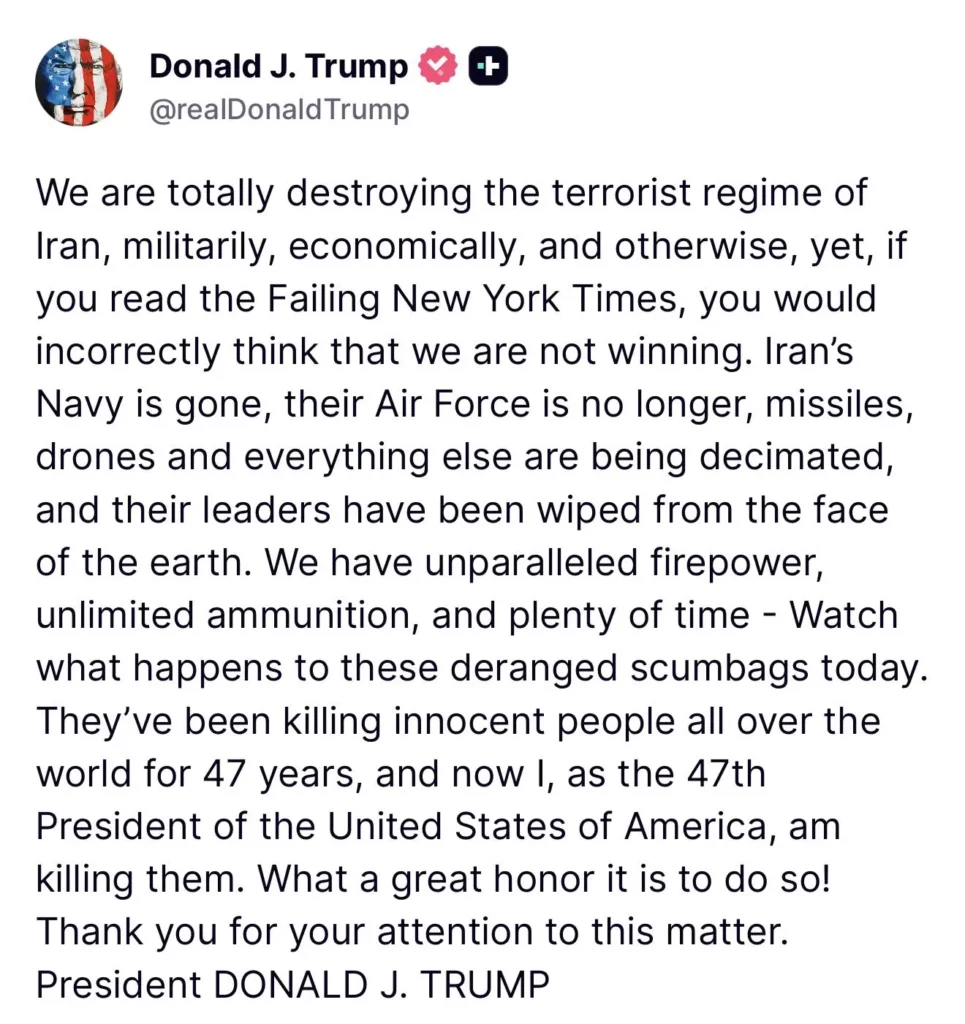
President Trump posted a detailed list of U.S. war objectives on Truth Social the afternoon of Thursday, March 19, framing them as nearly complete:
President Donald Trump on Truth Social, March 20, 2026, at 5:13 PM
Even as Trump signaled a potential wind-down, the U.S. is accelerating deployments. The 11th Marine Expeditionary Unit, made up of at least 2,200 Marines and sailors, is expected to deploy from San Diego in the coming days. Total U.S. personnel supporting the mission now stands at 50,000 service members, according to the Department of War.
Military Scorecard at Week Three
Pentagon Press Secretary Kingsley Wilson released the War Department’s weekly situation report Thursday, citing the following operational results to date:
Iranian ballistic missile and one-way drone attacks are down 90% since combat operations began February 28.
U.S. Central Command has damaged or sunk more than 120 Iranian naval vessels, including all 11 of Iran’s submarines.
Thousands of Iranian targets struck across command and control centers, IRGC headquarters, air defense systems, ballistic missile sites, weapon production bunkers, and naval assets.
Secretary Hegseth described the campaign as “laser-focused and decisive” at a press conference Wednesday, March 18, stating that U.S. objectives – destroying Iran’s missiles and launchers, eliminating its navy, and ensuring Iran never acquires a nuclear weapon – remain unchanged. “We will continue to deliver devastating combat power,” Wilson added.
Iran Strikes Jerusalem, Shuts Down Kuwaiti Refineries
An Iranian missile striking Jerusalem’s Old City near the Western Wall, Al-Aqsa Mosque, and the Church of the Holy Sepulchre, some of the holiest sites to Jews, Muslims, and Christians. (Source: X @noatishby)
Iran struck the ancient Old Quarter of Jerusalem on Thursday, with a missile landing only a few hundred feet from the Al-Aqsa Mosque and the Western Wall, among the most sacred sites in the world for Muslims, Jews, and Christians. Further Iranian attacks hit the city of Rehovot in central Israel, killing 15 people nationwide.
In Kuwait, Iranian strikes hit the Al-Ahmadi and Mina Abdullah oil refineries, forcing both to shut down. Iran’s Revolutionary Guard released a statement asserting that missile production is continuing and stockpiles remain high, a direct challenge to U.S. claims of near-total degradation of Iranian launch capability.
Brent crude oil peaked at $111 per barrel Thursday as the Strait of Hormuz remained effectively closed to tanker traffic. The U.S. continued operations targeting Iran’s navy and drone capabilities specifically to reopen the strait.
Iran’s New Supreme Leader Vows to Fight On
On the eve of Nowruz, the Persian New Year, Ayatollah Mojtaba Khamenei released a statement urging the Iranian nation to stay steadfast in the face of war and vowing to continue the battle. It is his second public statement since succeeding his father, who was killed on the opening day of the war. Fifteen senior IRGC and government officials have now been confirmed killed since February 28.
Update: Department of War Identifies Six U.S. Service Members Killed on March 12
March 14, 2026, at 9:00 PM
The Pentagon released the identities of the six American service members who died on Thursday, March 12, when their KC-135 Stratotanker (a refueling plane) crashed in Iraq. The incident is still under investigation.
Clockwise from top left: Capt. Seth R. Koval; Capt. Curtis J. Angst; Tech. Sgt. Tyler H. Simmons; Capt. Ariana G. Savino; Tech. Sgt. Ashley B. Pruitt; and Maj. John A. Klinner (Source: National Guard)
Three of the deceased were assigned to the MacDill Air Force Base in Florida and named as Maj. John A. Klinner, 33, of Auburn, Ala.; Capt. Ariana G. Savino, 31, of Covington, Wash.; and Tech. Sgt. Ashley B. Pruitt, 34, of Bardstown, Ky. The other three were from the Rickenbacker Air National Guard Base in Columbus, Ohio. They were: Capt. Seth R. Koval, 38, of Mooresville, Ind.; Capt. Curtis J. Angst, 30, of Wilmington, Ohio; and Tech. Sgt. Tyler H. Simmons, 28, of Columbus, Ohio.
“The aircraft was lost while flying over friendly airspace March 12 during Operation Epic Fury. The circumstances of the incident are under investigation. However, the loss of the aircraft was not due to hostile fire or friendly fire,” said the statement released by U.S. Central Command.
Iran Conflict Update: Six Air Force Personnel Killed in Crash, Total American Loss at 13
March 13, 2026, at 6:00 AM
Two weeks into Operation Epic Fury, the war shows no sign of letting up. The U.S. death toll has risen to 13, Iran’s new Supreme Leader issued his first public statement vowing to keep the Strait of Hormuz closed and open new fronts, and Israel struck central Tehran as thousands gathered for the annual Quds Day rally.
U.S. Death Toll Rises to 13
Six additional U.S. service members were killed on March 12 when a KC-135 refueling aircraft went down in western Iraq. U.S. Central Command confirmed the crash was not related to friendly or hostile fire, describing it as non-hostile. Four of the six crew members were initially found dead; recovery efforts to locate the remaining two were ongoing until U.S. CENTCOM confirmed at 10:18 a.m. on March 13 that the two additional “Crew Members of U.S. KC-135 Loss in Iraq Confirmed Deceased.” A second aircraft involved in the incident landed safely.
Combined with the seven combat deaths previously confirmed, the U.S. has now lost 13 service members, with eight others suffering severe injuries.
Israel Strikes Quds Day Rally in Central Tehran
A large explosion struck the Ferdowsi Square area of Tehran on Friday, March 13, where thousands had gathered for the annual state-organized Quds Day rally, the Iranian government’s annual demonstration calling for Israel’s destruction, in which crowds chant “death to Israel” and “death to America.” Israel had issued an explicit warning earlier in the day that it would target the area. There were no immediate reports of casualties.
The decision by Iranian authorities to proceed with the mass demonstration despite Israel’s warning, and Israel’s decision to strike it anyway, reflects the fierce determination on both sides as the war enters its third week.
Trump on Truth Social
President Trump posted a lengthy statement on Truth Social at 12:33 a.m. Friday:
President Trump’s 12:33 a.m. post on March 13, 2026, on Truth Social.
Pentagon Briefing: “Ramping Up and Only Up”
At an 8:30 a.m. press briefing Friday, March 13, Secretary of War Pete Hegseth and Joint Chiefs Chairman Gen. Dan Caine signaled that the operation is intensifying, not winding down. Hegseth told reporters that today would mark the highest volume of American strikes over Iran and Tehran since the war began, and that the pace is only moving in one direction.
“President Trump holds the cards,” Hegseth said. “He’ll determine the pace, tempo, and timing of this conflict. Today will be yet again the highest volume of strikes that America has put over the skies of Iran and Tehran. Ramping up and only up.”
Iran’s New Supreme Leader Issues First Statement
Mojtaba Khamenei – who succeeded his father as Supreme Leader following the elder Khamenei’s death on the opening day of the war – issued his first public statement Thursday, March 12. He did not appear on camera; the statement was read by a state television anchor, and did not specify his location or condition. An Israeli assessment indicated he was wounded in the war’s opening attack.
On neighboring Gulf states hosting U.S. forces, Khamenei issued a direct warning:
“These countries must clarify their position regarding those who have attacked our beloved homeland and killed members of our people. I recommend that they shut down those bases as soon as possible, because by now they must have realized that the United States’ claims of providing security and peace have been nothing more than a lie.”
On retaliation, he was explicit:
“I assure everyone that we will not refrain from avenging the blood of your martyrs. The retaliation we have in mind is not limited only to the martyrdom of the great leader of the Revolution; rather, every member of the nation who is martyred by the enemy constitutes a separate case in the file of revenge.”
Iran’s military spokesman separately warned that if Iranian energy facilities are targeted, Iran will strike “all the gas and oil facilities in the Middle East.”
Strait of Hormuz Remains Closed, Gulf Attacks Continue
Iran has continued widespread daily missile and drone attacks on Israel and neighboring Gulf states while keeping the Strait of Hormuz effectively closed to tanker traffic. A fifth of the world’s traded oil passes through the waterway. Friday’s attacks spanned the region:
Saudi Arabia downed nearly 50 drones sent in multiple waves, the Saudi defense ministry confirmed.
Oman reported two people killed when drones crashed in an industrial area in the Sohar region.
Bahrain sounded sirens warning of incoming fire.
Dubai saw black smoke rising from an industrial area after debris from an interception sparked a blaze. A building at the Dubai International Financial Center sustained damage from interception debris, a direct hit on one of the Middle East’s premier financial hubs, home to major banks, capital traders, and wealth managers. Iran had warned earlier this week it would target banks and financial institutions following an airstrike on a bank in Tehran.
Turkey saw NATO defenses intercept a ballistic missile fired from Iran, the third such intercept since the war began. Residents in the southern city of Adana reported hearing a loud explosion and sirens at Incirlik Air Base, used by U.S. forces.
Northern Israel saw nearly 60 people wounded after Hezbollah fired multiple rocket barrages from Lebanon.
Iran Conflict Update: Total American Losses at 7, Mines in the Strait, Iranian Strikes Losing Momentum
March 11, 2026, at 7:00 AM
Operation Epic Fury has entered day 12 with “the last 24 hours hav[ing] seen Iran fire the lowest number of missiles they’ve been capable of firing yet,” according to Secretary of War Pete Hegseth. Meanwhile, while the United States destroyed 16 Iranian mine-laying vessels near the Strait of Hormuz and the human toll continues to climb across the region.
Seventh American Service Member Killed
U.S. Army Sergeant Benjamin N. Pennington, 26, of Glendale, Kentucky (Source: U.S. Army)
The Pentagon announced Monday that Army Sgt. Benjamin N. Pennington, 26, of Glendale, Kentucky, died Sunday, March 8, from wounds sustained during a March 1 attack on Prince Sultan Air Base in Saudi Arabia. Pennington was assigned to the 1st Space Battalion, 1st Space Brigade of the U.S. Army Space and Missile Defense Command based at Fort Carson, Colorado. He had joined the Army shortly after graduating from high school.
The Pentagon separately confirmed that roughly 140 U.S. soldiers have been injured by Iranian missile and drone strikes since the operation began. Eight of those injuries were considered severe; most were described as minor. Pentagon spokesman Sean Parnell said the majority of injuries occurred at U.S. bases in countries neighboring Iran.
U.S. Destroys Iranian Mine-Laying Vessels Near Hormuz
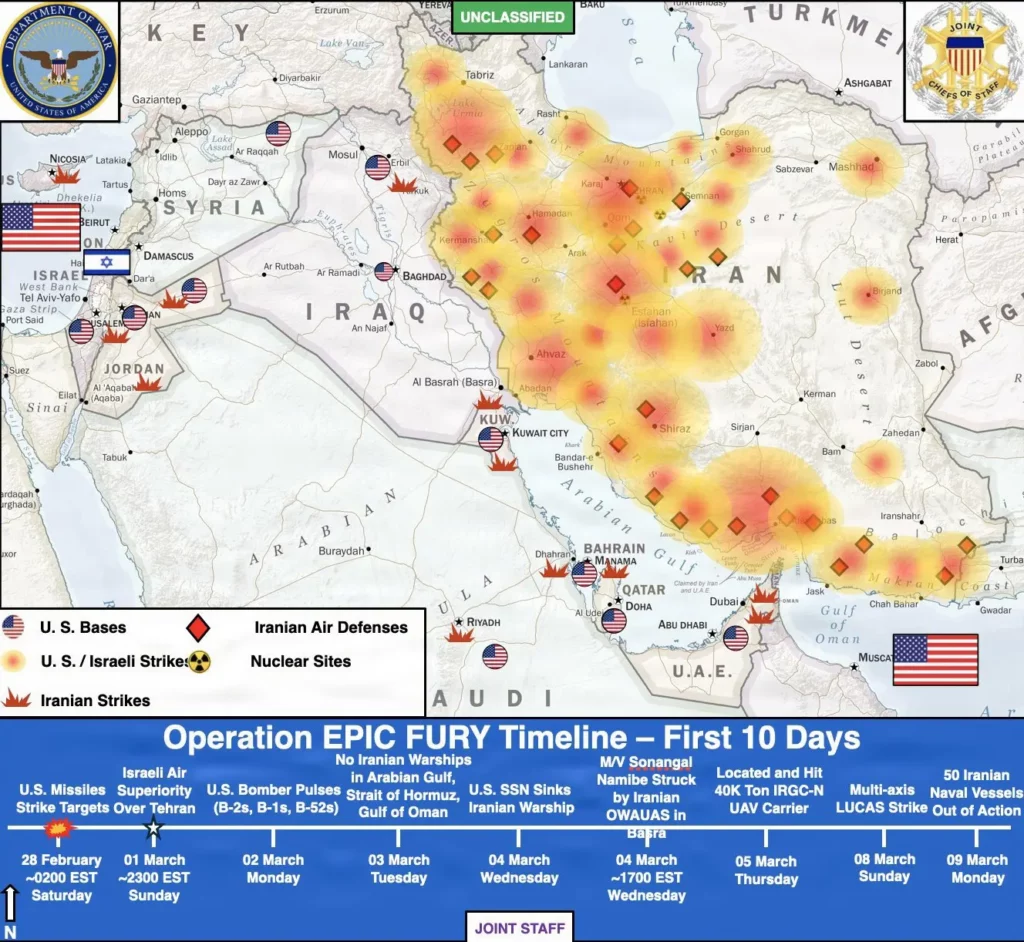
A map detailing the first 10 days of Operation Epic Fury (Source: U.S. Central Command)
The U.S. military announced Tuesday, March 10, it destroyed 16 Iranian mine-laying vessels near the Strait of Hormuz. The action followed a direct warning from President Trump on Truth Social: “If Iran has put out any mines in the Hormuz Strait, and we have no reports of them doing so, we want them removed, IMMEDIATELY! If for any reason mines were placed, and they are not removed forthwith, the Military consequences to Iran will be at a level never seen before.”
Secretary Hegseth said the U.S. would not allow what he called “terrorists” to hold the strait hostage. Roughly a fifth of the world’s globally consumed oil passes through the narrow waterway between Oman and Iran. The conflict has essentially closed the strait to tanker traffic and upended global energy markets.
Iranian Attacks in Sharp Decline
CENTCOM stated Wednesday morning, March 11, that Iranian ballistic missile and drone attacks have dropped drastically since the first 24 hours of Operation Epic Fury; a significant indicator of degraded Iranian launch capacity after 12 days of sustained strikes on missile production facilities, launch sites, and command infrastructure.
Screenshot of March 11, 2026, post on X by U.S. CENTCOM
That said, attacks have not stopped entirely. Saudi Arabia’s defense ministry confirmed it intercepted and destroyed six ballistic missiles launched toward Prince Sultan Air Base, which hosts U.S. troops, and destroyed drones heading toward the kingdom’s eastern region. Kuwait’s National Guard said it downed eight drones, with forces on high alert in coordination with the army, police, and other agencies. Two drones fell near Dubai International Airport, injuring four people, though air traffic continued normally.
Israel Strikes Hezbollah, Thwarts Drone Launch in Iran
Israel’s military completed another wave of strikes on Hezbollah command centers and weapons storage sites in Beirut’s southern suburbs, and struck a Hezbollah command post in the Tyre area of southern Lebanon. Separately, Israel Defense Forces (IDF) said it struck a drone launch squad in western Iran on Monday, minutes before the squad was set to launch drones toward Israel.
Prime Minister Netanyahu issued a direct public appeal to the Iranian people Tuesday, calling the war a “once in a lifetime opportunity” to remove the country’s clerical leadership. “In the coming days we will create the conditions for you to grasp your destiny,” he wrote on X. “Your dreams will become a reality. When the time is right, and that time is fast approaching, we will pass the torch to you. Be ready to seize the moment.”
Iranian Women’s Soccer Team Members Granted Asylum in Australia
Australia’s Home Affairs Minister Tony Burke confirmed that two additional members of Iran’s women’s soccer delegation – one player and one staff member – were granted humanitarian visas, bringing the total to seven team members allowed to remain in Australia. The women had sought protection after refusing to sing Iran’s national anthem during a match held in Australia when the war broke out. Iranian state television subsequently labeled them “traitors,” raising serious concerns about their safety if they returned home.
Iran Conflict Update: Week One Ends With 3,000 Targets Struck, Fallen Americans Return Home
March 7, 2026, at 4:20 AM
As Operation Epic Fury completes its first week, the strategic picture has shifted decisively: Iran issued an apology to its Gulf neighbors (pledging to stop attacking them even as drone and missile strikes continue), Israel continues to systematically dismantle Iran’s missile production and air defense infrastructure, and the remains of American service members killed in Kuwait have arrived home at Dover Air Force Base.
Dignified Transfer at Dover
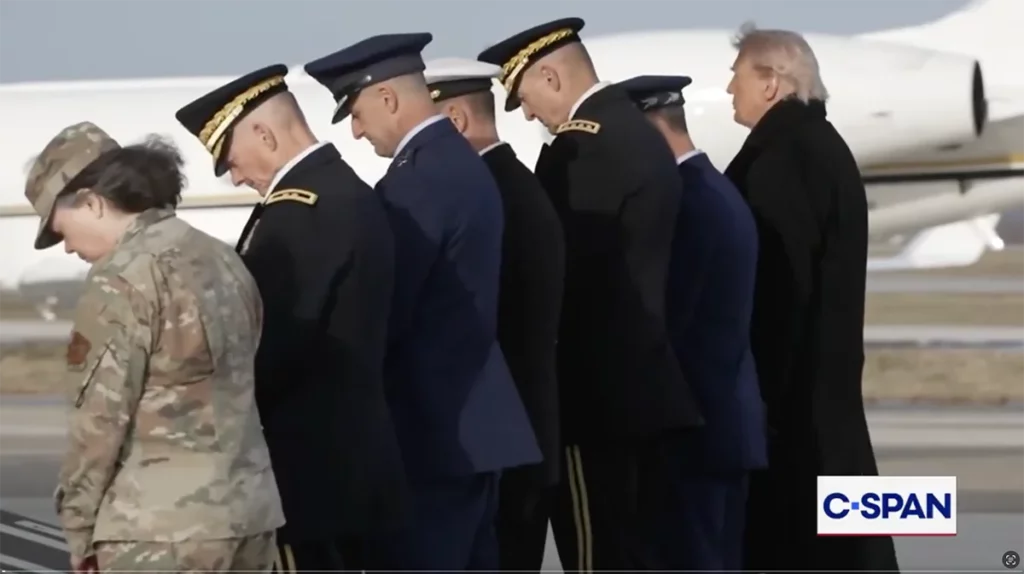
A military aircraft carrying the remains of U.S. service members killed in the Middle East arrived March 7 at Dover Air Force Base in Delaware. President Trump, Secretary of War Pete Hegseth, Joint Chiefs of Staff Chair Gen. Dan Caine, Vice President Vance, and other senior administration officials attended the dignified transfer ceremony, the formal military ritual in which fallen service members are returned to American soil.
President Trump, Defense Secretary Pete Hegseth, Joint Chiefs of Staff Chair Gen. Dan Caine and others participate in dignified transfer at Dover Air Force Base of two Iowa National Guardsmen and an American civilian interpreter killed in Syria. (Source: X @CSPAN)
CENTCOM: Over 3,000 Targets Struck in Week One
U.S. Central Command issued a blunt assessment of the operation’s first seven days: “U.S. forces have struck over 3,000 targets in the first week of Operation Epic Fury, and we are not slowing down.”
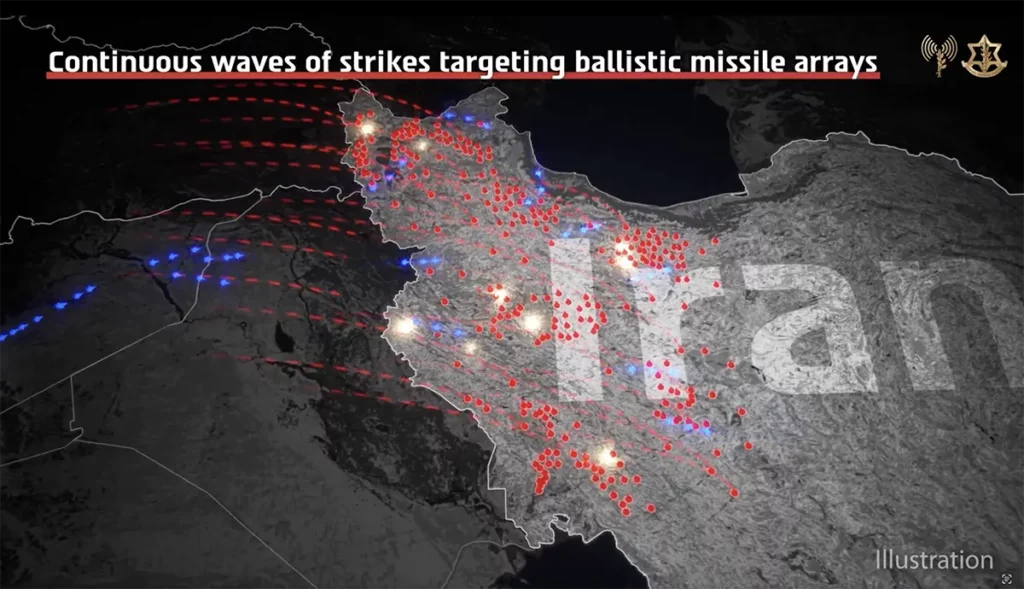
The Israel Defense Forces (IDF) separately detailed the scope of Israeli strikes against Iran’s missile infrastructure over the same period:
(Source: IDF via X @TheConsultant18)
Two main ballistic missile production sites struck at Parchin and Shahrud
Factories producing explosive materials for ballistic missile warheads
Complexes producing raw materials for missile engines
A missile engine mixing and casting facility
A complex used for research, development, assembly, and production of advanced cruise missiles
The IRGC Air Force air defense situation room – responsible for Iran’s aerial situational awareness and airspace defense – dismantled
16 IRGC Quds Force aircraft used to transfer weapons to Hezbollah struck at Mehrabad Airport in Tehran, along with several Iranian fighter jets
Additional air defense systems, command centers, storage facilities, and ballistic missile launch sites struck
The strikes at Mehrabad Airport are significant. Mehrabad has served as a central hub through which the IRGC armed and funded proxy forces across the Middle East for decades. Its targeting signals a deliberate effort to sever Iran’s logistical lifeline to Hezbollah, the Houthis, and other regional proxies, not just degrade Iran’s direct military capability.
Iran’s Warship: Crew Was Warned, Commander Refused to Evacuate
An Iranian sailor killed when the warship IRIS Dena was struck by a U.S. submarine reportedly called his father shortly before impact, relaying that American forces had issued two warnings for the crew to abandon the vessel. The warship’s commander refused to allow evacuation despite the imminent threat. Some crew members argued with the commander. The 32 survivors were predominantly sailors who defied orders and escaped on lifeboats on their own initiative.
The account raises direct questions about command decisions that cost the lives of the majority of the vessel’s 180-person crew.
In a related development, an internal U.S. State Department cable dated March 6 shows the U.S. urged Sri Lankan authorities not to return the 32 surviving Dena sailors or the 208 sailors Sri Lanka rescued from a second Iranian naval vessel, the auxiliary ship IRIS Booshehr.
Trump Declares Iran “The Loser of the Middle East”
On Saturday, March 7, Iranian President Masoud Pezeshkian apologized for attacks on “neighboring countries” and pledged to cease attacks on Gulf states even as missile and drone attacks continued. President Trump addressed the development directly:
White House post on X
CENTCOM Calls Out Iranian Disinformation
CENTCOM issued a pointed public statement mocking Iranian state media’s claims about the USS Abraham Lincoln aircraft carrier: “First the Iranian regime claimed and re-claimed — five days in a row — that it sank USS Abraham Lincoln. Now, the regime claims the aircraft carrier has miraculously resurfaced and ‘left the battlefield’ after ‘encountering Iranian missiles and drones.’ NEED WE SAY MORE?” The Abraham Lincoln has not been struck.
Coalition Coordination: Bahrain, UK, and U.S. Hold Defense Talks
On March 5, senior defense officials from Bahrain, the United Kingdom, and the United States held a virtual meeting under the Comprehensive Security Integration and Prosperity Agreement framework. Participants included Bahrain’s National Security Advisor, UK Chief of the Defence Staff Air Chief Marshal Sir Richard Knighton, and CENTCOM Commander Adm. Brad Cooper. The meeting addressed the regional security environment and “the Iranian regime’s deliberate aggression and attacks on innocent civilians across the Middle East.” The UK’s participation signals that the coalition responding to Iran is broadening beyond its initial U.S.-Israeli core.
Iran Conflict Update: War Spreads Across 15 Nations and American Death Toll Rises
March 5, 2026, at 1:15 PM
Six days into Operation Epic Fury, the conflict has continued to expland to the Strait of Hormuz, Cyprus, Turkey, Oman, Azerbaijan, and the Indian Ocean. The American death toll has risen, as has the casualty count across a number of other countries targeted by Iran, and President Trump has declared he intends to personally shape who leads Iran next.
American Casualties: Six Soldiers Killed in Kuwait
The U.S. death toll from the conflict has risen to at least six service members killed in Kuwait alone, all assigned to the 103rd Sustainment Command based in Des Moines, Iowa. The Department of War first identified four service members killed, followed by a later announcement identifying a fifth soldier:
Capt. Cody A. Khork
Sgt. 1st Class Noah L. Tietjens
Sgt. 1st Class Nicole M. Amor
Sgt. Declan J. Coady
Maj. Jeffrey R. O’Brien
All five died Sunday, March 1, at Port Shuaiba, Kuwait, in an unmanned aircraft system attack on an operations center located at a civilian port more than 10 miles from the main Army base. The Pentagon separately announced that Chief Warrant Officer 3 Robert M. Marzan is believed to be a sixth soldier who perished at the scene, pending positive identification by a medical examiner.
Iranian Strikes: Embassies, Data Centers, Oil Infrastructure, and Residential Areas
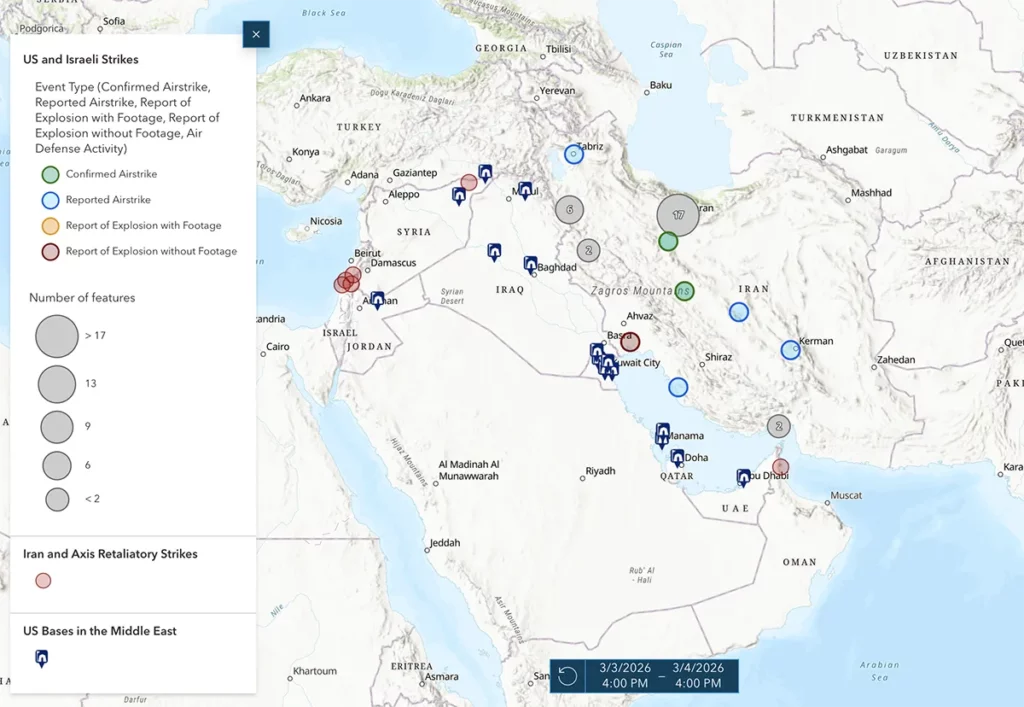
The target set Iran has pursued over six days goes well beyond military installations:
Screenshot of Interactive Map: U.S. and Israeli Strikes on Iran, March 3–4, 2026 (Source: Institute for the Study of War
Saudi Arabia: On March 3, Iran struck the U.S. Embassy in Riyadh with two drones, causing limited fire and minor damage, a direct attack on American diplomatic soil in the Arab world’s most powerful capital.
United Arab Emirates (UAE): An Iranian drone struck a parking lot outside the U.S. consulate in Dubai, sparking a small fire, confirmed by Secretary of State Rubio. Iran also targeted two Amazon data centers in the UAE. Three foreign civilians have been killed – workers from Nepal, Bangladesh, and Pakistan – and at least 68 people injured.
Qatar: Iran struck energy facilities in Qatar. Qatar’s Ministry of Defense confirmed that two ballistic missiles were launched, with one hitting Al-Udeid Qatari Base directly, the same installation that serves as the forward headquarters of U.S. Central Command.
Bahrain: Amazon confirmed a drone struck near one of its data centers in Bahrain. One civilian, an Asian worker, was killed by a fire set by a strike on Monday, March 2.
Kuwait: At least eight people have died, including one migrant worker killed in a strike that injured 32 others and an 11-year-old girl killed by shrapnel in a residential area of Kuwait City. The U.S. Embassy compound in Kuwait was struck on Monday, March 2. On Tuesday, it announced it was closing to the public until further notice.
Iraq: Multiple drones targeted areas around the U.S. consulate in Baghdad without hitting it directly. Protesters attempted to storm the U.S. Embassy on Sunday, March 1. Iraq’s Ministry of Oil announced it would halt production at a key oil field due to disruptions in the Strait of Hormuz.
Jordan: Five people were injured by falling shrapnel after Iranian projectiles were intercepted in Jordanian airspace.
Syria: Several people, including children, suffered minor injuries outside Damascus from Iranian missile debris.
Oman: An Indian mariner was killed off the coast of Muscat when a bomb-carrying drone boat exploded against an oil tanker. Four more mariners were injured Sunday when their vessel came under attack in the Strait of Hormuz.
Cyprus: A British Royal Air Force (RAF) base, Akrotiri, on the Mediterranean island came under attack by a Shahed-type unmanned aerial vehicle at 12:30 a.m. on the morning of March 2, causing minor damage but extending the conflict into European-adjacent territory for the first time. RAF jets were later reported to have shot down Iranian drones over Jordan on the evening of March 3.
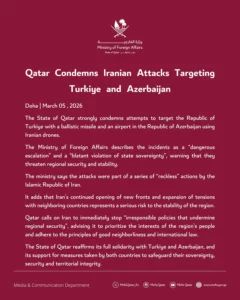
Qatar Condemns Iranian Attacks Targeting Turkiye and Azerbaijan, March 5, 2026 (Source: X @MofaQatar_EN)
Turkey: NATO air defense systems intercepted a ballistic missile launched from Iran heading toward Turkish airspace. Defense Secretary Hegseth said there was “no sense” the intercept would trigger NATO’s Article 5 collective defense clause. Iran denied firing any missile toward Turkey, stating it “respects the sovereignty of Turkiye.”
Azerbaijan: Azerbaijan’s Foreign Ministry accused Iran of drone strikes on its exclave of Nakhchivan, with one drone crashing near the airport and another near a school, injuring two civilians.
Strait of Hormuz and Maritime Attacks
Iran’s Revolutionary Guard claimed it struck a U.S. oil tanker in the northern Persian Gulf, setting the vessel on fire. Maritime security agency Vanguard said the attack appeared to have actually hit the Bahamas-flagged vessel Sonangol Namibe off the coast of Kuwait. Iraq’s Ministry of Oil confirmed it was halting production at a key oil field due to Strait of Hormuz disruptions — the first confirmed impact on regional oil output from the conflict.
Senate Rejects War Powers Resolution
The U.S. Senate voted 47-53 to defeat a Democratic war powers resolution that sought to block President Trump from using further military force against Iran. The vote came amid the administration’s shifting justifications for the conflict and warnings of more American casualties ahead, and effectively secures the White House’s authority to continue and expand operations without congressional constraint.
Trump: “I Have to Be Involved” in Choosing Iran’s Next Leader
President Trump acknowledged that Mojtaba Khamenei – son of the late Supreme Leader – is the most likely successor to lead Iran, and declared that outcome unacceptable. “Khamenei’s son is a lightweight. I have to be involved in the appointment, like with Delcy in Venezuela,” Trump said, drawing a direct parallel to his administration’s role in shaping Venezuela’s political transition. “We want someone that will bring harmony and peace to Iran.”
The Supreme Leader of Iran is a position that by the Islamic Republic’s own constitution is determined by an internal clerical body.
State Department Evacuations
The State Department reported it has assisted over 10,000 Americans abroad in departing 14 countries within the Middle East as the conflict’s geographic reach continues to expand. Assistant Secretary of State for Global Public Affairs Dylan Johnson stated today, March 5, that “nearly 20,000 American citizens have safely returned to the United States from the Middle East” since February 28.
Israeli Strike Kills Hamas Official in Lebanon
Israel Defense Forces reported that the Israeli Navy struck killed senior Hamas official Wassim Atallah al-Ali at his home in a pre-dawn strike in the Beddawi Palestinian refugee camp near Tripoli. It is the first reported targeted killing of a Hamas member since the U.S.-Israeli strikes on Iran triggered the broader regional war.
U.S.-Israel War With Iran: First American Casualties Confirmed, Khamenei Killed
March 1, 2026, at 12:00 PM
The conflict between the United States, Israel, and Iran entered its second day Sunday with a series of developments that mark a fundamental turning point: the first confirmed American combat deaths of the operation, the killing of Iran’s Supreme Leader, and Iranian strikes extending into a second consecutive day across Gulf nations.
First American Casualties
U.S. Central Command (CENTCOM) issued a statement Sunday morning confirming the operation’s first American deaths:
“As of 9:30 am ET, March 1, three U.S. service members have been killed in action and five are seriously wounded as part of Operation Epic Fury. Several others sustained minor shrapnel injuries and concussions — and are in the process of being returned to duty. Major combat operations continue and our response effort is ongoing.”
CENTCOM withheld the identities of the fallen pending next-of-kin notification, stating information would be released 24 hours after families are notified. The three service members are the first reported American fatalities since the operation launched Saturday morning.
President Trump had acknowledged this possibility directly in his announcement address: “The lives of courageous American heroes may be lost, and we may have casualties. That often happens in war, but we’re doing this not for now. We’re doing this for the future.”
Khamenei Confirmed Dead
It was confirmed Saturday evening that Iranian Supreme Leader Ali Khamenei, the man who has led the Islamic Republic since 1989, was killed in the day’s airstrikes.
The confirmation follows a cascade of senior leadership losses reported Saturday. Israel Defense Forces (IDF) spokesperson Effie Defrin confirmed the deaths of Islamic Revolutionary Guard Corps (IRGC) commander Mohammad Pakpour, Iran’s Defense Minister Amir Nasirzadeh, Supreme Leader adviser Ali Shamkhani, and Iranian Armed Forces Chief of Staff Mohammad Bagheri; all killed in a single Israeli strike in Tehran. It was further reported that four senior Iranian intelligence commanders had been killed: the heads of the foreign intelligence, security, and counterterrorism units, and an adviser on the war with Israel. A member of the Tehran City Council stated that Khamenei’s son-in-law and daughter-in-law were also killed in the strikes.
Former Iranian President Mahmoud Ahmadinejad and several close associates and bodyguards were reportedly killed in a separate Israeli airstrike on Tehran.
In a single day, Israel appears to have decapitated the senior military, intelligence, and political leadership of the Iranian regime simultaneously.
Iran Strikes for a Second Day
Iran continued missile and drone strikes across the Gulf on Sunday, March 1. Missile strikes against Israel are estimated at over 200 with over a dozen drone strikes, and an estimated 9 civilian deaths. An Iranian drone struck an Abu Dhabi naval base hosting French forces, causing a fire but no casualties, according to the UAE’s defense ministry. The base, known as Camp de la Paix, is Emirati but hosts French forces at the UAE’s invitation, meaning Iran has now directly struck military assets belonging to a permanent member of the UN Security Council.
The United Arab Emirates (UAE) Ministry of Defense provided the following update this morning: UAE air force and air defense forces have dealt with 165 ballistic missiles, two cruise missiles, and 541 Iranian drones to date. These attacks have resulted in deaths of three individuals of Pakistani, Nepalese, and Bangladeshi nationalities.
The Army General Staff Headquarters of Kuwait stated that the Air Defense Force had engaged 97 ballistic missiles and 283 drones. Qatar is reported to have successfully intercepted 66 ballistic missiles and 12 droneswhile reports for Jordan estimate 13 missiles and 36 drones.
Iranian missile strikes also continued in Bahrain. The Bahrain Defense Force announced it effectively countered “45 missiles and 9 drones, including Shahed 136-type drones.” The U.S. Embassy in Manama issued a security alert confirming the Crowne Plaza Hotel in the capital was struck on March 1, resulting in injuries, and warned American citizens that hotels may be continual targets.
Oman, which has served as a mediator between Washington and Tehran, reported two drone strikes on the commercial port of Duqm with one wounding a foreign worker. Oman condemned the attacks and pledged to take all necessary measures to protect its security.
Gulf Civilian Infrastructure Under Strain
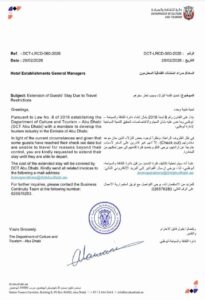
Memo circulating online reportedly from Abu Dhabi’s Department of Culture and Tourism regarding “Extension of Guests’ Stay Due to Travel Restrictions”
Abu Dhabi’s Department of Culture and Tourism (DCT) reportedly issued a directive Sunday ordering all hotels in the emirate to extend the stays of guests unable to travel due to the conflict, with the government covering all associated costs. The order has yet to be verified by DCT but reflects the practical reality now settling across Gulf capitals: this conflict is not a single-night event, and civilian infrastructure – airports, hotels, transit corridors – is operating under active threat.
The International Response
French President Emmanuel Macron, posting Saturday, February 28, called the outbreak of war between the U.S., Israel, and Iran a development carrying “grave consequences for international peace and security,” adding that “the ongoing escalation is dangerous for all. It must stop.” He called on the Iranian regime to engage in good-faith negotiations to end its nuclear and ballistic programs. Macron has not yet made a statement regarding the attack on the French base.
A protester was captured setting fire near a gate leading to the U.S. Consulate during a violent protest against the United States and Israel’s attack on Iran, in Lahore, and locals were seen storming the entrance area of the U.S. Consulate in Karachi, Pakistan, eventually setting a guard house on fire. The violence eventually resulted in the deaths of at least 22 pro-Iran demonstrators after clashes with security forces. A similar scene was unfolding at the U.S. Embassy in Baghdad.
Ursula von der Leyen, President of the European Commission, shared on X that she had just spoken with Saudi Arabia’s Crown Prince Mohammed bin Salman. She stated, “You can count on our full support in these turbulent times. The European Union–Gulf Cooperation Council partnership will only get stronger in the period ahead,” a message that mirrored previous posts regarding similar conversations with the leaders of Qatar, Jordan, and the UAE.
U.S. and Israel Strike Iran, Triggering Gulf-Wide Missile Retaliation From Tehran
February 28, 2026, 12:44 PM
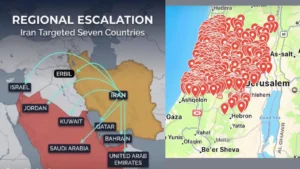
L: Targets of Iran’s retaliation as of February. 28, 2026; R: alerts after the IDF detects incoming missile attacks from Iran on February 28 at 2:47 p.m. Israel Standard Time (7:46 a.m. EST)
In the early hours of Saturday, February 28, Israel and the United States launched a major coordinated military offensive against Iran, striking targets across Tehran and multiple other Iranian cities in what Israeli officials are calling “Operation Roaring Lion.” President Trump simultaneously announced “major combat operations,” referred to as “Operation Epic Fury,” and called on the Iranian people to “seize control of your destiny.”
The Strike: Targeting Leadership, Not Just Infrastructure
The Israeli military spent months preparing its campaign of simultaneous airstrikes targeting senior Iranian political and military officials at several locations in Tehran. The plan included a major intelligence effort to “identify an operational opportunity at the moment when senior regime officials would convene,” the military said. A decision was made to strike in the morning, at approximately 8:15 a.m. Israel Standard Time (1:15 a.m. EST) rather than at night, and the army said it succeeded in “achieving tactical surprise for the second time,” referring to its strikes during the June 2025 war.
Intelligence officers spent thousands of hours compiling targets and conducted research “in parallel with precise location tracking of Iranian commanders and senior leadership,” the military said. It added that U.S. confidence in Israel’s “intelligence and operational capabilities” was a significant factor in Washington’s decision to join the operation.
This marks a significant tactical departure. Every previous Israeli strike on Iran — in June 2025 and October 2024 — came under cover of darkness. Saturday’s strike came in daylight, because the target was not infrastructure. It was a gathering.
According to a senior Israeli official, Iranian Supreme Leader Ali Khamenei and President Masoud Pezeshkian were targeted in Saturday’s joint U.S.-Israel attack. The official noted military forces also focused on taking out “those responsible for commanding the mass murder of Iranian protesters.” It’s been reported that Iran’s Defence Minister Amir Nasirzadeh and Iranian Revolutionary Guards commander Mohammed Pakpour were killed in Israeli attacks, but damage assessments will come out later.
The fate of Khamenei remains the most consequential unknown. It wasn’t immediately clear whether the 86-year-old leader was in his offices at the time of the strike. One source reported that Khamenei was not in Tehran and had been transferred to a secure location. During the 12-day war in June 2025, he was believed to have been taken to a secure location away from his Tehran compound. Khamenei has not made a public appearance in recent days.
If he was moved before the strike, it means someone inside Tehran’s inner circle provided Jerusalem with the meeting’s time and location, which is a remarkably high-level intelligence penetration. If he survived inside the building, the strike hit the room and failed to kill him. Either scenario represents a catastrophic breach of the regime’s operational security.
First publicly released satellite image of Ayatollah Ali Khamenei’s compound in Tehran, generally used as his official residence. (Source: X @trbrtc | Christiaan Triebert)
Satellite imagery also shows destruction at the compound of Iran’s Supreme Leader Ali Khamenei in Tehran following the airstrike.
The Scope of the Operation
In addition to the capital Tehran, the cities of Isfahan, Qom, Karaj, and Kermanshah were targeted. Blasts were reported across several cities including Tehran, Tabriz, Qom, Karaj, Khorramabad, Kermanshah, Ilam, and others. Iran’s Supreme Leader’s office in Tehran was targeted, and Iran closed its airspace for six hours.
On the American side, the operation extended well beyond air power. According to a U.S. official, the U.S. launched dozens of Tomahawk cruise missiles from warships positioned in the region, with American fighter aircraft also involved. The official added that the campaign will likely be measured in “days not hours,” indicating that Saturday’s strikes are the opening phase of a larger, coordinated operation, not a single-night event.
The Israel Defense Forces (IDF) confirmed the Israeli Air Force is conducting a broad strike on a number of military targets belonging to the Iranian regime in western Iran. Israel’s “Operation Roaring Lion” aims to fundamentally strike the Iranian terror regime and remove existential threats to the State of Israel for the long term. Officials stated that Israel is targeting Iranian leadership, while the U.S. is targeting military targets and ballistic missile sites that pose an “imminent threat.”
Israeli forces struck multiple Iranian strategic air defense systems in western Iran, including an advanced SA-65 installation in the Kermanshah area. (Source: Israel Defense Forces, X @IDF)
Israel Puts Its Civilian Population on War Footing
At 1:25 a.m. local time – hours before most Israelis were awake – the IDF posted the following message signaling the country was shifting to wartime civilian posture:
“Following a situational assessment, it was determined that as of today (Saturday), at 08:00, immediate changes will be made to the Home Front Command Guidelines. As part of the changes, it was decided to shift all areas of the country from Full Activity to Essential Activity. The guidelines include: a prohibition on educational activities, gatherings, and workplaces, except for essential sectors. The public is required to follow the guidelines published on the official Home Front Command channels. Full guidelines will be updated on the National Emergency Portal and the Home Front Command app.”
Under the new measures, all schools, universities, youth programs, and private classes were suspended across the country. Public gatherings of any size were banned, and most workplaces required to remain closed. Only critical sectors such as hospitals, emergency services, utilities, security forces, and essential food supply operations are permitted to continue. The guidelines are in effect until at least 8 p.m. on Monday evening.
The timing of this announcement, posted in the middle of the night before the strikes began, reflects the preparation timeline behind the operation. Israel had prepared its civilian population for retaliation before the first bomb fell.
Trump’s Address to the Nation
In an eight-minute address announcing the operation, President Trump laid out the historical case for the strikes:
President Trump announcing operation in Iran (Source: X @WhiteHouse)
“For 47 years, the Iranian regime has chanted ‘Death to America’ and waged an unending campaign of bloodshed and mass murder, targeting the United States, our troops, and the innocent people in many, many countries.
“Among the regime’s very first acts was to back a violent takeover of the US embassy in Tehran, holding dozens of American hostages for 444 days.
“In 1983, Iran’s proxies carried out the marine barracks bombing in Beirut that killed 241 American military personnel. In 2000, they knew and were probably involved with the attack on the USS Cole. Many died. Iranian forces killed and maimed hundreds of American service members in Iraq…
“It’s been mass terror, and we’re not going to put up with it any longer. From Lebanon to Yemen and Syria to Iraq, the regime has armed, trained, and funded terrorist militias that have soaked the earth with blood and guts.
“And it was Iran’s proxy Hamas that launched the monstrous October 7th attacks on Israel, slaughtering more than 1,000 innocent people, including 46 Americans, while taking 12 of our citizens hostage. It was brutal, something like the world has never seen before.
“Iran is the world’s number one state sponsor of terror and just recently killed tens of thousands of its own citizens on the street as they protested.”
In a separate statement, Trump acknowledged the potential cost directly: “The lives of courageous American heroes may be lost, and we may have casualties. That often happens in war, but we’re doing this not for now. We’re doing this for the future. And it is a noble mission.”
Iran Retaliates Across the Gulf
The Islamic Republic of Iran’s Foreign Ministry put out a statement on X, “Our sacred and beloved homeland, proud and civilization-making Iran, has once again been subjected to criminal military aggression by the #UnitedStates and the #ZionistRegime.”
Clouds of black smoke billow from the U.S. Navy’s 5th Fleet Headquarters at Naval Support Activity Bahrain in Juffair, a major district in Manama, Bahrain (Source: X @sentdefender | OSINTdefender)
Iran’s physical response was unprecedented in its geographic scope, firing ballistic missiles not only at Israel, but at multiple Gulf states simultaneously hosting U.S. military assets.
Bahrain: Bahrain said the service center of the U.S. Fifth Fleet was subjected to a missile attack. The U.S. embassy in Bahrain’s capital, Manama, issued a security alert warning of “imminent drone/missile attack in Bahrain.”
Qatar: Qatar’s Ministry of Defense released a statement: “The State of Qatar expresses its strong condemnation of the targeting of Qatari territory with Iranian ballistic missiles, considering it a flagrant violation of its national sovereignty.” Qatar’s Foreign Ministry said it reserves its “full right” to defend itself after what it described as Iranian aggression targeting Qatari territory.
United Arab Emirates (UAE): In the UAE, “the Ministry of Defence announced that the country was subjected to a blatant attack by Iranian ballistic missiles, which was dealt with by the UAE air defenses with high efficiency and a number of missiles were successfully intercepted.” The UAE’s Ministry of Defence also stated, “Authorities in the UAE also handled the fall of some missile debris in a residential area which resulted in some material damage. The fallen debris also resulted in one civilian death of an asian nationality.” It’s been reported that an Iranian ballistic missile or debris from interception hit the Palm Hotel & Resort in Dubai.
Official Ministry Statements
1 of 3
State of Qatar Ministry of Foreign Affairs Statement (Source: X @MofaQatar_ En)
Kingdom of Saudi Arabia Ministry of Foreign Affairs Phone Call With Kuwaiti Foreign Minister (Source: X @KSAmofaEN)
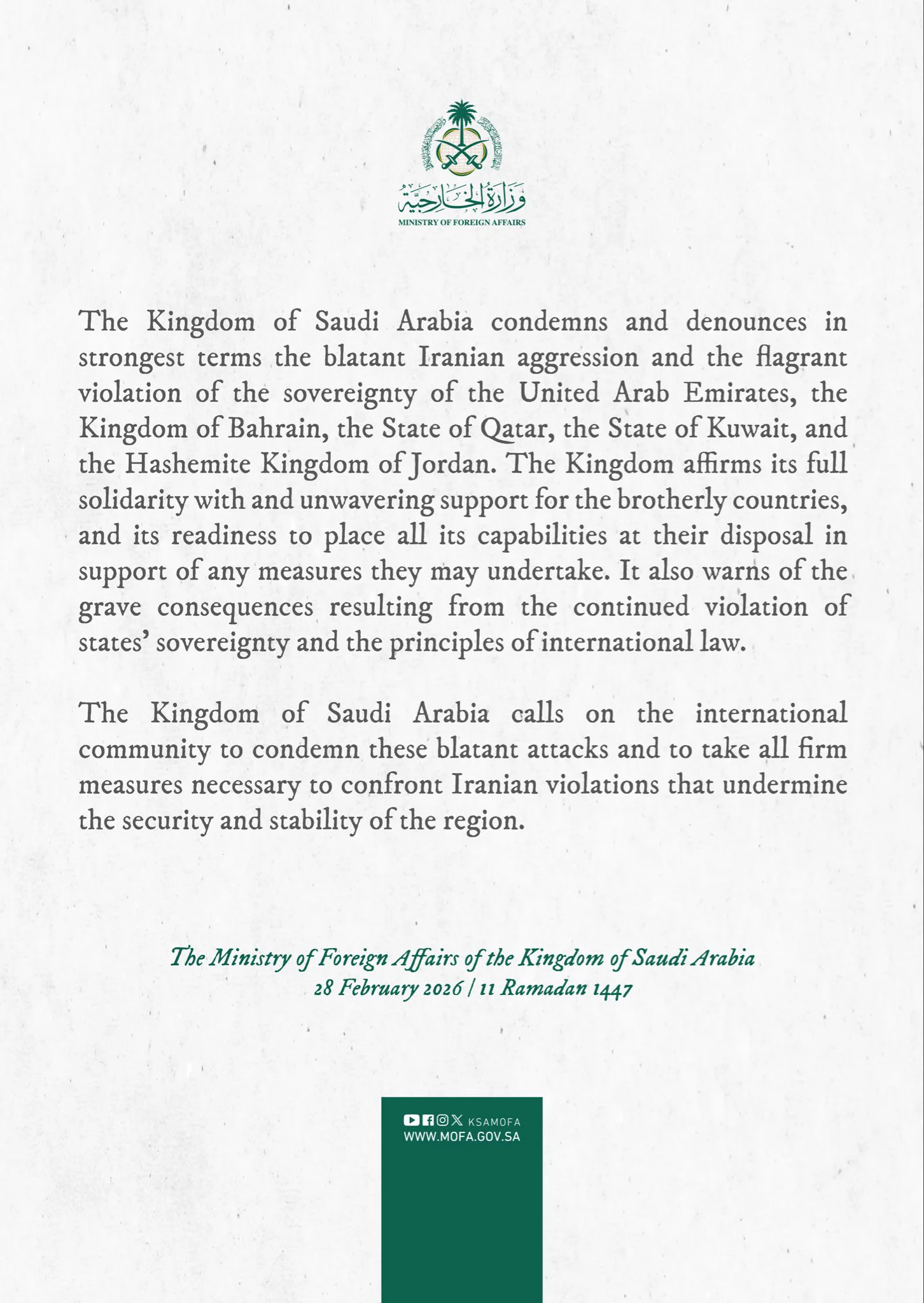
Kingdom of Saudi Arabia Ministry of Foreign Affairs Statement (Source: X @KSAmofaEN)
Kuwait: Kuwait, which has positioned itself as a neutral mediator through every Gulf crisis since 1991, just had Iranian ballistic missiles targeting its military bases and potentially its civilian airport. The Kuwaiti Army’s official spokesperson, Colonel Saud Abdulaziz Al-Otaibi, issued a formal statement: Ali Al-Salem Air Base – a major installation that hosts U.S. and coalition forces – came under direct ballistic missile attack. The Kuwaiti Air Defense Force intercepted the missiles, with fragments and debris from the interception falling in the vicinity of the base. Social media reports indicate a possible Iranian drone strike at Kuwait International Airport, though this has not been confirmed by official Kuwaiti sources.
Jordan: Two Iranian ballistic missiles were shot down by the Jordanian military, confirmed directly by the Jordanian armed forces. Jordan intercepted Iranian missiles in June 2025 as well but that was in defense of Israel. This time, Iran targeted Jordan itself.
The strategic consequences of Iran’s retaliation are difficult to overstate. In a single morning, Tehran fired ballistic missiles across the sovereign territory of nations that had not attacked it: countries that had, in many cases, spent years maintaining careful neutrality or even quiet diplomacy with Iran. Every nation whose airspace was violated now has legal and political justification to join whatever coalition forms next.
Saudi Arabia: Just four weeks ago, the kingdom brokered careful distance from the conflict, with the Crown Prince personally calling the Iranian President to warn that Saudi territory would not be used for attacks against Iran. That posture collapsed Saturday with reported impacts and explosions in Riyadh.
The Saudi Ministry of Foreign Affairs released a statement condemning what it called the “blatant Iranian aggression,” calling missile strikes on Gulf neighbors a “flagrant violation of sovereignty,” and pledging “full solidarity” with every attacked nation as well as placing “all its capabilities” in support of whatever measures those nations choose to take.
Iraq: “The international coalition forces successfully intercepted and downed several missiles and explosive-laden drones over Erbil,” counterterrorism forces in Iraq’s autonomous Kurdistan region said in a statement.
Iran fired at everyone and converted its last diplomatic relationships in the Gulf into potential adversaries in a single morning.
The Asymmetry
The operational contrast between the two sides’ strikes is stark. Israel spent months building intelligence on a single high-value gathering, struck in daylight to achieve surprise against an air defense doctrine built around nighttime attacks, and hit what it aimed at. Reports indicate that Israel may have destroyed a significant portion of Iran’s ballistic missile launchers.
Iran’s retaliation, fired across at least eight countries, appears to have resulted in intercepted or neutralized missiles across nearly every target country, with minimal reported damage to U.S. military assets and no reported American casualties among the tens of thousands of U.S. troops in theater.
One side hit what it aimed at; the other side hit one civilian with debris across six countries. That asymmetry will define what comes next.
Megan Norris possesses a unique combination of experience in writing and editing as well as law enforcement and homeland security, which led to her joining Homeland Security Today staff in January 2025. She founded her company, Norris Editorial and Writing Services, following her 2018 retirement from the Federal Air Marshal Service (FAMS), based on her career experience prior to joining the FAMS. Megan worked as a Communications Manager – handling public relations, media training, crisis communications and speechwriting, website copywriting, and more – for a variety of organizations, such as the American Red Cross of Greater Chicago, Brookdale Living, and Advocate Illinois Masonic Medical Center. Upon becoming a Federal Air Marshal in 2006, Megan spent the next 12 years providing covert law enforcement for domestic and international missions. While a Federal Air Marshal, she also was selected for assignments such as Public Affairs Officer and within the Taskings Division based on her background in media relations, writing, and editing. She also became a certified firearms instructor, physical fitness instructor, legal and investigative instructor, and Glock and Sig Sauer armorer as a Federal Air Marshal Training Instructor. After retiring from FAMS, Megan obtained a credential as a Certified Professional Résumé Writer to assist federal law enforcement and civilian employees with their job application documents. In addition to authoring articles, drafting web copy, and copyediting and proofreading client submissions, Megan works with a lot of clients on résumés, cover letters, executive bios, SES packages, and interview preparation. As such, she presented “Creating Effective Job Application Documents for Female Law Enforcement and Civilian Career Advancement” at the 2024 Women in Federal Law Enforcement (WIFLE) Annual Leadership Conference in Washington, DC, and is a regular contributor to WIFLE's Quarterly Newsletter. She also serves as Chief of Staff for growth[period], a global consulting firm specializing in business development, transaction advisory services, global risk management, and executive recruiting in the commercial and federal markets, and as Senior Director of Career Services for ESGI Potomac, the executive recruiting subsidiary of growth[period]. Megan holds a Master of Science in Integrated Marketing Communications from Roosevelt University in Chicago, and a Bachelor of Arts in English/Journalism with a minor in Political Analysis from Miami University, Oxford, Ohio.






 The strike came one day after Trump threatened to bomb Iran “back to the stone ages” if a deal was not reached, and signals an expanding target set beyond military and nuclear assets to include civilian and economic infrastructure.