
Key Takeaways
- The Army relies on “vertical lift systems,” such as helicopters, for reconnaissance and attack missions and to transport troops and equipment on the battlefield. The Army’s fleet of helicopters is aging and, starting in 2019, the Army prioritized funding to improve its vertical lift portfolio.
- However, the Army reprioritized its efforts in 2024. Specifically, the Army canceled one design due to cost concerns and moved funding to other opportunities. For example, it increased investments in drones.
- This Q&A report from the GAO reviews the Army’s decision to shift priorities and its plans to address future capability needs.
What GAO Found
The Army relies on what it calls vertical lift systems, primarily helicopters, to accomplish reconnaissance and attack missions and move troops and equipment to and around the battlefield. In its 2019 modernization strategy, the Army identified developing its Future Vertical Lift portfolio as a priority. This portfolio included two crewed and one uncrewed aircraft.
- Future Attack Reconnaissance Aircraft (FARA)—intended to provide reconnaissance, attack, and aerial security capabilities, and estimated to cost $5.3 billion for development and procurement.
- Future Long Range Assault Aircraft (FLRAA)—a medium-sized assault and utility aircraft that would deliver speed, range, agility, endurance, and sustainability improvements compared to current Black Hawk helicopters.
- Future Tactical Unmanned Aircraft System (FTUAS)—intended to execute reconnaissance operations as a rapidly deployable uncrewed aircraft with vertical take-off and landing capabilities.
The portfolio also included a variety of aircraft to be deployed from larger aircraft and development of an improved turbine engine.
In February 2024, the Army made significant changes to this portfolio. According to Army officials, Army leadership collaborated with officials from the Office of the Secretary of Defense to restructure the portfolio. This restructuring ended the development of FARA, continued investment in FLRAA, and increased investment in FTUAS. In addition, the restructuring increased investment in uncrewed aircraft while delaying production of the improved turbine engine.
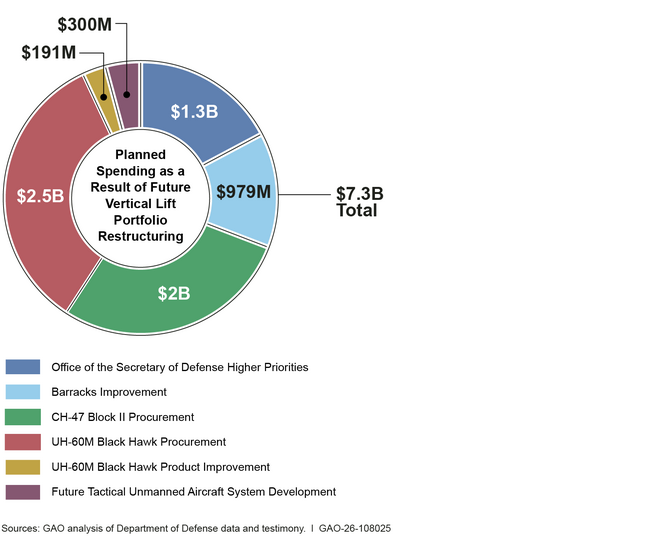
Army budget officials stated that these changes were due to concerns about the long-term affordability of developing and acquiring FARA and FLRAA simultaneously. Army officials stated that the restructuring decision shifted about $7.3 billion in planned spending to other priorities. These priorities included other programs with vertical lift capabilities as well as improvements to Army barracks.
Planned Spending from Fiscal Years 2025 through 2029 as a Result of Future Vertical Lift Portfolio Restructuring
Because of its decision to end development of FARA, the Army reduced planned capabilities for crewed reconnaissance and attack missions. The Army plans to rely on future uncrewed systems for some reconnaissance and attack missions and existing helicopters for attack.
The Army is currently considering further changes to its vertical lift capabilities. In April 2025, the Secretary of Defense announced the Army Transformation Initiative. This Initiative directs the Army to consider changes to both its acquisitions and force structure. As a result, the Army has proposed a number of other changes to its aviation portfolio, including:
- accelerating FLRAA development and fielding,
- accelerating fielding of launched uncrewed aircraft,
- distributing existing vertical lift capabilities across the Army, and
- ending development of FTUAS.
In GAO’s discussions with Army officials, the officials stated that none of these decisions have been finalized and will depend on the outcome of the fiscal year 2026 budget.
Why GAO Did This Study
In 2019, the Army identified six modernization priority areas – including capabilities for Future Vertical Lift – to improve its ability to operate in the modern battlefield. In 2024, the Army made significant changes to the portfolio of vertical lift systems it had been developing.
A Senate Report contains a provision for GAO to review and assess the capabilities affected by the Army’s restructuring decisions and the analyses that informed them. GAO’s report describes the revisions resulting from the restructuring, the reasons for the changes, how the changes impacted programs and vertical lift capabilities, and Army plans to address potential capability gaps.
To identify why the restructuring decision was made, who made it, what analyses may have been used, and potential effects on capabilities, GAO assessed and compared requirements documents preceding and subsequent to the Army’s 2024 restructuring decision, traced funding by analyzing budget documents, and interviewed numerous Army officials. These officials included the Vice Chief of Staff of the Army, officials from the office of the Assistant Secretary of the Army for Acquisitions, Logistics, and Technology; the Army Deputy Chief of Staff for Programs, which is the office responsible for aligning funding to the Army’s acquisition plans; and the Future Vertical Lift Cross-Functional Team, as well as officials from individual vertical lift-related programs.
Read the full GAO report here.