
Federal procurement law gives Native American tribes, Alaska Native Corporations (ANCs), and certain other Native organizations significant contracting preferences. These policies are rooted in the federal government’s treaty and trust obligations to Native communities and are intended to promote economic development, employment, and tribal self-determination. The preferences flow primarily through the Small Business Administration (SBA) 8(a) Business Development Program, federal acquisition regulations, and foundational statutes, including the Alaska Native Claims Settlement Act (ANCSA) of 1971.
- Special Access to the SBA 8(a) Business Development Program
The centerpiece of Native federal contracting is the SBA 8(a) Business Development Program, which helps small, socially and economically disadvantaged businesses access federal contracting opportunities. Also eligible to participate since 1986 are small businesses owned by Alaska Native Corporations, Community Development Corporations, Indian tribes, and Native Hawaiian organizations.
The program provides access to federal set-aside contracts, sole-source contracts (contracts awarded without competition), business development training and technical assistance, and entry into SBA mentor-protégé programs and joint ventures. Participation is structured as a nine-year term divided into a developmental stage and a transition stage.
- Unique Treatment for Tribal and ANC-Owned Companies
Tribal entities and ANCs receive treatment that differs meaningfully from that available to individual small business owners. They are presumed to be economically disadvantaged, which simplifies the eligibility process. More significantly, Alaska Native Corporations, tribally-owned firms, Native Hawaiian organizations, and Community Development Corporations may have multiple 8(a) firms, whereas individual participants are generally limited to one lifetime enrollment. This allows tribes and Native corporations to create multiple subsidiaries in different industries, substantially expanding their contracting footprint.
- Expanded Sole-Source Contracting Authority
One of the most consequential preferences is expanded access to sole-source contracts: awards made directly to a contractor without competitive bidding. Standard 8(a) firms face sole-source caps of $7 million for manufacturing contracts and $4.5 million for all other acquisitions. Tribal and ANC-owned entities are exempt from these thresholds. Congress has extended special procurement advantages to 8(a) ANC firms, including the ability to receive sole-source contracts for any dollar amount, subject to written justification requirements for very large awards. These rules are specifically intended to help Native communities build large, sustainable contracting enterprises.
- Direct Federal Awards Without Competition
Federal agencies can award contracts directly to tribal or ANC-owned 8(a) companies without a competitive procurement process. This streamlines the contracting process, reducing bid protests, shortening procurement timelines, and simplifying negotiations. Direct awards are common in defense logistics, IT services, facilities management, environmental remediation, and construction.
- Counting Toward Federal Small-Business Goals
Contracts with Native-owned businesses also help federal agencies meet annual small-business and disadvantaged business contracting benchmarks. The federal government sets targets of at least 5 percent for the share of contracting dollars that must go to small disadvantaged businesses each year, and Native-owned firms frequently qualify toward those goals, creating an institutional incentive for agencies to seek out tribal and ANC contractors.
- Alaska Native Corporations: A Federal Contracting Engine
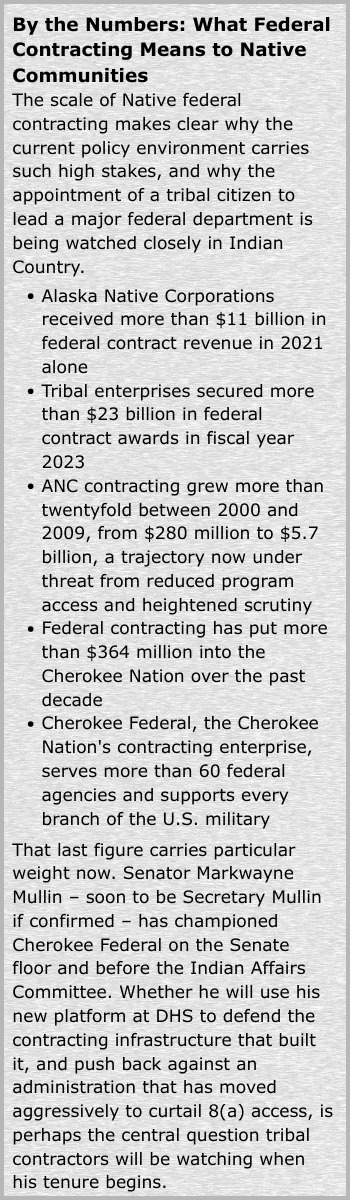
ANCs were established under ANCSA to manage land and resources on behalf of Alaska Native shareholders. Over time, federal contracting has become their primary economic engine. In 2021, Alaska Native corporations received more than $11 billion in federal contract revenue, with research showing that federal contracting is the primary source of revenue for the corporations. That revenue funds shareholder dividends, rural job creation, infrastructure, and cultural and educational programs. Tribal enterprises secured more than $23 billion in federal contract awards in fiscal year 2023.
- Joint Ventures and Partnership Structures
Native-owned companies can form joint ventures with larger, more established contractors, allowing experienced firms to provide expertise while tribal companies build past performance records. This model is widely used in defense, IT, and engineering, and it allows agencies to access specialized capabilities while directing awards through Native contracting vehicles.
- The Legal Foundation and Why It Matters Now
The policy rationale for these preferences is grounded in the federal government’s constitutional and treaty obligations to Native nations; not in race-based classification. Tribes are sovereign nations with a political, not racial, classification under U.S. law, a principle affirmed by the Supreme Court in Morton v. Mancari (1974). Tribal contracting preferences exist to honor treaty obligations and support economic self-determination; a legally distinct basis that supporters argue places them outside the reach of recent executive actions targeting DEI programs.
Current Environment: The 8(a) Program Under Pressure
These preferences, while still legally intact, are facing significant administrative and political headwinds. In June 2025, the SBA Administrator directed a full-scale audit of the 8(a) program following a Department of Justice investigation that revealed a bribery scheme involving more than half a billion dollars. In December 2025, the SBA sent letters to over 4,300 program participants – including tribally-owned entities – requiring three years of detailed financial records within 30 days, with failure to comply risking removal from the program.
Beyond enforcement, the program’s scope is narrowing. The Trump SBA accepted just 65 new 8(a) firms in 2025, compared to over 2,100 during the prior administration. SBA also cut 43 percent of its staff, the workforce that administers the program, causing significant slowdowns in new approvals and general program activity. Procurement goals have also been reduced: the SBA lowered its 8(a) contracting target from 15 percent to the statutory floor of 5 percent.
The Department of War has moved separately with Secretary Hegseth ordering a line-by-line review of all sole-source 8(a) contracts worth more than $20 million, framing the program as “the oldest DEI program in the federal government,” a characterization that tribal advocates strongly contested on legal and historical grounds.
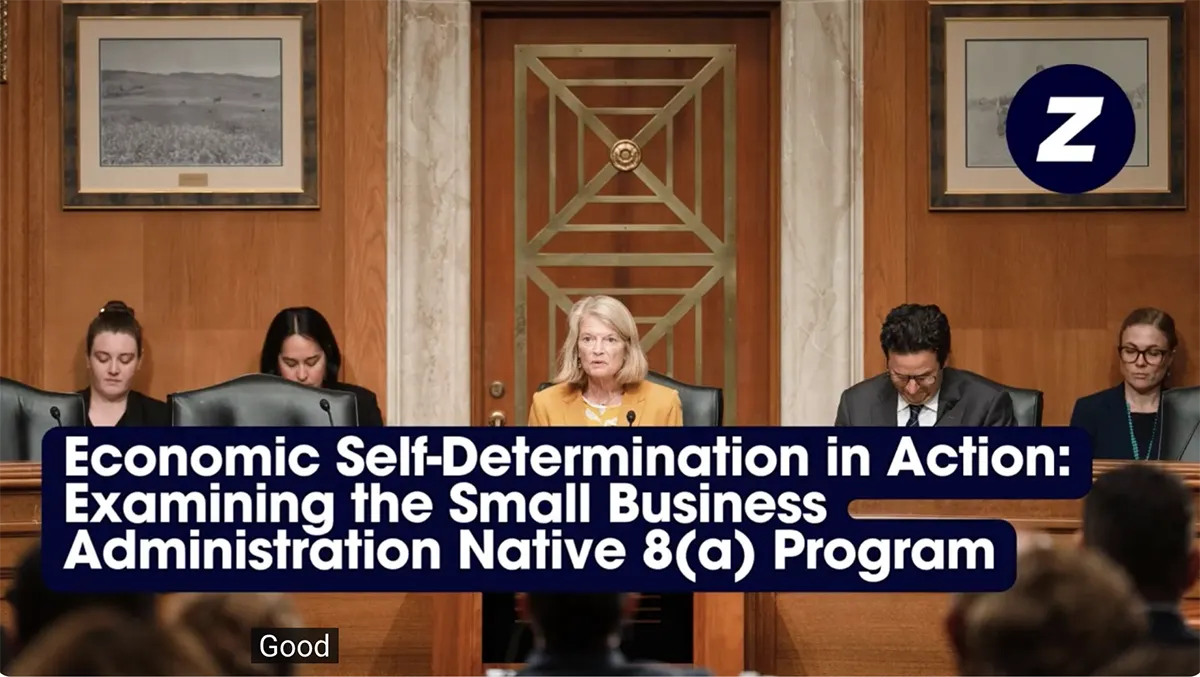
The real-world stakes of these policy shifts came into sharp focus at a February 10, 2026, Senate Committee on Indian Affairs oversight hearing entitled “Economic Self-Determination in Action: Examining the Small Business Administration Native 8(a) Program.” The hearing brought together tribal and Native corporation leaders to testify directly about what federal contracting means to their communities. Senator Markwayne Mullin (R-OK), who sits on the Indian Affairs Committee and is an enrolled member of the Cherokee Nation, introduced Cherokee Nation Principal Chief Chuck Hoskin Jr. as a witness and offered some of his most direct public comments yet on the program’s value: “Cherokee Federal is the largest contractor headquartered in the state of Oklahoma,” Mullin told the committee. “Through Cherokee Federal, the Cherokee Nation serves more than 60 federal agencies, supports every branch of our military, and protects our national security by assisting our brave warfighters both at home and abroad.”

Hoskin put concrete numbers behind that testimony. Over the past decade, he told the committee, federal contracting alone has put $364 million into the Cherokee Nation, revenue the tribe has used to solve problems the federal government has not. “The United States spends about the same today on Native housing as it did two decades ago,” Hoskin said. “What do we do? We pass a law that says on top of that 37 percent, we get $40 million to bring to bear to build new housing. So we can solve problems because we have this revenue flow through our diversified business portfolio but federal contracting has been key to that.”
The human dimension of that revenue was illustrated by Polly Watson, Vice President of Operations at Bristol Bay Native Corporation (BBNC) and a BBNC shareholder, whose family is from Perryville. It’s a village of fewer than 100 residents on the Alaska Peninsula, roughly 500 miles from Anchorage, where a round-trip airline ticket alone costs approximately $1,600 per person. BBNC serves more than 12,000 Alaska Native shareholders and approximately 11,000 descendants with ancestral ties to the Bristol Bay region. Watson described how the corporation’s federal contracting subsidiaries – delivering logistics, construction, facilities support, IT, and professional services to federal agencies – directly fund shareholder dividends, educational and vocational scholarships, workforce development, cultural and language preservation, and stewardship of lands her people have relied on for subsistence for thousands of years. “The 8(a) program functions as an outcome-driven model,” she told the committee.
The witnesses at the February hearing – which also included Katherine Carlton, President of Chugach Alaska Corporation, and Cariann Ah Loo, President of the Native Hawaiian Organizations Association – collectively represented the breadth of Native entities that depend on the program’s continued integrity and availability.
The structural advantages embedded in federal law remain in place. But the administrative machinery that activates them is under strain, and the political environment surrounding the program has shifted considerably. For tribes and ANCs that depend on 8(a) access to fund community programs and shareholder obligations, the coming months represent a critical period; one that will unfold, in part, under the watch of a new Department of Homeland Security (DHS) Secretary.
President Trump’s nomination of Sen. Mullin, as an enrolled citizen of the Cherokee Nation and a longtime advocate for tribal sovereignty, to lead the DHS has drawn cautious optimism from tribal leaders who see his appointment as a rare opportunity to have someone in a senior cabinet role who understands federal Indian law, treaty obligations, and the economic realities facing Native communities from the inside.
For an in-depth look at Mullin, Trump’s nominee to lead the Department of Homeland Security, read Homeland Security Today‘s feature, “Senator Markwayne Mullin: Who is Trump’s New S1 and What Does it Mean for DHS.”
(AI was used in part to facilitate this article.)