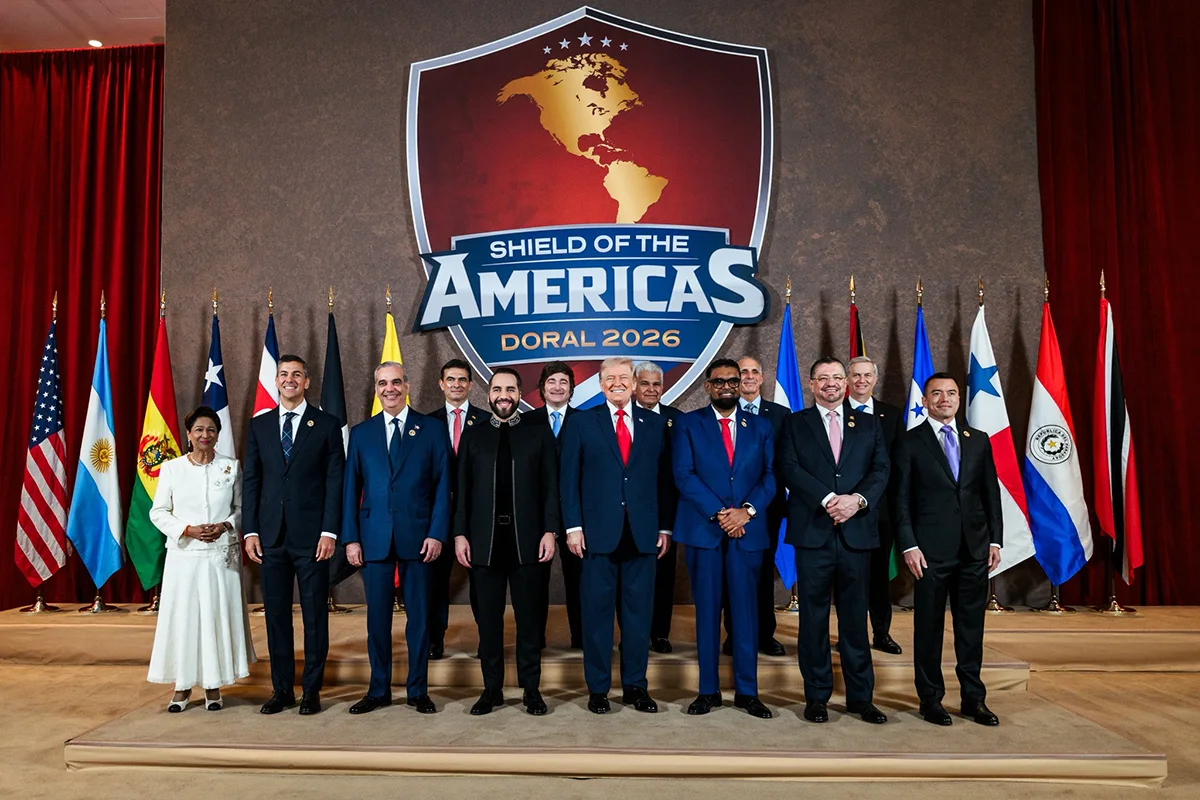
President Donald Trump convened leaders from a dozen Latin American and Caribbean nations at his Doral, Florida, golf resort Saturday, March 7 at a summit he called the “Shield of the Americas.” The centerpiece of the gathering was Trump’s signing of a proclamation in which the Secretary of War established the “Americas Counter Cartel Coalition,” a 17-nation military alliance that the White House says is built around a commitment to using lethal military force against cartel and narcoterrorist networks.
“The heart of our agreement is a commitment to using lethal military force to destroy the sinister cartels and terrorist networks once and for all,” Trump told the assembled heads of state. “We’ll get rid of them. We need your help.”
The coalition operates under the broader “Shield of the Americas” diplomatic and military framework aimed at dismantling drug cartels, which also will address border security and drug trafficking, and counter foreign adversary influence in the Western Hemisphere.
Who Was in the Room
The gathering drew a roster of leaders closely aligned with the Trump administration’s vision for the Western hemisphere. Among those present were Argentine President Javier Milei, Salvadoran President Nayib Bukele, Paraguayan President Santiago Peña, Ecuadorian President Daniel Noboa, Panamanian President José Raúl Mulino, Honduran President Tito Asfura, Guyanese President Irfaan Ali, Bolivian President Rodrigo Paz Pereira, and Dominican Republic President Luis Abinader.
Trump also acknowledged Chilean President-elect José Antonio Kast – whom he said he had endorsed – and the presidents of Costa Rica, and Trinidad and Tobago. Secretary of State Marco Rubio, Defense Secretary Pete Hegseth, Treasury Secretary Scott Bessent, Commerce Secretary Howard Lutnick, and Energy Secretary Chris Wright were also in attendance, along with U.S. Trade Representative Jamieson Greer and Deputy Secretary of State Chris Landau.
Special Envoy
One of the summit’s more consequential announcements had actually come days earlier: the removal of Kristi Noem as Secretary of Homeland Security and her reassignment as special envoy for the Shield of the Americas. Noem emailed DHS staff on the evening of Thursday, March 4, informing them her last official day at the department would be March 31. Trump had promised to elaborate on her new role at the summit but offered no additional details during his remarks.
Despite being present at the event alongside other Cabinet members, Noem was not mentioned when Trump personally thanked and introduced his secretaries by name. It fell to Secretary Rubio to formally introduce her to the assembled leaders. “You will see a lot of her,” Rubio told the group. “She’ll be very involved with each of you at a personal level and on a daily and weekly and monthly level to ensure that what we talk about here today and the work we do together continues on.”
Noem addressed the leaders directly, framing her new role in operational terms. “Our objectives are going to be to destroy the cartels, to go after these narcoterrorists that are destroying our people, killing our children and our grandchildren. We’re also going to keep our adversaries at bay,” she said, offering to share her personal cell phone number with each head of state for direct communication.
Venezuela, Cuba, and a Doctrine of Hemispheric Dominance
Trump devoted significant time to the administration’s January raid that resulted in the capture of former Venezuelan President Nicolás Maduro, describing it as a precision operation into a heavily fortified military base that lasted roughly 18 minutes and resulted in no American casualties. The United States has since formally recognized a new Venezuelan government under President Dulce Rodríguez and announced a “gold deal,” allowing the two countries to cooperate on the sale of Venezuelan gold and minerals.
Cuba, Trump suggested, is next. “Cuba’s at the end of the line. They’re very much at the end of the line. They have no money. They have no oil,” he said, noting that Cuba had historically depended on Venezuelan subsidies now cut off under the new Caracas government. “But Cuba’s in its last moments of life as it was. It’ll have a great new life, but it’s in its last moments of life the way it is.”
Mexico, Cartels, and the Coalition’s Core Mission
Trump identified Mexico as the “epicenter” of cartel violence in the hemisphere, describing the cartels as increasingly running the country and pledging that the U.S. would “do whatever is necessary” to defend national security, including the use of precision missile strikes, if requested by partner nations. “We’ll use missiles if you want us to use missiles. They’re extremely accurate,” he told the group.
The president cited a reported 96 percent reduction in drug trafficking by sea, a 67 percent reduction in fentanyl crossing the southern border, and what he called the largest single-year drop in the U.S. murder rate in recorded history. He framed the summit as a natural extension of those domestic security gains into a regional framework.
Trump also pointed to the Shield of the Americas as a direct counterpoint to what he described as decades of U.S. neglect of Latin America in favor of more distant conflicts. “They went to these faraway places where they weren’t even wanted,” he said of his predecessors. “It’s been abandoned by the United States for so many years.”
Context and Regional Tensions
The summit comes against a backdrop of complicated U.S.-Latin American relations. Several regional leaders have criticized the January Venezuela raid as a violation of sovereignty. Trump’s public clashes with Colombian President Gustavo Petro, who was not present, dominated headlines earlier in his second term, though the February 3 meeting at the White House was said to have been cordial.
The summit also coincided with active U.S. military involvement in Iran, which Trump briefly addressed at the outset of his remarks, telling the assembled leaders that “tremendous progress” had been made and describing it as “a pretty wild time, but it’s going very well.”

Saturday’s Doral summit was the capstone of a process already set in motion. Secretary of War Hegseth had formally launched the Americas Counter Cartel Coalition (A3C) two days earlier, on March 5, at U.S. Southern Command (SOUTHCOM) headquarters. At that event, the Americas Counter Cartel Conference, military leaders from across the Caribbean, Central America, and South America convened alongside Hegseth, who called it “a historic effort” and “the first ever America’s Counter-Cartel Coalition.” SOUTHCOM Commander Gen. Francis Donovan framed the stakes bluntly, describing narcoterrorism as “the single gravest threat to security in our region and across our hemisphere.”