
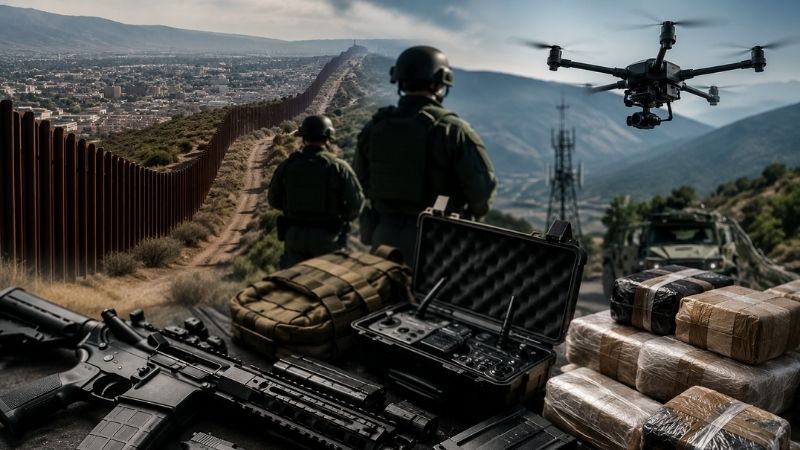
Over the past several years, I have had the opportunity to speak with a range of Mexican security professionals, military officers, intelligence analysts, prosecutors, and private-sector security practitioners who work the problem of weapons trafficking from the other side of the border. Their observations, taken together, present a picture that is both more alarming and more analytically tractable than most U.S. policy discussions acknowledge. The core finding is straightforward: weapons trafficking into Mexico has evolved from a firearms commerce problem into a transnational sustainment infrastructure, and the institutional architecture designed to address it has not kept pace.
The 2021 GAO report on firearms trafficking into Mexico identified persistent gaps in interagency coordination, data integration, and investigative exploitation. Those gaps have not closed. If anything, the operational environment has grown more complex. What follows are my observations on how the threat has evolved, and what a more effective enforcement posture might look like.
A Mature Logistics Ecosystem, Not a Black Market
The framing of weapons trafficking as an illicit commerce problem, focused on unlicensed dealers, straw purchasers, and smugglers, remains accurate as far as it goes. But it significantly understates the organizational sophistication now present in the ecosystem. Contacts described weapons trafficking networks that are increasingly compartmentalized, with dedicated procurement cells that operate with some independence from traditional cartel command structures. In some cases, independent trafficking brokers appear to function as specialized logistics providers, acquiring and moving weapons on behalf of multiple criminal organizations rather than serving a single cartel exclusively.
This organizational evolution has direct implications for enforcement. Cartel-centric investigations frequently succeed in building cases against specific organizations while leaving intact the procurement architecture those organizations depend on. If weapons acquisition is increasingly handled by parallel specialists, brokers, financiers, transporters operating in loosely affiliated networks, then the investigative logic that works for narcotics disruption may be insufficient for weapons.
This point deserves to be stated plainly: independent weapons trafficking rings have evolved outside traditional cartel structures entirely. They are not subordinate cells. They are not cartel-affiliated logistics arms. They are autonomous criminal networks that procure, move, and supply weapons as a specialized enterprise, serving multiple organizations or operating opportunistically. A targeting framework built around cartel hierarchy will not find them, because they do not live inside that hierarchy. They occupy the spaces between formal structures, and those spaces are, at present, largely unexamined. The practical consequence is not merely that these networks escape primary targeting, but that they may escape targeting altogether.
“Weapons trafficking into Mexico has evolved from a firearms commerce problem into a transnational sustainment infrastructure, and the institutional architecture designed to address it has not kept pace.” – Carlos L. Olivo
The Fragmentation of Acquisition
A consistent theme across my conversations was the increasing fragmentation of the weapons acquisition process itself. Rather than single actors purchasing complete firearms in volume, contacts described distributed purchasing structures, multiple buyers acquiring smaller quantities, components trafficked separately from complete weapons, and decentralized assembly occurring in-country. Clandestine manufacturing of AR-pattern replicas, particularly in the Bajio region, was cited as a growing phenomenon, associated most prominently with Cártel Jalisco Nueva Generación.
The operational implication of this fragmentation is significant. Seizure-based interdiction and serial tracing, the backbone of current enforcement, depend on encountering complete, recoverable weapons with traceable histories. Component trafficking and ghost-gun manufacturing deliberately circumvent both. The recent prosecution in the Western District of Texas involving AR-platform component trafficking into Nuevo León illustrates that federal prosecutors are beginning to pursue these cases, but the architecture for proactively identifying component trafficking networks at scale remains underdeveloped.
Drones, Electronics, and Forensic Countermeasures
Perhaps the most striking evolution described by my contacts involves the proliferation of drone warfare capability and associated electronic systems. Cartel use of drones for reconnaissance, explosive delivery, and aerial surveillance has been widely reported. Less discussed is the acquisition of anti-drone technology and signal-jamming equipment by the same organizations, a development that mirrors the electronic warfare adaptations documented in insurgent environments.
One former senior official with experience at Mexico’s specialized weapons and terrorism prosecution unit described a particularly significant operational security behavior: the removal of identifying chips and telemetry hardware from drones prior to deployment. This mirrors the forensic logic of serial number obliteration on firearms and suggests that criminal organizations are applying sophisticated counter-forensic thinking to their newer weapons systems. From an enforcement standpoint, this creates a meaningful gap: current legal frameworks do not treat drone forensic obfuscation with the same seriousness as serial number tampering, despite the functional equivalence.
The Financial Targeting Gap
Across every conversation I had, the most consistent observation was the comparative weakness of financial targeting directed at weapons trafficking networks. Sanctions, financial intelligence exploitation, and disruption strategies modeled on narcotics or money laundering investigations remain underdeveloped relative to the scale of the problem. Weapons traffickers, my contacts suggested, operate with considerably less financial scrutiny than major narcotics or money laundering targets.
Part of this is structural. The mature investigative pipelines that generate sanctions and financial enforcement actions tend to originate from large-scale narcotics investigations led by DEA, FBI, and HSI. ATF’s traditional role emphasizes tracing, firearms expertise, and investigative support, important functions that do not organically produce the kind of long-duration financial intelligence packages that OFAC and FinCEN typically rely upon. Bridging that gap requires both institutional investment and deliberate analytical methodology: using financial transaction data, money services business activity, and suspicious activity reporting to identify high-risk acquisition clusters before weapons reach crime scenes in Mexico.
This is not a resource constraint so much as an analytical one. The data to identify trafficking networks likely already exists within U.S. financial intelligence systems. What is missing is the systematic exploitation of that data specifically for weapons trafficking targeting, an integrated approach combining financial anomaly detection, geographic corridor analysis, and firearms intelligence to generate proactive investigative predication rather than reactive prosecution.
Toward an Intelligence-Led Model
The current enforcement posture, seizure, tracing, straw purchaser prosecution, produces important operational results but rarely dismantles procurement architecture. An intelligence-led model would reorient the sequence: identify trafficking clusters through financial and behavioral indicators, establish investigative predication, and then apply the full range of available tools, surveillance, conspiracy charges, financial disruption, sanctions, against the network rather than individual transactions.
This shift requires sustained investment in three areas: financial intelligence targeting specifically oriented toward weapons procurement; analytical frameworks capable of identifying fragmented acquisition patterns and component trafficking; and binational enforcement coordination that treats the problem as a shared transnational security challenge rather than a border management issue.
The threat is serious enough to warrant the investment. Mexican criminal organizations increasingly possess battlefield-capable weapons systems, not merely small arms, but .50 caliber rifles, RPG systems, drone platforms, and electronic warfare equipment. The sustainment infrastructure supporting those capabilities runs substantially through the United States. Dismantling it is both a law enforcement obligation and a national security imperative.