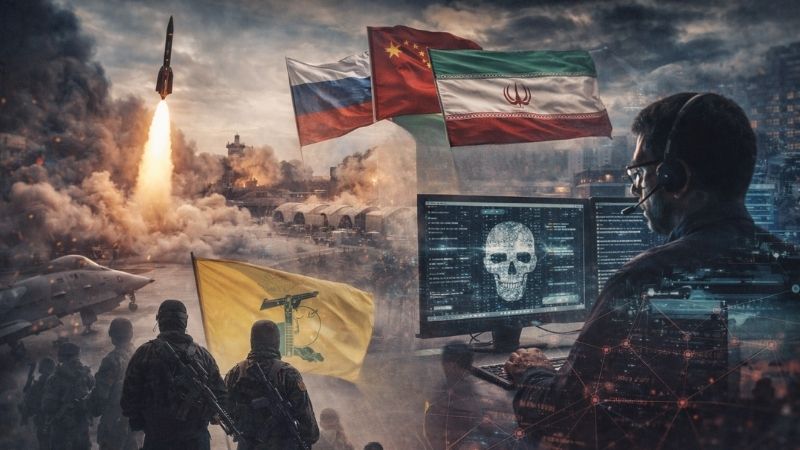
Iran’s response to Operation Epic Fury reflects a pre-planned, multi-domain retaliation framework designed to impose costs while preserving regime survivability and avoiding escalation thresholds that could trigger overwhelming U.S. retaliation. Rather than pursuing a decisive counterstrike, Tehran is implementing layered responses that combine kinetic attacks, cyber disruption, proxy activation, and geopolitical alignment with China and Russia. This approach enables Iran to demonstrate resilience and sovereign defiance while maintaining escalation control and preserving bargaining leverage.
Kinetic Retaliation: Targeting the Regional U.S. Military Posture
Iran’s immediate response has centered on missile and drone strikes against U.S. forward bases across the Middle East. Confirmed strikes and designated targets include Naval Support Activity Bahrain, Al Udeid Air Base in Qatar, Al Dhafra Air Base in the United Arab Emirates, Ali Al Salem Air Base in Kuwait, and Muwaffaq al-Salti Air Base in Jordan. Satellite imagery and open-source reporting confirmed impacts at Bahrain, Ali Al Salem, and Al Udeid. Reports of additional attacks in Saudi Arabia and near Erbil in Iraq indicate a targeting philosophy that treats the U.S. basing network as a unified operational system rather than discrete launch sites. Iranian statements suggest that between 14 and 27 installations were attacked or designated as targets. Whether the higher figure reflects actual strikes or strategic signaling, the operational message is consistent: the entire U.S. regional posture is vulnerable. (1)
This approach serves several strategic objectives. It demonstrates that Iran retains strike capability despite leadership decapitation and infrastructure damage. It disperses U.S. defensive resources across multiple host states. It reinforces deterrence by signaling that continued strikes will produce region-wide consequences rather than localized retaliation.
Cyber Operations: Asymmetric Cost Imposition and Plausible Deniability
Iran’s cyber capabilities provide an asymmetric instrument capable of imposing disruption while remaining below the threshold of conventional warfare. The IRGC Cyber-Electronic Command and the Ministry of Intelligence and Security oversee a network of advanced persistent threat actors positioned to support disruption, espionage, and influence operations.
APT33 has historically targeted aerospace, aviation, and energy sectors and possesses wiper malware designed to destroy data and disrupt operational technology environments. Past attacks on Saudi energy infrastructure demonstrate both capability and willingness to generate real-world economic disruption. (2) APT35/APT42 has expanded spear-phishing campaigns using AI-generated impersonation techniques, lowering the cost of sophisticated social engineering and enabling targeting of researchers, academics, and defense-adjacent professionals. (3) APT34 (OilRig) and MuddyWater specialize in espionage and infrastructure mapping, activities likely to support targeting decisions and vulnerability identification during the current conflict. (4) U.S. authorities have warned that Iranian cyber retaliation will likely prioritize critical infrastructure including power grids, water utilities, banking networks, and transportation systems because such attacks create public anxiety and economic disruption while preserving plausible deniability. (5)
Cyber operations are expected to be paired with coordinated disinformation campaigns designed to amplify confusion, erode public trust, and increase domestic political pressure against sustained military operations.
Proxy Networks and Expanded Homeland Risk
Iran’s proxy and affiliated networks provide deniable escalation options capable of extending the conflict geographically. Hezbollah-linked infrastructure and ideologically aligned cells represent a longstanding capability cultivated through IRGC-Quds Force relationships. Security analyses indicate that Hezbollah-affiliated assets in Europe and North America retain the operational capacity to target Jewish, Israeli, and U.S. government-linked individuals. (6) Importantly, proxy activation may not require intact centralized command and control. Semi-autonomous networks and ideologically motivated actors may mobilize independently in response to symbolic triggers such as leadership decapitation, increasing unpredictability and complicating deterrence calculations.
The China–Russia–Iran Strategic Triangle
Iran’s retaliatory posture is strengthened by its trilateral strategic pact with China and Russia, signed on 29 January 2026. Although the agreement does not constitute a mutual defense treaty, it provides diplomatic cover, intelligence cooperation, economic resilience, and technological support. (7)(8) China has reportedly provided satellite imagery and early warning data on U.S. force deployments, while Chinese surveillance vessels have monitored U.S. naval operations in the region. (9) Russia has agreed to rebuild Iran’s air defense systems, signaling long-term restoration of defensive capacity even if current operations degrade existing systems. (10) Iran’s potential acquisition of China’s CM-302 supersonic anti-ship missiles would significantly increase risk to U.S. naval assets in the Persian Gulf. (11) Reports of a rapid Chinese airlift of cargo aircraft to Iran suggest logistical support or delivery of defense components, while cyber cooperation may enhance Iranian offensive capabilities. (12) Collectively, this partnership reduces the likelihood of UN Security Council action against Iran and provides economic and technological pathways that mitigate the effects of Western sanctions.
Escalation Thresholds and Strategic Constraints
Iran’s retaliation strategy is shaped by a central tension: demonstrating defiance while avoiding actions that could trigger its own military destruction. Several escalation thresholds remain critical, including attacks on Gulf oil infrastructure, mining operations in the Strait of Hormuz, and proxy attacks on U.S. soil. Iran’s most effective strategy may lie in sustained cyber and proxy operations conducted below the threshold of formal state attribution. Such actions impose economic and psychological costs while denying the United States a clear conventional response pathway.
References
- Air & Space Forces Magazine, 1 March 2026; Wikipedia, ‘2026 Israeli-United States strikes on Iran,’ current as of 2 March 2026.
- Mjolnir Security, ‘The Asymmetric Battlefield: Iranian Cyber Threats to North American Critical Infrastructure,’ June 2025;IronNet analysis of APT33 activity.
- CyberProof, ‘Beyond the Blast Radius: Iran’s Digital Retaliation Expands Westward,’ July 2025.
- CSIS Strategic Technologies Blog, ‘Beyond Hacktivism: Iran’s Coordinated Cyber Threat Landscape’;Deepwatch Customer Advisory, July 2025.
- Deepwatch, ‘Customer Advisory: Elevated Iranian Cyber Activity Post-U.S. Strikes,’ July 2025;AttackIQ, ‘Iranian Cyber Threat Escalation,’ June 2025.
- SecurityInfoWatch, ‘Iran’s Cyber Threat Persists as Ceasefire Holds,’ citing multiple expert sources including Colin Clarke (Soufan Center).
- Middle East Monitor, ‘Iran, China and Russia sign trilateral strategic pact,’ 29 January 2026.
- Caspian Post, ‘China, Russia, and Iran Forge Agreement as US-Iran Tensions Intensify,’ February 2026.
- The National Interest, ‘How China Is Hardening the Iran Target Before the American Attack,’ February 2026.
- Ibid.; Middle East Monitor, January 2026.
- The National Interest, February 2026; Modern Diplomacy, ‘The Dragon’s Dilemma: China’s Strategic Playbook for a U.S.-Iran War,’ February 2026.
- Modern Diplomacy, February 2026.