
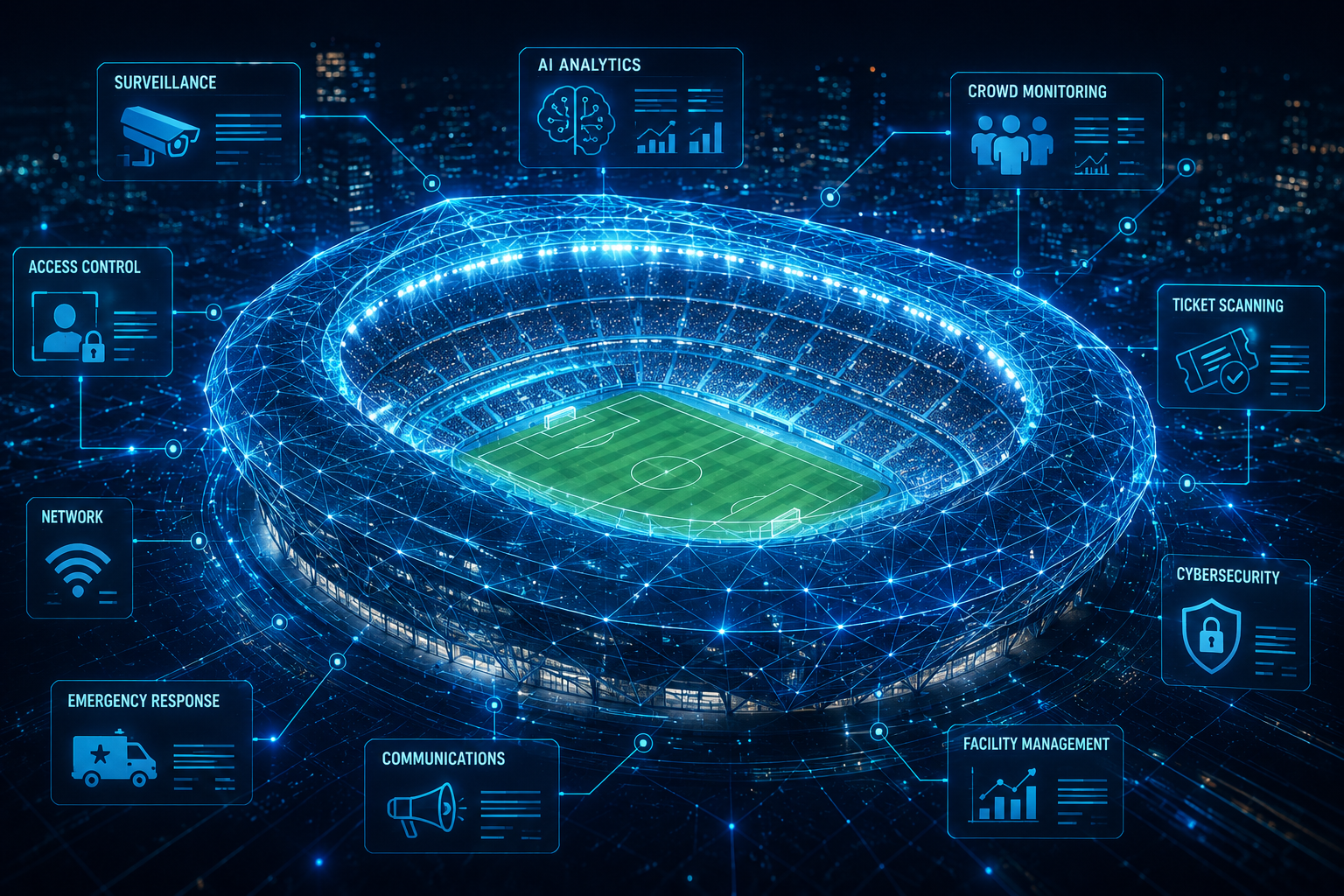
When most people think about FIFA World Cup security, they picture uniformed officers at stadium entrances, credential checkpoints, bag screenings, and perhaps a heavy law enforcement presence. While these visible measures are essential, they represent only a fraction of what it takes to secure one of the world’s largest and most complex sporting events.
The true security perimeter of the FIFA World Cup extended far beyond the stadium gates and represented the best in multijurisdictional coordination. It encompassed commercial facilities hosting teams and related events, transportation systems between venues, and critical infrastructure in and around venues, including electric grids, telecommunications networks, hospitals, water systems, and the digital infrastructure that connected them all. Protecting the tournament meant protecting the interconnected ecosystem that enables our economy.
The FIFA World Cup planning and event management highlighted two major themes – event security has become critical infrastructure security, and relationships are the key to successful planning and execution.
A New Definition of the Security Perimeter
Today’s threat environment has fundamentally changed the model by which we plan for and protect major events.
Threat actors can target and disrupt the tournament not just by attacking the stadium itself but could also target transportation systems moving the people and resources, the electric grid supporting stadium operations and broadcasting, the telecommunications enabling emergency communications, any number of critical infrastructure in the vicinity of the stadium, and any other element of the critical infrastructure ecosystem given the interconnectivity of today’s operating environment and potential for supply chain disruptions.
The World Cup required this consideration not just once at one location but for 104 matches at 16 stadiums across three countries.
Further complicating the coordination, organizers had to prepare simultaneously for kinetic attacks, cyber intrusions, unauthorized drone activity, insider threats, supply chain disruptions, severe weather, and the potential convergence of multiple threats occurring at once. Preparing and responding to each of these threats or the combination thereof expands the physical and digital perimeter even further and moves the preparation timeline earlier.
This level of complexity demands a whole-of-community approach and looking far beyond the stadium perimeter. This requires planners to consider how failures in one system could cascade across multiple sectors, potentially affecting the security and safety of the event. The objective was not simply preventing an attack—it was ensuring that the stadium and the interconnected infrastructure was secure and resilient to prevent widespread consequences.
For all those involved, this increase in locations, communities, threats, and timespan create an extra stressor and the possibility for responder fatigue – another complexity requiring close coordination and management.
The World Cup demonstrated that the event itself is only as resilient as the infrastructure and people that support it.
Coordination Was the Most Important Security Capability
Technology played an important role throughout the World Cup. Advanced screening systems, intelligence platforms, cybersecurity tools, and counter-unmanned aircraft systems all contributed to the security operation. But technology alone does not secure an event of this magnitude.
The greatest strength of the World Cup security effort was the ability to coordinate across countries, jurisdictions, and industries that may have divergent priorities and initiatives.
Agencies to include the Cybersecurity and Infrastructure Security Agency (CISA) described working alongside Federal, state and local governments, law enforcement, emergency management agencies, and infrastructure owners and operators. Organizations came together around a shared vision and mission to protect the World Cup and the communities hosting the events. Mo Telab, CISA’s Deputy Regional Director, described how an impromptu command center in a parking lot became the connection and collaboration point for all agencies involved – not because they were directed to report to the location, but because they recognized the value of constant coordination and the ability to communicate in real time. Mo stated “our regional team played a pivotal role in integrating stakeholders, sharing intelligence, and driving improvements that kept communities, athletes, and millions of fans safe. As we look ahead, CISA remains dedicated to securing America’s experience whether at global sporting events, national commemorations, or everyday operations by leading with expertise, partnership, and a forward-looking approach to risk management.”
This level of coordination did not emerge overnight. It was the product of years of relationship building, planning, exercises, and trust. This level of trust must be prioritized as part of our security planning and preparation.
The Private Sector Was Not Supporting the Mission—It Was the Mission
One of the most significant shifts in recent years is the recognition that protecting major events is no longer solely a government responsibility.
The vast majority of critical infrastructure in the United States is owned and operated by the private sector. Electric companies, telecommunications providers, transportation systems, water utilities, healthcare organizations, financial institutions, technology providers, among others, all played indispensable roles in ensuring the World Cup’s success.
These organizations were not simply supporting public safety—they were central to it.
This reinforces an important reality: private-public partnership and cross-sector coordination is no longer a desirable feature of infrastructure protection. It is an operational necessity.
The FIFA World Cup will be remembered for remarkable athletic performances, passionate and creative fans, and international celebration. It should also be remembered for demonstrating how security has evolved in an increasingly interconnected world. The same coordination models, resilience planning, intelligence sharing, and cross-sector partnerships that protected the tournament should not be reserved for globally significant events. They should inform how we prepare for the security and safety risks to our communities every day.
As threats become more complex and infrastructure systems become more interconnected, success will depend less on how well we protect individual facilities and more on how effectively we strengthen the seams – the relationships and systems between the organizations. And the only way to strengthen these seams is by creating mechanisms for cross-sector coordination and private-public partnerships that establish a shared vision, build trust, enable communication, and are capable of surviving the fatigue of planning, preparation, and response on the level of the FIFA World Cup.
To learn more, register to attend the Center for Cross-Sector Coordination (CXC) webinar on “Countering the Drone Threat” and stay tuned for an announcement on the FIFA World Cup webinar to follow.