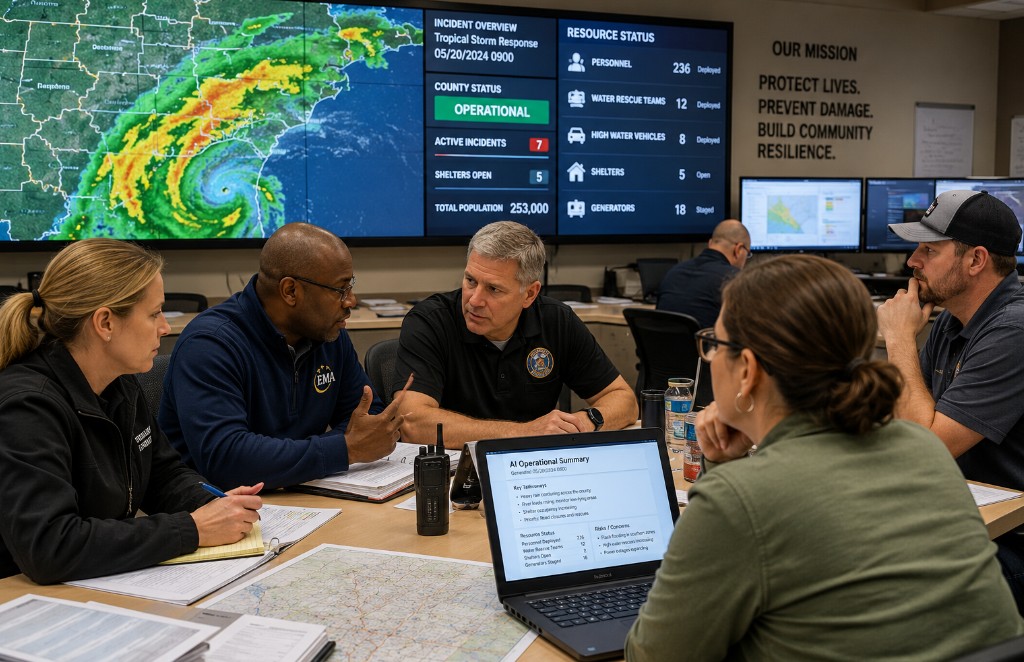
On Tuesday, the Markle Foundation, in collaboration with Aspen Digital and RAND published the AIDE report.
“This moment matters.” “An emerging gap.” “Force multiplier.” “Demand is clear. Adoption needs support.”
Those are a few of the phrases that grabbed my attention in the opening pages. They should grab yours too. Not because they are catchy. Because they are true.
What makes this report different is that it wasn’t written for Silicon Valley. It was written for emergency managers.
Emergency management has reached one of those moments that fundamentally changes the profession. A moment when new technology moves from curiosity to capability. A moment when leaders must decide whether they will shape change or spend years trying to catch up with it.
The AIDE report arrives at exactly the right time for exactly the right audience. It is not another report predicting a futuristic world dominated by artificial intelligence. It is a practical roadmap for emergency managers who want to better serve their communities while preserving what matters most: human judgment, accountability, and trust.
This report deserves to be read. So do both appendices.
More importantly, it deserves to be used. This is the kind of report that should lead to action.
For the past several years, emergency managers have heard both extremes. AI will solve everything. AI will destroy everything.
Neither is true.
Where AI Fits
The AIDE report lands squarely in the middle, where emergency management has always done its best work. It recognizes AI not as a replacement for experienced professionals, but as a force multiplier that allows those professionals to spend more time doing what only humans can do: making decisions, building relationships, solving complex problems, and leading people through uncertainty.
That is exactly the conversation our profession needs.
One of the strongest sections of the practitioner perspectives report asks a deceptively simple question: Where can AI actually make emergency management better?
The answers are refreshingly practical.
Not replacing emergency managers.
Helping them. Helping them prepare plans faster. Helping them analyze more information than any individual could reasonably process. Helping them summarize lengthy documents in minutes instead of hours. Helping them identify trends across hundreds of reports. Helping them draft materials that humans then refine. Helping them translate information into multiple languages. Helping them find time for the work that truly requires human experience and judgment.
The common thread running through every example is not automation. It is helping. Helping emergency managers reclaim time.
Time is perhaps the most valuable resource any emergency manager has. Every hour saved on administrative work is another hour available for coordination, planning, training, relationship building, community engagement, or supporting disaster survivors.
That is not replacing people.
That is making people more effective.
AI is a Means, Not Magic
The report also wisely avoids portraying AI as magic. Throughout its recommendations is an unmistakable emphasis on governance, training, oversight, transparency, evaluation, and human accountability. Again and again, the message is clear: AI should augment human expertise, not replace it. Success depends not only on technology but on leadership.
That distinction matters.
Emergency management has seen plenty of technologies arrive with promises of transformation. Some delivered. Others became expensive distractions because organizations adopted tools before developing processes or building trust.
The AIDE report argues for the opposite approach. Start with the mission. Understand the problem. Train the workforce. Build appropriate guardrails. Evaluate results. Then scale responsibly.
That is emergency management thinking.
It is also one reason I believe this report will have staying power.
The report repeatedly acknowledges another important reality that many practitioners already understand. The demand for AI is no longer hypothetical.
Emergency managers are already experimenting. Some are using AI to summarize situation reports. Some are drafting emergency plans. Some are analyzing data. Some are translating public information. Some are creating training materials.
Others remain hesitant, uncertain where to begin or concerned about risks.
Both groups are represented in this report.
From Interest to Implementation
Rather than creating winners and losers between “AI believers” and “AI skeptics,” the report builds common ground. It recognizes legitimate concerns while also acknowledging that standing still is becoming its own risk.
That may be one of the report’s greatest contributions. It gives permission for thoughtful adoption. Not reckless adoption. Not blind adoption.
Responsible adoption.
I also appreciate something subtler. This report is ultimately about people, not technology. One of the participants commented, “The amount of administrative and management stuff that takes up my time, as opposed to … core emergency management functions, I still find to be relatively disproportionate.” We all feel that. AI can help tackle that.
The technology will change every few months. The principles should not.
Leadership. Ethics. Governance. Transparency. Accountability. Continuous learning.
Those ideas will still matter regardless of which AI platform dominates next year. Perhaps the greatest value of this report is not that it answers every question. It doesn’t. Instead, it gives emergency management organizations a framework for asking better questions.
Where are our biggest time drains? Which repetitive tasks prevent our staff from focusing on mission-critical work? Where could AI improve quality? Where could it reduce burnout? Where should humans always remain in the loop? How will we train our workforce? How will we evaluate success?
Those conversations should be happening in every emergency management office in America.
This report provides an excellent place to begin them.
“This report was never intended to be the final word on artificial intelligence in emergency management,” explains Jessica Jensen, Senior Policy Researcher, RAND, “It is intended to help organizations begin responsibly integrating AI into their operations, recognizing both its tremendous potential and the importance of maintaining human judgment, accountability, and public trust.”
“Our goal wasn’t simply to put out another research paper,” shares Rich Serino, Senior Advisor to the Markle Foundation for the AIDE project; Former FEMA Deputy Administrator; Distinguished Senior Fellow Harvard -NPLI, “ It was to bring people into the conversation — to build a community of practice around responsible AI that empowers emergency managers, improves how we serve one another, and, at the end of the day, helps save more lives.”
As I finished reading the report, one final thought stayed with me.
The report thoroughly discusses how AI can support leaders, planners, operators, analysts, and logisticians. It highlights opportunities to improve decision-making, reduce administrative burden, strengthen planning, and increase operational effectiveness.
As I finished the report, I found myself thinking about one additional discipline that could become an even larger part of this conversation.
Communications.
In many ways, communicators serve as the connective tissue between nearly every capability discussed throughout the report. Public information officers and crisis communicators face many of the same challenges described throughout the report. They process enormous amounts of information under severe time pressure. They translate technical information into language the public can understand. They monitor rumors, summarize changing situations, draft messages, coordinate across agencies, and communicate with increasingly diverse audiences.
AI can help communicators do all of those things faster and often better, while leaving the essential human responsibilities exactly where they belong: determining strategy, exercising judgment, showing empathy, understanding community needs, and maintaining public trust.
The report identifies Situational Awareness as one of the most persistent challenges. It also emphasizes the necessary role of AI in Public Information and Early Warning. Communicators have essential responsibilities in each of these areas and more.
In the next phase of this important work, I hope communicators have an even larger role in the conversation.
Conclusion
Every benefit described throughout this report, creating time, improving quality, increasing speed, reducing repetitive work, strengthening decision support, and allowing professionals to focus on higher-value responsibilities, applies just as directly to emergency management communications.
The AIDE report should not become another document downloaded, skimmed, and filed away.
It should become a discussion guide. A leadership agenda. A training resource. A catalyst.
Emergency management has always evolved by adopting better tools while remaining grounded in its mission to protect lives and communities.
Artificial intelligence is simply the next tool. This report shows us how to use it wisely. Now comes the harder part.
Reading it is easy.
Giving it oxygen by bringing it to life is what matters.
Dan Stoneking is the Owner and Principal of Stoneking Strategic Communications, the Author of Crisis Communications and Emergency Management, the Founder and Vice President of the Emergency Management External Affairs Association, the Founder of Message Prism, and an Adjunct Professor in the Communications Department at West Chester University.