I have seen the Defense Production Act save lives. I have also seen what happens when critical resources are not available when communities need them most.
Most Americans first heard of the Defense Production Act (DPA) during the COVID-19 pandemic, when shortages of ventilators, masks, gloves, and other critical medical supplies dominated national attention. But the DPA was never intended to be a pandemic-only authority.
It is one of the nation’s core tools for ensuring that the industrial base can meet national defense, homeland security, emergency preparedness under the Stafford Act, and critical infrastructure needs before a crisis becomes unmanageable.
During the pandemic, hospitals struggled to obtain lifesaving equipment, healthcare workers searched for critical protective gear, and states competed for limited supplies. The federal government used the DPA to accelerate production of critical medical equipment and strengthen strained supply chains. Increasing the availability of lifesaving resources during a once-in-a-generation public health emergency was a national priority, and the DPA helped make that possible.
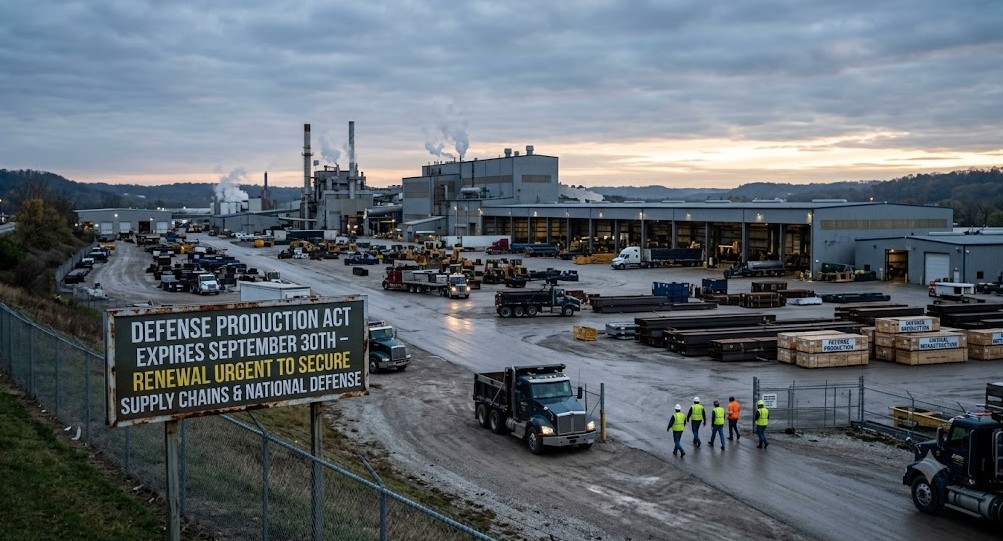
But the lessons from COVID-19 extend far beyond a public health emergency. The timing of this discussion matters. The Defense Production Act is set to expire on September 30, 2026, unless Congress acts. That deadline provides an opportunity not only to preserve an important national capability, but to examine how the DPA can better support preparedness for the complex disasters the nation faces today.
What Exactly Is the Defense Production Act?
The Defense Production Act was enacted in 1950 during the Korean War to ensure that the nation’s industrial base could meet critical defense needs. Over the decades, Congress expanded the law’s reach. Today, “national defense” includes emergency preparedness, critical infrastructure protection, homeland security, disaster response, energy production, space-related activities, and other national priorities.
That breadth matters because modern emergencies rarely fit neatly into one category. A major disaster, cyberattack, foreign conflict, or infrastructure failure can place simultaneous pressure on the same suppliers, materials, transportation networks, and skilled workforce.
Contrary to popular perception, the DPA does not give the federal government unlimited authority to take over private industry or nationalize factories. Instead, it provides a carefully structured set of authorities that help the nation respond when normal market forces cannot meet urgent needs.
The DPA allows the government to prioritize critical contracts and orders, expand productive capacity, strengthen domestic supply chains, gather industrial base information, and coordinate with industry under defined legal conditions.
Simply put, the DPA helps ensure that critical resources can be produced and delivered when lives depend on them. It also helps ensure that the industrial capacity to produce those resources exists before a crisis occurs.
That is an extraordinary authority. It should never be exercised casually. But extraordinary disasters often require extraordinary capabilities.
Every Disaster Eventually Becomes a Supply Chain Problem
Emergency managers understand that supply chain disruptions are a common feature of disasters.
Recent events illustrate the challenge.
The wildfires in Maui created immediate demand for temporary housing, communications equipment, construction materials, heavy equipment, and debris removal resources. Hurricane Helene strained supplies of transformers, utility poles, wire, generators, fuel, and restoration equipment across multiple states. California’s wildfires created extraordinary demand for firefighting resources, temporary housing, construction materials, utility equipment, heavy machinery, and environmental remediation.
The next catastrophic earthquake, hurricane, wildfire, or flood will create similar pressures.
Every disaster eventually becomes a supply chain problem.
Emergency managers devote tremendous effort to pre-positioning supplies, staging personnel, coordinating mutual aid, and anticipating resource shortages before disaster strikes. Yet many of the most critical resources remain dependent on manufacturing timelines and commercial supply chains that cannot always respond quickly enough to catastrophic demand.
That reality requires greater attention before the next crisis.
From Response Tool to Preparedness Tool
Too often, discussion of the Defense Production Act begins after shortages have already emerged. It should begin much earlier.
Imagine forecasters are highly confident that a catastrophic hurricane will make landfall within five days. Utility companies already know what they will need: transformers, utility poles, miles of conductor wire, generators, fuel, communications equipment, and countless other resources essential to restoring critical services.
Should conversations about production priorities begin after landfall, when shortages are already affecting response operations?
Or should emergency planners explore whether certain actions can occur before the first rain band reaches shore?
The better question is whether the nation has already identified industrial bottlenecks, validated priority requirements, and exercised the authorities needed to act before a shortage becomes a crisis.
Emergency management has long embraced proactive planning. We issue evacuation orders before floodwaters rise. We activate emergency operations centers before the first 911 call arrives. We stage search and rescue teams before buildings collapse.
Supply chains deserve the same proactive thinking.
The Defense Production Act should not be viewed solely as a response tool.
It should also be considered a preparedness tool.
A Powerful Tool That Requires Modernization and Continuity
Discussions about the Defense Production Act inevitably raise questions about executive authority. They should.
Emergency management already understands that extraordinary authorities must operate within law, oversight, defined purposes, and clear decision-making processes. The DPA is no different.
Disasters require government to act quickly. Emergency declarations can accelerate procurement. Access to dangerous areas may be restricted. Evacuation orders may temporarily limit individual movement. These authorities exist because disasters demand rapid action, but they also operate within legal boundaries and public accountability.
The Defense Production Act should be viewed through the same lens.
The DPA provides a lawful mechanism for prioritizing national defense and emergency preparedness requirements when scarce capacity cannot satisfy every demand at once.
DPA actions are already subject to statutory requirements, delegations, regulations, agency review, legal counsel, documentation, and oversight. The challenge is not simply adding more process. The challenge is ensuring the process is modern, fast enough for real emergencies, and capable of addressing today’s industrial base vulnerabilities.
The answer is a capable, modernized DPA that preserves accountability while allowing the nation to act before shortages cascade across critical sectors.
Looking Ahead
The disasters of tomorrow will almost certainly place even greater demands on America’s supply chains than the disasters of yesterday.
Think about the disaster that keeps you up at night. Perhaps it is a catastrophic earthquake along the New Madrid or San Andreas faults. A major hurricane striking a densely populated coastline. A rapidly expanding wildfire threatening multiple communities. A cascading cyberattack disrupting critical infrastructure.
Now add another challenge: What if those events occur while the nation is also facing a military contingency, foreign export restrictions, cyber disruptions to transportation networks, or shortages of critical minerals, energy components, pharmaceuticals, or industrial inputs?
If a transparent Defense Production Act process, supported by strong oversight and accountability, could accelerate production and delivery of critical resources needed to save lives and stabilize communities, would you want that capability available before disaster occurs?
The answer should be yes.
Preparedness is about reducing uncertainty before disaster strikes.
The emergency management community should not wait until the next catastrophic event to determine whether the Defense Production Act is fully aligned with today’s risks. We should evaluate whether existing authorities are sufficient, identify opportunities to improve coordination with industry, and determine whether thoughtful refinements could strengthen disaster preparedness while preserving public trust.
That evaluation is urgent since the DPA is scheduled to lapse on September 30, 2026, unless Congress acts. A lapse would not automatically cancel every existing DPA contract or project, but it would create a serious capability gap. The government’s ability to initiate new priority actions, invest in industrial capacity, respond to emerging shortages, and coordinate scarce resources across competing national requirements would be significantly constrained.
Since 1950, the DPA has lapsed only twice. Allowing it to lapse again would send the wrong signal at the wrong time. The nation is working to rebuild industrial capacity, strengthen supply chains, improve infrastructure resilience, support military readiness, and prepare for increasingly complex emergencies.
Two things can be true.
The DPA helped save lives during the COVID-19 pandemic.
It is also an extraordinary authority that should always be exercised with transparency, oversight, and public accountability.
Those truths are not in conflict.
The third truth is this: the DPA must not be allowed to lapse, and it must continue evolving to meet the industrial, infrastructure, energy, health, and national security challenges the country faces today.
The mission of emergency management is to save lives, protect property, and help communities before, during, and after disasters. Fulfilling that mission requires examining every capability that can strengthen preparedness and response, especially as disasters become more frequent, more complex, and more disruptive to the systems upon which modern society depends.
The American people deserve a government willing to use every responsible capability available to save lives and protect communities.
They also deserve a government that does not wait until disaster strikes to discover that the industrial base cannot produce what the nation needs.
Dan Stoneking is the Owner and Principal of Stoneking Strategic Communications, the Author of Crisis Communications and Emergency Management, the Founder and Vice President of the Emergency Management External Affairs Association, the Founder of Message Prism, and an Adjunct Professor in the Communications Department at West Chester University.