



In our first article, we discussed the current professional crisis emergency & disaster management is facing. A crisis fifty years in the making that has led to the major systemic failures and issues present-day. In part-two of this series we explore novel solutions and present a new path forward focused on building strong state and local programs less reliant on federal support. To address this new reality, significant change is required nationwide. Elected Officials, Emergency and Disaster Management professionals must act now. The following is an actionable blueprint for communities.
Shifting Away from Federal Doctrine to Emergency Management Professionalization
Emergency Management must establish its own professional values and identity, independent of federal doctrine or grant mandates aka “because the grant says so”. Professionalization should be driven by building unified values, standards, accreditation, certification, training, and higher education for both individuals and programs, public and private. The field should focus on measurable metrics that assess community readiness, rather than theoretical capability-building or resilience. As federal funding diminishes, investments in superficial capability-building will quickly disappear.
Rebalance State and Local Public Safety Budgets
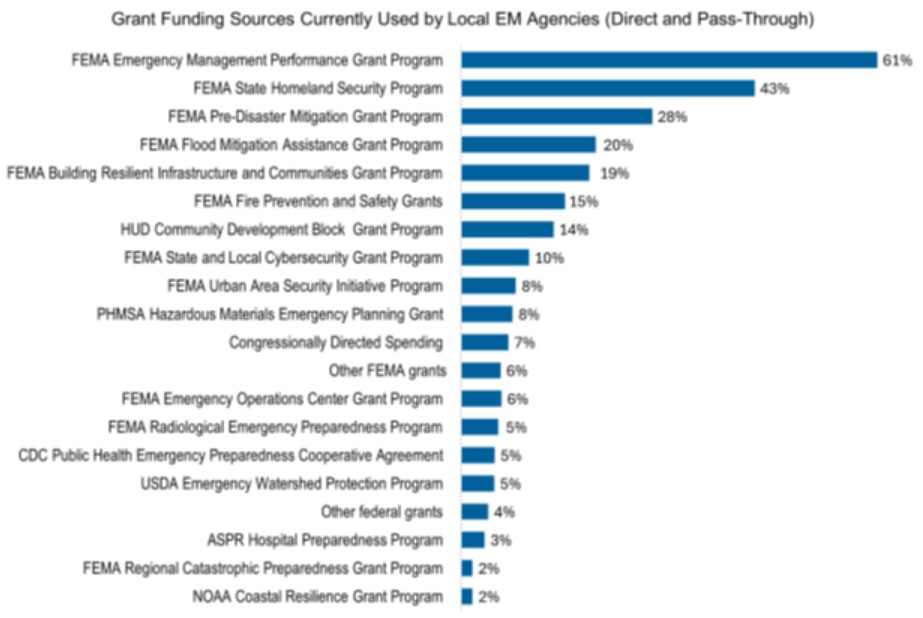
State and local governments, Governors, Mayors, County Commissioners, and Tribal Councils need to have real conversations with their local Emergency Managers and their communities. Historically, public safety budgets have prioritized police and fire departments, leaving local emergency management extremely underfunded. For example, as the former St. Louis Emergency Management Commissioner Sarah Russel testified in her case, just 10 days before a tornado struck the City of St. Louis causing major damage, “CEMA requested $969,274 for fiscal 2025. The agency received $451,484, which is about 47% of the requested amount. The total budget of the Department of Public Safety was more than $400 million. Russell’s 2026 request was for the department’s budget to be raised to 1% of the public safety budget”.i This scenario is common among emergency management agencies. As noted in the Argonne National Laboratories Report, “The most commonly used federal grant funding sources for local EM agencies come from FEMA, with the Emergency Management Preparedness Grant (EMPG) being used by 61% of local agencies and the FEMA State Homeland Security Program (SHSP) by 43%.”ii Most local communities receive less than 1% of non-federal public safety funding. Given this, it is essential to reevaluate public safety budgets and reset expectations for disaster management services.
Emergency managers should advocate for a reassessment of public safety spending with both the public and elected officials. Now is the time for candid discussions about budget priorities. For example, fire code and fire mitigation efforts have been extremely successful in reducing structure fires significantly since the 1980’s according to the National Fire Administration with “overall trends for residential building fires and losses for the 10-year period of 2014 to 2023 show… A 6% decrease in fires.”iv Given that most fire service calls are now medical, it is worth reconsidering investments in expensive fire apparatus and exploring whether resources could be better allocated to other priorities like alert and warning systems. Similarly, the need for costly police tactical vehicles and additional mobile command vehicles should be evaluated, with consideration given to whether existing infrastructure can be leveraged instead.
We need to shift from capability building as we know it now and look at the bigger picture, public safety systems building holistically. The field of emergency & disaster management simply, both figuratively and literally cannot afford to do so in silos anymore sans federal grant funding. Public Safety budgets should allocate at least 10% of total state and local public safety spending directly to emergency management programs. If FEMA resumes normal operations, future federal disaster grant eligibility should require state and local governments to meet this 10% spending threshold, similar to NATO’s defense spending requirements. The current system is failing because only FEMA has contributed significantly, while state and local governments have not met their responsibilities.
Regionalization & Intergovernmental Emergency Management Agreements
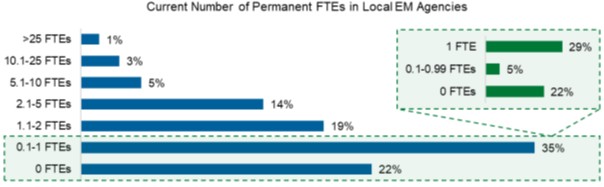
Many emergency management agencies are under-supported, underfunded, and understaffed. Local governments should consider regionalizing and establishing intergovernmental agreements to provide services across multiple jurisdictions or operational areas when independent operations are not feasible. No emergency management agency should rely on a single emergency manager, although this is the case in more than half of all communities across the country. According to the 2025 Argonne National Laboratory Report on EM Organizational Structures, Staffing, and Capacity Study: State, Local, and Territorial Findings “More than half of local EM agencies (57%) operate with one or less FTEs, with nearly a quarter (22%) having zero FTEs, 5% reporting having only a part-time FTE, and over a quarter (29%) having one FTE. Only 9% of local jurisdictions report having more than five FTEs (Figure 11).” v
Regionalization is a proven strategy used in federal funding programs such as UASI and MMRS. In the current context, it enables multiple jurisdictions to pool resources and funding, creating stronger emergency management programs. The concept is tried, tested, and true. For example, smaller California communities often form operational areas or intergovernmental agencies to address limited tax bases. Likewise, this can be seen in joint regional offices of emergency management in Colorado with the Pikes Peak Regional Office of Emergency Management. Regionalization is also leveraged by the fire service, emergency medical services, law enforcement, even road and transportation enterprises. Emergency managers should engage elected officials in comprehensive discussions about whether regionalization or contracting services would better serve their communities. Intergovernmental agreements must clearly define authorities, funding sources, and operational expectations.
Taxes, Fees, and Disaster Management Service Enterprises
Establishing new funding sources, such as dedicated public safety taxes for emergency management, is another way to strengthen agencies. As disasters increase and federal support declines, public sentiment may shift in favor of such measures.
On the other end of the spectrum, establishing Disaster Management Service Enterprises offers another viable option for funding emergency management agencies. Disaster Management Service Enterprises can be leveraged to establish fees charged to recipient agencies for shared disaster management services provided for emergency functions for communities such as alert and warning systems, emergency plan reviews, special event support, incident action planning, and other key services. There is a cost for everything in America, much like every community has fire and regional building code enforcement enterprises that charge for services for plan reviews, inspections, etc. so should emergency management to adequately build, maintain, and support the critical emergency support functions and services it provides. Emergency Management assets are often shared among the community for a variety of purposes. So, shouldn’t those users also pay and hold a shared responsibility for those assets as well?? Whether its police, fire, public health, parks and recreation or even the private sector?
Operationalize Public-Private Partnerships
Emergency Management needs new nationally available training providers that don’t shut down. The new normal of government shutdowns appears to be here to stay firmly placing FEMA into the category of NOT- Highly Reliable Organizations. We need reliable partners who can provide quicker, faster, more readily available services at speed and scale nationwide. While FEMA’s Emergency Management Institute, now National Disaster and Emergency Management University has been providing training and education to practitioners going back to its predecessor agencies and the Civil Defense Staff College originating from World War II, we now live in a day and age where politicization of disaster management and multiple shutdowns have shown FEMA is no longer a reliable partner. Not to mention the long extensive backlog of delays and lengthy process it is to request training from federally funded training consortiums that also shut down when the federal government does. Clearly, a new solution is needed, but how?
Public-private partnership can address critical gaps by leveraging true whole community and national resources. State and local governments should collaborate to establish regional training and education partnerships, supported by both public and private entities including contractors, higher educational institutions and training providers both public and private. These partnerships can provide reliable alternatives to federal training programs. However, these services should not be free; costs should be shared by states, local governments, agencies, or students. Emergency management agencies must develop locally supported training budgets and contribute to regional training entities to ensure dependable services. This model has worked successfully to establish robust regional training centers across Law Enforcement and the Fire Service in many states supported by state tax funding and local agency revenue.
National contracting for private sector emergency and disaster management services, including consulting, training, and exercises, requires significant reform. Contracting and acquisitions should be unified, standardized, and streamlined to reduce bureaucracy and facilitate timely service delivery. State and local governments must implement fair and consistent contracting practices to prevent ethical issues and nepotism. Contracting should be transparent and equitable, ensuring all vendors are evaluated fairly. For public-private partnerships to succeed, especially as federal support declines, ethical and transparent contracting is essential.
Sustainable Emergency Management Programs & Capability Building
Moving forward, Emergency Management must become an integral part of community governance. As communities grow, emergency management agencies should be established as essential services at incorporation or when reaching a certain population size. Funding sources should be identified from the outset. Agencies must set clear expectations for services and required funding, with all stakeholders contributing to their success. Multi-agency training and exercises should be funded by each participant to ensure equitable cost-sharing. Emergency managers should adopt measurable metrics focused on readiness, rather than the vague concept of resilience. Given the significant investment in resilience, much of it may be lost as federal funding declines and government shutdowns persist.
Ultimately, this shift in federal disaster funding signifies a sea-level change in accountability for disaster management in communities. With the Trump Administration’s reform push for disaster management, state and local elected officials will now be more accountable than ever for emergency management. While some communities are already trying to take the easy offramp by eliminating their emergency managers and haphazardly combining emergency management responsibilities as a secondary or tertiary duty for some poor Police or Fire Chief, or lower level emergency services officer. Local elected officials should be warned that when the next disaster failure happens, they will face public outrage for these decisions. Moving forward, scapegoating FEMA or the federal government won’t be a plausible defense for failed state and local government leadership and decision-making. As communities fail and are unable to recover from disasters there will be a reckoning.
References
i Hiba Ahmad, Kavahn Mansouri. (2026). St. Louis’ emergency management agency is still cash-strapped, understaffed months after the tornado. https://www.stlpr.org/government-politics-issues/2026-03-19/st-louis-emergency-management-agency-cash-strapped-understaffed-tornado
ii Argonne National Laboratory. (2025). EM Organizational Structures, Staffing, and Capacity Study: State, Local, and Territorial Findings Report Findings – EM Agency Access to Resources – Local Jurisdictions.: https://www.iaem.org/Portals/25/documents/2025/EM-Study-State-Local-and-Territory-Findings-Report-July-2025.pdf
iii Argonne National Laboratory. (2025). EM Organizational Structures, Staffing, and Capacity Study: State, Local, and Territorial Findings Report Findings – EM Agency Access to Resources – Local Jurisdictions.: https://www.iaem.org/Portals/25/documents/2025/EM-Study-State-Local-and-Territory-Findings-Report-July-2025.pdf
iv United States Fire Administration. (2026). Residential Fire Estimate Summaries (2014-2023). https://www.usfa.fema.gov/statistics/residential-fires/
v Argonne National Laboratory. (2025). EM Organizational Structures, Staffing, and Capacity Study: State, Local, and Territorial Findings Report Findings – EM Agency Characteristics – Local Jurisdictions.: https://www.iaem.org/Portals/25/documents/2025/EM-Study-State-Local-and-Territory-Findings-Report-July-2025.pdf
vi Argonne National Laboratory. (2025). EM Organizational Structures, Staffing, and Capacity Study: State, Local, and Territorial Findings Report Findings – EM Agency Characteristics – Local Jurisdictions.: https://www.iaem.org/Portals/25/documents/2025/EM-Study-State-Local-and-Territory-Findings-Report-July-2025.pdf