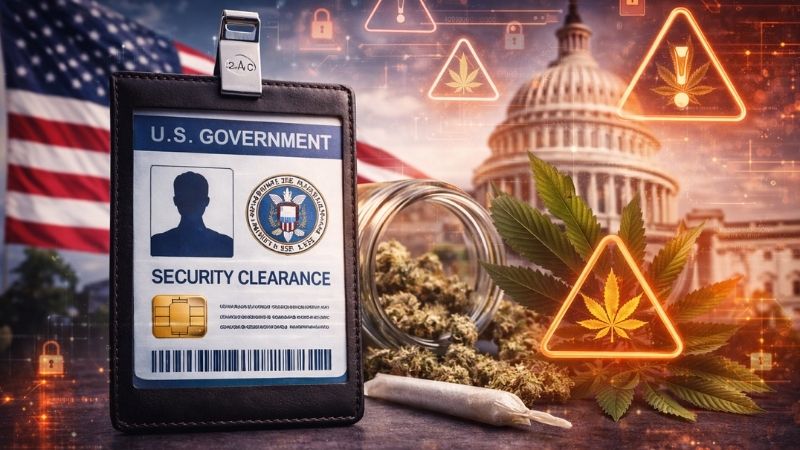
Marijuana, or its derivative THC, continues to be a treacherous quagmire for security clearance holders and adjudicators alike. The latest complication of this quagmire occurred on December 18, 2025, when President Donald Trump signed a new executive order regarding the reclassification of marijuana from a Schedule I controlled substance to a Schedule III controlled substance: “Increasing Medical Marijuana and Cannabidiol Research.”
Was Marijuana Reclassified as a Schedule III Drug?
Not yet. While numerous media outlets reported that President Trump’s executive order reclassified marijuana from a Schedule I controlled substance to a Schedule III controlled substance, it did nothing of the sort. Rather, the Order directs the Attorney General, Pam Bondi, to “take all necessary steps to complete the rulemaking process related to rescheduling marijuana to Schedule III of the [Controlled Substances Act].” In other words, marijuana remains a Schedule I controlled substance (for now).
The real push behind this initiative is for the federal government to recognize medicinal uses for marijuana, thereby legally permitting medicinal research and use. The change, if and when it arrives, would usher in a significant shift in the regulation of marijuana. Schedule I substances are defined as drugs with a high potential for abuse, and no currently accepted medical use in the United States, including under medical supervision. In other words, there is no federally legal way to use a Schedule I substance, such as marijuana, heroin, DMT, LSD, psilocybin, and MDMA.
What Does It Mean for Marijuana to Be a Schedule III Drug?
Schedule III substances have a lower potential for abuse than Schedule I and II drugs, have an accepted medical use in the United States, and may cause moderate or low physical dependence or high psychological dependence. Schedule III substances include Tylenol with less than 90 milligrams of codeine, ketamine, anabolic steroids, or testosterone. If marijuana was reclassified to a Schedule III controlled substance, it would open the door for security clearance holders to use marijuana with a valid medical prescription.
Would Rescheduling Marijuana Change the Rules for Security Clearance Purposes?
Not necessarily. The Security Executive Agent Directive (SEAD) 4, has three possible categories of concern with the use of marijuana found in Guideline E (personal conduct), Guideline H (drug use), and Guideline J (criminal conduct). Reclassification from Schedule I to Schedule III does not eliminate the use of marijuana as a national security concern. The misuse of a prescription or non-prescription drug in a manner inconsistent with its intended purpose raises a question of a person’s reliability, trustworthiness, and good judgment. Further, every agency and federal government contractor may have its own policy prohibiting the use of medicinal marijuana, thereby making a violation of that policy a security concern.
Can Security Clearance Holders Access Medical Marijuana?
Potentially, in some cases. A change from Schedule I to Schedule III means that marijuana, according to the federal government, would have an accepted medical use in the United States. Whereas, previously, federal employees, military members, and security clearance holders could not use marijuana under any circumstances (legal or not at the state level). Schedule III reclassification could potentially allow for the use of marijuana under the specific restrictions and supervision of a medical provider.
Yet, the changing legal landscape, at the state and federal level, introduces ambiguity. If reclassification were to occur, security clearance holders would still need to consider a multitude of factors before stepping into a quagmire that could place their clearance in jeopardy.