
Then March 14 arrived with a different email.
“In accordance with the President’s Executive Order entitled Hiring Freeze… the Department hereby rescinds your final offer.”
Thousands of students received similar emails this year. DOJ legal internships. FDIC positions. Veterans Health Administration placements. One law student had already given notice to her landlord, expecting summer in Washington, D.C. Instead, she spent five hours daily scrambling for any opportunity.
If you dream of serving in national security, I won’t pretend 2025 has been anything other than brutal. But you can use this moment to become a more knowledgeable, credible, and prepared candidate than you would have been otherwise.
Let me explain.
What Actually Happened
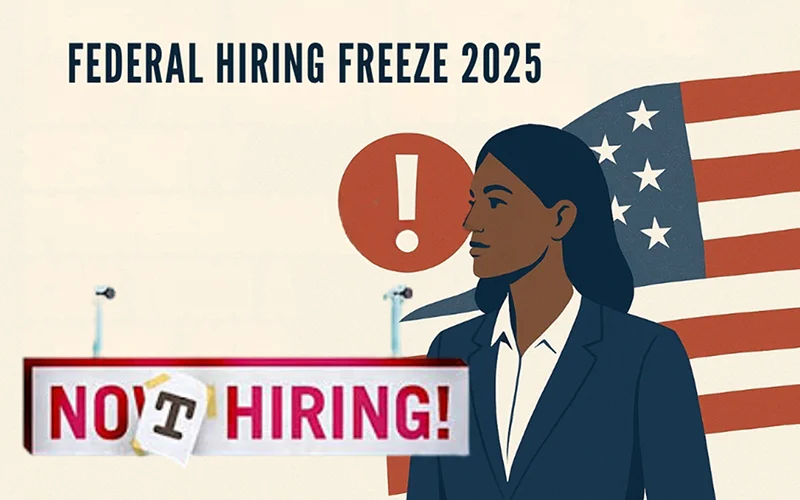
On January 20, 2025, a federal hiring freeze went into effect. Initially 90 days, it was extended in April, again in July, and again in October—this time indefinitely, with no end date.
The numbers:
- Over 300,000 federal employees projected to leave by year’s end
- State Department: 1,350 laid off, 3,000 positions eliminated
- USAID: reduced from 5,000+ to 290 personnel
- Government-wide goal: hire one for every four who leave
Exemptions exist for immigration enforcement, public safety, and military, but even these require Strategic Hiring Committee approval. The National Geospatial-Intelligence Agency suspended high school internships and scholarship programs.
Both parties have implemented hiring freezes before. They’re blunt instruments that always hurt early-career people most.
Why This Matters
I spent over two decades in national security. Six years as a Naval Flight Officer on nuclear deterrent missions. Over 20 years at State, including field time in Helmand Province, Afghanistan, and roles at FBI, DHS, INTERPOL, and DoD. I served as Director of the Office of Countering Violent Extremism and Acting Director for the Office of the Special Envoy to Defeat ISIS.
That career took decades to build. The expertise—institutional knowledge, relationships, understanding terrorist networks, building international coalitions—couldn’t be downloaded in a training course.
Look at what we face:
- Ukraine and the largest European land war since WWII
- Middle East realignments that make the Cold War look simple
- China’s systematic displacement of American influence
- Cyber threats that could cripple critical infrastructure
- AI-enabled disinformation at scale
- Transnational terrorism evolved far beyond post-9/11
This creates a multi-year gap in our national security workforce pipeline.
Expertise has a half-life. When a counterterrorism analyst with 15 years walks out, you can’t replace that with a brilliant college grad. When Foreign Service Officers who speak Pashto and understand Afghan tribal dynamics leave, that capacity can’t be quickly rebuilt.
Government hiring already takes 12-18 months for cleared positions. A multi-year freeze creates a “missing cohort.” The 23-year-old who should be getting her first clearance this year will be 26 or 27 before she starts.
Turn Waiting Time into Preparation Time
Here’s the reality: you can’t control hiring timelines, but you can control how you use this time.
I’ve served under six administrations. Agencies get reorganized, budgets get slashed and restored, priorities get shifted. The professionals who thrived kept building capabilities regardless of circumstances.
Every government hiring crisis has been followed by a surge. Post-9/11, we couldn’t hire fast enough. After 2008’s freezes, the thaw brought a scramble for talent. The work doesn’t disappear.
When hiring resumes—and it will—which candidate gets hired? The one who gave up and pivoted to investment banking? Or the one who spent freeze years learning Mandarin, earning a security studies master’s, working for defense contractors, and proving commitment regardless of obstacles?
The freeze gave you time to build a foundation that will serve you for decades. Use it to become more knowledgeable, more credible, and more capable than you would have been rushing into a junior position.
What to Do Right Now
I’ve spoken to dozens of young professional groups this year—UVA and Catholic University just last week. The questions are always the same: What should I do now? Is it worth staying committed?
Absolutely yes. Here’s how:
Build Skills That Take Years
Languages like Mandarin, Arabic, Russian, Farsi, and Korean require 2,200+ class hours. Start now. I learned Pashto for Afghanistan—communicating directly with tribal elders made me infinitely more effective.
Master technical skills: cyber operations, data science, AI, OSINT. Learn Python. Understand large language models. When building the coalition to defeat ISIS, we used data analysis to track foreign fighter flows. Those analysts were invaluable.
Pick a region and become an expert. Understand history, political dynamics, ethnic and religious complexities. Context matters.
Practice writing clearly. National security professionals constantly write assessments and briefing papers. Start a blog or Substack. Translating complexity into clarity serves you forever.
Get Alternative Experience
Defense contractors (Leidos, Booz Allen, SAIC, Northrop Grumman, BAE Systems) still hire for positions requiring security clearances. The work mirrors government roles. Government offices value people who’ve seen both sides.
Think tanks hire research assistants. You’ll work on cutting-edge policy, publish research, and build networks.
State and local homeland security fusion centers work closely with federal partners. Academic research positions develop analytical skills.
Build Your Network
The national security community is surprisingly small. Join professional associations. Build a LinkedIn presence with thoughtful analysis. Reach out for informational interviews—people still mentor.
IN Network connects young people with experienced professionals who’ve weathered these cycles. We’re still investing in the next generation because America will need dedicated, capable professionals in the years ahead.
Invest Strategically
Master’s programs in international relations, security studies, or regional studies pay dividends. The network matters as much as coursework.
Get certifications: Security+ for cyber, PMP for operations. Document language proficiency through DLPT or OPI.
Follow current events obsessively. The Cipher Brief, War on the Rocks, Lawfare, Foreign Affairs, Code Name: Citizen, and regional publications of your choice. You need to speak intelligently about threats and policy.
Consider Alternative Pathways
Military service provides leadership experience, clearances, technical training, and hiring preference. The discipline and operational experience are invaluable.
Fellowships like Fulbright and Boren Awards provide experience and credibility.
Be Financially Smart
Reduce student debt—it’s the enemy of career flexibility. Build 6-12 months savings. Plan for a potentially multi-year timeline to federal employment. That means be strategic and patient, not give up.
The Long Game
I flew nuclear deterrent missions in my 20s. I briefed ambassadors and generals in my 30s. I led offices combating violent extremism and defeating ISIS in my 40s and 50s.
The through-line was commitment regardless of obstacles. Reorganizations, budget cuts, policy reversals, changing priorities. The professionals who thrived kept building expertise and stayed focused on the mission.
Some of your peers will decide government service is too uncertain and pivot to consulting, tech, or finance. No judgment—those are legitimate choices.
But some won’t give up. They’ll use this time to become formidable. They’ll learn languages, build technical skills, develop regional expertise, and create networks that make them invaluable when hiring resumes.
I spent a year in Helmand Province. I saw what happens when America lacks expertise in critical regions, when we don’t have enough people who speak the languages or understand the cultures. I saw the cost of institutional knowledge gaps.
That capability doesn’t build itself. It requires a new generation stepping up when it would be easier to walk away.
Someone invested in me during uncertain times. That’s why I’m investing in you through IN Network. The work will still be there—possibly more urgent—when this freeze ends.
Don’t let this moment turn you away. Let it make you sharper, more prepared, more resilient. When doors reopen—and they will—be the candidate who’s impossible to turn down.
The national security of the United States doesn’t depend on perfect hiring cycles. It depends on people willing to commit to the long game, who understand service is measured in decades, not job offers.
This is your long game. Start playing it.