
Human trafficking remains one of the most complex criminal threats facing modern law enforcement and homeland security professionals. Despite significant policy attention and expanding enforcement efforts, the United States still lacks a comprehensive picture of the true scope of trafficking.
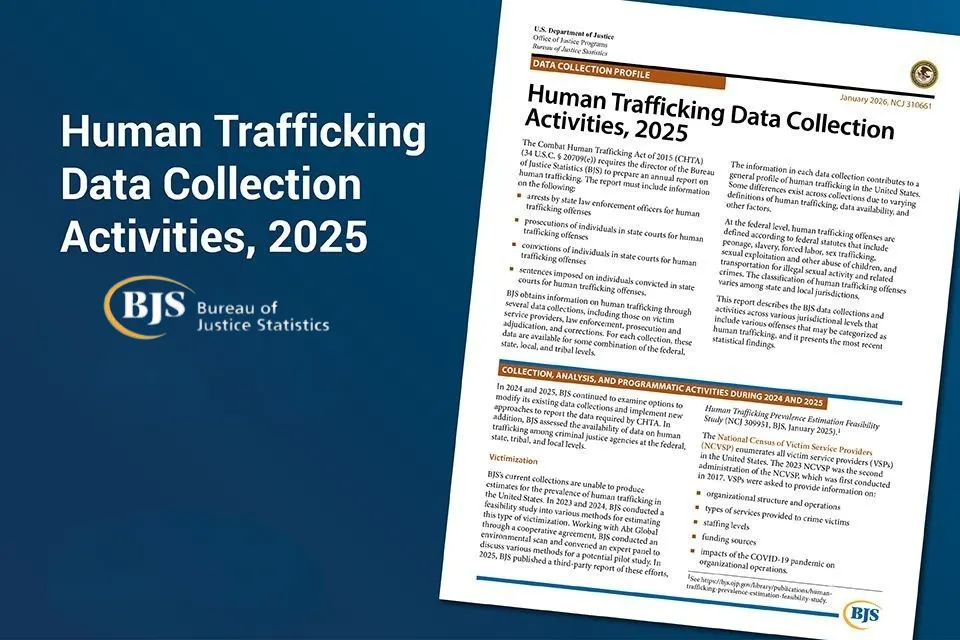
A report published in January 2026 from the Bureau of Justice Statistics (BJS) titled Human Trafficking Data Collection Activities, 2025, highlights both progress and persistent gaps in how trafficking is measured and understood across the criminal justice system. The findings illustrate a paradox: while prosecutions and investigative activity have increased over the past decade, the federal government still cannot produce reliable estimates of how prevalent human trafficking actually is in the United States.
For investigators and policymakers alike, the report offers an important reminder that data—and the systems used to collect it—play a central role in the fight against trafficking.
The Challenge of Measuring Human Trafficking
Under the Combat Human Trafficking Act of 2015, BJS is required to produce an annual report on trafficking activity across the United States. The law mandates data collection on arrests, prosecutions, convictions, and sentencing outcomes for trafficking offenses. However, assembling that information across thousands of law enforcement agencies, courts, and correctional institutions remains difficult.
The BJS report notes that current data systems are “unable to produce estimates for the prevalence of human trafficking in the United States.” To address this gap, BJS conducted a feasibility study in partnership with Abt Global to explore methods for estimating national trafficking victimization.
This challenge reflects a fundamental problem in trafficking investigations: much of the crime remains hidden. Victims often do not self-identify, cases may be recorded under different criminal statutes, and definitions of trafficking vary across jurisdictions. As a result, the data that exists largely reflects cases detected by law enforcement, not the full scope of victimization.
What Law Enforcement Data Shows
The FBI collects national trafficking data through its Uniform Crime Reporting system and the National Incident-Based Reporting System (NIBRS). These systems track incidents involving:
- Commercial sex trafficking
- Involuntary servitude and forced labor
According to national estimates derived from NIBRS data, law enforcement agencies recorded approximately 2,950 human trafficking incidents involving an estimated 3,570 victims in 2022. Sex trafficking dominated those cases:
- 81% of incidents
- 78% of victims
These numbers provide valuable operational insight but still represent only crimes known to law enforcement, which means the true number of victims is likely much higher.
Federal Prosecutions Continue to Rise
While incident counts remain relatively small compared to other crimes, federal enforcement activity has increased significantly over the past decade. According to BJS data:
- 2,329 suspects were referred to U.S. attorneys for trafficking offenses in FY 2023.
- 1,782 suspects were prosecuted.
- 1,008 defendants were convicted.
Compared to 2013, this represents:
- A 23% increase in referrals
- A 73% increase in prosecutions
- A 64% increase in convictions
These numbers suggest that investigative and prosecutorial capabilities have improved substantially. However, they also highlight the resource-intensive nature of trafficking cases, which often require long-term investigations, victim support services, and complex evidence collection.
Who Are the Defendants?
Federal court data offers insight into the demographics of individuals charged with trafficking-related offenses. Among defendants charged in U.S. district courts in FY 2023:
- 92% were male
- 63% were white
- 17% were Black
- 16% were Hispanic
- 96% were U.S. citizens
The median age of defendants was 35 years, with the majority between 25 and 49 years old. These statistics underscore that trafficking offenses are largely committed by adult offenders operating within the United States rather than by international criminal actors alone.
Trafficking in the Prison System
Corrections data provides another lens for understanding trafficking activity. According to the National Corrections Reporting Program, state prison systems reported:
- 916 prison admissions for trafficking offenses in 2023
- 2,220 individuals incarcerated for trafficking at year end
- 676 individuals released after serving trafficking-related sentences
Importantly, the percentage of prison admissions related to trafficking has increased every year from 2019 through 2023. While the numbers remain small relative to total prison admissions, the trend suggests growing identification and prosecution of trafficking offenses.
The Data Still Has Major Blind Spots
Despite improvements in federal reporting systems like NIBRS, trafficking data remains fragmented across agencies. Several structural issues complicate national measurement:
- Varying Definitions
Federal statutes define trafficking differently from many state laws, complicating classification across jurisdictions.
- Inconsistent Reporting
Not all law enforcement agencies fully participate in NIBRS or maintain consistent data-entry practices.
- Hidden Victims
Many trafficking victims never come into contact with law enforcement or victim service providers.
- Case Classification
Trafficking conduct may be prosecuted under other statutes such as child exploitation, prostitution, kidnapping, or labor violations. For these reasons, the BJS report cautions that official statistics likely capture only a portion of trafficking activity.
Why Better Data Matters
For homeland security and law enforcement professionals, improved trafficking data is more than a statistical exercise—it directly affects operational capability. Better data systems can help:
- Identify trafficking hotspots and emerging trends
- Allocate investigative resources more effectively
- Improve victim identification
- Strengthen collaboration across jurisdictions
Most importantly, reliable data can help policymakers evaluate whether current anti-trafficking strategies are actually working.
Moving Toward a More Complete Picture
The federal government’s effort to modernize crime reporting systems represents an important step toward better understanding trafficking. But the fight against trafficking will ultimately depend on more than improved statistics.
It will require stronger collaboration among law enforcement, prosecutors, victim service providers, researchers, and the technology sector—along with investigative tools capable of uncovering the hidden networks behind exploitation.
Until then, the numbers we see may only represent the visible edge of a much larger problem.