
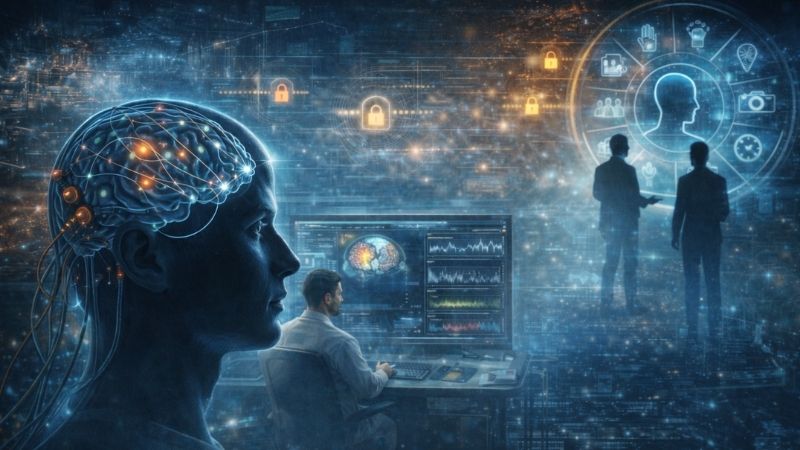
”The loss of mental privacy and the risk of mental manipulation present challenges that were previously unimagined and which demand immediate action.”
— Jared Genser.1
Introduction
Identity Intelligence (I2) is a specialized field that merges diverse data sources to build comprehensive profiles of targeted individuals. Essentially, I2 has two main functions: uncovering the identities and intentions of adversaries (discovery) and protecting the identities of friendly operators (concealment). Modern I2 extends beyond traditional pattern-of-life analysis by integrating biological, biographical, behavioral, and reputational data from multiple intelligence disciplines. Its primary objective, nevertheless, remains in identifying unknown or potential threats by linking individuals to locations, events, or materials, analyzing their routines, and assessing the risks they pose to U.S. national security interests.1, 2
Historically, analysts relied on biographical data — such as names, addresses, and travel records — to confirm or challenge identities. In today’s digital environment, behavioral data, like online activity, purchase patterns, and financial transactions, are also analyzed. Combined, these information streams reveal an individual’s routines, habits, and associations, providing the essential elements needed for effective operational planning.3
Biological data, on the other hand, comprises physical traits and biometrics—such as fingerprints, DNA, and iris scans of eyes, to name a few. Despite these established techniques, however, a new realm is emerging within the study of neuroscience, which has the potential to revolutionize biological I2 by leveraging the most unique data source of all: the human mind.4
Cognitive Technologies: The Basics
Traditionally, the intelligence community has relied on biographical, behavioral, and specific biological data for discovery. However, emerging neurotechnologies are introducing new methods that allow analysts to incorporate cognitive information into their work. The widespread adoption of such technologies, however, will depend, in part, on ongoing advances in neuroscience that improve the fidelity and accuracy of cognitive measurements. Nevertheless, although still in early development, these techniques have shown limited but promising results in laboratory settings for identification purposes.5 For instance, controlled studies indicate that the brain’s responses to stimuli can act as reliably distinct and stable markers when analyzed with neuroimaging methods, such as through the use of functional magnetic resonance imaging (fMRI) and electroencephalography (EEG) techniques, particularly when enhanced by artificial intelligence and sophisticated cognitive computational algorithms.6, 7
While the specifics of the cognitive refinement process that underlies the formation of unique cognitive signatures are beyond the scope of this article, it basically refers to the brain’s innate neuroplasticity—its ability to form, strengthen, or weaken neural pathways in response to life experiences. Through a complex dynamic interplay between genetic factors—which provide the brain’s blueprint—and personal experiences, an individualized “connectome” emerges which is essence is a map of the brain that blends electrical activity and structural connections into a unique “cognitive fingerprint.” Although this cognitive fingerprint may evolve throughout life, research indicates that core patterns within the connectome generally remain stable enough for consistent identification in most individuals by early adolescence, between ages 7 to 12. In other words, researchers have found that cognitive signatures, which again, are unique neural patterns shaped by genetics and experience—have the potential to offer a novel means of identifying individuals and, potentially, even the capacity to interpret brain activity in efforts to detect deception.8, 9
Counterintelligence Applications:
In counterintelligence, cognitive fingerprinting—a term commonly used to describe the application of this neuroscientific knowledge—can theoretically detect deception by analyzing brain activity during questioning. Unlike conventional methods that rely on verbal or behavioral cues, which subjects like professionally trained I2 operatives can consciously control, analysts can employ neurotechnologies to observe unique neural responses.10 Successful analysis requires establishing a baseline, or “cognitive fingerprint,” representing the subject’s typical brain responses to various stimuli. This method draws in part on research conducted by Dr. Lawrence Farwell, known sometimes controversially, for focusing on the P300 wave, which is an involuntary brain response that occurs within milliseconds after an individual recognizes information.11 During an interrogation, a subject’s neural activity would be measured through an fMRI or EEG device and compared to their baseline. If patterns, especially the P300 wave, deviate in ways linked to deception, this could theoretically, and arguably, have been demonstrated to showcase dishonest responses.12 Additionally, the technique can reveal “hidden knowledge” if a subject’s neural response unexpectedly shows familiarity with sensitive information, such as classified data, despite their denials. As such, this approach advances counterintelligence tradecraft beyond traditional behavioral analysis to a neurological level, providing a potentially more reliable detection tool.
Protection and Concealment: The Role of BCIs
Beyond revealing information through brain responses, the cognitive domain can also enhance the protection and concealment of I2 operatives, particularly through new technologies such as bi-directional brain-computer interfaces (bBCIs). Unlike traditional brain-computer interfaces, which enable users to control external devices with their thoughts, bBCIs facilitate two-way communication; in essence, not only can the brain control devices, but connected devices can also send information or stimulation back to the brain.13
The rise of bBCI technology brings both promise and risk for I2 operations. The technique of brain tapping—directly extracting information from intercepted brainwaves—offers significant opportunities for discovery and covert intelligence gathering, much like cognitive fingerprinting, but without the subject’s awareness.14 This could allow I2 analysts to access deeply hidden information outside the reach of traditional methods. However, the same technology introduces concerns about brain hacking, where hostile actors could manipulate or exploit brain activity via the introduction of nefarious signal interjection technologies, thereby raising the risk of unauthorized information leaks or even behavioral influence without consent, posing serious threats to operator safety and mission integrity.15
In addition to the discussion of the pros and cons of incorporating bBCI technologies into the I2 toolkit, bBCI technologies may also prove valuable for operator concealment, by assisting in both the recruitment and selection process of potential operators, as well as providing a necessary training device. During recruitment, for instance, bBCI technologies could objectively assess the innate cognitive traits crucial for I2 personnel, such as attention, focus, and mental workload, which can be measured under high-stress conditions.16 In theory, this could help identify candidates best suited for demanding roles. Additionally, since bBCI technologies are inherently dual-use, they have been incorporated into various commercial sectors, including the gaming industry. Neurogaming promises an interactive gaming experiences in which the intensity of the game (e.g., difficulty, vividness, violence, fear level) is bio-synchronized based on the player’s neural readings. 17, 18 In time, as neurogaming advances, the I2 community could incorporate elements into interactive training sets for onboarding operators as a mechanism to condition and learn to conceal their own biological markers, such as cognitive signatures, thereby enhancing operational security protocols.
Conclusion: Reshaping Identity Intelligence
Cognitive technologies are ushering in a transformative era for Identity Intelligence. By moving beyond conventional data sources, I2 can uncover valuable information through the analysis of human thoughts. The implementation of cognitive fingerprinting provides an objective, deception-resistant method for recognizing concealed knowledge. Additionally, bi-directional brain-computer interfaces and neurogaming are revolutionizing operational security by enabling operators to adapt their cognitive signatures for concealment. Collectively, these innovations redefine the methods used to identify adversaries and safeguard friendly forces, marking a significant evolution in I2 as a whole.
The author is responsible for the content of this article. The views expressed do not reflect the official policy or position of the National Intelligence University, the Office of the Director of National Intelligence,, the U.S. Intelligence Community, or the U.S. Government.
Footnotes:
1. Peter Baber, Pamela Baker, and Mark Dotson, “Identity Intelligence Contributes to Multi-Domain Operations,” Military Intelligence 46, no. 1 (2020): 28-30.
2. U.S. Air Force, Air Force Doctrine Publication 2-0: Intelligence, AFDP 2-0 (Washington, D.C.: Department of the Air Force, 2025): 25.
3. David Vergun, “The Situation Report: Pentagon Evolves Identity Management,” MeriTalk, September 14, 2016, https://www.meritalk.com/the-situation-report-pentagon-evolves-identity-management/.
4. Nita A. Farahany, The Battle for Your Brain: Defending Your Right to Think Freely in the Age of Neurotechnology (New York: St. Martin’s Press, 2023).
5. Christopher Mims, “Brain-Hacking Is Coming,” Slate, August 20, 2012, https://slate.com/technology/2012/08/brain-hacking-eeg-scanners-tap-your-mind-for-private-data.html.
6. Lawrence A. Farwell, “Brain fingerprinting: a comprehensive tutorial review of detection of concealed information with event-related brain potentials,” Cognitive Neurodynamics 6 (2012): 115-154.
7. NPR, “Brain-Computer Implant Lets Man Speak His ‘Inner Speech’ From His Mind,” NPR, August 20, 2025, https://www.npr.org/sections/shots-health-news/2025/08/20/nx-s1-5506334/brain-computer-implant-speak-inner-speech-mind.
8. Yong He et al., “High-accuracy individual identification using a thin slice of the functional connectome,” ResearchGate, September 2018, https://www.researchgate.net/publication/327661251_High-accuracy_individual_identification_using_a_thin_slice_of_the_functional_connectome.
9. Emily S. Finn et al., “Functional connectome fingerprinting: Identifying individuals based on patterns of brain connectivity,” Nature Neuroscience 18, no. 11 (November 2015): 1664–1671, https://www.google.com/search?q=https://www.researchgate.net/publication/ 282367527_Functional_connectome_fingerprinting_Identifying_individuals_based_on_patterns_of_brain_connectivity.
10. Jack Barsky with Cindy Coloma, Deep Undercover: My Secret Life & Tangeled Allegiances As a KGB Spy in America (Carol Stream, IL: Tyndale Momentum, 2017).
11. Lawrence A. Farwell, Drew C. Richardson, and Graham M. Richardson, “Brain fingerprinting field studies comparing P300-MERMER and P300 brainwave responses in the detection of concealed information,” Cognitive Neurodynamics 7, no. 4 (August 2013): 269–283, https:// www.researchgate.net/publication/250920768_Brain_fingerprinting_field_studies_comparing_P300-MERMER_and_P300_brainwave_responses_in_the_detection_of_concealed_information.
12. ibid., 8-15.
13. Nita Farahany, “The Battle for Your Brain: Defending Your Right to Think Freely in the Age of Neurotechnology,” YouTube, Carnegie Council for Ethics in International Affairs, January 22, 2024, https://www.youtube.com/watch?v=RrCPr_ROhgg.
14. World Economic Forum, “The brain-computer interface market is growing, but what are the risks?,” World Economic Forum, June 20, 2024, https://www.weforum.org/stories/2024/06/the-brain-computer-interface-market-is-growing-but-what-are-the-risks/.
15. Alexandre Armengol-Urpi, Reid Kovacs, and Sanjay E. Sarma, “Brain-Hack: Remotely Injecting False Brain-Waves with RF to Take Control of a Brain-Computer Interface” (unpublished manuscript, Massachusetts Institute of Technology, n.d.).
16. Benjamin Blankertz et al., “The Berlin brain-computer interface: non-medical uses of BCI technology,” Frontiers in Neuroscience 4 (December 2010), https://doi.org/10.3389/fnins.2010.00198.
17. FasterCapital, “Brain-computer interface: Brain-Computer Interfaces in Gaming: The Next Level of Immersion,” FasterCapital, n.d., https://fastercapital.com/content/Brain-computer-interface–Brain-Computer-Interfaces-in-Gaming–The-Next-Level-of-Immersion.html.
18. Matej Vrbnjak, Marjan Mernik, and Domen Verber, “Difficulty Adjustment Using Player’s Performance and Electroencephalographic Data,” ResearchGate, May 2023, https://www.researchgate.net/publication/370451792_Difficulty_Adjustment_Using_Player’s_Performance_and_Electroencephalographic_Data.