
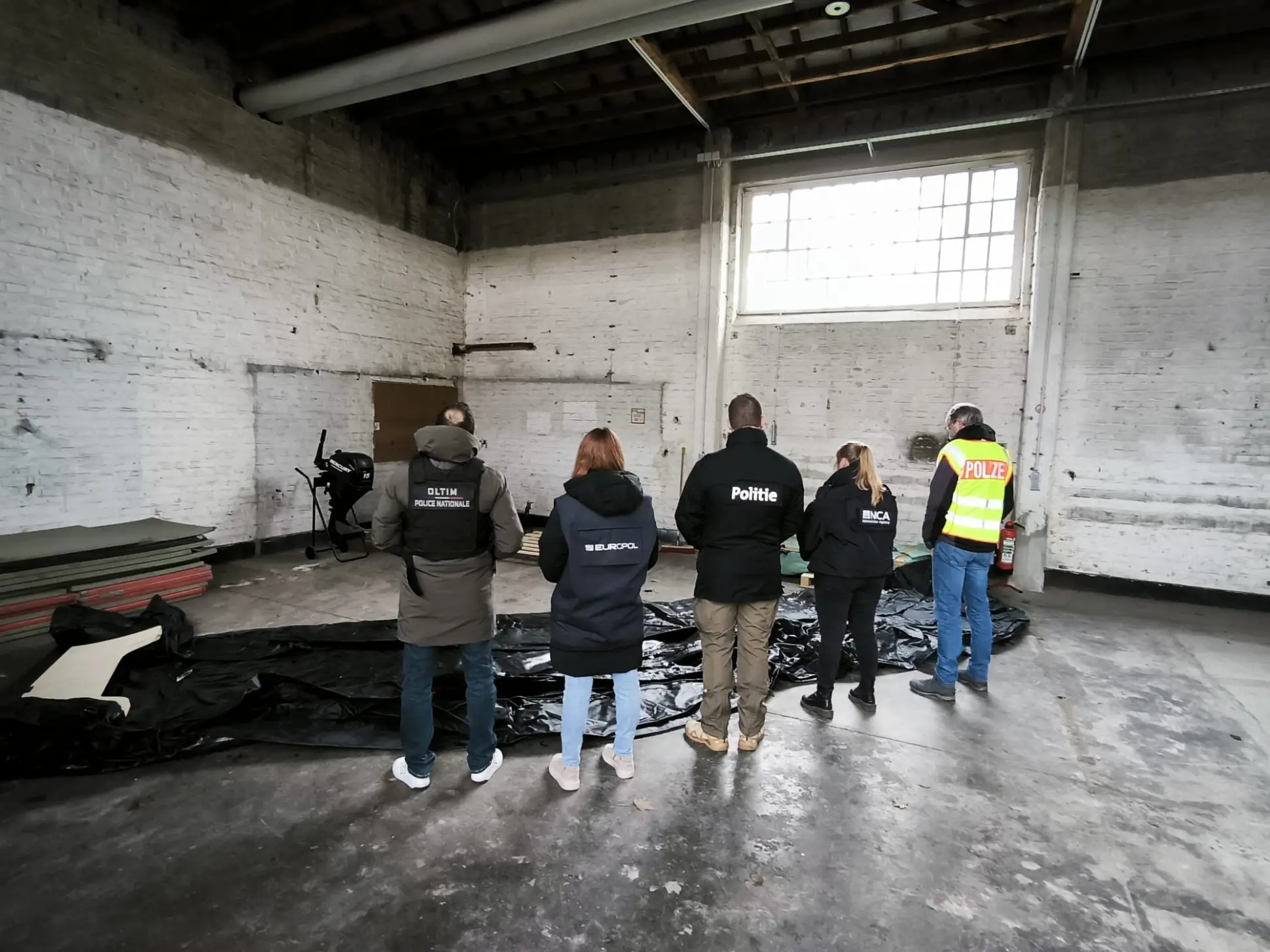
A joint investigation conducted under the framework of a Europol task force resulted in a significant disruption of the migrant smuggling supply chain serving criminal networks active along the English Channel. This operation is the outcome of close cooperation between law enforcement and judicial authorities from Belgium, France, Germany, the Netherlands, and the United Kingdom, with support from Eurojust.
Throughout the investigation, authorities from Belgium, France, Germany, and the Netherlands arrested a total of 17 individuals associated with the criminal network, who were involved in low-level logistical roles. Four suspected organisers, Syrian nationals, were arrested during the action day. The criminal network is suspected of arranging frequent deliveries of nautical equipment.
Results from 25 March:
- 14 locations searched (2 in Belgium and 12 in Germany)
- 4 High Value Targets arrested
- Seizures including: Seizures including: 11 boats, 1 engine, boxes of inner tubes, life vests, weapons, gold bars, over 30 electronic devices and almost EUR 60 000 in cash.
The investigation, initiated in 2025, targeted a criminal syndicate composed of Iraqi-Kurdish and Syrian members. This syndicate supplied networks that organised dangerous sea smugglings using small inflatable boats. The equipment was produced in Asia and imported from Türkiye via sea and land borders, arriving in bulk in Germany. There, it was stored in warehouses controlled by the network. The equipment was used to assemble unique sea smuggling packages, coordinated by an associated group. It is worth mentioning that the packages included inner tubes to be used by the migrants during the crossing in place of proper life vests.
Each smuggling package, worth over EUR 10 000 on the black market, included items such as an inflatable boat, engine, pumps, petrol jerry cans and tyre inner tubes. Criminal networks operating in Northern France purchased these kits in Germany or had them delivered to the French shores, often for an additional fee. They used the equipment to smuggle migrants across the English Channel using low-quality inflatable boats, many of whom originate from the Middle East and East Africa.
Highly profitable criminal activity
In 2025, more than 41 000 migrants and 670 boats successfully reached the UK. Over half of them originated from Eritrea, Afghanistan, Sudan, Iran, and Somalia. The loss of life remains a concern – 31 migrants became victims of the life-threatening smuggling attempts across the English Channel. On average, there were 66 migrants per boat that reached UK shores last year. Just one migrant pays between EUR 1 000 and EUR 2 000 for the perilous trip. As the nautical kits are sold for between EUR 10 000 and EUR 20 000, this suggests that criminal networks could earn as much as EUR 100 000 per boat.
Targeting criminal networks at scale
Migrant smuggling is a serious form of organised crime that endangers the lives of irregular migrants and undermines the security of EU citizens. Criminal networks treat human beings as commodities, smuggled in fishing boats, car trunks or freezing lorries. Vulnerable people often pay tens of thousands of euros for these perilous journeys. Violence has also become a defining feature of this criminal business model. Migrant smuggling networks increasingly rely on threats, kidnappings, beatings, sexual abuse and torture to extort migrants and their families for ransom.
Through its new European Centre Against Migrant Smuggling, established in March 2026, Europol is stepping up its efforts to combat this life-threatening and often inhumane criminal activity. Europol’s efforts focus on identifying and prioritising High Value Targets, mapping criminal networks and facilitators, and tracing, freezing and confiscating criminal proceeds across borders. By disrupting the financial and logistical foundations of these networks, Europol directly targets the profitability of migrant smuggling.
Operational taskforces targeting the entire migrant smuggling chain
Migrant smuggling networks operate far beyond EU borders. Europol strengthens cooperation with key partner countries through strategic and operational cooperation. This external engagement enhances the ability to dismantle criminal networks operating along entire smuggling routes and reinforces operational responses, including through operational taskforces. This operation builds on the outcomes of the previous Europol operational taskforces focused on migrant smuggling via small boats.
This latest investigation was conducted under a new operational taskforce, set up in 2025 and bringing together authorities from Belgium, France, Germany, the Netherlands and the United Kingdom to target criminal groups involved all along the migrant smuggling organisational chain for life-threatening crossings across the English Channel. The taskforce focuses on the logistical coordination and key organisers with particular attention to High Value Targets behind these networks.
Hands-on operational support
Europol supported the investigation by facilitating operational coordination, organising operational meetings and enabling the exchange and analysis of intelligence, which helped identify links between multiple national investigations. Europol also established a dedicated financial instrument to support participating countries and high-profile investigations. On the action day, Europol deployed two experts on the ground to assist German authorities with operational coordination and handle cross-checking of operational information against Europol’s databases in real time.
Eurojust supported the judicial cooperation by facilitating the exchange of information between national authorities and ensuring that the necessary legal instruments, including European Investigation Orders and European Arrest Warrants, were in place.
New Europol centre reinforces support against migrant smuggling
Migrant smuggling remains a key criminal threat for the EU, requiring coordinated action across the entire criminal chain – from recruitment and transit to the financial flows that support it. Europol supports investigations through a data-driven approach, enhancing cases provided by national authorities with operational analysis and expertise. Europol also facilitates information exchange and coordinates joint operations to disrupt criminal networks.
To strengthen Europol’s efforts to combat migrant smuggling, Regulation (EU) 2025/2611 was adopted in December 2025. This new EU legislation underscores the importance of addressing migrant smuggling at the EU level through enhanced cooperation, including the establishment of Europol’s European Centre Against Migrant Smuggling (ECAMS) in March 2026.
ECAMS ensures better systematic exchange of information and coordination of efforts. This includes strengthening expertise in OSINT and financial investigations, as well as enhancing the operational impact of the network of liaison officers from Frontex, Eurojust, and the Member States.
Law enforcement authorities involved:
- Belgium: Belgian Federal Police (Federale Politie / Police Fédérale)
- France: French Border Police (OLTIM-Office de lutte contre le trafic illicite de migrants)
- Germany: German Federal Police (Bundespolizei)
- The Netherlands: Royal Netherlands Marechaussee (Koninklijke Marechaussee)
- United Kingdom: National Crime Agency
Judicial authorities involved:
- Belgium: Investigative Judge in Bruges (Parket Brugge); Federal Prosecutors’ Office (Federaal Parket)
- Germany: General Prosecutor’s Offices of Hamm (Generalstaatsanwaltschaft Hamm), Public Prosecutor Office Düsseldorf (ZeOS NRW), Public Prosecutor Office Essen (Staatsanwaltschaft Essen)
- The Netherlands: National Public Prosecutors’ Office (Openbaar Ministerie)
- United Kingdom: Crown Prosecution Service
The original announcement can be found here.