


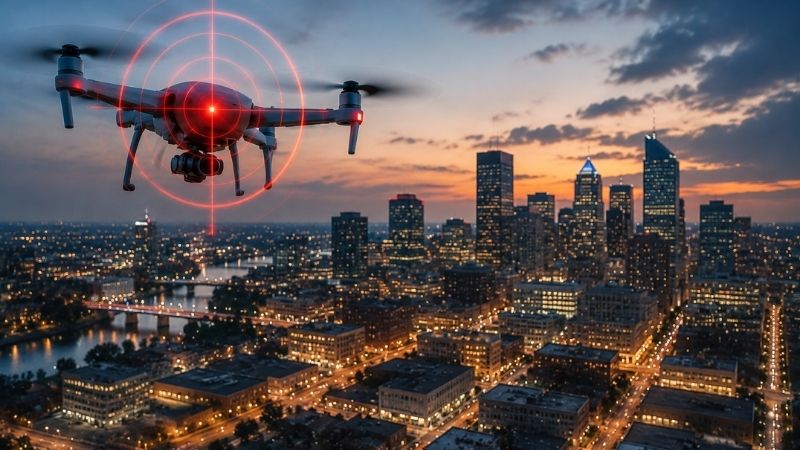
An unauthorized drone approaches a city hall carrying an unknown payload. Security professionals watch it on their screens. They identify it, they track it, and they notify authorities. Then they wait, not because they lack technology, but because they lack authority to act. Twenty years ago, communities recognized that ambulances could not always arrive before sudden cardiac arrest claimed a life. The solution was not to make ambulances faster. It was to distribute automated external defibrillators to the point of need and delegate their use to trained local personnel. Drone defense presents a remarkably similar operational problem. Response capability must already exist where the incident occurs. The capability of the sUAS (Drone) and its potential effects on a myriad of market verticals make this one of the most important security concerns of the last several decades.
The next major drone incident in America might begin at a military installation, airport, or critical infrastructure facility, but it is far more likely to occur over a city hall, police headquarters, courthouse, public festival, water treatment plant, or municipal utility. The challenge is not that local governments fail to recognize the threat. It is that they possess virtually no legal authority to respond once they identify it, and the Safer Skies Act doesn’t go far enough or provide enough capacity to serve all the needs across the country. This represents one of the most significant gaps in American public safety today.
Over the past several years, the proliferation of inexpensive commercial drones has fundamentally changed the security landscape. Events across the United States and lessons emerging from Ukraine demonstrate that small, unmanned aircraft are no longer simply recreational devices or photography platforms. They have become intelligence collection systems, contraband delivery mechanisms, harassment tools, and increasingly, precision weapons. Yet while the threat has evolved rapidly, the authorities granted to municipal governments have remained largely unchanged. The result is a dangerous imbalance. Cities are increasingly responsible for protecting citizens, public facilities, and major events, but they remain almost entirely dependent upon federal agencies for the authority to stop an airborne threat that may last less than two minutes. That model no longer works.
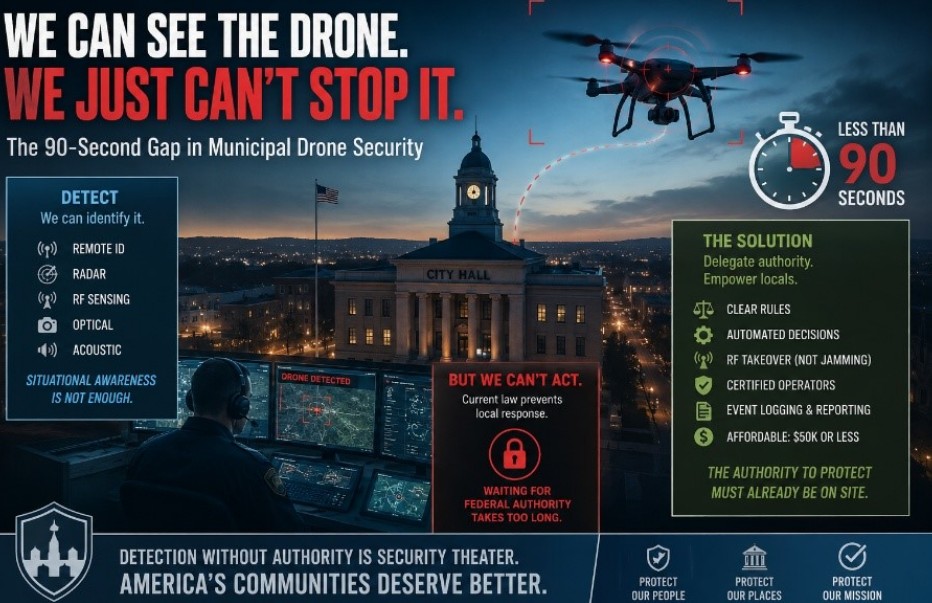
The Ninety-Second Problem
Time is the defining factor. A drone traveling only thirty miles per hour can cover more than half a mile in one minute. Faster systems travel considerably farther. By the time a police officer receives a report, drives to the location, visually identifies the aircraft, contacts another agency, determines legal authorities, and requests assistance, the incident is already over. This creates what can best be described as the ninety-second problem. If a drone is going to be intercepted before it reaches its objective, the capability must already exist at the facility being protected. Not across town, not at the state fusion center, and not at a nearby federal office. At the facility itself. Every discussion about drone response should begin with this operational reality. Response forces cannot outrun the physics of a potential nefarious drone threat.
Local Governments Already Own the Mission
Municipal governments already own the mission. Every city hall, police headquarters, courthouse, emergency operations center, water treatment facility, election office, public gathering space, and municipal utility represents a potential drone target, yet almost none possess lawful authority to defend themselves. These locations conduct government operations every day while serving thousands of citizens. Yet virtually none possess an organic capability to detect, classify, and respond to unauthorized drones. Instead, security personnel are often limited to watching the aircraft, documenting the event, and reporting to federal authorities who almost certainly cannot arrive before the drone departs. Imagine applying this same model to an active burglary. Local police would identify the suspect, observe the crime, and then wait for another agency to determine whether intervention was legally permitted. No one would accept that framework on the ground. Yet this is effectively how America manages drone threats today, and the surge and success of federal support for the World Cup does not reflect the reality of day-to-day security operations. Its clear detection is no longer the hard part. Technology has advanced dramatically. Modern systems can detect drones using combinations of Remote ID, radar, optical sensors, RF sensing, and acoustic detection depending upon operational requirements. Remote ID changes the discussion considerably. Under current FAA regulations, most drones operating in the National Airspace System are already required to broadcast identifying information. That creates an opportunity. Rather than attempting to determine operator intent—a nearly impossible task in real time—municipal systems should simply evaluate compliance. If an aircraft broadcasts valid Remote ID matching an approved municipal whitelist, operations continue normally; however, this ruling is tough to implement considering the number of drones that were manufactured before the rule’s employment.
In essence, it puts the responsibility on the drone owner to establish Remote ID, and that is a significant challenge. Closing that gap will likely require phased retrofit requirements or layered detection methods to bridge the interim period before full owner compliance is achieved. Some examples include: Local police drones, fire department aircraft, approved utility inspections, licensed news organizations, authorized commercial operators, approved delivery services. Everything else becomes significantly easier to evaluate. An aircraft operating inside a protected municipal zone without compliant Remote ID—or transmitting clearly fraudulent information—or not transmitting at all- is already operating inside a designated municipal protection zone without authorization under the proposed delegated authority framework. The system does not need artificial intelligence to predict hostile intent. It simply needs to recognize that an unidentified aircraft is operating where it should not be. Also, manned aircraft present an entirely different operational problem and should remain outside this decision process through standard ADS-B and transponder identification.
This creates an objective decision framework instead of relying on subjective judgment under stress. Additionally, detection without action is security theater. Many municipalities are beginning to explore drone detection technologies. Detection is important, but it is also insufficient because knowing a drone exists without possessing lawful authority to respond creates only situational awareness and does not create security. This is analogous to installing smoke detectors while prohibiting firefighters from entering burning buildings. Municipal leaders should be asking a simple question before purchasing any drone detection capability:
Once we detect an unauthorized drone, what exactly are we legally allowed to do?
Today, for most cities, the answer remains not much. That answer should concern every mayor, city manager, police chief, and emergency manager in America. There is a solid case for delegated authority. Congress has historically reserved counter-drone mitigation authorities for a limited number of federal agencies and now approved local agencies through the Safer Skies Act. That made sense when drone technology was rare. It makes far less sense when nearly every community in America experiences unauthorized drone activity. The solution is not unlimited authority. The solution is delegated authority.
Furthermore, Congress should establish a narrowly defined certification framework allowing qualified municipal agencies to conduct limited counter-drone mitigation under clearly prescribed conditions while expanding capacity across the country with multiple training sites. Delegated authority should be narrowly scoped. It should apply only to protected municipal facilities operating within defined geographic boundaries, require compliance with existing FAA Remote ID regulations, mandate event logging and federal reporting, and remain subject to rigorous certification, auditing, and technical standards. This would mirror countless other delegated public safety authorities already exercised by state and local governments. Municipal agencies already enforce complex laws involving hazardous materials, emergency management, public health, and critical infrastructure. Drone mitigation should become another carefully regulated public safety function.
Automation is essential in the age of AI and advanced computing; some argue every drone mitigation decision should involve a human operator. Operationally, this sounds reasonable. Practically, it fails. The ninety-second response window leaves little time for multiple layers of human approval. Instead, municipalities should adopt automated decision support built around objective compliance rules. The automated decision process becomes remarkably straightforward. Is Remote ID present? Does the aircraft belong to an approved operator? Is it operating within a protected zone? Is its identity valid? If those questions cannot be answered affirmatively, mitigation begins while certified personnel are simultaneously notified. If predefined conditions are met, the mitigation process begins automatically while simultaneously notifying certified personnel. Humans continue supervising the system, reviewing alerts, and documenting actions. They simply are no longer forced to make impossible decisions under severe time pressure. Automation should accelerate compliance—not replace accountability.
RF Takeover Instead of Broad Jamming
Not all mitigation technologies are equal. Broad RF jamming introduces significant concerns involving communications interference, emergency services, and FCC regulations. Municipal governments should avoid becoming spectrum managers. Instead, future systems should prioritize precision RF takeover or redirect capabilities where technically feasible. Rather than denying spectrum to everything nearby, these approaches focus specifically on the target aircraft. This minimizes collateral impacts while providing a safer and more legally defensible response. Precision matters, especially in dense urban environments; however, maintaining the protocol library is a big task for these systems and a potential issue when implemented.
Lastly, it’s important for those that service the market to build an affordable municipal solution. Large metropolitan police departments may purchase sophisticated integrated systems costing hundreds of thousands of dollars. Most American cities cannot. A practical municipal architecture should establish a target acquisition cost per protected facility. Companies need to understand that a budget that is realistic enough to allow widespread adoption while still providing meaningful capability is a win. Technology succeeds only when communities can afford to deploy it at scale. While major metropolitan areas may invest hundreds of thousands of dollars in sophisticated counter-UAS systems, most American municipalities cannot. If delegated authority is to become meaningful public policy rather than an unfunded mandate, the supporting technology must be designed with affordability as a primary requirement. An effective municipal capability should emphasize simplicity, automation, and legal defensibility over military-grade performance. It should provide continuous awareness of the local airspace, rapidly distinguish authorized aircraft from unknown operators, automate routine compliance decisions, maintain comprehensive event records, and enable precision mitigation only when clearly authorized under federal law. Equally important, it must integrate easily into existing public safety operations without requiring large technical staffs or specialized infrastructure.
Congress should not create an authority framework that only New York, Los Angeles, and Chicago can afford. The objective should be a scalable capability that is attainable for the thousands of small and mid-sized municipalities responsible for protecting the majority of America’s public buildings, community events, and critical local infrastructure. A practical acquisition target of less than $50,000 per protected facility would allow cities across the country to begin building meaningful capability instead of remaining dependent upon distant federal response. The purpose is not to create military installations at city hall. It is to provide local governments with an affordable, standardized capability that matches both the operational reality of the threat and the legal authorities delegated to them. Additionally, delegated authority must come with safeguards. Every mitigation event should generate a permanent digital record documenting the aircraft identification, system status, decision logic, mitigation actions taken, operator notifications, and post-event review. Certified municipal personnel should complete standardized FBI-approved training focused less on tactical operation and more on legal authorities, system oversight, reporting requirements, and liability protections. The certification becomes the legal framework that protects both municipalities and individual operators acting within approved procedures. Before any system earns operational trust, it must demonstrate a proven track record of correctly clearing legitimate aircraft, since a single wrongful mitigation against a police drone, news helicopter, or authorized delivery operator could undermine the entire framework. Transparency strengthens public trust.
A National Conversation Whose Time Has Arrived
Ukraine has demonstrated that inexpensive commercial drones can rapidly evolve into precision weapons. Municipal governments should not wait for the same lesson to be learned domestically before building an authority framework that matches today’s threat. America has invested heavily in detecting drone threats. It has invested far less in determining who is allowed to stop them. That imbalance is becoming increasingly difficult to justify. Municipal governments represent the first line of public safety for millions of Americans. Drone threats should be treated no differently. The technology exists, and the operational concepts are understood. Affordable solutions are within reach, but what remains missing is a legal framework that recognizes the reality of modern public safety. Congress, the FAA, the FBI, the Department of Homeland Security, state governments, municipal associations, and law enforcement leaders should begin a serious discussion about delegated counter-drone authority for certified local agencies. The objective is not to militarize local government. It is to acknowledge a simple operational truth. If an unauthorized drone can threaten a municipal facility in ninety seconds, then the authority to respond must already reside with the people standing there.
America does not need every municipality to own the most advanced counter-drone technology. It needs every municipality to possess sufficient capability, appropriate authority, and adequate decision advantage to protect the communities they serve. Until that conversation occurs, America’s cities will continue watching unauthorized drones fly overhead—fully aware of the threat, fully capable of identifying it, yet legally unable to protect the communities they were elected and sworn to serve.
