A five-day manhunt for the suspect in last weekend’s mass shooting at Brown University ended Thursday at a New Hampshire storage facility, where authorities discovered the man dead and revealed he also was suspected of killing a Massachusetts Institute of Technology (MIT) professor.
Claudio Neves-Valente, 48, a former Brown University graduate student and Portuguese national, was found dead Thursday evening, December 18, from a self-inflicted gunshot wound, according to Providence Police Chief Col. Oscar Perez.
Investigators believe Neves-Valente fatally shot two students and wounded nine others in a Brown University lecture hall on Saturday, December 13, then killed MIT professor Nuno F.G. Loureiro two days later at his home in Brookline, Mass., approximately 50 miles from Providence. Authorities have stated the suspect appeared to have acted alone.
Background on the Suspect
According to an Federal Bureau of Investigation (FBI) affidavit filed in federal court, Neves-Valente studied at Brown University on an F-1 student visa between August 2000 and May 2001, pursuing graduate studies in physics. Brown University President Christina Paxson confirmed he was enrolled in the physics graduate program during that period and stated he has no current affiliation with the university.

The FBI’s Legal Attaché in Lisbon determined that Neves-Valente and the slain MIT professor, Loureiro, attended the same academic program at a Portuguese university between 1995 and 2000. Loureiro graduated from Instituto Superior Técnico, Portugal’s premier engineering school, in 2000. That same year, Neves-Valente was terminated from a position at the Lisbon university, according to archived records.
After taking a leave of absence from Brown in 2001, Neves-Valente’s whereabouts remained unclear until 2017, when he was issued a diversity immigrant visa through the green card lottery program and subsequently obtained legal permanent residence status. His last known residence was in Miami, Florida.
Identifying the Suspect
The break in the case came from an unlikely source: a homeless man and reportedly a former Brown University student identified only as John, who recognized Neves-Valente from surveillance images released by police.

According to investigators, John had multiple encounters with Neves-Valente in the days before the shooting and observed him circling the block near campus. After police released images of a person of interest, John posted his suspicions on Reddit and called the tip line to flag his own post. Video footage later showed John walking in close proximity to the suspect.
John’s tip provided investigators with a crucial detail: a Nissan Sentra rental car with Florida plates. This information enabled Providence police to utilize a network of more than 70 street cameras operated by surveillance company Flock Safety, which track license plates and vehicle details. The witness may be eligible for a $50,000 reward.
Rhode Island Attorney General Peter Neronha credited the witness’s persistence: “When you do crack it, you crack it. And that person led us to the car, which led us to the name.”
Timeline of Events
The FBI affidavit details Neves-Valente’s movements in the days leading up to and following the shooting. He rented hotel rooms in Boston between November 26 and November 30, 2025, then rented the gray Nissan Sentra on December 1. License plate readers captured the vehicle approximately one mile from Brown’s campus repeatedly between December 1 and December 12.
The shooting occurred at approximately 4:03 p.m. on December 13, when an individual entered an auditorium where a study session was underway. Witnesses reported the shooter carried a pistol with a green laser sight, killing two students, Ella Cook and Mukhammad Aziz Umurzokov, and injuring nine more. He then walked out of the building.
On December 14, Google accounts associated with Neves-Valente logged in from IP addresses near Boston University. The following evening, Professor Loureiro was murdered at his Brookline home. FBI ballistics analysis determined that while both shootings involved 9mm casings, the firearms used were different.
After leaving Rhode Island, investigators said Neves-Valente affixed an unregistered Maine license plate over the rental car’s Florida plate to conceal his identity. Video footage showed him entering an apartment building near Loureiro’s residence, then arriving at the Salem, N.H., storage facility approximately an hour later, carrying a satchel and two firearms.
Professor Loureiro joined MIT in 2016 and was named last year to lead the school’s Plasma Science and Fusion Center, one of its largest laboratories. He had been conducting research to explain the physics behind astronomical phenomena such as solar flares.
Unanswered Questions
Authorities said many questions remain unanswered. “There are still a lot of unknowns in regard to motive,” said Rhode Island Attorney General Neronha. “We don’t know why now, why Brown, why these students and why this classroom.”
Although Brown University has approximately 1,200 cameras on campus, the attack occurred in an older section of the engineering building with limited camera coverage. Investigators believe the shooter entered and exited through a door facing a residential street bordering campus, which may explain why he was not captured on university surveillance.
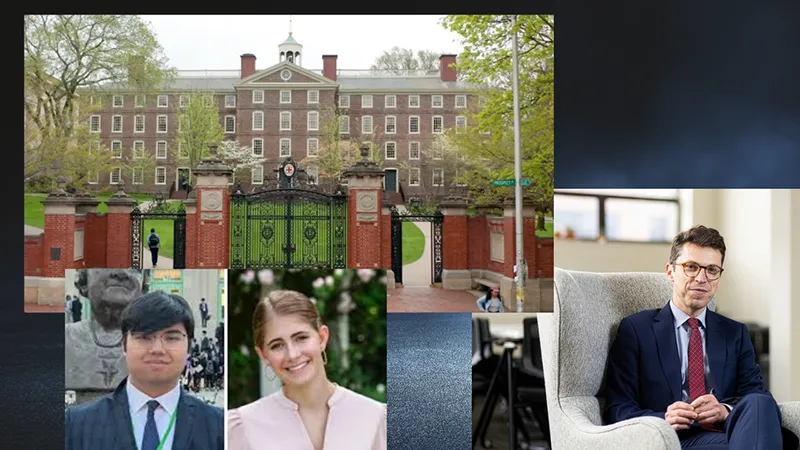
Rachel Friedberg is a professor of economics at Brown University and a faculty associate in the program for Judaic Studies. The shooting happened at a review session for the final exam of her Principles of Economics course, the most heavily attended class at Brown, taken by half of all undergraduates. Friedberg was not present during the shooting; it was led by her teaching assistants, she said. It remains unknown what the perpetrator yelled when he entered the classroom, and if or why he targeted that session.
Despite the discovery that Neves-Valente and Professor Loureiro were at the Institute for Plasmas and Nuclear Fusion in Portugal during the same time period, the exact connection and the motive for the killing now remains unknown as well.
Green Card Lottery Program Suspended
Following confirmation of the suspect’s identity, President Donald Trump suspended the diversity visa lottery program that had allowed Neves-Valente to obtain permanent residence in the United States.
Homeland Security Secretary Kristi Noem announced on the social platform X that, at Trump’s direction, she was ordering United States Citizenship and Immigration Services to pause the program. “This heinous individual should never have been allowed in our country,” Noem said of the suspect.

The diversity visa program makes up to 50,000 green cards available annually by lottery to people from countries with low immigration rates to the United States, many of them in Africa. Portuguese citizens won only 38 slots in the most recent lottery. Nearly 20 million people applied for the 2025 visa lottery, with more than 131,000 selected when including spouses.
The program was created by Congress, and the administration’s move is expected to face legal challenges. Lottery winners are required to undergo the same vetting and interview process at U.S. consulates as other green card applicants.