
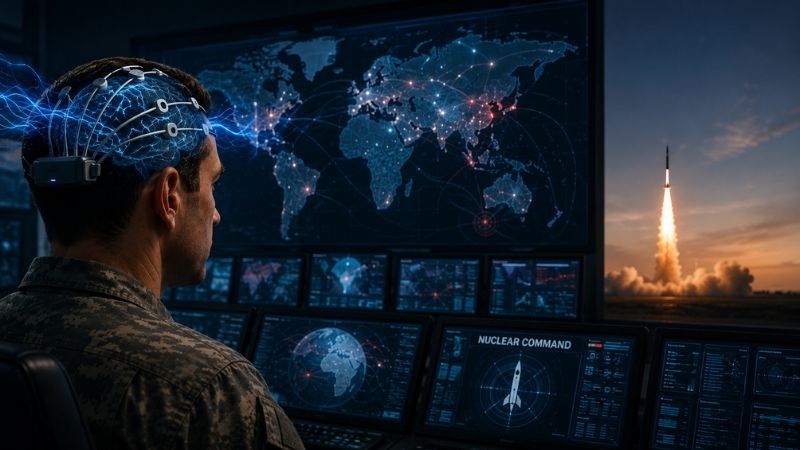
“Today, mankind stands on the eve of a great change… For the first time in military history… Smart digital algorithms and autonomous robotic warfighters are poised to replace not only the muscles but also the brains of warfare.”
– Can Kasapoğlu, “Hyperwar, artificial intelligence, and Homo sapiens”
While the U.S. nuclear Command, Control, and Communications (NC3) system remains a cornerstone of national deterrence, its reliance on human operators presents significant vulnerabilities to national security in light of emerging neurowarfare threats. Defined by the use of non-kinetic attacks targeting human cognition, neurowarfare introduces new risks to a system traditionally safeguarded by a “human in the loop” approach.1,2 For instance, adversaries such as the People’s Republic of China (PRC), under their mind superiority strategy, are developing doctrines like the system confrontation framework, which seek to target command and control (C2) nodes to gain cognitive dominance and create deliberate confusion-induced paralysis.3 As a result, the United States Strategic Command (USSTRATCOM) has significantly enhanced its military NC3 applications by integrating artificial intelligence-based technologies to address, in part, these emerging threats.4 For instance, according to the 2025 United States Strategic Command Posture Statement, AI and machine learning (AI/ML) will be used within the NC3 architecture to “enable and accelerate human decision-making.”5 However, despite perceived advantages, this evolution in terms of modernization techniques has expanded potential vectors for cognitive attacks, thereby increasing the risks of nuclear miscalculations and disruptions to command and control, in a classic example of the capability-vulnerability paradox.6,7
The potential deployment of emerging dual-use AI-enabled devices, such as Brain-Computer Interface (BCI) technologies, in C2 applications introduces substantial—yet still notional—vulnerabilities for the future NC3 architecture. Nevertheless, research and development efforts for these systems are progressing quickly through public-private partnerships, despite proof-of-concept findings that highlight their cyber and neuro-hacking vulnerabilities.8, 9 While these technologies offer certain advantages, they also pose significant risks; therefore, this paper seeks to evaluate these technologies, examine related threats, and suggest mitigation strategies to safeguard the integrity of the U.S. NC3 system as military leaders begin to weigh future adoption.
Growing Interest in Brain-Computer Interfaces
At its core, BCI technology enables direct communication between the brain and external devices by interpreting neural signals, thereby allowing users to control systems with their thoughts.10 With advancements in artificial intelligence (AI) and deep machine learning, particularly in the realm of cognitive computational algorithms, the U.S. military has shown a growing interest in BCIs to enhance essential aspects of command, control, decision-making, and communication.11 In fact, military theorists have argued that as AI-driven warfare rapidly exceeds human reaction times—a phenomenon referred to as battlefield singularity or hyperwar—BCIs’ usage may become essential to ensure that humans remain actively involved in decision-making and can keep pace with machine-operated systems of the not-too-distant future.12 As such, this human pacing necessity has spawned the BCI market to expand rapidly, with global revenues projected to grow from $1.74 billion in 2022 to $6.2 billion by 2030.13
Within the United States, the Defense Advanced Research Projects Agency (DARPA) leads research and development for the Department of Defense in this domain by fostering extensive public-private partnerships. For example, the DARPA Next-Generation Nonsurgical Neurotechnology (N3) program, with an estimated budget of $125 million, has recently awarded six renowned research institutes and organizations, to include Carnegie Mellon University, John Hopkins University Applied Physics Laboratory, and the Palo Alto Research Center, with millions of dollars’ worth of grants since 2018 for the development of wearable BCI interfaces for the use by able-bodies service members (reference table 1).14 Additionally, the Neuro-Enhancement for Battlefield Information Access (NEBIA) initiative is one of several aiming to use BCIs to deliver crucial battlefield data directly to soldiers’ brains.15 Together, these technologies, once realized, have the potential to enhance situational awareness and accelerate decision-making—both essential elements that support the NC3 system.16 Table 1 illustrates some ongoing funded efforts across the scientific community.
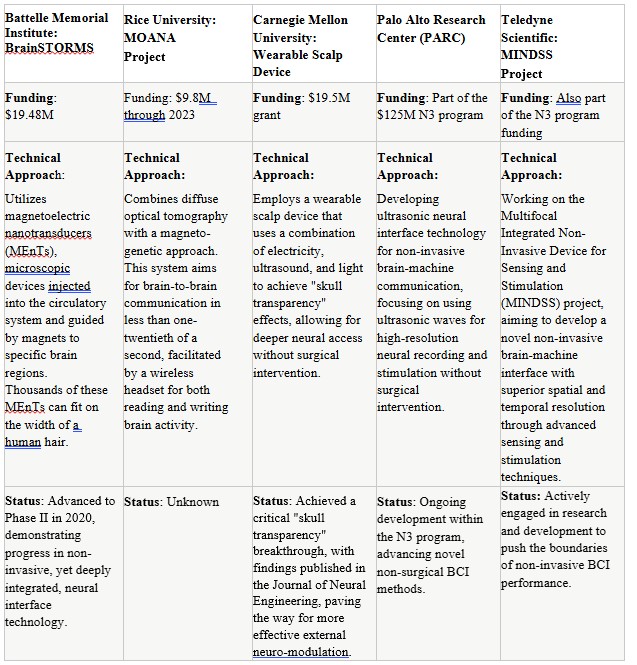
Table 1. Ongoing funded efforts across the scientific community. Source: Compiled by the author based on primary source documents.
The Vulnerability of BCIs in Neurowarfare
Integrating AI-enabled technologies, such as BCIs, into military applications, however, introduces significant vulnerabilities.17,18 Researchers not affiliated with the DARPA projects have already identified multiple ways in which BCI technology can be hacked and exploited for malicious purposes, as shown in Table 2 below.19 For example, the wireless interception of data transmitted between a BCI and its connected device—known as brain tapping—could expose critical operational information to adversaries. More direct and severe threats involve signal injection (also called brain-hacking), where attackers use radio frequencies to compromise the integrity of brain signals. Such interference can result in erroneous or biased outputs, potentially forcing individuals to act against their will and interests. Additionally, neuronal jamming techniques can disrupt or disable the neural connectivity essential to BCI functionality. These vulnerabilities are especially concerning in the realm of neurowarfare, where adversaries are reportedly experimenting with nonkinetic methods—such as ultrasonic frequencies or microwaves—to remotely disrupt the human brain.20, 21
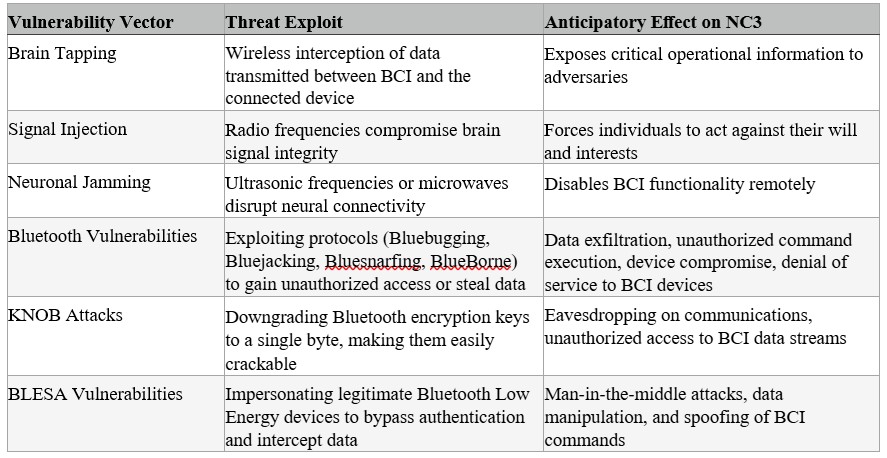
Table 2. Vulnerability of BCI Technology.
Source: Compiled by the author based on primary source documents
Mitigation and Recommendations
To counter these emerging cognitive vulnerabilities, U.S. policymakers and defense leaders must implement a proactive, multi-layered defensive strategy before BCI technologies are fully integrated into the NC3 architecture. This framework must establish rigid technical standards, clarify international legal boundaries, and build cognitive defenses for the human operators themselves.
First, the Department of Defense must mandate robust neuro-cybersecurity standards specifically tailored for neural interfaces. This requires enforcing end-to-end encryption for all BCI data transmissions to block external interception and mitigate the risk of brain tapping. Additionally, defense agencies must develop strict, mandatory security standards for both BCI hardware and software, backed by rigorous vulnerability assessment protocols. Securing these links ensures neural data confidentiality and prevents unauthorized information leaks that could compromise strategic command nodes.
Second, the United States must lead the establishment of international legal and ethical safeguards surrounding neurowarfare. Formal rules of engagement must be drafted to govern non-kinetic neuro-operations, explicitly recognizing adversarial signal injection as a direct breach of cognitive liberty and mental integrity. By driving international legal standards for BCI operations, the U.S. and its allies can create an essential regulatory framework that establishes clear boundaries and deterrence metrics for gray-zone neurowarfare activities.
Finally, the military must institute specialized cognitive resilience training for personnel operating within the nuclear enterprise. This involves developing targeted mental fortification training and psychological defenses designed to help operators recognize and counter cognitive manipulation tactics. By establishing clear threat-recognition and response protocols, the nuclear enterprise can build human cognitive resilience against neurowarfare attacks, significantly reducing the efficacy of adversarial “deterrence by confusion” strategies
Conclusion
As military theorist Can Kasapoğlu notes, “Smart digital algorithms and autonomous robotic warfighters are poised to replace not only the muscles but also the brains of warfare.” This evolution has rendered the NC3 system increasingly vulnerable to the non-kinetic threats posed by neurowarfare and BCI integration. If the United States fails to secure the “neural link,” it risks a future where the most critical decisions in national defense are not made by human logic, but by compromised signals or “jammed” intent. Strengthening our neuro-cybersecurity, therefore, is not just a matter of system integrity but rather the only way to ensure that the ultimate authority over our nuclear arsenal remains authentically human. By taking a proactive, multi-layered approach, the U.S. can protect the mind of the operator as effectively as the integrity of the deterrent itself.
The author is responsible for the content of this article. The views expressed do not reflect the official policy or position of the National Intelligence University, the Office of the Director of National Intelligence, the U.S. Intelligence Community, or the U.S. Government.
FOOTNOTES
- Office of the Deputy Assistant Secretary of Defense for Nuclear Matters, Nuclear Matters Handbook 2020 [REVISED] (Washington, D.C.: Office of the Deputy Assistant Secretary of Defense for Nuclear Matters, 2020), 11-12.
- Congressional Research Service, Defense Primer: Nuclear Command, Control, and Communications (NC3), CRS In Focus IF11697 (Washington, DC: Congressional Research Service, 2021), 2.
- Jeffrey Engstrom, Systems Confrontation and System Destruction Warfare: How the Chinese People’s Liberation Army Seeks to Wage Modern Warfare (Santa Monica, CA: RAND Corporation, 2018).
- Sylvia Mishra and Philip Reiner, Artificial Intelligence in Nuclear Command, Control & Communications: A Technical Primer (San Francisco, CA: Institute for Security and Technology, 2025), 1-17.
- Anthony J. Cotton, “Statement of Anthony J. Cotton, Commander, United States Strategic Command, Before the Senate Armed Services Committee on Strategic Forces,” U.S. Strategic Command, March 26, 2025, 5.
- Sylvia Mishra and Philip Reiner, Artificial Intelligence in Nuclear Command, Control & Communications: A Technical Primer (San Francisco, CA: Institute for Security and Technology, 2025), 1-17.
- Kayla T. Matteucci, Protecting Nuclear Command, Control, and Communications Below the Threshold of Armed Conflict: Don’t Count on Deterrence, IDA Paper NS P-14360 (Alexandria, VA: Institute for Defense Analyses, 2021), 7.
- Timothy Marler, Edward Bartels, and Andrew Binnendijk, Brain-Computer Interfaces: U.S. Tactical Military Applications and Implications, An Initial Assessment (Santa Monica, CA: RAND Corporation, 2020), 3.
- Battelle, “Battelle Neuro Team Advances to Phase II of DARPA N3 Program,” press release, Battelle, December 5, 2018, accessed September 28, 2025, https://www.battelle.org/insights/newsroom/press-release-details/battelle-neuro-team-advances-to-phase-ii-of-darpa-n3-program.
- S. Kulshrestha, “Military Applications of Brain Machine Interface (BMI) Technology,” Taazakhabar News, February 4, 2024.
- Anika Binnendijk, Timothy Marler, and Elizabeth M. Bartels, Brain-Computer Interfaces: U.S. Military Applications and Implications, An Initial Assessment (Santa Monica, CA: RAND Corporation, 2021).
- Ibid., 13-14.
- William LeBeau and Michael Freeman, “The Brain-Computer Interface Market Is Growing, but What Are the Risks?” World Economic Forum, June 2024, https://www.weforum.org/stories/2024/06/the-brain-computer-interface-market-is-growing-but-what-are-the-risks/.
- DARPA, “Nonsurgical Brain-Machine Interfaces,” news release, DARPA, May 20, 2019, accessed September 28, 2025, https:// www.darpa.mil/news/2019/nonsurgical-brain-machine-interfaces.
- S. Kulshrestha, “Military Applications of Brain Machine Interface (BMI) Technology,” Taazakhabar News, February 4, 2024.
- Office of the Deputy Assistant Secretary of Defense for Nuclear Matters, Nuclear Matters Handbook 2020 [REVISED] (Washington, D.C.: Office of the Deputy Assistant Secretary of Defense for Nuclear Matters, 2020), 11-12.
- Sylvia Mishra and Philip Reiner, Artificial Intelligence in Nuclear Command, Control & Communications: A Technical Primer (San Francisco, CA: Institute for Security and Technology, 2025), 1-17.
- Anika Binnendijk, Timothy Marler, and Elizabeth M. Bartels, Brain-Computer Interfaces: U.S. Military Applications and Implications, An Initial Assessment (Santa Monica, CA: RAND Corporation, 2021).
- Alexandre Armengol-Urpi, Reid Kovacs, and Sanjay E. Sarma, “Brain-Hack: Remotely Injecting False Brain-Waves with RF to Take Control of a Brain-Computer Interface,” in Proceedings of the 2023 ACM CHI Conference on Human Factors in Computing Systems, Article 397 (New York, NY: Association for Computing Machinery, 2023).
- William LeBeau and Michael Freeman, “The Brain-Computer Interface Market Is Growing, but What Are the Risks?” World Economic Forum, June 2024, https://www.weforum.org/stories/2024/06/the-brain-computer-interface-market-is-growing-but-what-are-the-risks/.
- Sergio López Bernal, Alberto Huertas Celdrán, and Gregorio Martínez Pérez, “Neuronal Jamming cyberattack over invasive BCIs affecting the resolution of tasks requiring visual capabilities,” Computers & Security 112 (2022): 102534.
BIBLIOGRAPHY:
Armengol-Urpi, Alexandre, Reid Kovacs, and Sanjay E. Sarma. “Brain-Hack: Remotely Injecting False Brain-Waves with RF to Take Control of a Brain-Computer Interface.” In Proceedings of the 2023 ACM CHI Conference on Human Factors in Computing Systems, Article 397. New York, NY: Association for Computing Machinery, 2023.
Battelle. “Battelle Neuro Team Advances to Phase II of DARPA N3 Program.” Press release. Battelle. December 5, 2018. Accessed September 28, 2025. https://www.battelle.org/insights/newsroom/press-release-details/battelle-neuro-team-advances-to-phase-ii-of-darpa-n3-program.
Binnendijk, Anika, Timothy Marler, and Elizabeth M. Bartels. Brain-Computer Interfaces: U.S. Military Applications and Implications, An Initial Assessment. Santa Monica, CA: RAND Corporation, 2021.
Congressional Research Service. Defense Primer: Nuclear Command, Control, and Communications (NC3). CRS In Focus IF11697. Washington, DC: Congressional Research Service, 2021.
DARPA. “Nonsurgical Brain-Machine Interfaces.” News release. DARPA. May 20, 2019. Accessed September 28, 2025. https://www.darpa.mil/ news/2019/nonsurgical-brain-machine-interfaces.
Engstrom, Jeffrey. Systems Confrontation and System Destruction Warfare: How the Chinese People’s Liberation Army Seeks to Wage Modern Warfare. Santa Monica, CA: RAND Corporation, 2018.
Kulshrestha, S. “Military Applications of Brain Machine Interface (BMI) Technology.” Taazakhabar News. February 4, 2024.
LeBeau, William, and Michael Freeman. “The Brain-Computer Interface Market Is Growing, but What Are the Risks?” World Economic Forum, June 2024. https://www.weforum.org/stories/2024/06/the-brain-computer-interface-market-is-growing-but-what-are-the-risks/.
López Bernal, Sergio, Alberto Huertas Celdrán, and Gregorio Martínez Pérez. “Neuronal Jamming cyberattack over invasive BCIs affecting the resolution of tasks requiring visual capabilities.” Computers & Security 112 (2022): 102534.
Marler, Timothy, Edward Bartels, and Andrew Binnendijk. Brain-Computer Interfaces: U.S. Tactical Military Applications and Implications, An Initial Assessment. Santa Monica, CA: RAND Corporation, 2020.
Matteucci, Kayla T. Protecting Nuclear Command, Control, and Communications Below the Threshold of Armed Conflict: Don’t Count on
Deterrence. IDA Paper NS P-14360. Alexandria, VA: Institute for Defense Analyses, 2021
Mishra, Sylvia, and Philip Reiner. Artificial Intelligence in Nuclear Command, Control & Communications: A Technical Primer. San Francisco, CA: Institute for Security and Technology, 2025.
Office of the Deputy Assistant Secretary of Defense for Nuclear Matters. Nuclear Matters Handbook 2020 [REVISED]. Washington, D.C.: Office of the Deputy Assistant Secretary of Defense for Nuclear Matters, 2020.