
Pakistan has been experiencing a particularly volatile period marked by both domestic and transnational threats, as evidenced by two major developments: the recent designation of the Balochistan Liberation Army (BLA) and its Majeed Brigade faction as Foreign Terrorist Organizations (FTOs) by the U.S. Department of State in August 2025, and the deadly suicide bombing in Quetta on September 2. In the latter, a suicide attacker detonated explosives outside a stadium as supporters of a nationalist party were leaving a political rally, killing at least 13 people and injuring over 30. The Islamic State in Iraq and Syria (ISIS) claimed responsibility for the attack, highlighting the persistent presence of global jihadist actors operating within Pakistan’s borders.
These incidents are part of a broader escalation in terrorist violence that has intensified since the Taliban’s return to power in Afghanistan in 2021. Border regions such as Khyber Pakhtunkhwa and Balochistan have seen a sharp rise in attacks, driven by cross-border insurgencies and ideological extremism. Among the most active domestic actors is the BLA and its elite wing, the Majeed Brigade—key players in the long-running Baloch separatist insurgency. The group has claimed responsibility for a series of high-profile attacks, including coordinated suicide bombings in Karachi and Gwadar in 2024, and the 2025 hijacking of the Jaffar Express, which resulted in 31 deaths and the brief hostage-taking of over 300 passengers.
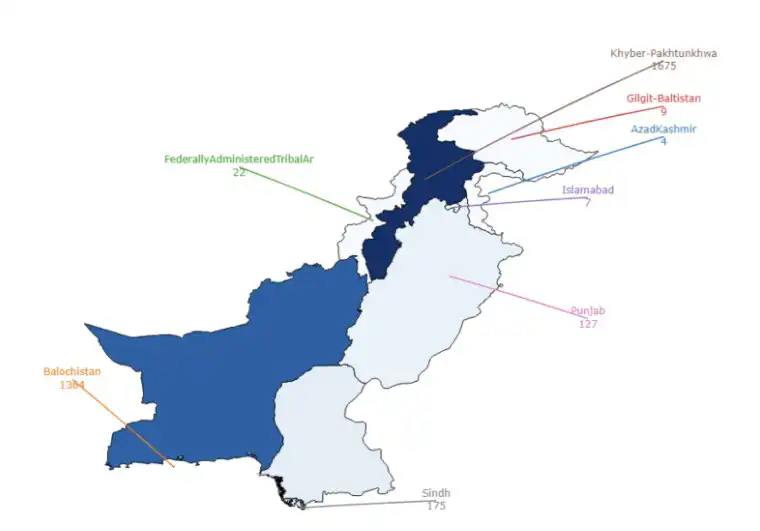
According to the map below, Pakistan has documented the presence of numerous perpetrators operating across multiple regions of the country. Between 2018 and 2024, Khyber Pakhtunkhwa reported 1,675 terrorist attacks, the majority of which were attributed to jihadist groups. Balochistan followed with 1,364 incidents, while Sindh recorded 175 attacks, primarily carried out by separatist organizations. Several other regions also experienced dozens of attacks during this period, reflecting the widespread and geographically dispersed nature of terrorism within the country.
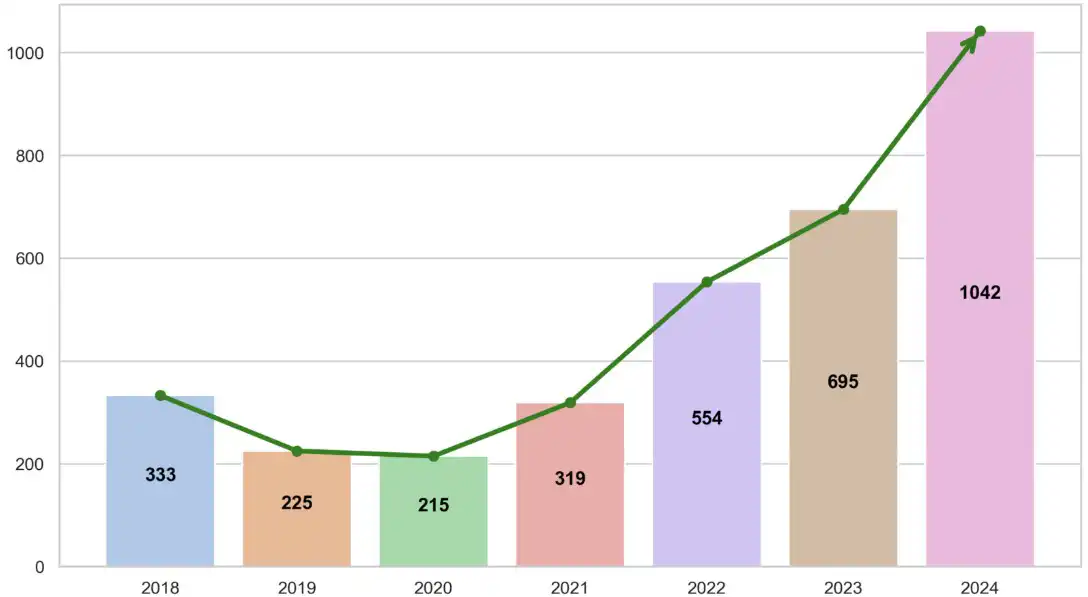
Pakistan has experienced a fluctuating yet overall increasing trend in terrorist attacks since 2018. The recorded incidents numbered 333 in 2018, followed by a decline to 225 in 2019 and 215 in 2020. However, the Taliban’s takeover of Afghanistan in 2021 marked a significant inflection point, correlating with a sharp rise in violence. Following this geopolitical shift, the number of attacks escalated substantially, increasing from 319 incidents in 2021 to 554 in 2022, 695 in 2023, and reaching 1,042 in 2024. This upward trajectory underscores the profound impact of regional developments on Pakistan’s internal security dynamics.
The persistence and escalation of terrorism in Pakistan can be attributed to a combination of ideological, geopolitical, and historical factors. One major driver has been the expansion of Salafi-jihadist ideologies, often financed by private donors and business elites in Gulf states, which has contributed to the radicalization of militant networks across the region. In provinces such as Balochistan and Sindh, armed violence is also fueled by separatist movements seeking greater autonomy or outright independence, further complicating the national security landscape. Additionally, Pakistan is now facing the unintended consequences of its long-standing strategic support for the Taliban during the U.S.-led intervention in Afghanistan. While the initial aim was to help install a friendly and influenceable regime in Kabul, the Taliban’s eventual return to power in 2021 emboldened domestic militant groups—most notably Tehrik-e-Taliban Pakistan (TTP), a Pashtun-led insurgency. The TTP significantly escalated its operations following the Taliban’s takeover.
Figure 3 below illustrates the most active perpetrator groups responsible for terrorist attacks in Pakistan between 2018 and 2024. The Tehrik-e-Taliban Pakistan (TTP) emerges as the most prolific actor during this period, with a total of 1,596 recorded attacks. Established in December 2007 under the leadership of Baitullah Mehsud, the TTP originated as a coalition of militant factions operating primarily in Pakistan’s Federally Administered Tribal Areas (FATA) and Khyber Pakhtunkhwa (KPK)—regions historically marked by limited state presence and proximity to the Afghan border. Ideologically grounded in a rigid Deobandi interpretation of Sunni Islam, the TTP seeks to dismantle the Pakistani state and replace it with an Islamic caliphate governed by Sharia law, explicitly rejecting Western democratic ideals. The group maintains longstanding ties with global jihadist networks, including Al-Qaeda, aligning its agenda with broader transnational extremist movements. Over the years, the TTP has executed numerous high-profile attacks, such as the assassination of former Prime Minister Benazir Bhutto in 2007 and the 2014 massacre at the Army Public School in Peshawar, which claimed the lives of over 130 children. The group employs a range of violent tactics, including suicide bombings, armed assaults, and the use of improvised explosive devices (IEDs), supported by sophisticated propaganda and digital recruitment strategies aimed at radicalizing marginalized youth in economically underdeveloped tribal areas. The Taliban’s return to power in Afghanistan in 2021 has further emboldened the TTP, intensifying its operational tempo and exacerbating Pakistan’s already fragile security environment.
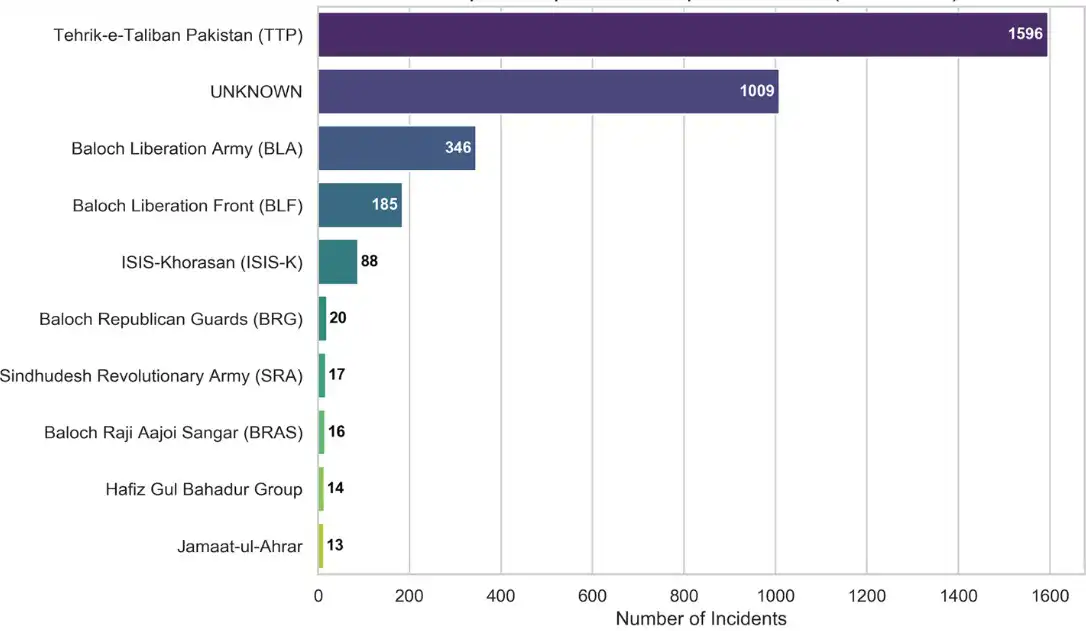
The second most active perpetrator group, which has shown a notable escalation in violence in recent years, is the Balochistan Liberation Army (BLA), responsible for 346 attacks between 2018 and 2024. Founded in 2000, the BLA is widely recognized as the most formidable among the Baloch separatist organizations operating in Pakistan’s Balochistan province. An ethnonationalist militant group, the BLA seeks the secession of Balochistan from Pakistan, motivated by longstanding grievances related to political marginalization, economic underdevelopment, and cultural repression. The group operates primarily in Balochistan and along the Afghan border, where it is believed to maintain logistical and operational sanctuaries. The BLA has claimed responsibility for numerous high-profile and lethal attacks targeting Pakistani military and police forces, educational institutions, journalists, and civilians. In addition to its anti-state agenda, the group has been implicated in ethnic violence, particularly the systematic targeting of non-Baloch minorities within the province. In recent years, BLA attacks have increasingly focused on Pakistani and Chinese personnel associated with the China–Pakistan Economic Corridor (CPEC), which the group views as emblematic of external exploitation and demographic engineering. The Government of Pakistan has officially designated the BLA as a terrorist organization. Other notable Baloch separatist groups, also listed in Figure 3, include the Baloch Liberation Front (185 attacks), the Baloch Republican Guards (20 attacks), and Baloch Raji Aajoi Sangar (16 attacks), all of which contribute to the broader insurgent landscape in Balochistan.
Also featured among the top perpetrator groups is the Islamic State – Khorasan Province (ISIS-K), which carried out 88 attacks in Pakistan’s Khyber Pakhtunkhwa and Balochistan provinces between 2018 and 2024. Initially based in eastern Afghanistan, ISIS-K was largely confined to a few provinces prior to the Taliban’s return to power in 2021. However, widespread disillusionment with the Taliban’s governance has since enabled ISIS-K to expand its presence significantly, now reportedly operating across all 34 provinces of Afghanistan. The group has capitalized on emerging political and sectarian tensions, directing a series of deadly attacks against both Taliban forces and the Shi’a community, including assaults on mosques in 2022 and 2023. This expansionist momentum has extended into neighboring Pakistan, where ISIS-K has demonstrated an increasing operational capacity. The group exploits radicalized segments of society—particularly in the Federally Administered Tribal Areas (FATA) and Khyber Pakhtunkhwa—where socioeconomic deprivation, weak governance, and ideological networks facilitate recruitment and support for its transnational jihadist agenda.
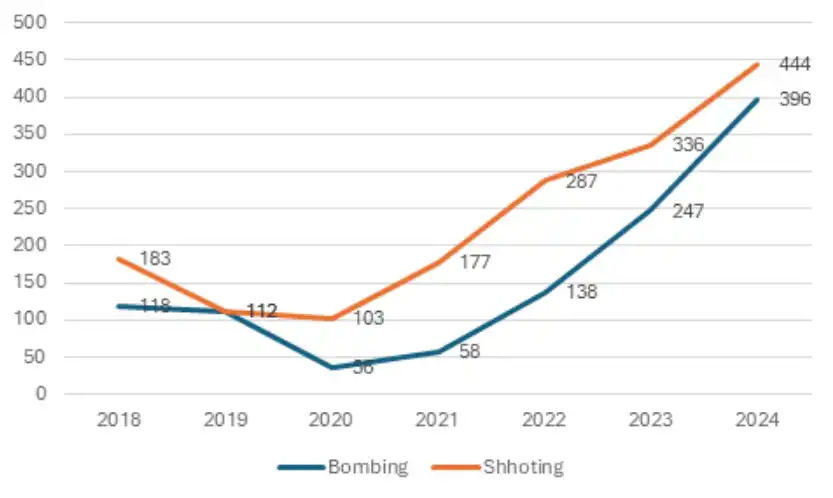
Figure 4 illustrates the distribution of tactic types employed by terrorist perpetrators in Pakistan. Consistent with the overall rise in terrorist incidents across the country, the predominant methods of attack have been bombings and shootings. Bombing incidents most frequently involve the use of IEDs and hand grenade attacks, both of which are characteristic of asymmetric warfare tactics commonly utilized by insurgent groups operating in the region. Shooting attacks, on the other hand, primarily involve the use of firearms and are often directed at security personnel, government facilities, or civilian populations.
To conclude, Pakistan’s evolving security landscape exemplifies the long-term and often unintended consequences of strategic engagement with militant actors. The state’s historical support for the Afghan Taliban, initially intended to secure geopolitical leverage in the region, has inadvertently contributed to the resurgence of domestic militancy that now threatens national cohesion and stability. Chief among the actors driving this trend is the Tehrik-e-Taliban Pakistan (TTP), which has significantly expanded its operational footprint in Khyber Pakhtunkhwa following the Taliban’s return to power in 2021. Concurrently, Baloch separatist movements have intensified their activities, with the Balochistan Liberation Army (BLA) emerging as one of the most active and lethal groups. Together, the TTP and BLA are responsible for a substantial share of the terrorist violence recorded in Pakistan between 2018 and 2024. Given the structural conditions that facilitate insurgency, such as state fragility, economic underdevelopment, and ethno-political grievances, it is likely that Pakistan will continue to grapple with sustained militant activity in the years to come.