
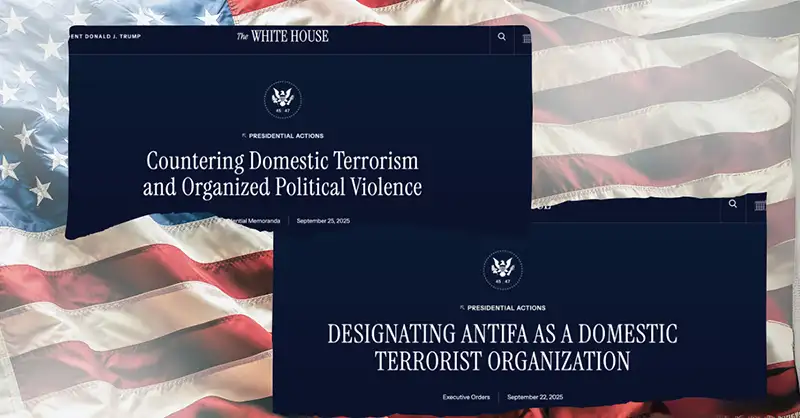
On September 22, 2025, President Donald Trump signed an executive order designating Antifa as a “domestic terrorist organization.” Three days later, on September 25, the administration issued National Security Presidential Memorandum (NSPM-7) titled “Countering Domestic Terrorism and Organized Political Violence,” establishing a comprehensive federal strategy to address what the administration characterizes as organized political violence.
Antifa Designation
The executive order designates Antifa (short for anti-fascist) as a domestic terrorist organization, describing it as “a militarist, anarchist enterprise that explicitly calls for the overthrow of the United States Government, law enforcement authorities, and our system of law.” The order directs all relevant executive departments and agencies to “investigate, disrupt, and dismantle any and all illegal operations” conducted by or supported by Antifa.
National Strategy Memorandum
NSPM-7 establishes a broader framework for addressing domestic terrorism, identifying what the administration calls common motivations including “anti-Americanism, anti-capitalism, and anti-Christianity” and “support for the overthrow of the United States Government.”
This national strategy is required “to investigate and disrupt networks, entities, and organizations that foment political violence so that law enforcement can intervene in criminal conspiracies before they result in violent political acts.”
Key Provisions and Directives
The memorandum directs several federal agencies to take specific actions:
Federal Bureau of Investigation (FBI) Joint Terrorism Task Forces (JTTFs): Coordinate national strategy to investigate and prosecute entities engaged in political violence
Department of Justice (DOJ): Prosecute all federal crimes related to organized political violence and issue guidance on domestic terrorism priorities including “organized doxing campaigns, swatting, rioting, and property crimes”
Treasury Department: Identify and disrupt financial networks funding domestic terrorism
Internal Revenue Service: Ensure tax-exempt entities do not finance political violence or domestic terrorism
Attorney General: Recommend groups for potential designation as domestic terrorist organizations
Department of Homeland Security and DOJ: Designate domestic terrorism as a “National Priority Area” for resource allocation
Administration’s Stated Justification
The administration cites several incidents as justification for the orders:
- The assassination of Charlie Kirk;
- Previous assassination attempts on President Trump;
- Attempted assassination of Supreme Court Justice Brett Kavanaugh;
- Anti-police riots resulting in deaths and over $2 billion in property damage; and
- A reported 1,000% increase in attacks on ICE officers since January 21, 2025, including:
- The September 24, 2025, shooting at a Dallas ICE facility, killing one detainee and injuring two others.
According to a Center for Strategic & International Studies study, “left-wing…violence has risen from very low levels and remains much lower than historical levels of violence carried out by right-wing and jihadist attackers.” However, far-left extremist attacks outpaced far-right violence for the first time in over three decades during the first half of 2025.
The two authors, Daniel Byman and Riley McCabe, stated that “Leaders across the political spectrum must condemn violent extremism of all kinds, denying it legitimacy and reducing its appeal.” Byman warned that the data should not be taken by the government “as an excuse for a crackdown on legitimate organizations.”
Legal Framework Considerations
Currently, U.S. Code Title 18, Section 2331 defines domestic terrorism but does not establish specific federal penalties for domestic terrorism charges. Unlike Foreign Terrorist Organizations (FTOs), there is no existing legal mechanism for designating domestic groups as terrorist organizations. Individuals who commit acts classified as domestic terrorism are typically prosecuted under related violent crime statutes.
“When Timothy McVeigh killed 168 people with a truck bomb at Oklahoma City’s federal building in 1995, described as the worst act of domestic terrorism at the time, he was not convicted of terrorism. He was convicted of killing federal agents and other crimes, but terrorism was not one of them.” wrote Ajit Maan – Founder and CEO of Narrative Strategies, and Editor at Large, Counter-Narrative for Homeland Security Today – in her LinkedIn post addressing the issues of designating individuals as domestic terrorists.
Reactions and Perspectives
Views from the Opposition
Legal Experts:
- Faiza Patel (director of the Liberty and National Security Program at the Brennan Center for Justice): “The law does not have a parallel statute for designating anybody as a domestic terrorism organization — that simply doesn’t exist in the law.”
- Pat Eddington (Cato Institute): Called the order “idiotic on multiple levels,” noting there’s “no constitutional provision or statute granting any president the power to designate a domestic civil society organization a ‘domestic terrorist organization.'”
Political Officials:
- Robert Weissman (Public Citizen): “The administration is conjuring vast, imaginary conspiracies as a thinly veiled ruse to crack down on its political opponents, based on their viewpoints.”
- California State Senator Scott Wiener: Characterized the order as “classifying anyone challenging his regime or espousing anti-MAGA worldviews as ‘domestic terrorists.'”
Policy Experts:
- Tom O’Connor (current consultant on counterterrorism and previous FBI Special Agent): Argued that “it is the violence not the ideologies which needs to have a penalty.” “Designating ‘groups as a Terrorist Organization’ is a slippery slope and will infringe on 1st amendment rights. It is about the violence.” He also linked to his December 2024 Homeland Security Today article, “Congress Should Make Domestic Terrorism a Federal Crime,” to reinforce his statement, “We did not get to this place overnight. Congress needs to act and call ALL violence for political purposes illegal under Federal Laws.”
Views from Supporters
Administration Officials:
- Stephen Miller (White House Deputy Chief of Staff and Homeland Security Advisor): “This is the first time in American history that there is an all-of-government effort to dismantle left-wing terrorism, to dismantle antifa.”
- Treasury Secretary Scott Bessent stated on Fox Business (at 06:05): “We are going to follow the money…ANYONE who is funding a domestic terrorist organization should know that you will be examined and you will be held accountable. This violence has to STOP.”
- White House spokesperson Abigail Jackson: Stated that Antifa uses “violence and terrorism to try and accomplish their sick goals.”
Former Officials:
- Ken Cuccinelli (served as Trump’s deputy secretary of Homeland Security during the first administration): Expressed support for the action, stating “he can direct a skewing of DOJ resources to attack the problem … I wish we had done it in 2020 when these people were rather clearly going from city to city. And I asked for it and didn’t get it.”
Media Coverage
Major news outlets covered the orders with varying emphasis:
- Associated Press: “Trump orders crackdown on ‘domestic terrorists’ in escalation of a campaign against political rivals”
- The Washington Post: “Trump targets domestic terrorists — but only mentions the ‘radical left'”
- NPR: “Trump issues executive order designating antifa a ‘domestic terrorist organization'”
- Politico: “Trump’s antifa order thrills allies — and tests the law”
- Fox News: “Trump to sign executive order dismantling ‘domestic terrorism networks’”
- The Dallas Express: “Trump Signs Directive Targeting Domestic Terrorism After Charlie Kirk Assassination”
- The Hill: “Trump goes after antifa, sparking fears about crackdown on dissent”
Early Implementation Effects
Law Enforcement Actions
- Several Antifa members were arrested and charged after surrounding an ICE building in Eugene, Oregon
- The Department of Homeland Security has reportedly arrested dozens of individuals characterized as “Antifa-aligned left-wing violent extremists”
Investigative Changes
- The Justice Department quietly removed an online study that had shown far-right extremists commit “far more” fatal violence than those on the far left.
- Questions remain about potential impacts on federal agencies like the FBI and Transportation Security Administration and their systems such as the Terrorist Screening Database.
The orders represent a significant shift in the federal approach to domestic security threats, with implementation and legal challenges likely to unfold in the coming months.