
Understanding the significance of El Mencho’s death requires knowing who he was and what made Cartel de Jalisco Nueva Generación (CJNG) one of the most powerful criminal organizations in the Mexican mafia ecosystem.
Born in Mexico from a very poor family, El Mencho was an elementary school dropout who lived illegally in the United States, in the San Francisco Bay Area, for a few years. He was arrested and deported multiple times and spent time in a federal prison in 1992. After his deportation, he joined the Sinaloa Cartel, where he rose through the ranks until he consolidated power and formed what is now known as the Cartel de Jalisco Nueva Generación.
What made CJNG the cartel it is today is both its willingness to wage open war against the Mexican state and its high institutional capacity. CJNG has been by far the most aggressive cartel in its attacks on the military, employing helicopters, explosives dropped from drones, anti-personnel mines, and RPGs to shoot down Air Force assets. In other words, there has been no restraint.
The other part of their success has been the effectiveness of their financial operations, their business discipline, and the fierce loyalty of their people to El Mencho.
CJNG structured its business model through a few important geopolitical choices. The first was taking control of critical chokepoints in Mexico’s supply chain, expanding its operations into the port environment. The cartel has corrupt access to the ports of Manzanillo and Lázaro Cárdenas on the Pacific coast, but can also reach Veracruz and Matamoros on the Gulf, making it a truly coast-to-coast cartel capable of operating on both sides of Mexico’s coastline. This created, in particular, the capacity to transform Mexico’s ports into intake valves for the synthetic drug supply, which means that globally, CJNG sits at the core of the fentanyl Silk Road. You cannot shut down Manzanillo without shutting down the Mexican economy. This gives them the resilience of being completely imbricated in legitimate trade.
Precursors and chemicals shipped from ports in China, like Hong Kong, arrive at Lázaro Cárdenas and Manzanillo, where the cartel collects them, manufactures the fentanyl and meth, and later introduces them through legitimate points of entry, often again using containers and sending them along the coasts to arrive mixed in with legitimate cargo at ports in the United States. As of today, Jalisco Nueva Generación remains the bridge between Chinese precursors and American fentanyl consumers. It sits at the midpoint in the chain of distribution that connects these two great powers on their most contentious non-military issue.
Jalisco Nueva Generación, like many other cartels, operates with a deviant innovation model that subcontracts much of its operations to smaller units, giving it enormous resilience. Today, Jalisco Nueva Generación is the only cartel in Mexico with a presence in all 32 Mexican states, in no small part because it can franchise without needing direct control of every operation. This is not unlike how McDonald’s can expand anywhere on the planet by making sure that every single franchise operates following the rules of the parent model.
So, What Happened on February 22?
Somewhere in the Sierra of Jalisco, a massive deployment of Mexican federal forces and armed helicopters converged around Tapalpa. They launched a manhunt to capture El Mencho, the leader of the Cartel de Jalisco Nueva Generación. A temporary flight restriction (TFR) was deployed around the area early in the morning. After heavy gunfighting, an official message from the Mexican government confirmed that El Mencho was critically wounded during a confrontation in the surrounding woodlands and died en route to a hospital via helicopter.
This raid came at a moment in which Mexican authorities were under intense pressure from the Trump administration to show more results in the war on drugs. Pressure from the Department of War had increased significantly leading up to the operation. For example, just days before the raid, American forces executed unprecedented lethal kinetic strikes against two Mexican fast boats in international waters in the Eastern Pacific. In a historical first, the U.S. military killed all of the occupants, who were identified as Mexican nationals from Nayarit working for the Jalisco New Generation Cartel (CJNG), applying the exact same lethal force they had been using against Venezuelan vessels in the Caribbean under Operation Southern Spear.
The Mexican government immediately claimed that the operation that killed el Mencho 100% conducted by Mexican forces. The physical raid was indeed carried out by Mexican Army and National Guard special forces. However, it is now clear that, while technically executed by domestic troops, this operation also represents the first major success of the newly created U.S. Joint Interagency Task Force-Counter Cartel (JIATF-CC), which provided the detailed target package that made the strike possible.
What Was the Response of the Drug Cartel?
The cartel’s response was preplanned, premeditated, and geographically coordinated across an enormous area, following a very clear playbook they had used before to protect El Mencho. This time, though, it was deployed not preemptively, but as pure retaliation and a show of force against federal authorities.
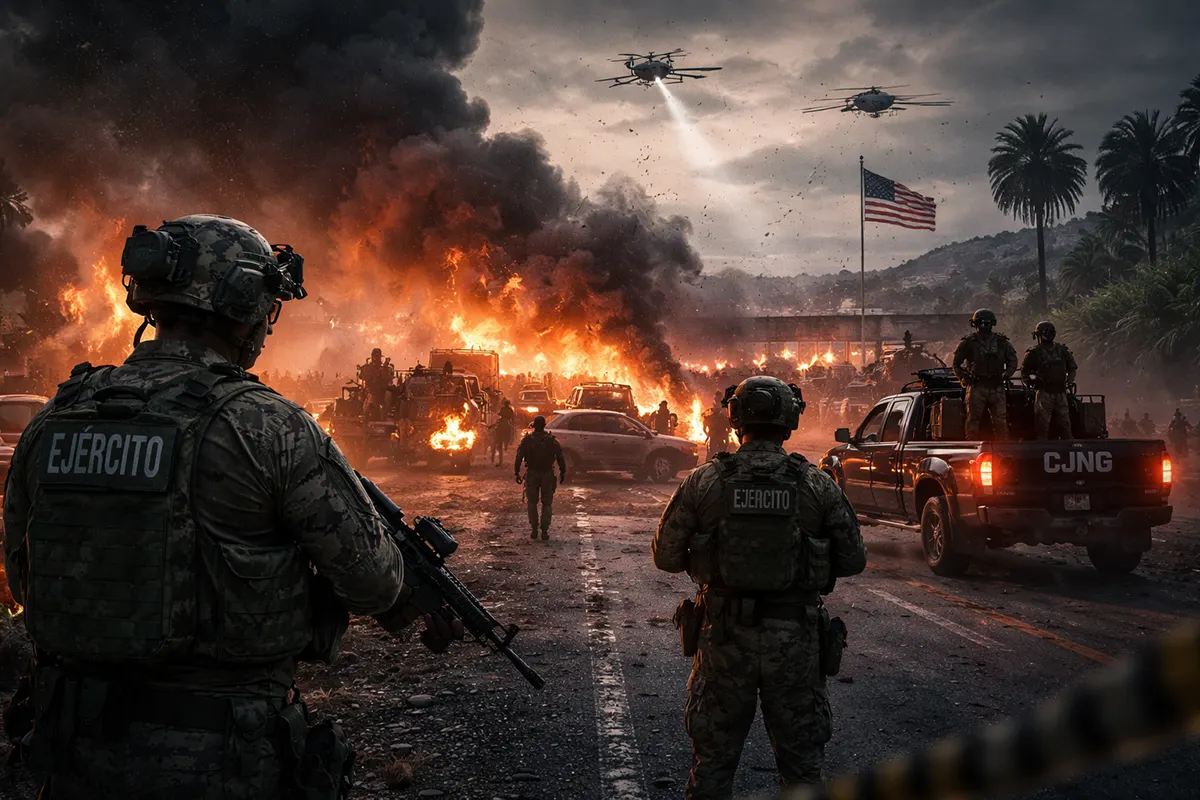
Within minutes of El Mencho’s death, both Governor Lemus of Jalisco and federal authorities reported confrontations around the area of Tapalpa. The cartel deployed concentric circles of burned and blocked vehicles designed to limit the movement of authorities by besieging different cities across the state of Jalisco.
In Guadalajara, the capital of Jalisco and the second most important industrial pole in the country outside of Mexico City, burned vehicles and violence forced most of the population to take shelter in their homes as if in a war zone. At the Guadalajara International Airport, rumors of active shooter situations (which proved false) and threats of bombs forced quick evacuations of terminals, grounding flights across the region.
Puerto Vallarta, one of Mexico’s most important beach resorts, was effectively placed under siege. The so-called narco-bloqueos expanded, and the panic was fueled by a highly sophisticated disinformation campaign on social media. Rumors spread that buildings were being torched, including deep fake images of the famous cathedral in downtown Puerto Vallarta burning to the ground. According to Mexican security officials and intelligence experts, cartel-linked networks actively weaponized these fabricated images as a form of psychological warfare, designed to sow terror.
Michoacán, Guanajuato, Tamaulipas, Aguascalientes, and Baja California all reported similar events: narco-bloqueos, gunshots, and clear, coordinated expressions of violence from the cartel against the state.
Why This Matters
It is important to understand that, unlike previous occasions where these operations had a clear tactical objective to limit the capacity of the Mexican government to capture or disrupt cartel operations, the violence we witnessed on February 22 was exclusively retaliatory.
No restraint.
No forbearance.
The sole purpose was to demonstrate the consequences of messing with the cartel’s leadership.
President Claudia Sheinbaum finds herself between a rock and a hard place, under pressure from the Trump administration to take a more active role in the war against drugs, with violence on the streets as a direct consequence of it, and a narco-political elite that remains untouched and so far well imbricated within the Mexican state.
The immediate aftermath of the raid underscored how delicate Sheinbaum’s position is. Mexican authorities moved quickly to preserve the narrative of national sovereignty, acknowledging U.S. intelligence support while emphasizing that the operation itself was conducted by Mexican forces. While the tactical action was indeed carried out by Mexico’s military, it relied in part on intelligence provided through U.S. channels, including JIATF-CC. Subsequent public remarks to Congress stating that “we’ve taken down” the cartel leader added another layer of complexity, drawing attention to Washington’s role and complicating efforts to project the operation as a fully autonomous assertion of Mexican authority.
The Aftermath
The initial challenge for the government of Mexico was calming the apocalyptic violence that the Cartel de Jalisco Nueva Generación unleashed. They succeeded to do it, and even performed some important follow-up arrests afterwards.
But the broader question remains: Can the Mexican government demonstrate that state capacity is sufficient so that cartels don’t feel emboldened to burn cities to the ground with impunity every time a leader is targeted? What we saw after the successful killing of El Mencho seems to suggest that the answer to this question, at least right now, is: no.
Scenes from Jalisco demonstrated two realities: a cartel capable of challenging the urban integrity of historically protected tourist and economic hubs, and a state rapidly overwhelmed by the sheer logistical capacity of organized crime.
The killing of El Mencho was an Osama bin Laden manhunt moment for President Sheinbaum. But its meaning beyond the tactical victory and the subsequent retaliatory violence will only become clear if it serves as the first step in a much longer process to permanently diminish the geopolitical and geostrategic capabilities of Mexican cartels.