
For most of modern policing, warrants were built around a simple premise: identify a place, identify an object, identify evidence. A home, a car, a phone. A search, a seizure, a return.
Smart devices have quietly broken that model.
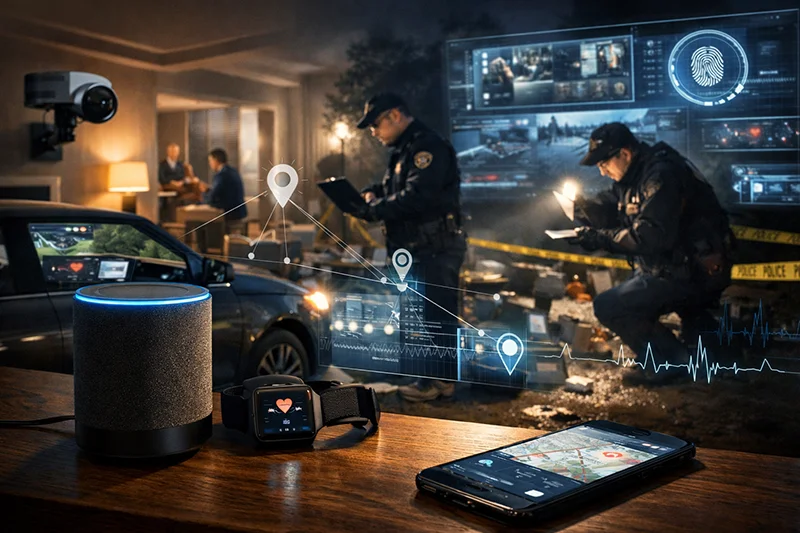
Connected homes, vehicles, wearables, and AI-mediated platforms no longer generate a single category of evidence. They generate continuous, ambient, multidimensional behavioral data that reveals far more than investigators often intend to collect. As courts across the United States grapple with this reality, a growing number of judges are asking a deeper question:
What exactly are we authorizing the government to search when a smart device “testifies?”
The answer increasingly implicates multiple forms of privacy at once, not just data stored on a device. And that mismatch is straining traditional warrant frameworks.
Smart Devices Are Not Single-Purpose Evidence Sources
A smart speaker may capture audio, but it also reveals patterns of presence, routines, relationships, and timing. A connected vehicle may log location, but it also exposes behavioral rhythms, associations, and inferred intent. Wearables may track health data, but they simultaneously illuminate movement, stress responses, and daily habits.
Yet warrants are still often drafted as if these systems were static containers of discrete files. That assumption is increasingly untenable.
Legal scholars have long recognized that privacy is not monolithic. A well-known typology of privacy identifies multiple distinct but overlapping privacy interests, including spatial, behavioral, communicational, associational, informational, and decisional privacy, among others. Smart-device evidence routinely cuts across several of these domains simultaneously, even when investigators believe they are targeting only one.
Eight Privacy Domains Implicated by Smart Devices
When courts review smart-device warrants, they are often, explicitly or implicitly, weighing impacts across multiple privacy categories:
- Spatial Privacy
Smart homes and connected vehicles intrude directly into spaces traditionally afforded the highest constitutional protection. Continuous sensor data can reconstruct a person’s location within a home, not just whether they were there.
- Behavioral Privacy
Internet of Things (IoT) logs reveal routines: sleep patterns, daily schedules, habits, and deviations from normal behavior. This is qualitatively different from isolated observations.
- Communicational Privacy
Voice assistants, messaging integrations, and notification logs capture fragments of communication, even when the device is not perceived as a “communications platform.”
- Associational Privacy
Location correlations, proximity data, and shared device usage can expose who someone spends time with, how often, and under what circumstances.
- Informational Privacy
Raw logs, metadata, and cloud-stored records aggregate personal information far beyond the immediate scope of an investigation.
- Decisional Privacy
Patterns inferred from smart devices may reveal intimate decisions, health choices, religious practices, or personal relationships, without accessing any explicit content.
- Temporal Privacy
Unlike traditional searches, smart-device data often spans weeks, months, or years, collapsing past, present, and future behavior into a single evidentiary return.
- Inferential Privacy
AI-driven analytics transform raw data into predictions and behavioral conclusions—an evidentiary leap that courts are increasingly wary of when not explicitly authorized.
A warrant drafted to justify intrusion into one of these domains can easily, and unintentionally, authorize intrusion into several others.
Why Traditional Warrant Language Is Failing
The constitutional issue is not simply collection. It is scope, proportionality, and explanation.
Courts are increasingly skeptical of warrants that:
- authorize broad categories of smart-device data without explaining relevance,
- fail to distinguish between raw data and algorithmic inference,
- lack temporal or functional limits,
- or do not address foreseeable collateral collection involving third parties.
In effect, judges are signaling that “device-based” warrants are no longer sufficient. What matters is the privacy impact of the data, not merely where it resides.
This mirrors earlier judicial responses to cell-phone searches, geofence warrants, and cell-site location information (CSLI) collection, but with higher stakes due to the ambient and continuous nature of smart-device telemetry.
The Suppression Risk Ahead
The danger for investigators and prosecutors is not hypothetical. Suppression challenges increasingly focus on:
- overbreadth,
- lack of particularity,
- insufficient nexus between probable cause and specific data types,
- and failure to justify inferential or secondary analysis.
As smart-device evidence becomes more common, courts are likely to scrutinize not only what was collected but why it was reasonable to collect it in that form.
Agencies that cannot clearly articulate how each data category relates to the offense, and how privacy impacts were constrained, face growing litigation risk.
Rethinking Warrants for a Smart-Device Era
The emerging judicial message is not anti-technology; it is pro-discipline. Defensible smart-device warrants increasingly require:
- explicit mapping between investigative need and data category,
- narrow temporal and functional boundaries,
- acknowledgment of inferred or AI-derived outputs,
- documentation of minimization strategies,
- and traceable records explaining analytical decisions.
In short, courts are asking investigators to do what smart devices themselves do: be precise, contextual, and transparent.
From Data Containers to Privacy Ecosystems
Smart devices are not merely repositories of evidence. They are ecosystems of lived experience, collapsing multiple dimensions of privacy into a single technical interface.
Warrant standards that fail to account for this reality will continue to fracture under judicial scrutiny; not because courts are hostile to digital evidence, but because constitutional protections demand clarity when technology obscures boundaries.
The future of smart-device investigations will not be defined by access to data, but by the ability to justify, constrain, and explain its use across the many forms of privacy it implicates.