
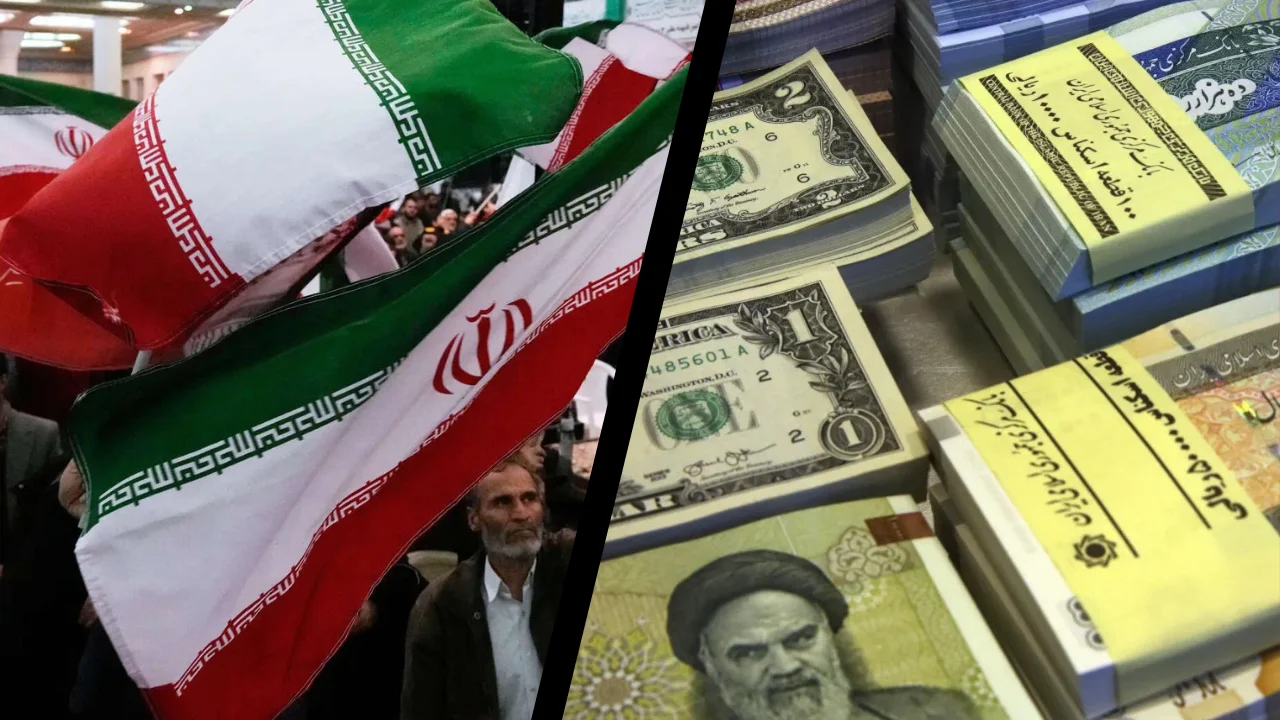
Iran remains at the forefront of economic upheaval and political unrest. While protests continue to escalate, the Iranian regime continues its unwillingness to yield in its pursuit and development of nuclear weapons or take responsibility for its internal corruption or economic ineptitude. Recent media updates reported “three people killed as demonstrations took to the streets to protest after a precipitous drop in the value of the rial, the country’s currency. International sanctions over Iran’s refusal to pare back its nuclear ambitions have led to widespread economic problems, including a devaluation of its currency.”i At the time of this writing, Iran’s currency, the Rial, is severely devalued, trading at 997157.5 IRR to 1 US dollar.ii
Events are rapidly unfolding along with additional killings increasing daily; this should not be considered a surprising occurrence; rather, it reflects long-standing distrust between the Iranian people and their government, and the US and Iran, which has led to economic sanctions that have affected the Iranian economy and its isolation from world markets. This article reviews published open-source information on historical events in Iran and discusses the interplay among past and current events, Iran’s governmental system, U.S. sanctions, and enforcement that affect Iran’s economy today.
Reflecting on Iran’s Transformation to a Belligerent State
Current protests, demonstrations, and resulting deaths are the standard course for Iran. The so-called modern state of the former Persian Empire has undergone several significant and historical transformations. The invasion during WWII by both the Soviet Union and the British Empire to secure their oil fields and to keep logistical supply lines open to Russia resulted in Iran’s distrust of foreign powers and provoked contempt for their actions. After the war, the reigning Shah of Iran issued a decree nationalizing the oil fields to regain control. In response to these efforts, the US and the United Kingdom orchestrated Operation AJAX in 1953 to overthrow the Shah’s rule.iii Upon succeeding, a new Shah was installed, favorable to Western interests and politics. It was during this new Shah’s rule, Mohammad Reza Pahlavi, that the seeds for discontent and revolution were sown. Under his rule, Iran became a brutal autocracy, repression and torture of dissenters were routine, as such, “public disapproval for the regime grew, furthered by an economic recession and public perceptions of the shah as a corrupt U.S. puppet.”iv

In 1979, the Shah was overthrown by the Iranian Revolution and fled into exile. Returning from exile that same year, and, as established by a new Iranian constitution, the cleric Ayatollah Ruhollah Khomeini was welcomed as Iran’s supreme leader.v The 1979 revolution ended 2,500 years of monarchical rule and initiated a comprehensive reorganization of Iran’s government and institutions.
A Battle-Hardened Regime
Iran’s current form of government has endured since 1979 and demonstrated substantial resilience. To date, it has withstood exceptional controversy, political intrigue, internal rebellion, and foreign military attacks. Upon reviewing a timeline of events, it is difficult to grasp how the center continues to hold after the invasion of Iran by Iraq in 1980, which included the use of chemical weapons. Iran’s counter invasion on Iraq in 1982 to reclaim its territory; the oil tanker wars of 1984; Iran Flight 655 shot down in 1988 by the USS Vincennes; and recent times, including Israel’s June 2025 Operation Rising Lion, followed by the US Joint Forces’ Operation Midnight Hammer that same month on its nuclear facilities. In addition to these events, since 1996, Iran has faced severe economic pressures from the U.S. and the UN, including economic sanctions that have affected its economy.
Figure 1 illustrates Iran’s regime structure, as set out in the Constitution of the Islamic Republic of Iran, including key leadership responsibilities.
FIGURE 1: Iran’s Current Regime Structurevi

Key Leadership Responsibilities
The Supreme Leader’s authority is not absolute; he is elected by the Assembly of Experts. The President, who heads the government, answers to him. The 290-seat Parliament (majlis) is directly elected for four-year terms, with five seats for religious minorities. The Guardian Council approves laws in accordance with the constitution and Islamic law. The Expediency Council serves as a mediator between the parliament and the Guardian Council. The Supreme National Security Council, led by the president and comprising the parliamentary speaker and the chief justice, comprises the heads of all three branches of government.
Applying Pressure on the Iranian Economy
Since 1979, the US government has pursued a sanctions enforcement campaign in efforts to curtail Iran’s efforts to obtain a nuclear weapon and counteract its negative influence with sympathetic actors. This is a unified effort by the US government, beginning with the President’s most recent National Security Presidential Memorandum/NSPM-2, establishing policy and delegating responsibilities to the Secretary of the Treasury to impose enforcement remedies; the United States Permanent Representative to the United Nations to work with key allies to establish international (snapback) sanctions; the Secretary of Commerce for export control; the Attorney General all legal steps to investigate, disrupt, and prosecute; and the Director for the Office of Management and budget to draft necessary budgetary, administrative and legislative proposals; when combined, the NSPM-2 acts to codify in law and take actions the President deems necessary to ensure the safety and security of the American people.vii
The Office of Foreign Assets Control (OFAC) within the U.S. Department of the Treasury administers and enforces economic sanctions against countries and individuals. The Iran Sanctions are highly robust and complex, with many provisions designed to expose the denial and deception activities of other countries that go to great lengths to conceal their assistance to Iran, particularly those seeking to import or export Iranian petroleum products.viii While not a complete list of the Iran sanctions, the following are offered with links as an illustrative example of the level of effort required to preclude Iran from requiring the necessary capital funds and materials for a nuclear weapons program:
- Guidance for Shipping and Maritime Stakeholders on Detecting and Mitigating Iranian Oil Sanctions Evasion(April 16, 2025)
- Iran Ballistic Missile Procurement Advisory (October 18, 2023)
- Guidance to Industry on Iran’s UAV-Related Activities (June 09, 2023)
- Guidance to Address Illicit Shipping and Sanctions Evasion Practices (May 14, 2020)
- Deceptive Practices by Iran with respect to the Civil Aviation Industry (July 23, 2019)
- Financial Channels to Facilitate Humanitarian Trade with Iran and Related Due Diligence and Reporting Expectations(October 25, 2019)
- Notice on the Re-imposition of the Sanctions on Iran that had Been Lifted or Waived Under the JCPOA (November 04, 2018)
Appraising the Impact of Sanctions
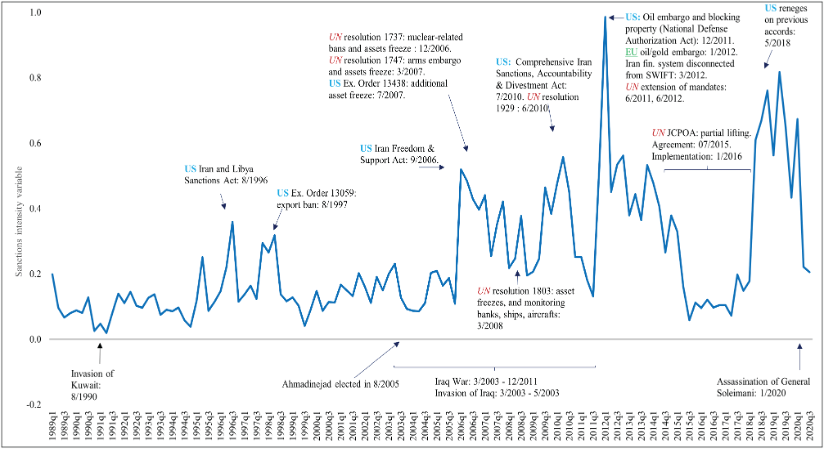
Figure 2 illustrates research conducted by Dario Laudati and M. Hashem Persaran, spanning from 1989 1st quarter to the 2020 3rd quarter. “Overall, there seems to be little doubt that US sanctions have harmed the Iranian economy.”ix Their model identifies the short-run and long-run effects of sanction shocks on oil export revenues, Iran’s rial/USD exchange rate, money supply growth, inflation, and output growth, while controlling for foreign output growth and other global factors, such as global equity market volatility.x
FIGURE 2: Sanctions intensity variable over the period 1989 Q1–2020 Q3.
Final Thoughts
Social media continues to report on the grim economic challenges facing everyday people in Iran. World leaders, including the Prime Minister of Israel, Benjamin Netanyahu, and President Trump, are encouraging the people to resist and overthrow their government. Emily Chang of ABC News reported on President Trump’s post on his Truth Social media platform, “vowing that if Iran [shoots] and violently kills peaceful protesters,” then the US would step in and “rescue” them.” He also added the US is “locked and loaded and ready to go.”xi There has been no further reporting or statements from the White House as to how “rescue” is defined. On the surface, these statements sound encouraging and hopeful. However, the US must remain vigilant against Iran’s continuous propaganda, always casting the West as the enemy, thereby providing the US as a foil for the current regime to define itself by.
In his scholarly article, All the Ayatollah’s Men, Ray Takeyh writes that Khomeini and his supporters successfully sold the narrative that “the Western powers were rapacious imperialists determined to exploit Iran’s wealth for their own aggrandizement and subjugation of Muslims.”xii With this understanding, attempts to help Iran could inadvertently turn public opinion against those offering assistance and prompt rejection of Western aid, as the wounds of Operation Rising Lion and Operation Midnight Hammer remain fresh in most people’s minds.
It is with significant risk that the people of Iran take on the current regime. While not impossible, one would hope that there are regime insiders who are empathetic and who desire change and a return to the world economy, including a semblance of a normal home life. Those who stayed and fought after the 1979 coup and attempted to work towards a more mainstream government suffered a series of purges, including arrests, trials, and executions that affected as many as 4,500 military personnel and nearly 6,000 activists, effectively eliminating any remaining opposition.”xiii
Those who escaped persecution after the 1979 revolution became the first significant wave of Iranian immigrants to the US. Kevan Harris of UCLA’s International Institute noted that “at that time, US immigration law prioritized family members of US residents, allowing Iranians already settled in America to bring in spouses, parents, and children. Between 1978 and 1980, more than 35,000 Iranians arrived in the US.”xiv Many of these immigrants were Iran’s most educated professionals and former elites.
The West should anticipate that any chance of a successful Iranian regime change will require the spilling of blood and treasure against an entrenched and fanatical Islamic government. Short of this success, once people lose their country and home, where do they go?
Endnotes
i. Faucon, Benoit, “Iranian Protesters Killed as Unrest Turns Violent on Fifth Day,” Wall Street Journal, Apple News online, 01 January 2026, https://apple.news/AHSQnrcrsSVeHbRgKlFmHOQ (Accessed 05 January 2026)
ii. Markets-Business Insider, currency converter online, US Dollar -Iran (IRR); https://markets.businessinsider.com/currency-converter/united-states-dollar_iranian-rial (Accessed 09 January 2026)
iii. Defense Intelligence Agency (DIA), “Iran Military Power, Ensuring Regime Survival and Securing Regional Dominance.” Pgs.2-4. August 2019; https://www.dia.mil/Military-Power-Publications/ (Accessed 06 January 2026)
iv. Defense Intelligence Agency (DIA), “Iran Military Power, Ensuring Regime Survival and Securing Regional Dominance.” Pgs.2-4. August 2019; https://www.dia.mil/Military-Power-Publications/ (Accessed 06 January 2026)
v. CFR.org Editors, online, 16 June 2025, World International Property Organization (WIPO), with permission of Homa Katouzian, Iranian Studies, translation of the Iranian Constitution (1989), Iranian Studies 47:1, 159-200. https://www.wipo.int/edocs/lexdocs/laws/en/ir/ir001en.pdf (Accessed 02 January 2026)
vi. CFR.org Editors, online, “The Islamic Republic’s Power Centers,” online, 16 June 2025. https://www.cfr.org/article/islamic-republics-power-centers (Accessed 22 June 2025)
vii. The White House, NATIONAL SECURITY PRESIDENTIAL MEMORANDUM/NSPM-2, “Imposing Maximum Pressure on the Government of the Islamic Republic of Iran, Denying Iran All Paths to a Nuclear Weapon, and Countering Iran’s Malign Influence,” 04 February 2025, https://www.whitehouse.gov/presidential-actions/2025/02/national-security-presidential-memorandum-nspm-2/ (Accessed 03 January 2026).
viii. U.S Department of the Treasury, Office of Foreign Assets Control (OFAC), Iran Sanctions. https://ofac.treasury.gov/sanctions-programs-and-country-information/iran-sanctions (Accessed 03 January 2026)
ix. Laudati, D., & Pesaran, M. H. (2023). “Identifying the effects of sanctions on the Iranian economy using newspaper coverage.” Journal of Applied Econometrics, 38(3), 271–294. https://doi.org/10.1002/jae.2947
x. Ibid, Laudati, D., & Pesaran, M. H. (2023).
xi. Chang, Emily, “Trump warns US is ‘locked and loaded’ if Iran kills peaceful protesters,” ABC News, online; https://abcnews.go.com/Politics/trump-warns-us-locked-loaded-iran-kills-peaceful/story?id=128845602 (Accessed 02 January 2026)
xii. Takeyh, Ray, “All the Ayatollah’s Men,” The National Interest, No. 121 (September/October 2012), pp. 51-61 (11pages). https://www.jstor.org/stable/42896549 (Accessed 22 June 2025)
xiii. DIA, page 3.
xiv. Harris, Kevan, UCLA International Institute, online, 15 February 2023, “Mapping the Iranian diaspora in America,”https://www.international.ucla.edu/Institute/article/262699 (Accessed 04 January 2026).