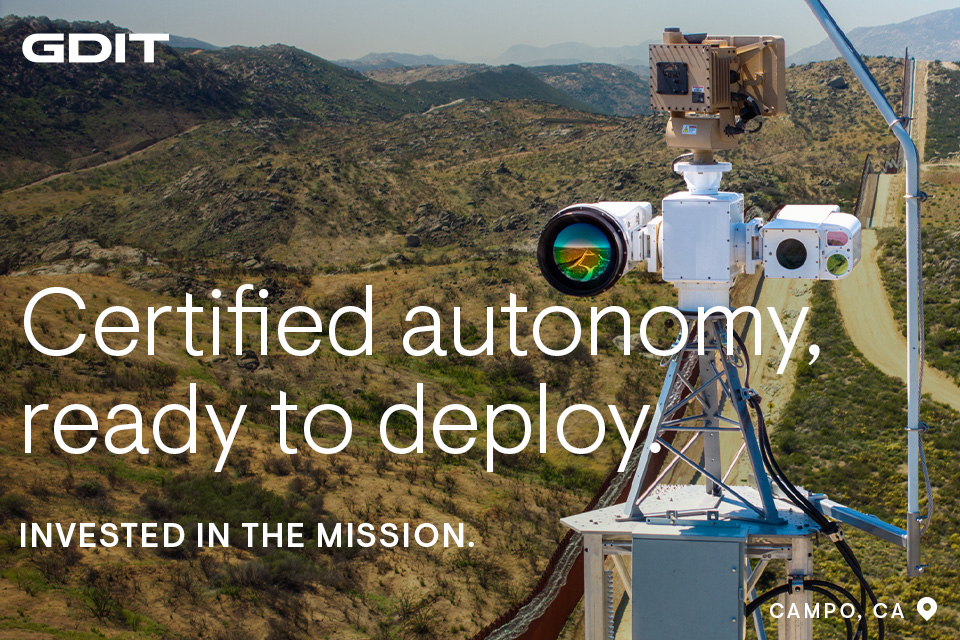

Border protection has entered a new era. Borders have become strategic pressure points where military tensions, transnational crime, irregular migration and hybrid warfare converge. And it’s no longer just a physical challenge: protecting borders now also requires proactive vigilance across cyber and digital realms.
Yet many organizations still rely on outdated strategies and isolated sensors. These approaches were not designed for today’s environment, where threats move quickly and the lines between war, crime and terrorism have blurred.
In this fast-changing landscape, traditional methods can no longer keep pace. For example, a vessel “going dark” may be exposed first through irregular satellite signals, not sonar. A trafficking network may leave digital traces months before its activities are spotted in the field. A surge in irregular migration may be detectable through social media activity long before crossings occur at the border. By the time a threat reaches the fence or coastline, it is often too late for an effective response.
Governments need modern solutions that redefine their mission around a central principle: border intelligence. This requires fusing multi-domain data and applying analytics and predictive insights to detect threats and suspicious activity long before they reach a physical border.
Why Legacy Systems Are Falling Behind
Across ground, marine and air environments, agencies face similar systemic gaps:
-
- Fragmented data ecosystems with limited ability to integrate or correlate across sources
-
- Short-range detection that misses activity farther from the border
-
- Land and maritime blind spots that adversaries exploit
-
- Difficulty detecting long-term patterns and prioritizing which high-risk areas should be monitored
-
- Growing asymmetry as bad actors adopt advanced technologies, including drones, spoofing tools and encrypted communications, which give them disproportionate power and reach.
The result is a persistent cycle of detecting threats late and responding in a reactive approach.
Achieving Comprehensive Operational Awareness with a Border Intelligence Approach
Border intelligence depends on gathering data from multiple domains, fusing them into a single operational picture and turning that information into actionable insights. With so many disparate sources and immense data volumes, this is not a trivial task.
This is why decision intelligence is a critical component of a holistic border intelligence solution. By leveraging an AI-powered decision intelligence platform, border and maritime forces can fuse and analyze structured and unstructured data at scale. These systems make it possible to detect suspicious patterns across geography and time, reveal hidden connections, surface anomalies and prioritize threats based on risk and context.
When harnessed correctly, massive data volumes become a gold mine of actionable intelligence rather than a burden.
A Three-Layer Border Intelligence Model
Relying on information from a single domain, whether imagery, signals or social feeds, creates blind spots. Effective threat analysis requires correlating SIGINT, OSINT, ELINT and imagery into one coherent picture. True border intelligence goes further by leveraging analytics to surface real threats and guide targeted responses.
- The Sensor Layer: Obtaining a Multi-Domain View
Each domain adds valuable information, and when correlated together, they reveal a rich intelligence picture unattainable from any single source.
-
- Signals intelligence (SIGINT): Communications patterns and signals
-
- Electronic intelligence (ELINT): Electronic emissions, radars, clandestine transmitters
-
- Visual / Imagery intelligence (VISINT/IMINT): Drones, aircraft, satellites, fixed cameras
-
- Open-source intelligence (OSINT): AIS, social media, shipping registries, dark web forums
- The Analytics Backbone: Turning Information into Insight
Traditional border systems and sensors, as powerful as they may be, cannot keep pace with the speed and complexity of modern threats. That’s why agencies need a powerful analytical backend capable of transforming raw data into intelligence. Such a platform must be capable of ingesting both structured and unstructured data from every domain, automatically linking threat actors, vessels, vehicles, transmissions and locations into a coherent picture, detecting anomalies and early indicators of illicit behavior, and generating prioritized alerts.
- Operational Deployment: Applying Insight in the Field
Effective border intelligence must reach every tier of the organization. Strategic leaders need it to guide resource allocation and manpower. Analysts rely on it to detect trends, map patterns and understand evolving threats. Field operators depend on timely, actionable insights that improve tactical decision-making in real time. The strength of this approach lies in connecting these levels into a unified flow of intelligence rather than treating them as isolated functions.
How Border Intelligence Changes Outcomes
When an agency adopts a border intelligence model, the effect is transformative. Threats can be identified far earlier because analysts can connect patterns across multiple domains. Agencies can deploy their resources more effectively, guided by predictive insights.
In one recent case, a maritime enforcement organization used Cognyte’s border protection solution to identify a fleet of fishing vessels conducting covert fuel transfers to a sanctioned state and was able to successfully disrupt their operations.
Conclusion: Intelligence Is the New Frontier
Borders will continue to face hybrid, fast-moving and technologically sophisticated threats. The agencies that succeed will be those who can see earlier, understand deeper and act faster.
Border intelligence shifts the mission from guarding a line to understanding an ecosystem. From reacting to anticipating. Achieving this transformation requires the right technological foundations and analytical capabilities—a challenge Cognyte helps agencies meet through its border intelligence approach.
With over 30 years of domain expertise, Cognyte understands the operational realities and evolving challenges of border protection. That experience underpins our fully integrated solution, combining advanced sensors in the field with a powerful analytics backbone. Supporting diverse missions from wide area monitoring to target engagement, Cognyte delivers a continuous flow of intelligence from the field to headquarters. This empowers agencies to anticipate threats earlier, make faster, better-informed decisions, and coordinate responses across every level of command.
This is a Sponsored post.