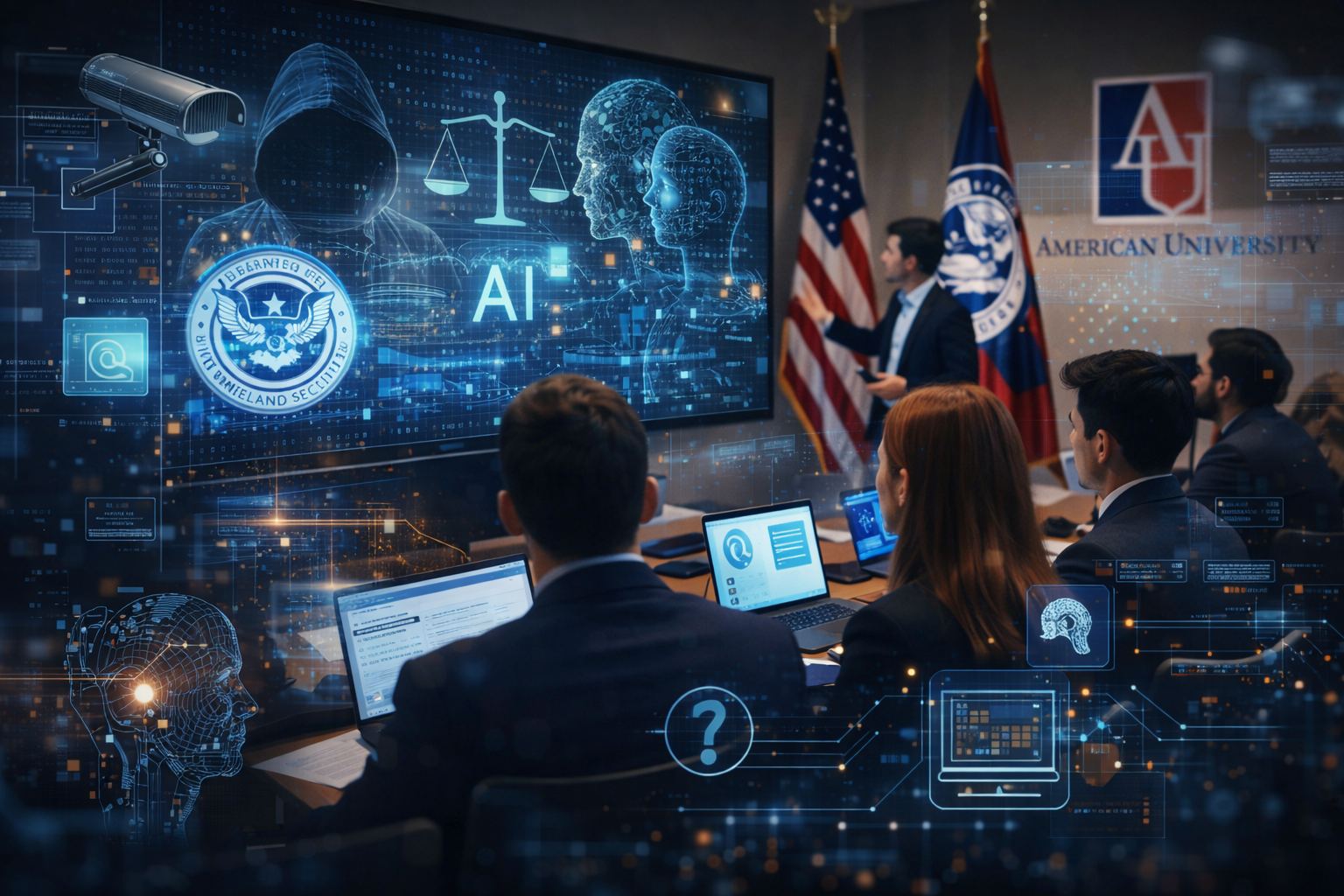
This fall, a student research team from American University’s School of Public Affairs (SPA) conducted an in-depth analysis of how predictive artificial intelligence is transforming U.S. counterterrorism operations and what legal, ethical, and civil-liberties challenges arise as these systems become more integrated into national security work. The project, “The Legality of Predictive AI in Counterterrorism,” was developed as part of the course AI and Homeland Security under the supervision of Dr. Trace Lasley, Senior Executive in Residence in the Terrorism and Homeland Security Policy (THSP) Program. According to Dr. Lasley, “My goal with this course is to lay a strong foundational knowledge of AI and its unique role across homeland security missions. My goal for the project is to show students what it’s like to apply that knowledge in the homeland security enterprise.”
The team’s research assessed how AI-enabled tools are used within the Department of Homeland Security’s (DHS) Mission 1: Preventing Terrorist Attacks and evaluated whether existing legal and regulatory frameworks sufficiently protect constitutional and civil-liberties interests in an era of algorithmic decision-making. The project also examined the role of private-sector developers in designing, building, and supporting DHS analytical and predictive systems. The team raised key questions about transparency, accountability, and the governance of industry-supported AI. Throughout the semester, leaders from BigBear.ai, a leading AI company providing national security solutions to the commercial and government sectors, met with the class to provide expert insights on how DHS employs the company’s AI tools. Building on strong ties between BigBear.ai and the THSP program, students were able to learn firsthand how to present their ideas and incorporate feedback. Jim McLaughlin, the Senior Vice President for Technical Solutions participated in the project throughout the semester. “The AI and Homeland Security class’s head-to-head competition fosters a genuinely engaging environment; the students put together thoughtful projects with well researched and executed approaches. It’s impressive to see a new generation of scholars tackling current trends in AI and government policy implications.”
Drawing on numerous academic, industry, and government sources, including DHS’s AI roadmap, key OMB guidance (M-25-21 and M-25-22), and recent reports from the GAO and the Privacy and Civil Liberties Oversight Board (PCLOB), the study analyzed how predictive systems are designed, deployed, and overseen across DHS components. The project uncovered the need for clearer safeguards around algorithmic fairness, bias mitigation, data governance, and due-process protections, particularly when AI-driven assessments influence counterterrorism risk evaluations and operational decisions.
Ekaterina Bykova, the project manager, explained, “Our research shows that AI in counterterrorism is no longer a question of if but how. If governments treat AI as operationally inevitable, they must also treat civil-liberties protections as non-negotiable. That means not just asking for ‘more transparency’, but building concrete mechanisms that align incentives across DHS, private contractors, and regulators.”
On Thursday, December 4th, the students presented their capstone project to senior BigBear.ai staff, including CEO Kevin McAleenan, at the company’s headquarters in Tysons, Virginia. During the briefing, they discussed potential future regulatory developments relevant to the company’s work. This project reflects American University’s ongoing commitment to advancing research at the intersection of emerging technology, national security, and democratic governance.