
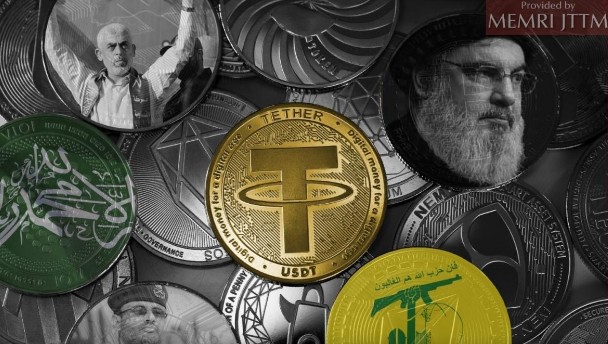
Part of the mission of President Trump’s Board of Peace to restore normalcy and rebuild Gaza is to determine how Gazans are going to buy what they need and conduct business – and this could be a new or existing stablecoin. While the proposal is still in the “preliminary stage,” according to the Financial Times, if the organization does go for an existing coin, it could be Tether, the most popular stablecoin globally. Also in the news is Meta’s plan to integrate stablecoin payments into its apps later this year. However, on February 23, the Trump-backed USD1 stablecoin briefly dipped slightly below its benchmark $1 price but quickly recovered; a spokesman for its company said that its engineering and security teams had “repelled a coordinated attack.”
In July 2025, MEMRI Executive Director Steven Stalinsky, who has extensively researched and written about jihadi use of technology, including cryptocurrency, published a piece about stablecoins and how they are being used by global terrorist organizations yet despite this were being favored and promoted by the U.S. government.
Below is his article, which provides insight into the importance of stablecoins to jihadis and how they are finding them attractive for fundraising and other purposes.
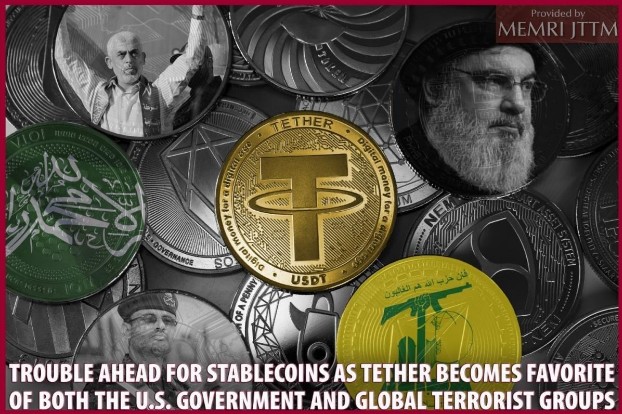
Trouble Ahead For Stablecoins As Tether Becomes Favorite Of Both The U.S. Government And Global Terrorist Groups
Terrorist groups – ISIS, Al-Qaeda, Hezbollah, Hamas, the Houthis, and others – have, since 2014, used cryptocurrency to fund their activities, including targeting the U.S. and the West. Their social media fundraising campaigns now share crypto wallet addresses and detailed instructions for sending funds in Bitcoin, Monero, Ethereum, Ether, and the like. As recently as July 1, a Telegram bot belonging to the new Iran-backed “Islamic Resistance Front in Syria – Formidable in Might” militia announced it was fundraising for its military activity via cryptocurrency.
As it invests heavily in integrating digital currencies into the U.S. government financial system, the Trump administration has come out swinging against terrorist use of crypto. This week it was announced that a man from Detroit, Michigan, a hotbed of jihadi activity, had pleaded guilty to concealing cryptocurrency donations to ISIS.
Last month, the Department of Justice sentenced a Virginia man who had used it to raise nearly $200,000 for ISIS. Following this, Attorney General Pam Bondi said, “If you fund terrorism, we will prosecute you and put you behind bars for decades.” FBI Director Kash Patel added, “This is more proof that the FBI will investigate and work with our DOJ partners to hold accountable anyone who assists ISIS or other terrorist groups. Whether you are a fighter or send money, these activities are illegal.”
This follows a March 27 DOJ announcement that it had seized $200,000 in cryptocurrency from wallets and accounts benefiting Hamas, traced from a fundraising address that was used to launder over $1.5 million in virtual currency.
It’s not just Americans using crypto for fundraising for jihadi groups – the issue is global in reach. U.S. officials have been speculating that cryptocurrencies may be being used in Lebanon to finance Hezbollah. HSBC bank in London froze multiple accounts on suspicion that cryptocurrency was moved through them to Hizbullah and Hamas, according to a May 1 report.
The emerging favorite cryptocurrency of these groups, however, is issued by Tether, a stablecoin – a token backed by the company’s reserves in various fiat currencies. Tether USD (USDT), which is pegged to the U.S. dollar, is the largest company in the digital assets industry and the world’s most widely used stablecoin. It represents over two thirds of the $200 billion stablecoin market. It is currently the third-most valuable cryptocurrency, and its parent company also aims to launch its own AI.
One of Tether’s biggest financial backers, Cantor Fitzgerald, lost 658 of its employees in the World Trade Center on 9/11. The company, which was headed by Howard Lutnick for nearly two decades until his appointment as commerce secretary, is likely unaware that its investment could be helping facilitate global jihad. Lutnick said at a July 2024 Bitcoin conference, “My brother was killed by jihad. Let me make it crystal, crystal clear. We would never ever be associated with a company that has anything to do with jihad.”
The U.S. government is moving closer to allowing Tether wide usage in the U.S. market in exchange for an agreement to work with law enforcement. In recent Congressional moves, on June 17, the Senate passed, with bipartisan support, the GENIUS and Stable acts that establish a regulatory framework for stablecoins. However, as one report noted, the GENIUS act will make stablecoin issuers like Tether subject to auditing, and they will have to end risky practices.
Still, over the past few weeks, the stablecoin market has grown to $256 billion and could soon reach above $2 trillion in value. Lining up to use them are Bank of America, PayPal, Walmart, Amazon and other major businesses.
At the same time, Russia, China, Iran, and even North Korea are all looking to tie their currencies to stablecoins.
Although terrorists’ embrace of stablecoins has yet to be formally addressed publicly by government agencies – Treasury, FinCEN, Department of Justice, and others – they have done an admiral job disrupting it. On April 2, the Treasury’s Office of Foreign Assets Control (OFAC) took action against Houthi financial facilitators coordinating with elements linked to the Iranian IRGC Qods Force, which had procured tens of millions of dollars’ worth of weapons and other commodities from Russia, as well as stolen Ukrainian grain, for Houthi-controlled Yemen. Also found were eight digital asset wallets, via which the Houthis transferred tens of millions of dollars in Tether to a sanctioned Russian crypto exchange.
Hamas and Palestinian Islamic Jihad have also reportedly collected over $130 million in cryptocurrency in recent years, through a fundraising campaign, including in Tether, by the Hamas affiliate Gaza Now. This campaign is ongoing despite the sanctioning of its members in the West by the U.S. and U.K. for fundraising on Telegram, and despite its leader’s arrest. Just last week, Gaza Now promoted another Tether wallet on its Telegram account.
Further proof of U.S. government determination to go after terrorist use of stablecoins was the April 1 FinCEN “Advisory on the Financing of the Islamic State of Iraq and Syria (ISIS) and its Global Affiliates.” It warned of cryptocurrency’s importance to ISIS and the organization’s solicitation of cryptocurrency donations, including in Tether, through its magazine “Voice of Khurasan.”
It should be noted that on June 17, Tether blocked several wallets involved in terror financing, weapons proliferation, and other financial offenses, freezing over $12 million in USDT on the Tron blockchain. Also on June 25, Tether froze some $700 million in USDT held in 112 cryptocurrency wallets that were possibly linked to Iran.
Monitoring of terrorist fundraising shows that Tether has become a favorite. Most recently, on June 16, the pro-ISIS Telegram channels “Bayda’ Al-Muwahhideen” and “Al-Jasad Al-Wahed” solicited funds in Tether. In Syria in 2025, the Syrian Popular Resistance channel on Telegram shared a poster featuring a QR code for donating in Tether to fund operations and to purchase and manufacture weapons. In March, the Syria-based militant training group Malhama Tactical launched an ongoing fundraising campaign on its X account for its “military needs,” providing QR codes for Tether.
As the government clears the way to linking Tether to its own cryptocurrency plan, one thing is certain: There is a small but closing window to stop terrorist groups that are exploiting stablecoins before this becomes an unmanageable national security issue. The new presidential working group on digital assets should come up with solutions. These can include setting an industry standard, formulating a pledge for companies to employ technology to remove terrorist groups activity with it, setting Know Your Customer and other Anti-Money Laundering requirements, and utilizing a grading system that penalizes companies that fail to act, fining them or excluding them from working with the government.