
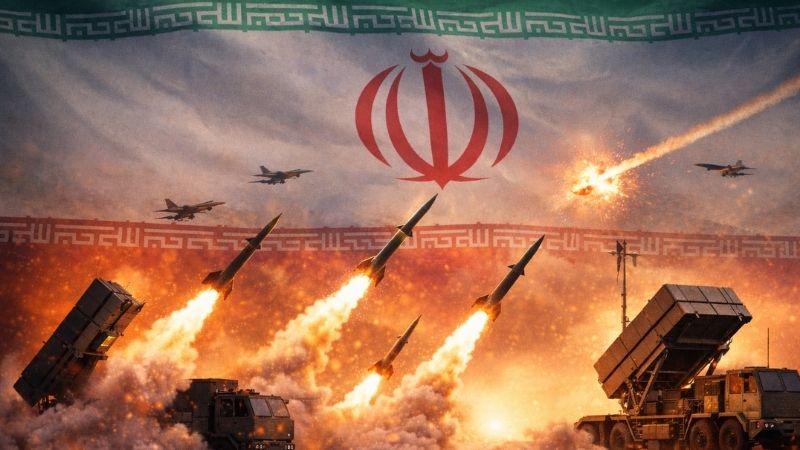
As the US-Israel war on the Iranian regime continues to escalate, the key question is not why Tehran has chosen to strike Arab countries rather than directly retaliating against Israel or the American forces stationed along its maritime borders. The more important question, which this article aims to answer, is how the Arab Gulf states have managed to effectively defend themselves, so far, against the barrage of Iranian missiles and drones that have crowded Gulf skies since the outbreak of the war. As recently as the early 2010s, most of the Gulf monarchies lacked active or skilled armed forces. Due to their smaller size and population compared to their inflated economic wealth, they preferred to outsource security needs from regional and international allies. So, what has changed this time, and what does that mean for the future of the regional security architecture?
Hopelessly striving for survival, Tehran seems determined to expand the war zone geographically and economically. By directly attacking neighboring oil-dependent Arab Gulf states, Tehran aims to create a regional security crisis and a global energy disruption strong enough to slow down the American-Israeli offensive while the remnants of the regime buy time to manipulate. That reasoning is deeply rooted in the Islamic Republic’s long record of instrumentalizing Arab territories and populations as disposable arenas for its regional confrontations.
For decades, the Iranian regime has viewed large parts of the Arab world as a strategic backyard, where it can plant armed proxies and use their territories as a launchpad to attack Israel and exert ideological and cultural hegemony. In Iraq, Lebanon, Syria, and Yemen, Iranian-backed militias have embedded themselves within fragile states, reshaping local politics while causing suffering for ordinary citizens. The humanitarian impacts of these actions, ranging from economic collapse, famine, displacement, to prolonged civil wars, have scarred entire societies and destabilized the region for generations.
In contrast, the ongoing war is highlighting a different positioning by Arab Gulf states. Their collective siding with the US and Israel against Iran, and their ability to intercept hundreds of Iranian missiles and drones, so far, without external help, not only represents a healthy departure from the traditional relationship dynamic between the Iranian regime and Arab states, but it also suggests that a profound transformation has taken place in the military buildup of the region.
The impressive defense display by the Arab Gulf states today highlights the peak of a significant strategic shift that has been quietly developing across the Middle East since the Arab Spring. This transformation has become more evident over the past decade as Arab Gulf states played direct and indirect roles in political and military conflicts stretching from Libya to Yemen, and from the Eastern Mediterranean to the Horn of Africa.
As the Arab Gulf states were the only turf to withstand the waves of pro-democracy revolutions that swept through the region in 2010-2011, they found themselves compelled to step up and take on the responsibility of regional leadership, especially after Egypt’s dramatic political and economic weakening, and Syria’s descent into terrorist-led domestic conflicts. Historically, Egypt and Syria dominated the region’s political and diplomatic landscape and provided security support to Gulf states whenever needed. Moreover, as Iran took advantage of the chaotic aftermath of the Arab Spring to activate and embolden its affiliated militias in Lebanon, Iraq, Syria, and Yemen, the Gulf states found it necessary to develop their military power and deterrence capabilities, not only by investing in purchasing arms from Western providers, but also by enlarging the volume of highly trained personnel.
One of the most notable aspects of this new strategic posture has been the substantial investment in modernizing national military forces. Defense planners across the Arab world, especially in the Gulf, embarked on ambitious programs to upgrade their armed forces with advanced combat systems, integrated missile defenses, sophisticated surveillance technologies, and modern air and naval platforms. The Arab armament quest has reshaped the global defense market itself, compelling major arms manufacturers to recalibrate their priorities toward a region that is no longer merely purchasing equipment but increasingly seeking to participate in its production and technological development.
This is why the ability of the Arab Gulf states to absorb and repel large-scale missile and drone attacks from Iran in late February through early March is best explained not by acquiring a single “miracle defense system,” but by the shift from platform-centric militaries toward layered air and missile defense, early warning, interoperability, and sustainment-oriented defense industrial ecosystems. The key factor is the unglamorous architecture of air defense (e.g., radars, command-and-control, data links, training pipelines, interceptor stockpiles, and maintenance ecosystems), as these are the determinants of whether a state can withstand repeated attacks without facing strategic paralysis.
The measurable investment base for this remarkable transformation is measurable. Stockholm International Peace Research Institute (SIPRI) estimates that military spending in the Middle East reached $243 billion in 2024, with Saudi Arabia as the region’s top spender at $80.3 billion. The most telling procurement signals in the current war are the endurance purchases and sustainment packages embedded in official U.S. foreign military sales notifications. In late January 2026, the U.S. Defense Security Cooperation Agency (DSCA) notified Congress of a potential sale to Saudi Arabia of 730 Patriot PAC-3 MSE interceptors for an estimated $9 billion, a figure that most plausibly reflects stockpile expansion under sustained threat conditions. Days earlier, DSCA also announced a possible $800 million Patriot sustainment and follow-on technical support package for Kuwait, underscoring that operational performance is inseparable from long-tail support, training, and maintenance infrastructure. DSCA’s documentation of a December 2024 THAAD case for the UAE, covering THAAD missiles and launchers, illustrates how Gulf states have been building vertical defense depth.
Nevertheless, the Gulf’s 2026 performance is best understood as integration, not isolated national batteries. US–GCC joint statements in 2024 explicitly emphasized multilateral work on integrated air and missile defense and referenced a GCC Early Warning Study as a preliminary step toward eventual regional integration. CENTCOM’s descriptions of Eagle Resolve frame the exercise as a tool for developing a regional approach to integrated air and missile defense, and CENTCOM reports on Eagle Resolve 2025 highlight Integrated Air and Missile Defense (IAMD) as a “critical pillar” for protecting populations and infrastructure.
The 2026 Iran war has now converted years of procurement and training into wartime metrics, and, importantly, into a diplomatic record that Gulf governments have selectively chosen to publicize. On March 4, Qatar’s Ministry of Foreign Affairs summarized Defense Ministry reports indicating it had monitored three cruise missiles, 101 ballistic missiles, 39 drones, and two Su-24 combat aircraft, and had successfully intercepted three cruise missiles, 98 ballistic missiles, 24 drones, and two Su-24s. Bahrain’s Defense Force General Command reported intercepting and neutralizing 61 missiles and 34 drones within a defined window. The UAE’s disclosures have been even more explicit about scale. UAE’s official news agency, WAM, relayed Ministry of Defense figures describing more than 800 detected and intercepted threats, including drones and ballistic and cruise missiles, and acknowledged that some threats still fell within the country, which is precisely what “layered defense” looks like in practice: high interception rates alongside residual leakage and collateral effects.
What is newly clarified, more than what is newly discovered, is the centrality of endurance to the Arab state’s success in repelling Iranian air attacks as the war continues to develop. The question is no longer whether the system works, but how long it can endure. Sustained interception is costly and inventory-depleting, especially if the war lingers into an attrition phase. Reuters reported on March 4th that defense executives planned to meet at the White House amid concerns about stockpile depletion and the need to accelerate production, an unusually straightforward acknowledgment that industrial time has become a strategic factor, not just a logistical detail. Even the Gulf’s public messaging has started to reflect this understanding. UAE officials, pushing back on external reports, have emphasized not only multi-layered air defenses but also maintaining a “robust strategic stockpile of munitions” to sustain interception over prolonged periods.
This marks the most significant update since the 2015-2022 arms race: Gulf military modernization is becoming more industrial rather than purely acquisitive. Saudi Arabia’s localization agenda is now quantified in the official statements. GAMI (the General Authority for Military Industries) reported that military spending localization reached 24.89% by the end of 2024, with goals to surpass 50% by 2030. More important than the percentage itself is what localization targets by creating chokepoints in sustainment and readiness. GAMI’s first industrial participation agreement with Raytheon Saudi Arabia was explicitly designed to localize deep maintenance and refurbishment of Patriot systems. This represents an archetypal example of how maintenance ecosystems are becoming strategic assets in missile-defense strategies. Meanwhile, Saudi defense industrial partnerships have expanded into advanced manufacturing, including composites production linked to aerospace supply chains.
The UAE’s trajectory is similar in structure but more export-oriented in presentation. EDGE’s own materials describe a growing order backlog of $12.8 billion as of September 2024 and an expanding international footprint, signaling a strategic intent to become a producer and exporter, not just an importer. This industrial logic is reinforced by planned partnerships. Leonardo and EDGE (UAE’s defense and technology corporation) reported milestones toward a joint venture set to launch in 2026, explicitly centered on technology transfer, governance principles, and market potential. Even intra-Gulf industrial collaboration, once politically unthinkable, has started to emerge as a security instrument. In January 2026, EDGE and Qatar’s Barzan Holdings announced plans for a strategic joint venture focused on co-developing advanced defense technologies, a quiet but potentially important mechanism for building trust through shared supply chains and mutual incentives for interoperability.
None of this eliminates the structural constraints. Integration is politically demanding. It requires trust, data sharing, and secure communication standards in a region that simultaneously pursues diversification and manages intra-Gulf competition. Still, the 2026 battlefield test strongly suggests that Gulf states have already passed a key milestone. Their defenses did not just “hold” in an abstract sense; they operated at scale, repeatedly, and in conditions that forced governments to reveal numbers and defend narratives in real time. Strategically, the Gulf is no longer defined solely by “wealth purchasing security.” It is increasingly shaped by the ability to organize, integrate, and sustain complex defensive systems long enough to prevent an adversary from gaining the political leverage that missile and drone coercion is designed to produce.