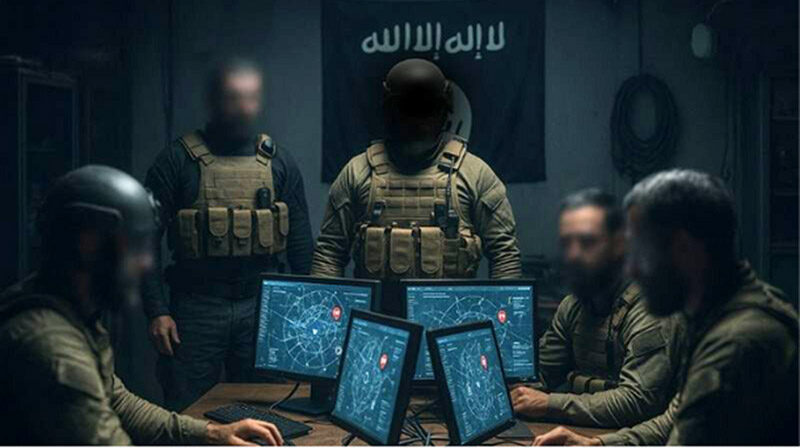
Terrorist groups have always been quick to seize on new technologies. Today that pattern is accelerating with the widespread availability of advanced generative AI tools. Millennial leaders within jihadi movements are experimenting, sharing, and operationalizing AI at speed – changing tactics almost daily and creating a new front: cyber jihad.
To grasp how central AI has become to a new generation of jihadis, listen to what they say amongst themselves on encrypted platforms. Their chatter is blunt and strategic. In an Islamic State Khorasan Province (ISKP) English-language magazine, an ISIS supporter based in the West urged followers to “adapt with tech, computer hacking and various other modern warfare tactics,” calling the world “a cyber battlefield” and arguing that young mujahideen must be educated in those areas. He explicitly stated, “We don’t want to become victims of this new AI, we want to harness it and use it to our advantage to destroy the USA and its allies’ satellites and server infrastructure.”
MEMRI will soon publish a major study examining terrorist groups’ use of AI. This forthcoming work promises to be the most comprehensive to date on this topic. Jihadi groups’ embrace of AI is a breakthrough in cyber jihad on par with their mass adoption of social media over a decade ago.
AI augments recruitment, makes propaganda far more convincing, enables scalable misinformation, and can be turned to cyber-enabled attacks and fundraising. From ISIS and Al‑Qaeda to Hezbollah, Hamas, the Houthis, the Taliban, and a host of smaller groups, AI is emerging as a new and potent weapon.
Warnings have come from unexpected corners. At the UN in late September, Somalia’s Prime Cabinet Secretary Musalia Mudavadi warned that AI can “generate propaganda, manipulate information through deepfakes, automate recruitment messaging, or support cyber-enabled crimes” – and stressed the continuing threat from Al‑Shabab in the region. Recently on Houthi television, a man introduced as an “AI expert” described AI’s usefulness for predictive analysis – tracking behavior and movement, mapping relationships, and analyzing group emotions – and explicitly recommended such capabilities for tactical advantage.
The rapid advance in jihadi expertise in using AI is alarming. Between March and May 2024, a pro‑ISIS media group released four AI‑generated videos featuring a news anchor in military uniform announcing attacks. This was presented at that time as a worrying evolution in jihadi media. Eighteen months later, jihadis are producing AI-generated battlefield videos so realistic they could be used to claim attacks that never occurred – boosting perceived strength to recruit, diverting attention while real operations unfold elsewhere, or simply sowing confusion and distrust in news reporting. Deepfakes and AI‑generated audio – already appearing as AI text‑to‑speech versions of official propaganda – will make it harder for the public and authorities to distinguish fact from fiction.
AI’s danger is not limited to imagery or voice. It can automate operational planning, teach novices how to design explosives or conduct cyberattacks, and enable coordination at scale. On encrypted platforms, supporters have discussed building AI agents specifically for cyberwarfare – tools to launch DDoS attacks, distribute malware, or manipulate infrastructure. They are also avid consumers of Western analysis on AI and warfare, sharing academic articles amongst their followers in order to learn and adapt strategic lessons.
Some jihadis are even evaluating privacy‑focused AI services and encrypted platforms – tools that advertise no data logging and strong privacy protections. Those services can be a double‑edged sword: They are vital for legitimate privacy needs, but they can also complicate efforts to detect and deter malicious planning.
AI could also scale up access to instructions for making weapons, facilitate attacks on crowded venues, assist in attempts to procure dangerous materials on the dark web, or even help design biological threats. Whether or not those extreme scenarios materialize, the combination of malicious intent, accessible tools, and the speed of technological change demand a proactive response.
Yet government preparedness is sorely lacking. Western counterintelligence and counterterrorism agencies have historically been two steps behind jihadi adoption of new platforms or tools. Despite a handful of voices on Capitol Hill, there has been little sustained, public cross‑administration effort to address AI’s weaponization by extremist groups. This vacuum is dangerous: Leaving technical and policy responses to be improvised during crises guarantees lost time, greater damage, and harsher tradeoffs later.
The solution is straightforward: a dedicated, cross‑agency government task force that brings together intelligence, defense, homeland security, law enforcement, diplomacy, cybersecurity experts, AI technologists, civil‑society stakeholders, and privacy advocates. Its mission should be multi‑pronged:
- Assess and map extremist use of AI in real time – propaganda, recruitment, operations, and cyber threats.
- Invest in tools to detect and attribute AI‑generated content – deepfakes, synthetic audio, and manipulated imagery.
- Coordinate offensive and defensive cyber capabilities that can interdict malicious AI‑enabled attacks while respecting legal and ethical limits.
- Drive public-private partnerships with AI platforms and infrastructure providers to harden systems, improve reporting, and create rapid response protocols.
- Launch education initiatives for first responders, journalists, and the public on how to recognize and respond to AI‑enabled disinformation and threats.
- Fund research on hardened verification systems for media and guardrails for AI models that could be abused.
- Fund research focusing on how terrorists groups are using AI and come up with ways to stop it.
This is not a call to hamstring innovation or to sacrifice civil liberties. Any effective response must be transparent, legally grounded, and balanced with robust privacy protection. But neither can it be laissez‑faire: the consequences are too grave.
AI is already a weapon in the hands of jihadis around the world. The longer policymakers wait, the more entrenched and sophisticated these threats will become. A government task force is urgently needed, as are a national security strategy and funding for research institutions focusing on this issue. These are essential for dealing with a rapidly changing battlefield where the tools of the future are being used against us today.
To view the original article as well as additional reports from the Middle East Media Research Institute, visit MEMRI’s website.