
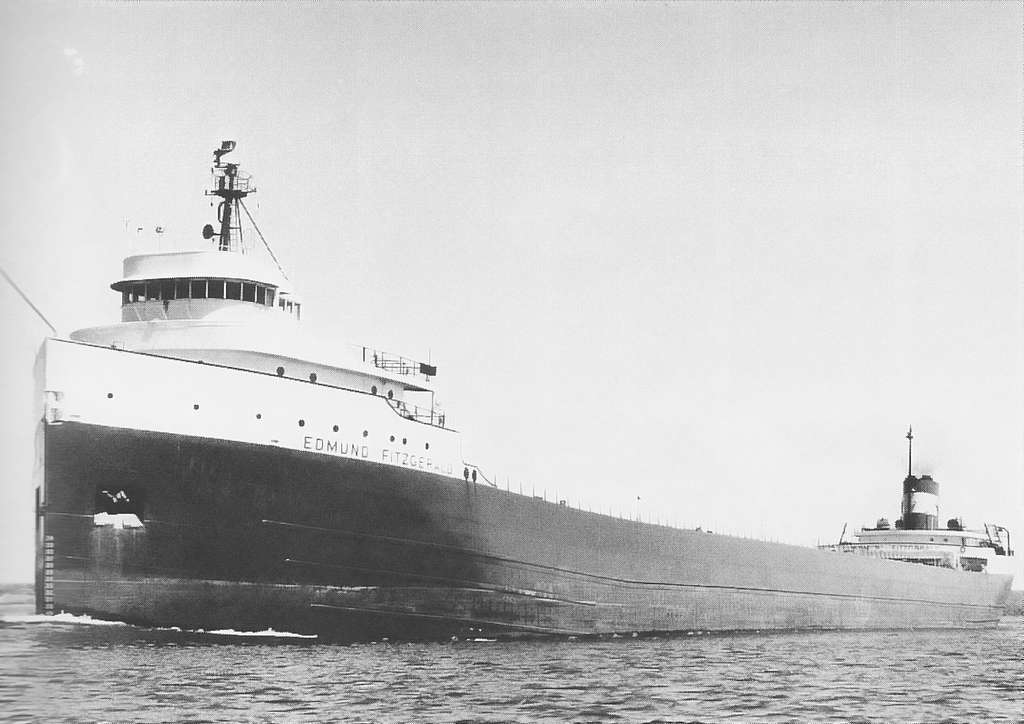
“We are holding our own” – the last radio transmission by the SS Edmund Fitzgerald to the SS Arthur M. Anderson on November 10, 1975.
This week marks the 50th anniversary of the sinking of the SS Edmund Fitzgerald on Lake Superior. It was one of the deadliest shipwrecks on the Great Lakes with 29 crew lost and resulted in significant changes for the Great Lakes shipping industry. Since this incident and the resulting changes, there has not been a major marine casualty on Great Lakes.
The Coast Guard released a Marine Casualty Report on July 26, 1977 that concluded “that the most probable cause of the sinking was the loss of buoyancy resulting from massive flooding of the cargo hold. This flooding most likely took place through ineffective hatch closures. The vessel drove into a wall of water and never recovered, with the breaking up of the ship occurring as it plunged or as the ship struck the bottom.”
The National Transportation Safety Board also released a Marine Accident Report on May 4, 1978. The conclusion was similar to the Coast Guard’s in that “the probable cause of this accident was the sudden massive flooding of the cargo hold due to the collapse of one or more hatch covers. Before the hatch covers collapsed, flooding into the ballast tanks and tunnel through topside damage and flooding into the cargo hold through nonweathertight hatch covers caused a reduction of freeboard and a list. The hydrostatic and hydrodynamic forces imposed on the hatch covers by heavy boarding seas at this reduced freeboard and with the list caused the hatch covers to collapse.”
The “wall of water” and “heavy boarding seas” cited in the reports were some of the worst that the Master of the vessel had experienced. Modern-day computer models show that the waves increased to 25 feet at the time of the sinking. Given that the model focuses on an average size, it is possible that a rogue wave could have been 1.5-2x that size. The SS Arthur M. Anderson reported a wave as high as 35 feet. Weather advisories reported 57 mph wind gusts at the time, but the SS Arthur M. Anderson experienced an 86 mph gust that would have been classified as hurricane force.
These weather conditions created challenges for the response efforts, but the Coast Guard responded quickly with all available assets. At 2103, on November 10th, the SS Arthur M. Anderson (which had been trailing behind) reported to Coast Guard Station Sault Ste. Marie that the SS Edmund Fitzgerald was missing. Within minutes, the CG Rescue Coordination Center in Cleveland (RCC) directed Coast Guard Air Station Traverse City to dispatch aircraft. Then RCC directed CGC Naugatuck (WYTM 92) to get underway from Sault Ste. Marie, Michigan and CGC Woodrush (WLB 407) to get underway from Duluth, Minnesota (approximately 300 miles away from the scene). Additional Coast Guard aircraft and patrol boats participated in the search along with C-130s from Canada, the Michigan Air National Guard and Coast Guard Air Station Elizabeth City. Several commercial vessels in the area also contributed to the search including the SS Arthur M. Anderson, the SS Wiliam Clay Ford and SS Hilda Marjanne.
The search efforts did not recover any survivors or bodies. In fact, per the Coast Guard’s Marine Casualty Report, “[o]nly one lifeboat, one-half of another lifeboat, two inflatable life rafts, twenty-one life jackets or life jacket pieces and some miscellaneous flotsam identified as being from the Fitzgerald were found.” One of the vessel’s life rings washed ashore and a civilian, Larry Orr, found it. It had been on loan to the Great Lakes Shipwreck Museum in Michigan’s UP until recently, the State of Michigan acquired it in the settlement of litigation that was unrelated to the shipwreck.
The sinking of the SS Edmund Fitzgerald changed the Great Lakes shipping industry forever. The Coast Guard’s report made 15 recommendations that the Coast Guard Commandant initiated actions on, including to (a) amend regulations that related to load line regulations and weathertight integrity, (b) amend regulations to reflect the necessity for a means of detecting and removing flood water from the cargo hold and for watertight subdivision of the cargo hold spaces, (c) implement changes regarding lifesaving equipment and crew training, (d) increase the mariner’s awareness of hazards in the Great Lakes and update applicable navigational charts and (e) ensure that emergency position indicating radio beacons could be used and operated in the VHF-FM marine band so that it could be picked up by constant monitoring of Channel 16 by stations in the US and Canada.
Does anyone know where the love of God goes
When the waves turn the minutes to hours?
(Lyrics from The Wreck of Edmund Fitzgerald, a song by Gordon Lightfoot (1976))
(The author is responsible for the content of this article. The views expressed do not reflect the official policy or position of his employer, the U.S. Coast Guard, the U.S. Coast Guard Reserve or the U.S. Coast Guard Auxiliary).