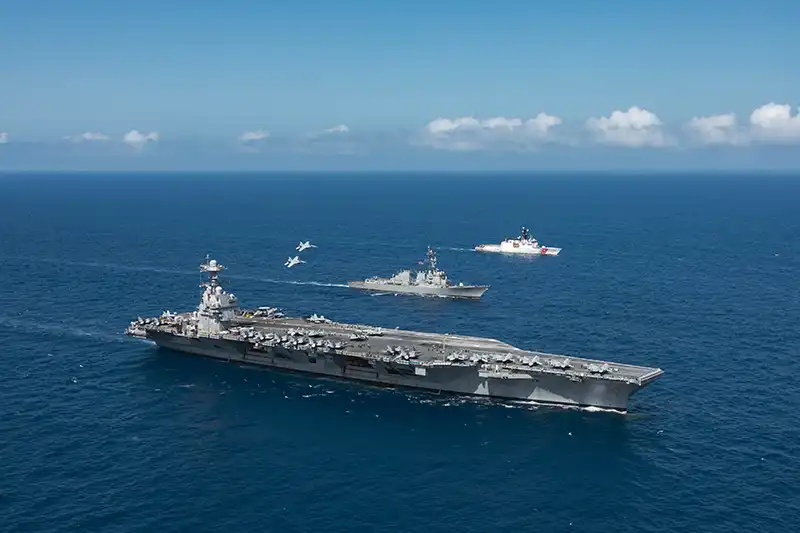
The confrontation between the United States and Venezuela has entered a new phase. In early November 2025, U.S. naval forces sank a Venezuelan vessel in the Caribbean, citing counter-narcotics operations. The deployment of the USS Gerald R. Ford carrier group, long-range bombers, drones, and special operations units confirms a shift from deterrence to active force projection.
Venezuela responded by requesting military and technical support from Russia, China, and Iran. Radar upgrades and strategic coordination are underway. The Maduro government has denounced the U.S. action as armed aggression and is preparing legal escalation. Neighboring states, including Trinidad and Tobago, have raised military alert levels in anticipation of spillover.
This is not a bilateral dispute. It bypasses diplomatic and legal frameworks, exposes intelligence contributors to reputational and compliance risk, and stresses AI-led counterterrorism systems. High-risk deployments in contested zones require immediate recalibration of contributor protection, legal safeguards, and operational traceability.
Secondary escalation vectors are active. Cyber sabotage, disinformation, and maritime disruption are now part of the environment. Defense, intelligence, and regulatory teams must coordinate. Exposure must be reassessed. Frameworks must be recalibrated. Discipline must be mapped and enforced across all layers.
Operational Timeline and Tactical Assets
The escalation between the United States and Venezuela is unfolding through direct deployments and active military pressure. Below are the key developments in the Caribbean theater.
November 1, 2025 – Naval Engagement
U.S. naval forces sank a Venezuelan vessel in international waters near Curaçao. The Pentagon described the strike as part of a counter-narcotics operation, citing intelligence links to criminal networks. The decision was cleared at the highest level. Venezuela called it armed aggression and a breach of sovereignty.
November 2, 2025 – Carrier Group Deployment
The USS Gerald R. Ford left Norfolk with a full strike group: missile cruisers, destroyers, and support vessels. The carrier brings F-35C fighters, surveillance aircraft, and electronic warfare systems. Over 4,000 personnel are involved. Long-range bombers are active from Puerto Rico and Florida.
Airspace Restrictions and Tactical Zones
The FAA, under Pentagon coordination, restricted civilian flights south of Puerto Rico. The zone aligns with active planning and suggests incoming aerial maneuvers. Intelligence confirms MQ-9 drones and special operations teams are conducting reconnaissance and target validation.
Strategic Objectives
Although framed as counter-narcotics, the scale of assets points to broader goals. These include disrupting Venezuelan port logistics, disabling radar and air defenses, applying pressure on Maduro’s command structure, and sending a signal to Russia and Iran.
Tactical Risk Assessment
The deployment exposes intelligence contributors, embedded analysts, and field operatives to elevated risk. Stealth aircraft, electronic warfare, and special forces indicate a blended strategy using kinetic, cyber, and informational tools. Without a UN mandate, legal and reputational exposure is active for all involved.
Venezuelan Response and Strategic Alliances
Venezuela has activated a layered response to the U.S. escalation. President Maduro condemned the sinking of the Venezuelan vessel as armed aggression and a breach of international law. The incident has been framed by Caracas as part of a broader campaign to destabilize the state.
Outreach to Russia, China, and Iran
Within 48 hours, Venezuela requested support from Russia, China, and Iran. The requests included radar and air defense upgrades near ports and borders, technical advisors for planning, cybersecurity teams to protect infrastructure, and logistics support including fuel, spare parts, and communications systems. Russian and Iranian media signaled early backing. Moscow reportedly sent a reconnaissance team. China remained publicly neutral but increased backchannel contact through its diplomatic missions.
Internal Mobilization and Legal Action
Venezuela activated reserve units and reinforced military sites near strategic locations. State media described the U.S. strike as a violation of sovereignty, invoking historical narratives of resistance. Legal teams are preparing to escalate the case at the United Nations and the Organization of American States, citing breaches of maritime law and regional stability.
Regional Reactions and Spillover Risk
Trinidad and Tobago raised its alert level due to proximity and refugee risk. Colombia and Brazil called for restraint. Cuba expressed support for Venezuela and condemned the U.S. strike. Intelligence teams warn of spillover risks including militia movements across borders, disruption of trade routes and energy flows, and activation of proxy networks tied to criminal groups.
Strategic Assessment
Venezuela is using legal pressure, diplomatic coordination, and media framing to slow escalation and build regional support. Russia and Iran add complexity across air defense, cyber operations, and logistics. The threat environment now extends beyond conventional military confrontation
Legal and Normative Dimensions
The U.S. strike against Venezuelan assets in the Caribbean has triggered a legal and operational vacuum. There is no United Nations mandate. The scale of the deployment exceeds the scope of a standard interdiction. This creates pressure on the principles of sovereignty, proportionality, and accountability.
Sovereignty and Maritime Law
The sinking of a Venezuelan vessel in international waters was justified by Washington as a counter-narcotics action. Caracas claims it violated the UN Convention on the Law of the Sea, citing freedom of navigation and non-interference. Legal analysts warn that the use of force without Security Council approval sets a precedent. It weakens regional norms and opens space for unilateral action.
Proportionality and Strategic Exposure
The deployment of a full carrier group, long-range bombers, and special operations units for a single interdiction raises questions. The U.S. frames the operation as a response to transnational crime. But the scale of force suggests broader objectives. This ambiguity increases legal risk and exposes military and intelligence contributors to reputational fallout.
Institutional Accountability
The United Nations and the Organization of American States have issued statements calling for investigations. But enforcement is weak. Geopolitical alignments block consensus. The gap between legal frameworks and operational realities is now visible. There is no shared mechanism to manage escalation or assign responsibility.
Intelligence Exposure and Contributor Safety
The confrontation is putting pressure on intelligence systems and the people inside them. Analysts, field contributors, and protocol designers face growing exposure. The risks are not only physical. They include legal liability, reputational damage, and politicized attribution. As operations expand, protection must be built in. Traceability is not optional. It is a structural requirement.
Exposure Inside AI-Led Pipelines
Modern intelligence systems rely on machine-led workflows supported by human input. These systems often lack safeguards. Roles are unclear. Legal thresholds are not flagged. Attribution can be manipulated. When something fails, contributors are visible but unprotected. Without audit protocols, they are exposed only when it is too late.
Auditability and Structural Safeguards
To reduce exposure, workflows must be traceable. Every decision must be logged with time and authority. Roles must be defined. AI systems must flag legal and operational risks before they escalate. Reputational safeguards must protect individuals from system-level failure. These protections must be built into the architecture. In high-risk missions, especially those involving cross-border actions or legal ambiguity, this structure is essential to keep operations stable and institutions defensible.
Intelligence Exposure and Contributor Safety
The escalation between the United States and Venezuela is exposing structural weaknesses in intelligence workflows. Contributors working inside AI-led systems, field operations, and protocol design are now facing direct risk. As deployments expand and legal clarity breaks down, safety and traceability are no longer optional. They are operational requirements.
Exposure Inside AI-Led Systems
Modern intelligence pipelines rely on machine-led processes supported by human input. Analysts, validators, and protocol designers operate inside systems that often lack built-in safeguards. Legal thresholds are not flagged. Roles are unclear. Attribution can be distorted. In this escalation, contributors involved in targeting and modeling face legal exposure, reputational damage, and politicized audits. Without audit protocols, they remain invisible until something fails. And when it fails, they are exposed without defense.
Auditability and Structural Protection
To reduce exposure, workflows must be traceable. Every decision must be logged with time and authority. Roles must be defined so contributors know where their responsibility ends. AI systems must flag legal and operational risks before they escalate. Reputational safeguards must protect individuals from system-level failure. These protections must be built into the architecture from the start. In high-risk missions, especially those involving cross-border actions or legal ambiguity, this structure is essential to keep operations stable and institutions defensible.
Escalation Vectors and Risk Governance
The confrontation between the United States and Venezuela is not limited to military deployments. It activates parallel escalation channels that include cyber sabotage, maritime disruption, disinformation, and proxy movements. These vectors require coordinated response across intelligence, defense, and regulatory systems.
Cyber Intrusions and Infrastructure Targeting
As U.S. assets expand in the Caribbean, Venezuelan cyber units and allied actors may target infrastructure, financial systems, and intelligence networks. Prior confrontations show that cyber retaliation often precedes physical escalation. Intelligence teams must deploy monitoring routines that detect lateral movement, credential harvesting, and infrastructure probing in real time.
Disinformation and Narrative Warfare
State and non-state actors are using media channels to shape perception. Venezuelan sources describe the U.S. operation as a violation of sovereignty. U.S. sources frame it as a counter-narcotics mission tied to regional security. Russian and Iranian platforms inject alternative narratives that complicate attribution and distort consensus. Governance systems must include narrative mapping, source validation, and reputational safeguards to isolate contributors from politicized distortion.
Maritime Disruption and Trade Corridors
The Caribbean hosts key energy and logistics routes. Escalation may trigger sabotage against tankers, ports, or undersea cables. Insurance markets and shipping operators are already adjusting risk models. Intelligence contributors must integrate maritime surveillance, anomaly detection, and predictive routing to reduce exposure.
Proxy Activation and Border Volatility
Criminal networks and irregular militias may use the confrontation to expand across porous borders. Colombia, Brazil, and Guyana face increased risks of infiltration, arms trafficking, and refugee surges. Regional teams must coordinate intelligence sharing, deploy mobile audit units, and reinforce legal safeguards to prevent systemic destabilization.
Governance Imperatives
Managing risk in this environment requires more than reaction. Agencies must isolate exposure, track decisions, and build systems that protect legal standing, reputation, and operational stability. Threat models must reflect fast-moving conditions, unclear rules, and reputational risk. The U.S.–Venezuela confrontation is a live test of regional resilience. Governance must match the scale and speed of the challenge.
Conclusion & Strategic Outlook
The confrontation between the United States and Venezuela confirms a structural shift in hemispheric security. What began as a maritime interdiction has triggered a multi-domain escalation involving naval deployments, third-party alignments, legal ambiguity, and reputational targeting. The speed of events has outpaced existing frameworks.
This is not a conventional standoff. It is a live test of legal resilience, contributor protection, and system integrity under pressure. There is no formal mandate. Russia and Iran are active. Cyber and narrative channels are open. Intelligence contributors and protocol designers are exposed by design, not by exception.
Operational systems must embed auditability at every level. Contributor safety is a structural requirement. Legal resilience must be built into both AI-led and human-led workflows. Governance must anticipate ambiguity, speed, and reputational volatility as baseline conditions.
This is not an anomaly. It is a signal. The architecture is under strain. Agencies that fail to recalibrate will face the next rupture without protection, without clarity, and without time.
Verified Sources – Strategic Escalation in the Caribbean
U.S. Military Operations in the Caribbean
- USS Gerald R. Ford Carrier Strike Group Deploys to the Caribbean Amid Rising Tensions
24/7 Wall St., October 25, 2025
https://247wallst.com/military/2025/10/25/uss-gerald-r-ford-carrier-strike-group-deploys-to-the-caribbean-amid-rising-tensions
- Ford Carrier Strike Group Ordered to Deploy to the Caribbean
The Aviationist, October 24, 2025
https://theaviationist.com/2025/10/24/ford-csg-ordered-to-caribbean
- Trump Sends World’s Largest Aircraft Carrier into Caribbean
Yahoo News, October 25, 2025
https://www.yahoo.com/news/articles/trump-sends-world-largest-aircraft-180912634.html
Venezuelan Response and Strategic Alliances
- Venezuela’s Maduro Turns to Russia, China, Iran as U.S. Presence Builds in Caribbean
Independent Press, November 1, 2025
https://independentpress.cc/venezuelas-maduro-turns-to-russia-china-iran-as-us-presence-builds-in-caribbean/2025/11/01
- Russia Flexes in Venezuela – But Does It Really Matter?
RedState, November 1, 2025
https://redstate.com/streiff/2025/11/01/russia-flexes-in-venezuela-but-does-it-really-matter-n2195733
- Power Play on Venezuela’s Coast Is About Hegemony, Not Drugs
Tehran Times, November 2, 2025
https://www.tehrantimes.com/news/519857/Power-play-on-Venezuela-s-coast-is-about-hegemony-not-drugs
International Reactions and Legal Condemnations
- UN Experts Condemn Coercive Intervention in Venezuela by the United States
Office of the High Commissioner for Human Rights (OHCHR), October 30, 2025
https://www.ohchr.org/en/press-releases/2025/10/un-experts-condemn-coercive-intervention-venezuela-united-states
- UN Urges Restraint as U.S. Strikes Escalate Tensions with Venezuela
UN News, October 31, 2025
https://news.un.org/en/story/2025/10/1166081
- UN Condemns U.S. Strikes on Alleged Drug Boats in the Caribbean
Republic World, October 30, 2025
https://www.republicworld.com/world-news/unacceptable-un-condemns-us-strikes-on-alleged-drug-boats-in-the-caribbean-calls-for-immediate-halt
FAA Airspace Restrictions and Tactical Zones
- U.S. Issues NOTAM Restricting Airspace off Ceiba, Puerto Rico
DemState, November 1, 2025
https://demstate.com/article/us-issues-notam-restricting-airspace-off-ceiba-puerto-rico-nov-1-2025
- U.S. Imposes Flight Restrictions off Puerto Rico under Pentagon Orders
Al Mayadeen English, November 1, 2025
https://english.almayadeen.net/news/politics/us-imposes-flight-restrictions-off-puerto-rico-under-pentago