
The Science and Technology Directorate (S&T) researches and develops technologies, methods, and procedures that enhance the physical security of the nation’s critical infrastructure. In this article, they discuss Project CHARIOT, which quantifies risks in the rail, oil, and natural gas sectors to inform innovative industry solutions.
America’s $80 billion rail system covers nearly 140,000 miles of track and is fundamental to the nation’s transportation and supply chain networks. Ensuring the security and resilience of this critical infrastructure is vital to maintaining economic stability, public safety, and national security. S&T’s Critical Infrastructure Hardening Achieved through Risk-reduction in Informational and Operational Technology, or Project CHARIOT, has been studying digitally controlled operational technology (OT) systems that lie at the heart of rail operations to improve cyber resilience.
“Newer technologies are being integrated with legacy systems that have been in place for decades,” said S&T Director of National Resilience Solutions Brannan Villee. “The goal of our program is to have industry and the U.S. government working side by side to develop an at-scale platform for testing cyber scenarios that could impact operations in oil and natural gas, freight rail operations, and provide a structure for evaluating both hardware and software in industrial control systems.”
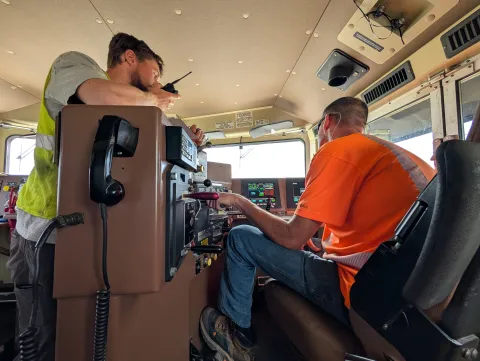
Last fall, S&T and the Pacific Northwest National Laboratory (PNNL) conducted rail communication testing at the Transportation Technology Center (TTC) in Pueblo, Colorado. Representatives from the Federal Railroad Administration (FRA) and industry partners from the Association of American Railroads (AAR) participated in these collaborative efforts.
To operate safely, a locomotive engineer must be able to monitor and control the entire train using sensors and communication devices. PNNL had previously performed isolated testing on Head-of-Train/End-of-Train (HOT/EOT) communications devices to assess their performance and reliability. Field testing at TTC allowed S&T and PNNL to further demonstrate and quantify the importance of maintaining robust communications among HOT/EOT devices, generating data to support ongoing research and improvement efforts.
Researchers utilized operational rail infrastructure, including full-size rail cars in motion, to validate laboratory findings and collect data under realistic conditions. These efforts confirmed the value of comprehensive, real-world testing to inform future standards and practices.
“Throughout at-scale testing for Project CHARIOT, our team demonstrated how cyber events can impact on railroad operations,” said Erin Plemons, Director of the Center for Critical Infrastructure Protection at ENSCO, which operates the TTC. “This work underscores the importance of continued collaboration and investment in strengthening rail system resilience.”
Bringing together government and industry partners fostered important discussions around enhancing rail resilience and identifying both short- and long-term solutions. “By identifying and testing these systems through programs like CHARIOT, we can reduce risks and proactively embed security into new standards, saving operational costs and improving safety,” said Dr. Matthew Rogers, Industrial Control Systems Cybersecurity Expert at the Cybersecurity and Infrastructure Security Agency. The investment is already paying off. Industry is updating standards to address identified risks, and FRA, in collaboration with Idaho National Laboratory, is using test results to inform the development of an EOT risk assessment and mitigation resource guide.
“As rail technology becomes more interconnected, our approach to safety must be equally sophisticated,” said FRA OT Cybersecurity Lead Jen Gallagher. “CHARIOT testing at the TTC demonstrates the importance of securing the digital links that move our freight. This project highlights the vital collaboration between the FRA, DHS, and our industry partners, turning research insights into resilient, real-world solutions that protect our infrastructure and the national supply chain.”
Project CHARIOT is guided by an interagency working group that brings together stakeholders from the U.S. Transportation Systems Sector to inform the testing of rail and oil and natural gas critical infrastructure components. The working group utilizes member expertise to design effective test scenarios and uses the resulting information to advance the missions of participating agencies and strengthen cyber resilience.
“The Project CHARIOT working group is a strong example of how S&T is achieving efficiencies and realizing the impact of one investment across multiple priority missions in the federal government,” said Cynthia Spishak, S&T Director of Operations and Research Analysis. These collaborative events highlight the success of Project CHARIOT in uniting stakeholders to advance rail safety and resilience. S&T is proud to help keep America’s rail system on track.
The original announcement from DHS S&T can be found here.