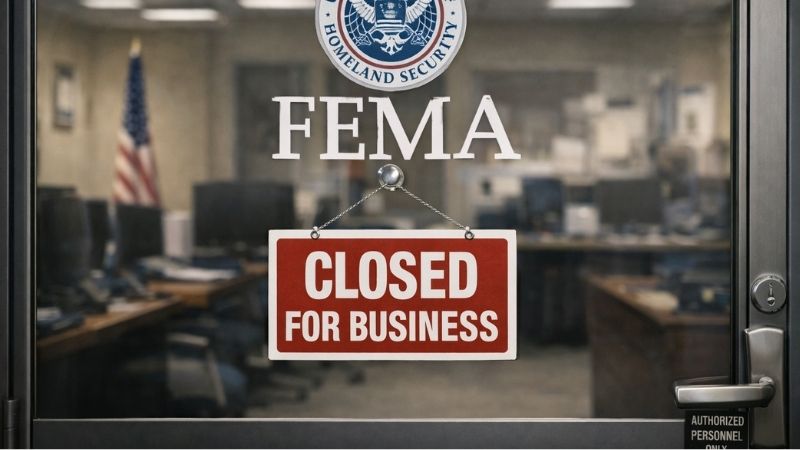
For decades, emergency managers across this country have operated with a fundamental assumption: if an incident overwhelms state, tribal, or local capability, there is a federal backstop. That Federal Emergency Management Agency.
But what happens when FEMA is shut down, temporarily defunded, functionally frozen, or unable to execute its mission?
Whether caused by a lapse in appropriations, political gridlock, workforce disruption, or structural reorganization, even a short-term FEMA shutdown has immediate and cascading consequences. Emergency management is built on layered capability. Remove the top layer abruptly, and stress fractures begin to show everywhere else.
This is not a political argument. It is a planning exercise. And emergency managers should treat it as one.
What Breaks First?
Disasters do not shut down. When FEMA shuts down, it means that coordination, reimbursement, and surge support slow down or disappear precisely when they are needed most.
Here are some likely pressure points.
- Delayed or Denied Disaster Declarations
Without FEMA staff processing damage assessments and recommendations, presidential disaster declarations stall. That means no Individual Assistance. No Public Assistance. No Hazard Mitigation funding.
Communities could face:
- Months-long reimbursement delays
- Unfunded debris removal
- Infrastructure repair costs are borne locally
- Survivors waiting for housing support
The financial shock to counties and small jurisdictions could be devastating.
- Grant Program Interruptions
Preparedness grants such as the Homeland Security Grant Program, EMPG, BRIC, and other mitigation funding streams could be paused or slowed.
For many jurisdictions, those grants fund:
- Planning staff
- Exercises
- Communications equipment
- EOCs and fusion support
- Cyber preparedness
A prolonged pause doesn’t just slow improvement, it erodes baseline capability.
- National Response Coordination Gaps
FEMA operates the National Response Coordination Center and coordinates Emergency Support Functions under the National Response Framework. If federal coordination is degraded:
- Interstate resource ordering becomes more complicated
- Federal agency integration slows
- Voluntary agency coordination may fragment
- Information sharing weakens
The system may still function — but friction increases.
And in disaster response, friction costs lives.
- Logistics and Commodities
FEMA’s logistics centers maintain commodities like water, meals, generators, and tarps. A shutdown could:
- Delay commodity movement
- Reduce transportation contracts
- Interrupt staging operations
States with strong logistics systems will fare better. Those dependent on federal distribution may struggle quickly.
- Confidence Erosion
Perhaps the most under-discussed consequence is psychological.
Emergency management runs on trust. Trust between levels of government, trust with elected officials, and trust with the public. If FEMA is absent or unstable, then governors, tribal leaders, mayors, and county executives may begin making independent decisions that fragment unity of effort.
That fragmentation can outlast the shutdown itself.
So What Can State, Tribal, and Local EMs Do?
Emergency managers cannot control federal funding. But they can control preparation and posture.
Here are some courses of action.
- Strengthen Intrastate Mutual Aid
Revisit EMAC agreements. Revalidate resource typing. Conduct tabletop exercises assuming no federal augmentation for 30–60 days.
Ask bluntly: What can we sustain on our own?
If you’ve not tested that assumption, now is the time.
- Build Financial Contingency Plans
Work with state budget offices and county finance directors now.
- Identify reserve funds
- Clarify emergency spending authorities
- Review reimbursement timelines
- Pre-identify bridge financing options
Disasters are expensive. If federal reimbursement pauses, liquidity becomes the crisis.
- Expand Private Sector and NGO Partnerships
Organizations such as the American Red Cross, Team Rubicon, and faith-based coalitions can help fill temporary capability gaps.
Formalize those relationships before you need them.
The private sector also holds critical logistics capacity. Contracts and MOUs should not assume federal supplementation.
- Prioritize Risk-Based Planning
If grant funding slows, prioritize:
- Core life-safety capability
- Continuity of operations
- Critical infrastructure protection
- High-probability hazards
This is not the moment for aspirational planning. It is the moment for disciplined prioritization.
- Communicate Calmly with Elected Officials
Do not speculate. Do not politicize.
Provide factual assessments:
- What capabilities remain intact
- What gaps may emerge
- What financial exposure exists
- What decisions may be required
Leaders handle uncertainty better when they are briefed early and honestly.
- Preserve Your Workforce
If FEMA shutdown discussions create fear among your own staff, especially those partially federally funded, address it directly.
Transparency builds retention.
Uncertainty drives talent away.
A Hard Truth
The emergency management system in the United States was never designed to operate without federal participation. Since the creation of FEMA in 1979, the federal role has become deeply embedded in doctrine, funding, and expectation. But the need, expectation, and delivery of federal support began in our nation’s infancy.
The first legislative act of federal disaster relief in U.S. history followed a devastating fire in Portsmouth, New Hampshire in December 1802. The destruction of large areas of the city’s seaport threatened commerce in the newly founded nation. In 1803, U.S. Congress provided relief to affected Portsmouth merchants by suspending bond payments for several months.
The question is not whether states, tribes, and localities can function without federal support.
They can.
The question is how painful that learning curve would be, how slow, and how many communities would struggle during the adjustment. And frankly, will people die.
The Real Test
Emergency management is fundamentally about resilience.
Not just infrastructure resilience.
Not just community resilience.
Institutional resilience.
Preparedness is not just about hurricanes and earthquakes.
It is about governance disruption.
It is about funding disruption.
It is about continuity of support.
The best emergency managers already think this way. They do not panic. They plan.
Because disasters do not pause for political processes.
And neither should preparedness.
We are the United States. We have a shared purpose, agreement, and collective action, creating a unified nation. At a time when our nation is deeply divided on key values, we must, more than ever, be unified in protecting the safety of our communities and citizenry from the threat of disasters.
Dan Stoneking is the Owner and Principal of Stoneking Strategic Communications, the Author of Cultivate Your Garden: Crisis Communications from 30,000 Feet to Three Feet, the Founder and Vice President of the Emergency Management External Affairs Association, and an Adjunct Professor in the Communications Department at West Chester University.