



The U.S. emergency & disaster management system is undergoing its second major transformation since 9/11. Without continued federal grant funding and support from DHS and FEMA, the U.S. emergency and disaster management system has become crippled, operating only at minimal levels. Many programs, including those that provide important disaster response and management training that are entirely dependent on federal funding have shut down entirelyi. State and local emergency management agencies are also facing dire funding shortfalls with some still having not received federal grant disbursements paid in almost a year.ii “Wyoming’s Office of Homeland Security, which responds to disasters, relies on the feds for 92% of its money, said Director Lynn Budd. With that federal support in question, the state could face a precarious situation when the current grants expire at the end of September”.iii The unfortunate reality is that a majority of states also find themselves in this situation like Wyoming, as they rely on FEMA funding for state and local operations and emergency management staffing. Emergency Management agencies across the country are facing this new reality, and they may have to close programs and layoff a majority of their workforce without new funding.
Herein lies the problem, the U.S. emergency and disaster management system has for years been dependent on federal funding across the country. State and local governments have used federal resources without developing plans to increase their own contributions, resulting in the current professional crisis.
Despite $1.1 trillion invested since 2002, the U.S. Emergency and Disaster Management system remains fragile and is now collapsing as federal grant funding has stopped.
Recently, many organizations have reported at professional conferences that agencies don’t have state or local funding to continue operating. Nor can they continue to pay for the maintenance and operation of the billions of grant dollars spent on expensive equipment such as multi-million-dollar emergency vehicles and apparatus, radio systems, emergency operation center software, Mobile Command trucks, HazMat gear, etc. that have been purchased over the years. State and local governments cannot absorb these costs without new tax revenue, which is politically challenging. The situation is so severe that, without FEMA, most emergency managers cannot even access training or free online courses from FEMA’s National Disaster & Emergency Management University because the Trump Administration’s political theater and stints over the DHS funding lapse.
Because the emergency management profession remains underdeveloped, practitioners have limited options for ongoing training and education. This challenge is worsened by insufficient local training budgets and a reluctance or inability to seek private-sector resources. As a result, many agencies cannot afford even modest training expenses. Emergency Management has become so indoctrinated with receiving federal funding and “freemium” that many emergency managers cannot operate without it. Instead of developing new collaborative initiatives, funding mechanisms, solutions, and problem solving by developing coalitions and partnerships, and investing state and local resources to pick-up the slack left by the Trump Administration’s gutting of FEMA, the emergency and disaster management community seems rather content on continuing to beg for the restoration of federal grant funding or trying to wait out the administration hoping for administrative change with the next instead of working to tackle the problem now. Which is surprisingly contradictory given the number of times emergency management professionals beat their chests and proclaim that disaster management is a “no-fail mission”. Shouldn’t our training, education, and support systems across the disaster management enterprise be too? This is illustrated fantastically in an image from the article, “The Ethics of Being Intrepid” by Michael Prasad.
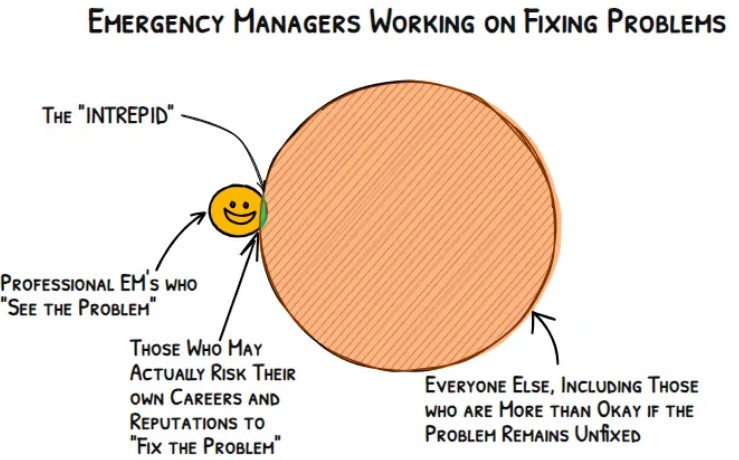
How did we get here?
Prior to 1970, federal emergency management was limited to immediate response, mobilization and civil defense preparedness, and limited disaster recovery that was provided on an “as needed” basis.
This moment in disaster management history is not a new one. Before FEMA existed, the U.S. had moved and reorganized the federal disaster management agency repeatedly going back to World War I, from the Executive Office of the President to DOD, GSA, DOJ, DOI, and so forthv. In 1973 during the Nixon Administration, federal disaster management and civil defense went from a single national coordinating agency to a decentralized one as federal disaster relief and recovery was brought under the umbrella of the Department of Housing and Urban Development (HUD), by Presidential Reorganization Plan No. 2 of 1973. The Federal Disaster Assistance Administration was created as an organizational unit within HUD. This fracturing decentralized federal disaster response and led to numerous government agencies being involved in disaster reliefvi. In some cases, more than 100 separate agencies might be arguing for control and jurisdiction of a disaster. Critics of the order noted that no single entity was responsible for coordinating the federal response to a major disaster. This would lead to the creation of FEMA following several historic incidents and at the request and pressure from the National Governor’s Association.
President Carter reversed course four years later with the creation of FEMA after several major disasters proved fragmented federal disaster relief was a mistake. States wanted a single federal coordinating entity, not 100 separate federal agencies vying for power and control, so the State’s reversed course and the rest is history. Federalism won out over strong state and local government emergency and disaster management. Ever since this decision, state and local governments have become more and more dependent on the federal government and FEMA. This has had an effect on not just state and local governments with them becoming so dependent that they even required federal grant funding for basic operations, but in turn as the federal government becomes more involved in state and local disaster management it has degraded and pulled federal emergency management away from focusing on its original purpose and missions, protecting the nation from catastrophic emergencies during peace and war -“PACE AC BELLO MERITA,” the original inscription on FEMA’s symbolism and flag. These federal emergency management missions include preparing for civil-defense, mass mobilization activities, economic and supply-chain disruptions, and strengthening Defense Production Act activities for civil and military crises such as seen during the COVID-19 pandemic.
Now, post-9/11 FEMA is an abused agency by DHS and is relegated to a low position of importance, primarily handling grant management when it should be focused on its primary missions on a national scale. Especially, now more than ever, as the world enters a period of extremely heightened geopolitical instability and a major rise in terrorist attacks on the U.S. homeland with the U.S. – Iran War. On the other hand, state and local governments who are constitutionally responsible for public safety, emergency, and disaster management within their jurisdictions have, over time, continued to abdicate their own responsibility by not sustainably funding and supporting state and local emergency management agencies, opting to be reliant on federal funding to do anything. A common emergency management sentiment from this problem heard across the country is “let’s see if we can get a grant to pay for it”, reinforcing the gaming of federal grant funding over state and local investment.
When disasters occur and failures happen in response and the recovery after, it’s not all FEMA’s fault. FEMA has been propping up the U.S. disaster management system since World War II. In reality, it is state and local elected officials who should face a political reckoning for underfunding and not supporting local emergency management. Where FEMA and U.S. disaster management has arguably gone wrong, is that every community across the United States is now reliant on the federal government for disaster support and recovery, with no consequences. Because FEMA and past and present Presidents have created a culture and expectation that FEMA and the federal government will bail out communities’ post-disaster, the federal government has helped establish a culture where there is no accountability and no consequences post-disaster for those responsible for failed local preparedness. State Governors and local elected and appointed officials have up to this administration been largely unscathed from past crises and disasters by shifting blame to FEMA or their emergency manager. In an era of Trump’s Administration, where disaster declarations and federal bailouts are being denied as the new norm, the stakes and consequences have never been higher. History shows that, without a federal disaster declaration and federal disaster recovery support funding, communities that lack a strong economic base and are unable to recover on their own will fail. Communities and towns will dry up as their economic drivers move to safer and more stable communities that are less vulnerable to disasters. America could soon face a wave of new ghost towns from mass disaster and climate migration following these incidents. While this article examined the current professional crisis faced by emergency & disaster management; the next article will explore actionable solutions… Stay tuned!
References
i Jeva Lange. (2026). Scoop: FEMA Cancels All Emergency Manager Trainings Except for those related to the FIFA World Cup. https://heatmap.news/adaptation/fema-canceles-emergency-training
ii Page Forrest and Jad Maayah. (2026). Uncertainty Surrounding Federal Disaster Funding Looms Over State Budgets. State fiscal debates to watch in 2026. https://www.pew.org/en/research-and-analysis/articles/2026/01/15/uncertainty-surrounding-federal-disaster-funding-looms-over-state-budgets
iii Alex Brown. (2025). Big budget cuts leave federal disaster aid uncertain for states. https://newjerseymonitor.com/2025/07/15/big-budget-cuts-leave-federal-disaster-aid-uncertain-for-states/
iv Michael Prasad, “The Ethics of Being Intrepid”, The LIPER, 2026
v Dr. Arthur J. Simental. (2025). What History tells us about Trump’s plan to shut down FEMA would mean for disaster response. https://www.linkedin.com/pulse/what-history-tells-us-trumps-plan-shut-down-fema-would-simental-bmvic/?trackingId=xdR5AIYQRl6%2F8B9Bub8lAA%3D%3D
vi Homeland Security Digital Library, Disaster Relief Act of 1974. https://www.hsdl.org/c/timeline/disaster-relief-act-1974/