

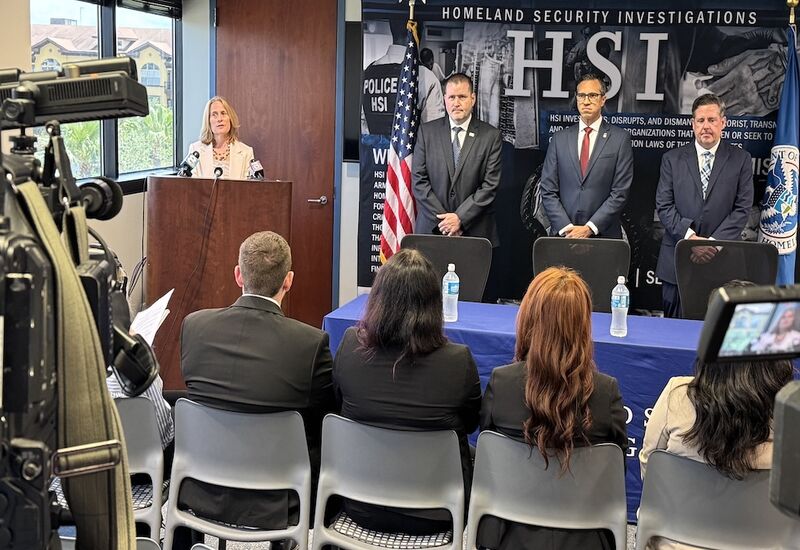
Homeland Security Investigations and the University of South Florida are expanding efforts to improve how trafficking victims are identified, connected to services, and supported through recovery under a new partnership announced in Florida.
On May 22, HSI’s Tampa and Miami field offices signed a Memorandum of Understanding with USF’s Trafficking in Persons Risk to Resilience (TIP) Lab to adopt and expand a coordinated victim-response framework developed by university researchers alongside state and local partners.
At the center of the collaboration is the university’s Bridging Resources and Information Gaps in Human Trafficking (BRIGHT) Project, a technology-driven platform designed to rapidly connect trafficking survivors with support services including healthcare, safe housing, and victim assistance programs.
The system allows law enforcement, nonprofit organizations, social workers, and anti-trafficking groups to coordinate care and track support efforts for survivors of labor and sex trafficking. Through the partnership, HSI special agents and victim assistance specialists will use an expanded version of the tool tailored to law enforcement operational needs.
“HSI’s commitment to a victim-centered approach is at the heart of our human trafficking investigations,” said HSI Tampa Acting Special Agent in Charge Micah McCombs. “By partnering with the University of South Florida and leveraging innovative tools like BRIGHT, we are not only strengthening our ability to identify, recover and support survivors of human trafficking, but multiplying our impact through enhanced collaboration with federal, state and local partners. This is truly a force multiplier.”
HSI plays a major role in federal anti-trafficking investigations nationwide, accounting for nearly half of all human trafficking investigations and prosecutions annually. Between October 2020 and October 2023, HSI’s Victim Assistance Program assisted 3,715 victims, including more than 2,000 minors.
Officials involved in the partnership said the goal is to strengthen coordination between agencies and service providers while building a scalable response model that could inform future anti-trafficking efforts beyond Florida.
“HSI recognizes that combating trafficking and supporting survivors requires partners in all areas of the anti-trafficking community, especially in academia,” said HSI Miami Acting Special Agent in Charge Jose R. Figueroa. “This partnership has already produced evidence-based research that will inform how HSI can more effectively deploy our limited personnel to stabilize victims and ensure traffickers are held accountable.”
USF researchers said the collaboration is designed to reduce the burden victims often face while navigating multiple agencies and recovery systems after being identified by law enforcement.
“What makes this partnership unique is that it brings together survivors, service providers, federal partners, university researchers and operational technology into one coordinated response effort,” said USF criminology professor Shelly Wagers, who directs the BRIGHT Project. “Our hope is that this work helps build more connected systems that reduce the burden victims and survivors often face while navigating recovery and support during some of the most vulnerable moments of their lives.”
The BRIGHT platform launched in 2024 and has already been adopted by 145 anti-trafficking organizations, service providers, and law enforcement entities across Florida, including the Florida Department of Children and Families, the Florida Attorney General’s Office, and the Crisis Center of Tampa Bay. According to USF, the platform has helped connect around 100 victims with services and resources.
Researchers at the TIP Lab said the initiative will also help evaluate which intervention and stabilization strategies are most effective over the long term.
“Our hope is that we build more connected, informed and victim-centered responses both in Florida and nationally, which partnerships like this will allow us to do,” said Joan Reid, director of the USF TIP Lab.