
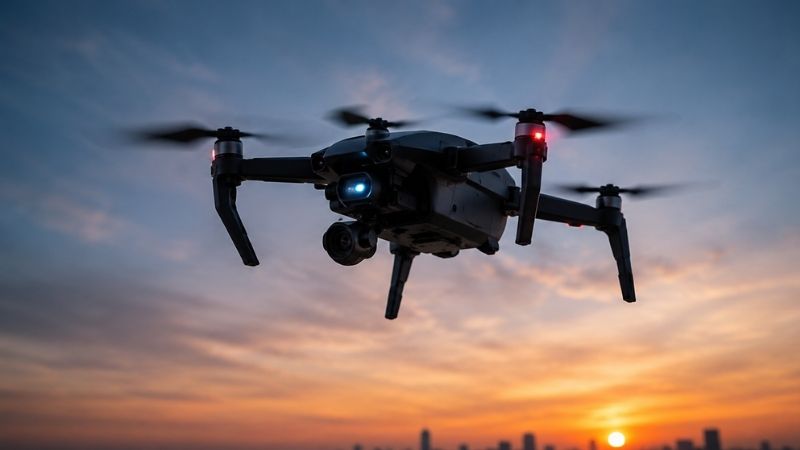
In June 2026, two events underscored a reality that security professionals can no longer ignore: the drone threat is no longer theoretical. At the FIFA World Cup 2026, one of the largest sporting events ever hosted in the United States, federal authorities reported more than fifty drone seizures and 150 drone airspace incursions near stadiums, fan festivals, and related venues during the opening weeks of the tournament, and that number is growing. Despite extensive public awareness campaigns, temporary flight restrictions, and a significant federal security presence, drones repeatedly appeared near World Cup venues across multiple host cities. The incidents demonstrated both the accessibility of drone technology and the challenge of protecting large-scale public events from aerial incursions.
Just days later, security professionals confronted a far more sobering reminder of what the future may hold. Before the UFC Freedom 250 event planned for the South Lawn of the White House, federal investigators disrupted an alleged attack plot involving explosive-laden drones intended to trigger panic and mass casualties. While the attack was prevented, the case highlighted the growing appeal of drones as tools for disruption and attack. It also reinforced a lesson that many security professionals have been discussing for years: drone threats are no longer confined to military battlefields. World Cup 2026 and the White House UFC events have become the largest real-world validation of 3D Physical Security™. They are now a homeland security challenge.
These incidents reveal an uncomfortable truth. The question facing security leaders is no longer whether drones represent a threat. The question is whether their organizations are prepared to respond when that threat emerges, and the way forward with the rapid evolution of sUAS (Drones) as a potential threat delivery platform is the concept of The ARTRE Method (Authority, Resource, Train, Rehearse, Execute), an operational readiness framework to help organizations achieve Decision Advantage within the 3D Physical Security™ environment. Linking the concepts together to better frame the outcomes for a myriad of critical infrastructure, mass gathering venues, and sensitive sites that need to address this now.
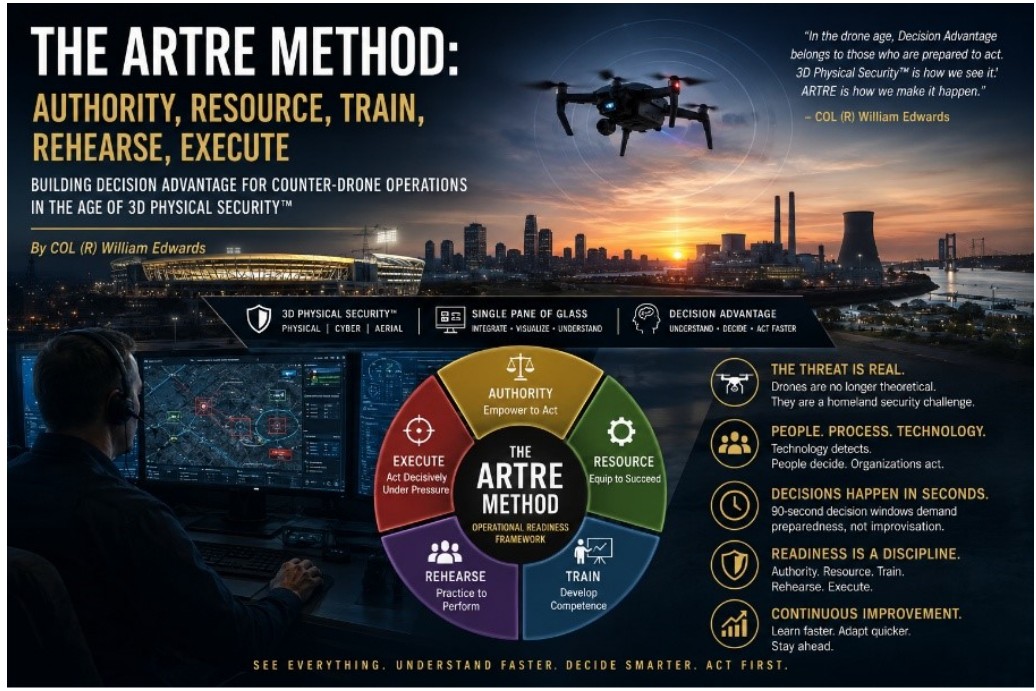
The framework itself is not simply a checklist. What makes it distinctive is that it serves as the operational implementation framework for Decision Advantage within the 3D Physical Security™ environment. Most Counter-UAS discussions focus on sensors, effectors, authorities, or policy.
The ARTRE Method focuses on organizational readiness and decision-making. It bridges strategy and execution, linking these pioneering efforts together.
- 3D Physical Security™ defines the environment (Physical, Cyber, and Aerial Domains).
- Single Pane of Glass defines how information is integrated.
- Decision Advantage defines the desired outcome.
- The ARTRE Method defines how organizations build the capability to achieve that outcome.
That relationship makes ARTRE more than a training model or planning checklist. It becomes the operational doctrine that enables the broader framework.
For years, the counter-drone conversation has centered on technology. Discussions often focus on radar systems, radio frequency detection, artificial intelligence, cameras, mitigation technologies, and the latest attempts at a common operating picture of all this sensor data. Organizations routinely ask what sensor they should buy, which technology performs best, or what system offers the highest probability of detection. These are important questions, but they are not the most important questions. When a drone appears over a stadium, approaches a critical infrastructure facility, hovers near a data center, or enters the airspace surrounding a mass gathering, the success or failure of the response will rarely be determined by technology alone. A sensor may detect the aircraft, and software may classify it. A common operating picture may attempt to display it, but technology cannot determine intent, authorize action, coordinate stakeholders, direct protective measures, or manage the consequences of an unfolding incident. Those responsibilities belong to people operating within an organization that has prepared itself to act.
Throughout my career in military intelligence, counterterrorism, physical security, emergency preparedness, and Counter-UAS operations, I have observed a consistent pattern. Organizations rarely fail because they lack technology. They fail because they lack a framework for turning information into action in a rapidly decreasing decision window. This challenge sits at the heart of what I have previously described as Decision Advantage—the ability to understand a situation, make informed decisions, and act faster than an adversary. It is also the driving force behind the concepts of the Single Pane of Glass and 3D Physical Security™, both of which seek to reduce decision friction and improve situational awareness across the physical, cyber, and aerial domains. Yet awareness alone is insufficient, and organizations must also possess the authority to act, the resources to respond, the training to perform, the discipline to rehearse (allocating time), and the ability to execute under pressure. That is the purpose of The ARTRE Method and its framework: Authority, Resource, Train, Rehearse, and Execute. ARTRE is an operational readiness framework designed to help organizations build Decision Advantage in the drone age. Now, let’s walk through the importance of each step.
Authority:
While discussions about Counter-UAS capabilities often focus on detection systems and mitigation technologies, authority remains the single most important component of an effective drone defense program. Additionally, a trust, certify, and verify leadership approach requires a major cultural shift if there is any chance of protecting the thousands of key facilities and venues across the United States. A drone can be detected, tracked, classified, and assessed, but if no one possesses the authority to act, the organization remains vulnerable. For many years, mitigation authority in the United States has remained concentrated within a small number of federal agencies. While this approach was understandable during the early stages of drone proliferation, the threat environment has evolved beyond what a centralized response model can reasonably address.
Today, thousands of critical infrastructure facilities, transportation hubs, stadiums, entertainment venues, energy facilities, manufacturing sites, data centers, and sensitive government locations face potential drone threats. It is neither practical nor realistic to expect a limited number of federal organizations to provide comprehensive protection across such a vast and diverse operating environment. The challenge is no longer one of awareness. The challenge is one of scale. The capability exists, but the capacity does not. Drone threats occur locally, often with little warning and within compressed decision timelines. A suspicious drone approaching a chemical facility, a power generation site, a major sporting venue, or a crowded public gathering may require immediate action. Waiting for decisions to move through multiple layers of bureaucracy creates delay at precisely the moment when speed matters most.
This reality highlights the importance of delegated authority and decentralized response capabilities. Organizations closest to the threat often possess the greatest situational awareness and the fastest ability to respond. Facility security directors, venue operators, emergency managers, security operations centers, and local public safety officials understand their environments, their vulnerabilities, and the consequences of a successful attack. Empowering these stakeholders through clearly defined authorities and responsibilities creates a more resilient and responsive security architecture. Decentralization also expands national capacity. Rather than relying on a limited number of federal resources to address drone threats across the country, a distributed model enables thousands of trained professionals operating at critical infrastructure facilities, mass gathering venues, and sensitive sites to contribute to the nation’s security posture. Such an approach creates broader geographic coverage, faster response times, and increased operational flexibility while reducing the burden on federal agencies.
The SAFER Skies Act represents an important step in the right direction because it acknowledges the need to expand Counter-UAS authorities beyond a narrow group of federal stakeholders. However, the legislation falls short of what will ultimately be required. The scale of the drone threat demands a broader framework that empowers appropriately trained, certified, and accountable operators at the state, local, tribal, territorial, and private-sector levels to protect critical assets and public spaces. Any expansion of authority must include rigorous safeguards, certification standards, oversight mechanisms, and accountability measures. Yet maintaining an overly centralized model risks creating coverage gaps that adversaries can exploit. The ability to detect a threat without the authority to respond creates only the illusion of security. True readiness is achieved when authority, capability, and responsibility are aligned. If authorization creates the ability to act, resourcing creates the capability to act effectively.
Resourcing
The biggest investments with any security program are always people and technology, and resource decisions should begin with understanding the mission, risk to its success, and not technology. Organizations must understand the threat environment they face and invest accordingly. The objective is not to buy the most equipment. The objective is to acquire the right capabilities and integrate them into a coherent operational architecture. This is where the concept of the Single Pane of Glass becomes essential. Radar feeds, RF sensors, optical systems, trusted access/arrival, information/intelligence reporting, and visualizing the potential threat in a 90-second decision window should not operate independently. Understanding specifications, sensor capability, and then layering that technology to accomplish the outcome of the drone vulnerability and risk assessment is the most accurate way to enable resources. These sensors provide data, and that data should converge into a common operating picture that supports rapid understanding and informed decision-making. Every additional screen creates friction; we must better leverage technology solutions to alleviate operator paralysis. Every disconnected system slows the response. Resources should be selected and integrated to reduce complexity rather than increase it, while technology remains a key enabler.
Training
Training is what transforms capability into readiness. Organizations often assume that installing equipment automatically creates operational effectiveness, but it does not. Personnel must understand not only how technology works but also how it fits within the broader decision cycle, including maintaining the equipment at full operational capability. Unfortunately, there are many scenarios where the resources are underutilized or simply forgotten because they are not maintained or require skills beyond the operator’s training to keep the system in play. Maintenance is a training event. Furthermore, security personnel, facility leadership, emergency managers, legal advisors, communications teams, and executive decision-makers all have roles to play during a drone incident. Training develops competence, confidence, and clarity. It ensures that stakeholders understand their responsibilities before an incident occurs rather than attempting to learn them during a crisis. Knowledge alone, however, is insufficient. Organizations must rehearse, and there is a significant difference between understanding a procedure and executing it effectively under pressure.
Rehearse
Rehearsals transform knowledge into proficiency. Through tabletop exercises, simulations, drills, and full-scale operational exercises, organizations validate plans, strengthen coordination, identify weaknesses, and improve decision-making. Military organizations have long understood that repetition builds confidence. The same principle applies to Counter-UAS operations. Rehearsals expose communication failures, reveal authority gaps, identify technology limitations, and strengthen organizational performance before a real-world incident occurs. The roadblock to a rehearse plan is always “time.” Leaders must build in time to conduct rehearsals of the operational program. Failing to do so puts the plan in jeopardy. The final step in the framework is execution.
Execution
Execution is where authority, resources, training, and rehearsal are tested under realistic conditions. It is the moment where organizations determine whether their Counter-UAS program functions as intended. Execution should not be viewed as an end state. It should be viewed as part of a continuous cycle of improvement. Every exercise, incident, assessment, red-team event, and after-action review provides an opportunity to refine procedures, strengthen integration, improve training, and increase readiness. The organizations that excel in Counter-UAS operations are not necessarily those with the largest budgets or the most advanced technologies. They are the organizations that learn the fastest, adapt the quickest, and continually refine their capabilities. As drone technology continues to evolve, the importance of Decision Advantage will only increase.
Security leaders can no longer afford to view drone defense solely through the lens of technology acquisition. Effective Counter-UAS operations require a comprehensive framework that integrates authority, resources, people, procedures, and continuous improvement into a unified capability. The ARTRE Method provides that framework. It offers organizations a practical method for operationalizing the principles of 3D Physical Security™, enabling the Single Pane of Glass concept, and ultimately creating Decision Advantage. In an environment where threats can emerge from above with little warning, readiness is no longer defined by what an organization owns. It is defined by how quickly and effectively it can understand a threat, make a decision, and take action. In the drone age, Decision Advantage belongs to those who are prepared to act.