
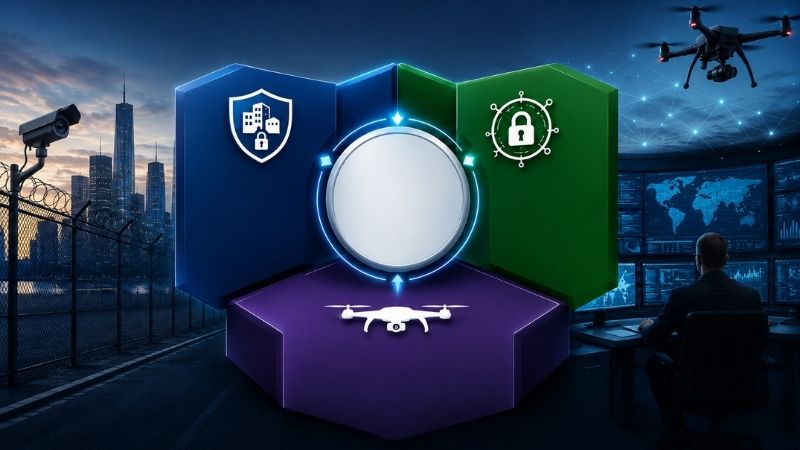
Security frameworks are often born from necessity. They emerge when existing models can no longer explain the realities practitioners face in the field. The concept of 3D Physical Security ™ is one such framework. It did not emerge from theory alone, but from years of observing the convergence of physical security, cyber systems, autonomous technologies, and the rapidly expanding threat posed by unmanned aircraft systems. As drones transformed from niche technologies into ubiquitous tools capable of disrupting critical infrastructure, penetrating secure facilities, and threatening public safety, it became increasingly clear that traditional approaches to security were no longer sufficient.
For decades, physical security operated largely within a two-dimensional construct. Security professionals focused on protecting facilities, assets, and people across a horizontal plane defined by fences, barriers, access control systems, cameras, guards, and patrols. Success was measured by the ability to deter, detect, delay, and respond to threats approaching from the ground. As technology advanced, the industry embraced the concept of physical-cyber convergence, recognizing that modern security systems relied heavily on interconnected networks, software platforms, and digital infrastructure. This convergence represented a significant step forward, but it remained incomplete. The emergence of inexpensive, accessible, and highly capable drones fundamentally altered the security environment. Threats were no longer confined to the perimeter or the network. They could now approach from above, bypassing traditional barriers and rendering many long-standing assumptions obsolete. The physical security profession had entered a new era, yet much of the industry continued to operate under frameworks designed for a different threat landscape.
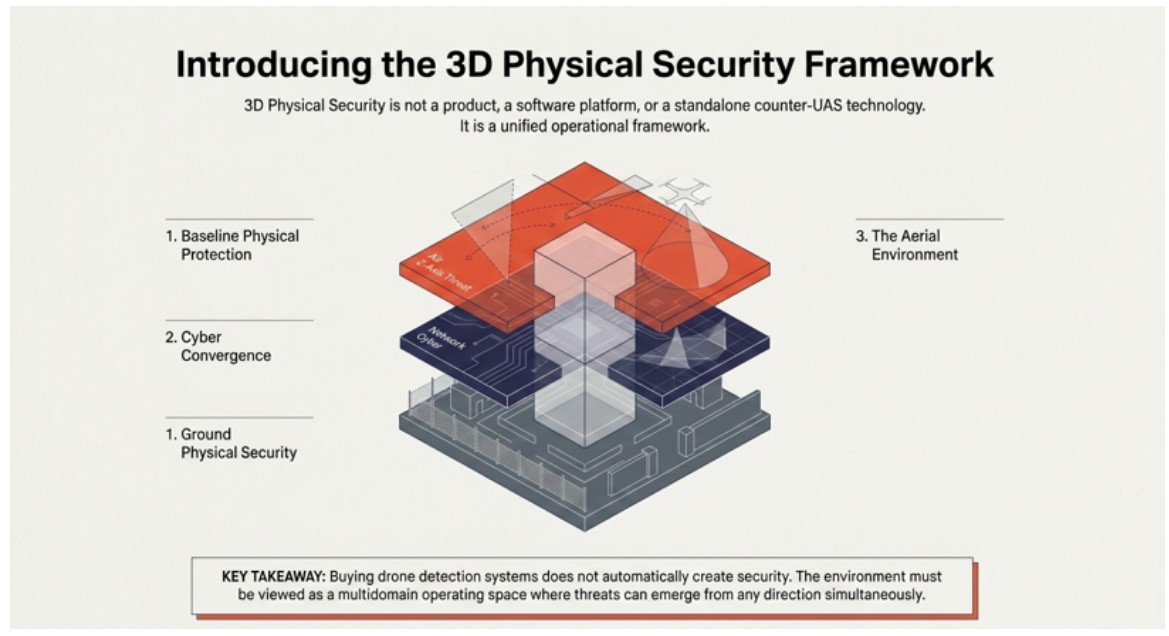
The concept of 3D Physical Security ™ recognizes that security is no longer confined to the ground domain and must account for aerial threats, cyber convergence, and decision advantage. It represents an evolution in security thinking that reflects the realities of modern operations. Rather than viewing physical security as a collection of protective measures surrounding a facility, 3D Physical Security ™ views the environment as a multidomain operating space in which threats can emerge from the ground, the network, or the air. This framework has been developed and refined through years of writing, research, speaking engagements, and operational experience focused on emerging technologies and security transformation.
Across numerous publications addressing drones, counter-unmanned aircraft systems, critical infrastructure protection, and technology-enabled security operations, a consistent theme has emerged: security programs must adapt faster than the threats they are designed to counter. The rise of unmanned systems accelerated that realization. What was once considered a niche concern quickly evolved into a mainstream security challenge. Commercially available drones demonstrated the ability to conduct surveillance, transport contraband, disrupt operations, collect intelligence, and potentially deliver harmful payloads. Incidents involving airports, correctional facilities, public events, energy infrastructure, and military installations revealed vulnerabilities that conventional security programs were not designed to address. The response to these developments cannot be limited to technology acquisition alone. Purchasing drone detection systems or counter-UAS capabilities does not automatically create security effectiveness. Organizations must adopt a broader framework that integrates sensors, analytics, response capabilities, governance, and decision-making processes into a cohesive operational model. This requirement forms the foundation of 3D Physical Security ™. At its core, the framework consists of three interdependent dimensions.
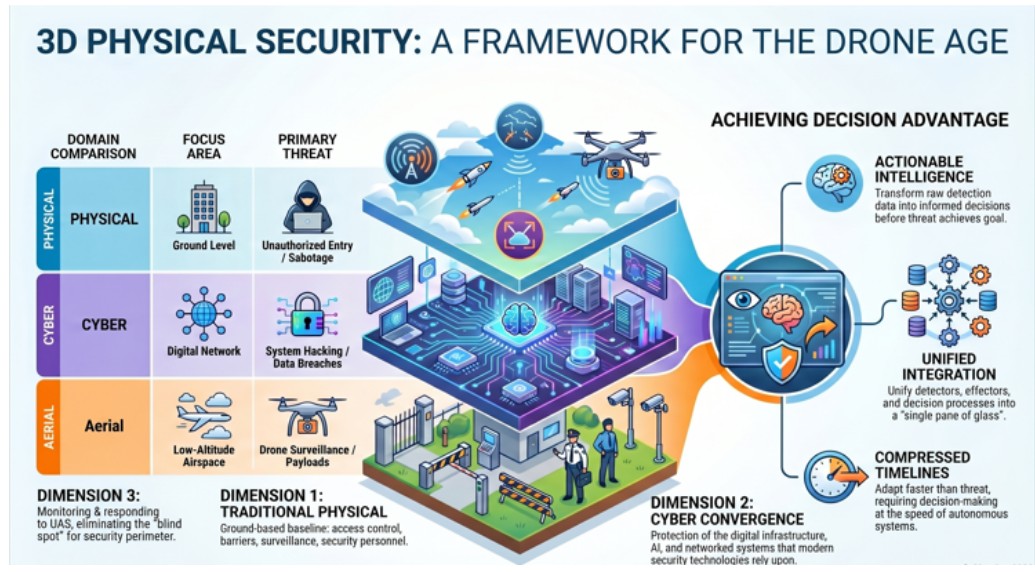
The first dimension remains traditional physical security. Access control systems, surveillance technologies, perimeter protection, security officers, and emergency response capabilities continue to serve as essential components of any security program. These capabilities provide the baseline protection necessary to safeguard people, facilities, and assets.
The second dimension encompasses cyber convergence. Modern security technologies are increasingly network-dependent. Cameras, sensors, access control platforms, artificial intelligence applications, and command centers all rely upon digital infrastructure. The security of these systems cannot be separated from the cybersecurity practices that support them. Vulnerabilities in one domain frequently create risks in the other.
The third dimension introduces the aerial operating environment. Drones have effectively created a new avenue of approach for both legitimate and malicious actors. Security programs that fail to monitor, understand, and respond to aerial threats are operating with a significant blind spot. The aerial dimension requires organizations to develop capabilities for detection, assessment, identification, and response while understanding the legal, operational, and technological considerations associated with counter-drone operations.
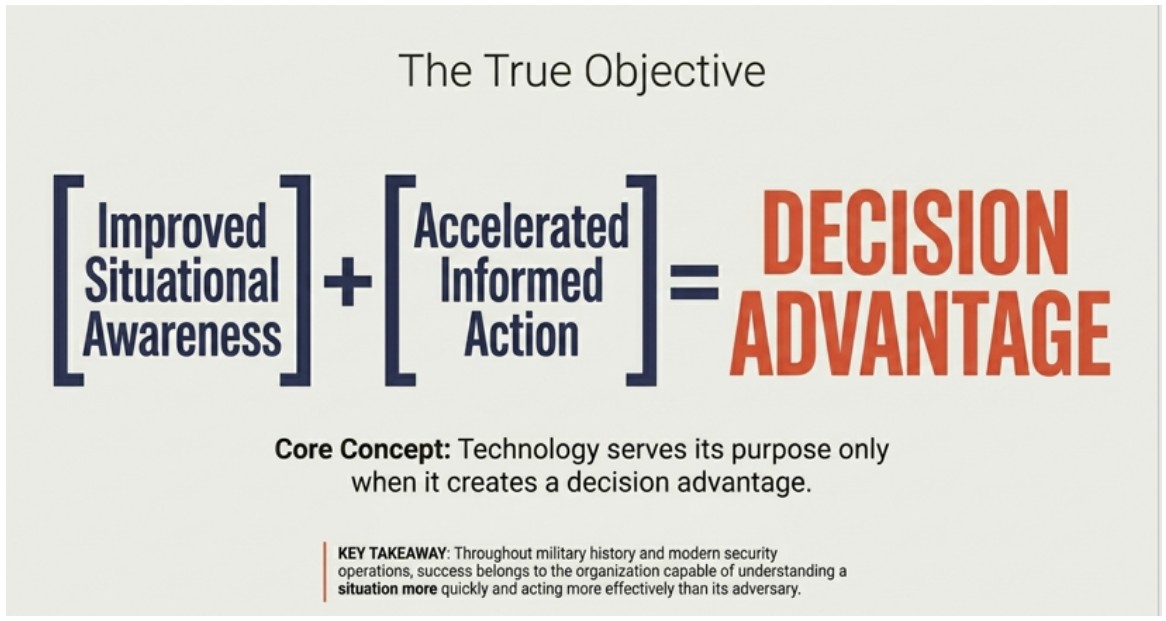
Yet the framework extends beyond the simple acknowledgment of three domains. The true objective of 3D Physical Security ™ is to create a decision advantage. Throughout military history and modern security operations alike, success has often belonged to the organization that understands a situation more quickly and acts more effectively than its adversary. Technology serves this objective only when combined with education, understanding, and training to improve situational awareness and accelerate informed decision-making.
This emphasis on decision advantage has become a recurring theme in “the single pane of glass” theory surrounding drone detection, autonomous systems, and next-generation security operations. The challenge is not merely identifying a threat. The challenge is transforming information into actionable decisions before a threat achieves its objective. Detection without assessment creates uncertainty, and assessment without response creates delay. This generates operational paralysis and increases risk. The future of security will increasingly be defined by organizations that successfully integrate detectors, effectors, and decision-making processes into unified operational capabilities. Sensors will continue to improve, artificial intelligence will continue to evolve, and autonomous technologies will become more prevalent. Yet the fundamental requirement will remain unchanged: security leaders must be able to understand emerging threats and make timely decisions within increasingly compressed timelines.
The development of 3D Physical Security ™ reflects this reality. It is not a product, a software platform, or a standalone technology solution. It is a framework for understanding and addressing the multidomain security challenges of the modern era. It recognizes that threats now move across physical, cyber, and aerial environments simultaneously. It acknowledges that traditional security models must evolve. Most importantly, it provides a conceptual foundation for organizations seeking to build resilient security programs capable of operating in an age defined by autonomous systems, converged technologies, and rapidly accelerating threats.
As the drone age continues to reshape the security landscape, the profession must move beyond legacy assumptions and embrace a broader perspective. Security is no longer two-dimensional. The operating environment has changed, the threat continues to challenge conventional thought and approaches, so the framework must change as well. That framework is 3D Physical Security ™.
“3D Physical Security™ is a security framework developed by COL (R) William Edwards.”