
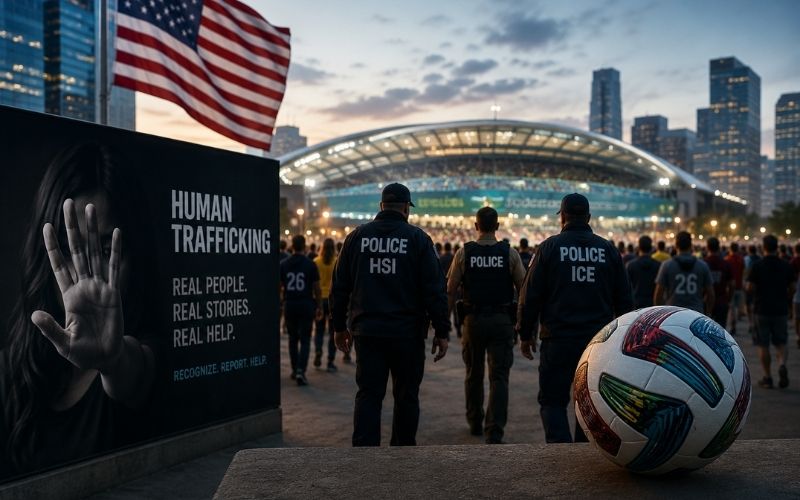
As the United States prepares to host the 2026 FIFA World Cup alongside Canada and Mexico, public safety agencies, anti-trafficking task forces, advocacy organizations, and media outlets are once again raising concerns about the potential for increased human trafficking activity surrounding a major international sporting event. Vigilance is appropriate. Human trafficking remains a persistent and evolving threat affecting communities across the United States every day. However, operational planning for the World Cup should be grounded in realistic threat assessments, sustainable investigative strategies, and evidence-based practices rather than assumptions unsupported by consistent operational data.
The narrative that major sporting events create dramatic temporary surges in human trafficking has existed for years, particularly surrounding events such as the Super Bowl. Yet research and operational experience have often produced mixed findings, with many studies struggling to distinguish between increases in online commercial sex advertising, proactive law enforcement activity, and confirmed trafficking victimization. In many cases, heightened visibility and enforcement surrounding a large event can create the perception of a trafficking spike without demonstrating a proportional increase in coercive exploitation.
A human trafficking victim is not simply an individual engaged in commercial sex or unlawful labor activity. A trafficking victim is someone compelled through force, fraud, or coercion to engage in labor, services, or commercial sex acts. In the case of minors engaged in commercial sex, any child under the age of 18 is legally considered a trafficking victim regardless of force, fraud, or coercion. Distinguishing between consensual adult activity, opportunistic criminal behavior, and organized trafficking victimization is operationally critical when allocating investigative resources, prioritizing victim services, and communicating realistic threats to the public.
The 2026 FIFA World Cup presents an operational environment fundamentally different from prior single-city sporting events. Rather than concentrating tourism and commerce into one metropolitan area over a single weekend, the World Cup will span sixteen host cities across three countries over thirty-nine days. Millions of visitors will move dynamically between cities, airports, hotels, entertainment districts, and transportation systems throughout the tournament.
This distinction matters because it challenges the common assumption that traffickers will flood a singular host city with victims in response to concentrated demand. The modern commercial sex market in the United States is already highly decentralized, digitally enabled, and geographically adaptive. Online advertising platforms, encrypted communications, rideshare applications, short-term rentals, and existing trafficking corridors already allow exploiters to operate fluidly across state lines independent of major sporting events. In practical terms, traffickers do not need the World Cup to create demand in cities such as Dallas, Houston, Miami, Atlanta, Los Angeles, or New York. Demand already exists in these locations year-round.
That reality should not minimize legitimate concerns surrounding exploitation during the tournament. Opportunistic criminal activity may increase in some areas. Transient populations can create vulnerabilities for at-risk youth, runaway juveniles, undocumented individuals, and economically vulnerable persons. Labor trafficking concerns tied to hospitality, transportation, construction, food service, cleaning services, and temporary employment sectors also deserve attention. Large-scale international events also increase demand for temporary labor across industries historically identified as vulnerable to labor trafficking and exploitative labor practices.
Public safety agencies should be cautious about equating increases in online escort advertisements or solicitation arrests with confirmed increases in trafficking victimization. Increased online advertising may indicate elevated commercial sex activity, but advertisement volume alone should not automatically be interpreted as evidence of coercive trafficking. Operational analysis must distinguish between advertising activity, consensual adult activity, organized criminal facilitation, and confirmed victimization.
Large-scale arrest operations centered primarily on buyers or low-level prostitution offenses may generate media attention, but they do not necessarily translate into meaningful disruption of organized trafficking networks or improved outcomes for victims. Media coverage surrounding trafficking operations often prioritizes dramatic headlines, arrest totals, or “massive sting” narratives without fully explaining the realities of trafficking investigations or long-term victim recovery. Public reporting may describe operations as major anti-trafficking successes while failing to distinguish between prostitution-related arrests, warrant sweeps, and confirmed trafficking victim identification.
While these operations may generate significant public attention, arrest statistics and volume-based metrics do not necessarily reflect meaningful disruption of organized trafficking networks or successful long-term victim stabilization. In some cases, trafficking victims themselves unintentionally and at times intentionally become part of the headline cycle. Individuals attempting to navigate the trauma of being removed from environments built upon coercion, manipulation, violence, psychological control, shame, and dependency may suddenly find themselves at the center of highly publicized operations, media narratives, or social media discussions. Victim-centered responses must recognize that sensationalized reporting and aggressive operational messaging can unintentionally contribute to further trauma, fear, distrust, and re-traumatization for survivors already struggling to stabilize after prolonged exploitation.
This highlights a key issue often overlooked in trafficking operations: identifying a victim is not the same as stabilizing one. Victims are frequently misidentified as offenders, undocumented migrants, or runaways, and even after recovery they remain vulnerable without long-term support. Stabilization often requires coordinated help from law enforcement, healthcare providers, advocates, housing services, and case managers. As a result, trafficking investigations are far more resource intensive than many traditional criminal cases, often lasting months or years, they are simply not accomplished in short term operations.
Major international events also require public safety agencies to guard against operational tunnel vision. Human trafficking is only one of several security concerns associated with a globally visible event such as the FIFA World Cup. Historically, international sporting events have attracted attention from violent extremists, lone actors, cyber threat actors, and individuals motivated by political, ideological, or religious grievances. The current global threat environment, including ongoing geopolitical instability, heightened antisemitic and antimuslim activity, and persistent concerns surrounding lone-offender attacks against soft targets, reinforces the importance of maintaining an all-hazards security posture throughout the tournament.
Across the United States, Canada, and Mexico, host cities will manage large crowds, transportation hubs, entertainment districts, fan zones, and internationally recognizable venues over an extended period of time. These environments inherently create soft-target concerns requiring coordinated intelligence sharing and vigilance across federal, state, local, tribal, and international partners.
Recent events have demonstrated how rapidly operational priorities can shift during large public gatherings. The 2025 New Orleans vehicle attack highlighted the reality that a single violent incident can immediately redirect law enforcement resources, intelligence personnel, public messaging efforts, and command attention toward counterterrorism and mass-casualty response operations. In practical terms, major incidents involving lone offenders or ideologically motivated violence can quickly consume the same investigative and operational resources often relied upon by human trafficking task forces and related investigative units.
This reality reinforces the importance of building flexible and sustainable operational plans ahead of the 2026 FIFA World Cup. Agencies should anticipate the possibility that resources initially allocated toward trafficking enforcement, crowd management, or public safety operations may need to be rapidly reassigned in response to evolving threat conditions. The ability to maintain continuity of trafficking investigations and victim services during broader public safety incidents will be just as important as surge planning tied directly to the tournament itself.
Human trafficking will not suddenly appear with the opening match, nor will it disappear following the final whistle.
Existing trafficking markets, organized criminal activity, and online exploitation ecosystems will continue to operate before, during, and after the tournament. The same can be said for broader public safety and homeland security concerns. The World Cup should therefore be viewed not as a singular crisis event, but as a force multiplier placed upon systems already managing ongoing threats.
For that reason, operational planning should focus less on building temporary panic-driven responses and more on strengthening sustainable systems already proven effective in combating exploitation and violence. Multi-disciplinary task forces should prioritize intelligence-led investigations, interstate information sharing, cyber-enabled investigations, OSINT analysis, hotel and transportation partnerships, behavioral threat awareness, and trauma-informed victim response protocols.
The distributed nature of the World Cup also reinforces the need for regional coordination rather than isolated city-based responses. Texas alone will host matches in both Dallas and Houston while also sitting adjacent to existing interstate trafficking corridors and major transportation infrastructure. The Northeast Corridor, stretching from Boston to New York and Philadelphia, presents similarly complex movement patterns involving rail systems, airports, and interstate highways. These realities demand coordinated intelligence efforts and realistic operational expectations rather than assumptions of singular “ground zero” trafficking hotspots.
Law enforcement agencies and partner organizations should also recognize the importance of measured public messaging. Awareness campaigns remain valuable, particularly those focused on recognizing indicators of exploitation and encouraging responsible reporting. At the same time, overstating unsupported trafficking surge claims risks undermining public trust and creating unrealistic expectations regarding what enforcement operations can realistically accomplish. The anti-trafficking community benefits most when operational planning is informed by evidence, investigative experience, and long-term strategy rather than sensationalism.
Human trafficking remains a significant public safety and humanitarian issue requiring aggressive, coordinated, and victim-centered responses. Likewise, the broader homeland security environment surrounding the 2026 FIFA World Cup will require sustained vigilance against a variety of evolving threats. The most effective response to trafficking surrounding the 2026 FIFA World Cup will not come from panic, inflated projections, or headline-driven enforcement statistics. It will come from disciplined investigations, coordinated intelligence-sharing, victim-centered stabilization efforts, balanced operational planning, and long-term investments in systems capable of identifying and disrupting exploitation long after the tournament ends.