
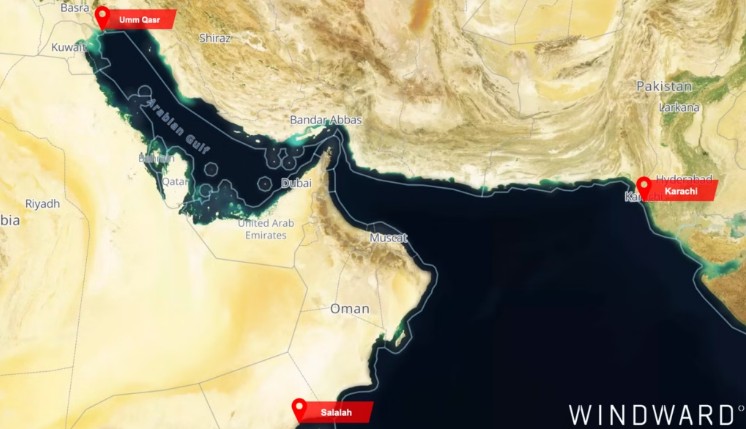
Key Takeaways – July 30, 2026
- A drone struck ENERGOS WINTER, a U.S.-managed LNG floating storage unit at Damietta, Egypt, on July 29, with fire spreading to a second LNG tanker alongside.
- Iranian state television had named Damietta as a retaliation target two days earlier, citing Ukraine’s strike on an Iranian vessel in the Caspian Sea, pointing to an Iranian-directed operation separate from the Houthi campaign.
- OFAC sanctioned two firms running an IRGC-backed Hormuz extortion scheme, the Persian Gulf Marine Insurance Company and HormuzSafe Marine Services Authority, alongside eight shadow fleet vessels.
- A Chinese-flagged bulk carrier completed a full transit from China to Jeddah through Bab el-Mandeb during the active Houthi blockade, confirming the China-Houthi safe passage arrangement is operational in practice.
- Hormuz recorded 20 transits on July 29, with 55 IRGC high-speed craft documented across multiple swarms.
- The dark tanker cluster above Larak Island grew from 14 to 18 vessels, with 17 of 18 now dark.
- Kharg Island’s three export terminals were all empty on July 29, with the western terminal without a berthed vessel for 11 days.
- Yanbu King Fahd Industrial Port has sustained fully dark high-tempo loading for a fourth consecutive day.
Operational Overview
The conflict’s geographic footprint has expanded beyond the Gulf and Red Sea into the broader eastern Mediterranean energy corridor. A drone struck ENERGOS WINTER, a U.S.-managed LNG floating storage unit moored at Damietta, Egypt, on the evening of July 29, with fire spreading to GASLOG SALEM alongside. Iranian state television had named Damietta as a retaliation target two days earlier, citing Ukraine’s strike on an Iranian vessel in the Caspian Sea, pointing to an Iranian-directed operation rather than a Houthi one.
OFAC simultaneously moved against the financial architecture underpinning Iran’s Hormuz operations, designating two firms running an IRGC-backed extortion scheme that forces commercial vessels to purchase mandatory insurance to transit the Strait, alongside eight shadow fleet vessels for transporting Iranian crude and petrochemical products.
The China-Houthi safe passage arrangement is now confirmed operational at the vessel level. A Chinese-flagged bulk carrier completed a full China-to-Jeddah transit through Bab el-Mandeb during the active Houthi blockade of Saudi-linked shipping, using nationality-signaling AIS declarations throughout with no incident. Saudi-linked vessels face active targeting in the same corridor.
Hormuz continues to operate under IRGC pressure. 20 transits were recorded on July 29 with 55 IRGC high-speed craft documented across multiple swarms, an abnormally elevated small-boat presence. The dark tanker cluster above Larak Island grew from 14 to 18 vessels. Kharg Island’s three export terminals were all empty. Yanbu King Fahd port has sustained fully dark high-tempo loading for a fourth consecutive day, confirming Saudi crude exports continue despite the Houthi blockade and Lloyd’s war risk insurance withdrawal.
Windward assesses the operational risk environment across the Strait of Hormuz, Red Sea, Gulf of Aden, northern Arabian Gulf, and now the eastern Mediterranean as critical, with Iranian retaliation reaching Egyptian energy infrastructure, active corridor enforcement across the Gulf, and differential access rules now visibly operating across both major waterways.
Outlook
The conflict’s operating map has expanded again. Iranian retaliation has now reached the eastern Mediterranean, with the Damietta LNG strike introducing a new front separate from both the Gulf and Red Sea theaters and directly linked to the Ukraine-Caspian strike. Egypt is now on the active threat picture, and the vessel-relocation pattern following the strike matches the operational response seen at Yanbu and other targeted ports.
The financial and access architecture underpinning both fronts is also visibly shifting. OFAC has moved against the Hormuz extortion scheme’s core entities and eight additional shadow fleet vessels. The China-Houthi safe passage arrangement is operational in practice, confirmed at the single-vessel level with a Chinese-flagged bulk carrier completing a China-to-Jeddah transit through the active Houthi blockade using nationality-signaling AIS declarations. Saudi-linked vessels face active targeting in the same corridor.
Operationally, both waterways continue to run under altered conditions. Hormuz sees IRGC high-speed craft presence at abnormally elevated levels, the Larak dark cluster grew from 14 to 18 vessels, and Kharg’s three terminals were all empty on July 29. Yanbu is on a fourth consecutive day of fully dark high-tempo loading, confirming Saudi crude exports continue despite the Houthi blockade and Lloyd’s war risk insurance withdrawal.
Windward assesses the operational risk environment across the Strait of Hormuz, Red Sea, Gulf of Aden, northern Arabian Gulf, and now the eastern Mediterranean as critical, with Iranian retaliation reaching Egyptian energy infrastructure, active corridor enforcement across the Gulf, and differential access rules now visibly operating across both major waterways.
Read the full update from Windward here.
Key Takeaways – July 28, 2026
- Hormuz recorded 6 transits on July 27, all via the northern corridor, with zero tanker crossings in either direction.
- Bab el-Mandeb crossings fell 22% since the July 20 Houthi blockade declaration, with tanker transits down 39% and Saudi-linked crossings down 46%.
- Lloyd’s market insurers began excluding Saudi-linked vessels from war risk cover on July 24, driving the sharpest decline in tanker transits.
- Windward assessed 102 potential blockade-breaker vessels on July 27, including 5 Tier 1 candidates within approximately 65 nautical miles of the blockade line.
- Two vessels are assessed as having already crossed the blockade line undetected while operating dark.
- Yanbu King Fahd Industrial Port is operating entirely AIS-dark, with 22 vessels detected across two July 28 passes and 12 actively loading.
- Windward identified 158 vessels across five parameters as potentially exposed to Houthi targeting, including two Bahri VLCCs currently inside Yemeni waters.
- Three China-linked VLCCs transited Bab al-Mandeb in two days despite the Houthi blockade, suggesting Chinese oil cargoes loaded from Yanbu have secured an exemption.
Operational Overview
Both major Gulf corridors are effectively closed to normal commercial tanker traffic, for different reasons on each side. Hormuz recorded zero tanker crossings on July 27, with all six transits routing through the IRGC-controlled northern corridor. Bab el-Mandeb crossings have fallen 22% since the July 20 Houthi blockade declaration, with tanker transits down 39% and Saudi-linked crossings down 46%.
The mechanisms differ. Hormuz is closed via IRGC enforcement, sustained IRGC high-speed craft presence in the southern strait, and the northern corridor bottleneck. Bab el-Mandeb is closing via a Houthi blockade backed by a Lloyd’s market insurance withdrawal from Saudi-linked vessels, which took effect on July 24 and is assessed as the primary driver of the sharpest tanker decline.
Iranian and Saudi crude are both still moving, but under altered conditions. On the Iranian side, 102 potential blockade-breaker vessels are lined up across three tiers, with five Tier 1 candidates within approximately 65 nautical miles of the blockade line and two vessels assessed as having already crossed undetected. On the Saudi side, Yanbu King Fahd Industrial Port is operating entirely dark with continuous loading throughput, and three China-linked VLCCs have transited Bab el-Mandeb loaded from Yanbu, suggesting Chinese oil cargoes have secured an exemption from the Houthi blockade.
Windward assesses the operational risk environment across the Strait of Hormuz, Gulf of Oman, northern Arabian Gulf, Red Sea, and Bab el-Mandeb as Critical, with both major Gulf corridors effectively closed to normal commercial tanker traffic, active kinetic threats on both fronts, and enforcement and evasion patterns compounding across the wider region.
Outlook
Two Gulf corridors are now effectively closed to normal commercial tanker traffic simultaneously. Hormuz is closed via IRGC enforcement and the northern-corridor bottleneck. Bab el-Mandeb is closing via a Houthi blockade backed by the Lloyd’s war risk insurance withdrawal from Saudi-linked vessels. Both are producing the same operational outcome, with tanker crossings collapsing, dark activity surging, and evasion tradecraft spreading across the wider fleet.
Iranian and Saudi crude are both still moving under altered conditions. On the Iranian side, 102 potential blockade-breaker candidates are queued up against the line, with two already assessed to have crossed undetected. On the Saudi side, Yanbu is operating fully dark with continuous loading throughput, and China-linked tonnage has secured an exemption from the Houthi blockade that is now visibly moving Yanbu-loaded crude eastbound through Bab el-Mandeb.
Windward assesses the operational risk environment across the Strait of Hormuz, Gulf of Oman, northern Arabian Gulf, Red Sea, and Bab el-Mandeb as Critical, with both major corridors effectively closed to normal commercial tanker traffic, active kinetic threats on both fronts, structurally elevated dark activity across the region, and Chinese-linked tonnage now visibly operating under differential rules on both fronts.
Read the full update from Windward here.
Key Takeaways – July 26, 2026
- The Houthis resumed attacks on July 22 following a September 2025 ceasefire, hitting or affecting four vessels across the reporting period.
- Houthi missile strikes hit the Saudi Aramco refinery at Jizan on July 25, with five thermal anomalies detected across the complex, while missiles inbound for Yanbu were intercepted.
- Yanbu port has transitioned from predominantly AIS-active to entirely AIS-dark tanker operations at berth as vessels shield against the Houthi hit list.
- Saudi Arabia has established a working alternative export route via the SUMED pipeline and Cape of Good Hope, adding approximately $9 per barrel to transport cost.
- Windward Early Detection flagged 43 crude oil tankers with AIS gaps in the Arabian Gulf for July 15 to 22, the highest single reading in four years.
- The EU released its 21st sanctions package, designating 41 additional vessels and, for the first time, a crewing agency.
Operational Overview
The Red Sea has reopened as a second active front. The Houthis resumed attacks on July 22 following a September 2025 ceasefire, hit a Saudi Aramco refinery at Jizan on July 25, and launched missiles intercepted before reaching Yanbu. Four vessels have been hit or affected across the reporting period.
Saudi crude has not stopped moving. It has bifurcated. Yanbu port has transitioned to entirely AIS-dark tanker operations at berth as vessels shield against a Houthi hit list. Saudi Arabia has established a working alternative export route via the SUMED pipeline and Cape of Good Hope, adding cost and voyage time but demonstrating the market’s adaptability. Chinese-linked tonnage continues transiting Bab al-Mandeb under the Houthis’ established carve-out.
Outlook
The maritime operating environment is now defined by two active fronts. The Red Sea and Bab al-Mandeb theater has reopened with the Houthis resumed, a Saudi Aramco refinery hit, and Yanbu port operating entirely dark. The Gulf of Oman and Strait of Hormuz theater continues under active U.S. enforcement, with the CHARMINAR release exposing the sophistication of shadow fleet fraudulent documentation and the Strait recording just one transit on July 25.
Saudi crude is finding new pathways at added cost, and the broader Arabian Gulf dark activity signal continues to intensify beyond sanctioned Iranian tonnage into a shared operating mode across the wider Gulf fleet. Windward assesses the operational risk environment as elevated across the Strait of Hormuz, Gulf of Oman, northern Arabian Gulf, and now the Red Sea and Bab al-Mandeb, with the resumption of the Houthi campaign, active U.S. kinetic enforcement, and structurally elevated dark activity across the region all compounding simultaneously.
Read the full update from Windward here.
Key Takeaways – July 9, 2026
- U.S. Central Command struck more than 80 targets inside Iran overnight on July 7 to 8, including air defense systems, coastal radar sites, anti-ship missile capabilities, and more than 60 IRGC small boats in and around the Strait of Hormuz.
- Iran retaliated with missile and drone strikes on U.S. military sites in Bahrain and Kuwait, with Kuwaiti air defenses intercepting approximately 15 projectiles.
- President Trump declared the ceasefire with Iran over, and the U.S. Treasury simultaneously revoked the general license authorizing Iranian oil sales.
- Four vessels rerouted from the southern corridor to the central corridor, and an India-flagged crude tanker carrying approximately 1.95 million barrels made a full U-turn.
- July 8 to 9 overnight recorded only five transits, with a single outbound bulk carrier and zero outbound tanker cargo.
- Approximately 63 million barrels of Iranian crude are now at sea with the legal cover of the Treasury waiver stripped away, with demand outside China near zero.
- At Kharg Island, all three terminals remained occupied through both strike nights, and an Iran-flagged NITC-operated OFAC-sanctioned VLCC was confirmed loading dark on July 8.
- Windward assesses the operational risk environment across the Strait of Hormuz, Gulf of Oman, and northern Arabian Gulf as critical.
Operational Overview
The Strait of Hormuz is once again operating under full conflict conditions. Overnight into July 8, U.S. Central Command struck more than 80 targets inside Iran in direct response to Iranian attacks on three commercial vessels transiting the Strait. Iran retaliated against U.S. military sites in Bahrain and Kuwait, President Trump declared the ceasefire over, and the U.S. Treasury revoked the general license that had authorized Iranian oil sales under the now-defunct interim agreement.
The commercial response was immediate and sharp. Four vessels rerouted from the southern corridor to the central corridor within hours of the escalation, and an India-flagged crude tanker carrying approximately 1.95 million barrels of Kuwaiti crude bound for Singapore made a full U-turn. By the July 8 to 9 overnight window, transit volume had contracted to just five crossings, with a single outbound bulk carrier and zero outbound tanker cargo, the sharpest single-window contraction of the reopening period.
Iranian crude exports have not stopped. Current export pace is assessed at approximately 1.5 million barrels per day, moving almost entirely to China via flag hopping shadow fleet tankers. Kharg Island held full terminal utilization through both strike nights, and an Iran-flagged NITC-operated OFAC-sanctioned VLCC was confirmed loading dark on July 8. What has changed is the legal cover. Approximately 63 million barrels of Iranian crude are now at sea with the U.S. waiver stripped, demand outside China near zero, and any operator, insurer, or intermediary facilitating these flows now fully exposed to secondary sanctions.
Outlook
The partial normalization that had been built since mid-June has effectively collapsed. Ceasefire declared over, sanctions reimposed, kinetic exchanges active on both sides, and the Strait of Hormuz now functionally closed to commercial outbound traffic for the first time since the reopening began.
Iranian crude exports continue in the dark and continue at pace, but the legal cover of the U.S. waiver is gone. Approximately 63 million barrels of Iranian crude are now at sea with demand outside China near zero, the export network reliant on flag hopping, AIS spoofing, and asymmetric anchor-swing manipulation to reach its single remaining buyer at scale. Any operator, insurer, or intermediary facilitating these flows is now fully exposed to U.S. secondary sanctions.
The southern corridor’s viability as a safe transit lane is again in question, with only two of 18 outbound vessels using it on July 8 and a U-turn recorded at the Strait exit off Khasab overnight. The Traffic Separation Scheme remains uncleared. The IMO evacuation framework remains suspended. And with funeral proceedings for former Supreme Leader Ali Khamenei still underway, no near-term resumption of diplomatic engagement is in prospect.
Windward assesses the risk environment as Critical across the Strait of Hormuz, Gulf of Oman, and northern Arabian Gulf, with active U.S.-Iran kinetic exchanges, ceasefire collapse, sanctions reimposition, and corridor uncertainty all compounding simultaneously.
Read the full update from Windward here.
Key Takeaways – July 7, 2026
- Two laden tankers were struck overnight on the NCAGS-approved outbound route, including AL REKAYYAT, a Marshall Islands-flagged Qatari LNG carrier, and a Saudi-owned ULCC, both running dark at the time of attack.
- The AL REKAYYAT strike is the third confirmed IRGC attack on Qatari LNG assets in 2026, following a hit near Ras Laffan in March and the turning back of two LNG carriers under IRGC pressure in April.
- Six vessels were rerouted from the southern corridor to the central corridor in immediate response, and one LNG tanker carrying approximately 902,200 barrels of cargo halted its transit and anchored midway in the Strait.
- The strikes occurred during multi-day funeral proceedings in Iran for former Supreme Leader Ali Khamenei and amid ongoing U.S.-Iran peace talks.
- Kharg Island reached simultaneous three-terminal loading activity for the first time in weeks, with 85% of the eastern waiting area assessed as laden.
- Windward has confirmed a new Iranian sanctions evasion technique, asymmetric anchor-swing spoofing, in which vessels broadcast fabricated AIS anchorage tracks while actually loading at Kharg Island.
- July 6 recorded 45 transits, and two convoys of 11 commercial vessels each were observed approaching the southern corridor exit on the morning of July 7.
- Windward assesses the operational risk environment for commercial shipping throughout the Strait of Hormuz, Gulf of Oman, and northern Arabian Gulf as critical.
Operational Overview
The Strait of Hormuz is functionally contested again. Overnight into July 7, the IRGC struck two laden tankers running dark on the NCAGS-approved outbound route, hitting a Qatari LNG carrier and a Saudi-owned ULCC in a single window. Six vessels rerouted from the southern corridor to the central corridor in immediate response, and one LNG tanker halted its transit and anchored midway to the Strait.
The AL REKAYYAT strike marks the third confirmed IRGC attack on Qatari LNG assets in 2026. Combined with the concurrent strike on a Saudi ULCC, the pattern suggests U.S.-aligned Gulf energy infrastructure is now within the IRGC’s target envelope.
The southern NCAGS corridor’s status as a safe transit lane, sustained through the past two weeks by U.S. military escort under Project Freedom, is now in serious question. Commercial traffic is still moving, with 45 transits on July 6 and two 11-vessel convoys approaching the southern corridor on the morning of July 7, but the operating assumptions behind the reopening are being retested in real time.
At Kharg Island, Iranian crude export operations continued to accelerate irrespective of the escalation, with all three loading terminals simultaneously active for the first time in weeks and the eastern waiting area 85% laden. Separately, Windward confirmed a sophisticated new Iranian evasion technique, asymmetric anchor-swing spoofing, in which sanctioned tankers broadcast fabricated AIS anchorage tracks while actually loading at Kharg.
Windward assesses the operational risk environment throughout the Strait of Hormuz, Gulf of Oman, and northern Arabian Gulf as Critical, with IRGC kinetic strikes on the approved outbound route, active corridor enforcement, and the IMO evacuation framework suspended all compounding simultaneously.
Outlook
The NCAGS-approved outbound route is no longer functioning as a safe lane. The IRGC has now struck two dark laden tankers on that route in a single overnight window, including a Qatari LNG asset for the third time this year.
The commercial response has been immediate. Six vessels rerouted from the southern corridor to the central corridor, and an LNG tanker halted mid-transit and anchored, all before the morning was out. The two 11-vessel convoys now approaching the southern corridor exit are the next indicator of whether commercial confidence in the lane can be sustained under current conditions.
Iran’s export operations are running in the opposite direction. Kharg Island is at peak throughput, all three terminals loading simultaneously, the waiting area 85% laden, and sanctioned tonnage is now exporting under a new fabricated-anchorage evasion technique that AIS monitoring alone cannot detect.
Windward assesses the operational risk environment as critical. The IMO evacuation framework remains suspended, IRGC corridor enforcement is now kinetic across the previously safe southern lane, and the gap between diplomatic engagement and maritime reality continues to widen.
Read the full update from Windward here.
Key Takeaways – June 29, 2026
- Two kinetic incidents in 72 hours have tested the post-MoU operating environment, including the June 25 attack on the Singapore-flagged cargo vessel EVER LOVELY and the June 27 UAV strike on the Panama-flagged VLCC KIKU carrying Qatari crude.
- The June 27 strike on a commercially neutral, non-sanctioned vessel carrying legitimate Gulf cargo represents a significant escalation in targeting parameters.
- The IMO vessel evacuation plan remains suspended following the June 25 attack, with no confirmed resumption date; approximately 115 ships and 2,500 crew members were moved in the three and a half days the plan operated.
- The U.S. military-assisted southern corridor under Project Freedom continues to function, with a Saudi-flagged tanker confirmed transiting under active U.S. AWACS air cover on June 29.
- Total daily transits are averaging approximately 13, roughly 90% below pre-war levels of 130 to 138 per day.
- Two OFAC-sanctioned Iranian-linked tankers were identified broadcasting fraudulent Norwegian flag registrations, one of the most audacious deceptive flagging incidents documented during the conflict.
- Kharg Island resumed dual-berth loading for the first time since June 20 to 22, with a sanctioned IRISL-operated tanker confirmed loading approximately 707,000 barrels on June 28.
Operational Overview
The Strait of Hormuz is technically open, but it is not functioning as commercial infrastructure. Two kinetic incidents in 72 hours, an IMO evacuation corridor suspended without a resumption date, and total daily transits averaging approximately 13, roughly 90% below pre-war levels, collectively describe a corridor that is open in name but operating well below the threshold of normal commercial activity.
What has not collapsed is the U.S.-assisted southern corridor under Project Freedom, which has continued to function throughout the IMO suspension and is now sustaining the southern lane on its own, with a Saudi-flagged tanker confirmed transiting under active U.S. AWACS air cover on June 29.
Iran’s posture is hardening rather than softening. The IRGC issued a formal statement on June 24 declaring any routing outside Iranian-designated lanes highly dangerous and prohibited. The June 25 EVER LOVELY attack followed in the southern corridor, and the June 27 UAV strike on a Panama-flagged VLCC carrying Qatari crude, KIKU, introduced a non-sanctioned, commercially neutral vessel into the targeting set. In parallel, two OFAC-sanctioned Iranian-linked tankers have been identified broadcasting fraudulent Norwegian flag registrations, a deliberate provocation in a corridor under active U.S. and European military scrutiny.
Windward assesses that the Strait is now operating under competing pressures, with Iranian enforcement tightening on one side and U.S. military escort maintaining a corridor on the other, and that the gap between technical openness and functional commercial throughput continues to widen.
Outlook
The Strait of Hormuz is open, but recovery has stalled. Two kinetic incidents in 72 hours, one of them targeting a commercially neutral VLCC carrying Qatari crude, have raised the targeting threshold beyond sanctioned tonnage. The IMO evacuation framework is suspended without a confirmed resumption date. Total daily transits are running at roughly 10% of pre-war volume. Iranian enforcement is now active across all three corridors, and the deliberate provocation of fraudulent Norwegian flag broadcasts signals that Iran does not intend to recalibrate its export network to international standards.
What has held the corridor together is the U.S.-assisted southern lane under Project Freedom, now sustaining limited safe-passage transits with active AWACS air cover. Whether that mechanism alone can carry the corridor while the IMO framework is suspended will be tested in the coming days, with the ADNOC LNG carrier’s next movement at the southern corridor approach the clearest near-term indicator of operator confidence.
The gap between technical openness and functional commercial throughput continues to widen, and a full normalization of the Strait remains contingent on Iranian enforcement of de-escalation, the resumption of the IMO evacuation framework, and the clearance of the Traffic Separation Scheme, none of which are in prospect as of this reporting cycle.
Read the full update from Windward here.
Key Takeaways – June 25, 2026
- The IRGC published a claim on its official Telegram channel that three tankers transiting the southern corridor were ordered to turn back, with Windward identifying five vessels exhibiting turnaround behavior consistent with the claim and a sixth losing AIS signal during the incident.
- A VHF Channel 16 broadcast warned all vessels that transit without AIS or IRGC permission would be at their own risk.
- The southern corridor, previously described as not requiring Iranian approval, is now subject to active IRGC enforcement, eliminating the only route operators believed to be free of Iranian control.
- June 24 recorded approximately 49 AIS-visible transits, the highest single-day count of the conflict, before the June 25 incident introduced renewed uncertainty.
- June 25 itself recorded 43 transits, confirming Hormuz remains operationally open despite the IRGC enforcement action.
- Cargo throughput is running at approximately 50% of pre-conflict crude volume, with LPG recovering to 100% of pre-conflict volume at approximately triple the pre-conflict price.
- Two OFAC-sanctioned VLCCs departed Kharg Island together via the northern corridor in a paired transit assessed as a deliberate tactic to dilute enforcement exposure.
Operational Overview
A week of widening commercial confidence in the Strait of Hormuz has run into the first significant test of the post-MoU operating environment. On June 25, the IRGC published a Telegram claim that vessels in the southern corridor had been ordered to turn back, with Windward identifying five vessels exhibiting behavior consistent with the claim. A VHF Channel 16 broadcast warned all vessels that transit without AIS or IRGC permission would be at their own risk. The southern corridor, previously described as not requiring Iranian approval, is now subject to active IRGC enforcement.
The reversal interrupts a clear normalization trajectory. June 24 had recorded approximately 49 AIS-visible transits, the highest single-day count of the conflict, supported by the IMO evacuation corridor announcement and Oman’s publication of six authorized eastbound waypoints. June 25 still recorded 43 transits, indicating Hormuz remains operationally open, but the southern corridor’s status as a safe alternative to the IRGC-controlled northern lane is now in question.
With Iran now asserting control across all three corridors, the trajectory toward full normalization has stalled. Cargo throughput is recovering unevenly, with crude running at approximately 50% of pre-conflict daily volume and LPG running at 100% of pre-conflict volume but at roughly triple the pre-conflict price.
Outlook
The Strait of Hormuz is open, but no longer trending cleanly toward normalization. The IRGC’s enforcement action in the southern corridor on June 25 indicates that Iran is now actively controlling access across all three lanes for the first time since the MoU signing, eliminating the only route operators believed to be free of Iranian control.
The northern corridor remains subject to IRGCN permit requirements and is heavily Iran-linked at the vessel level. The southern corridor’s status as a safe alternative is now in question. And the Traffic Separation Scheme remains uncleared.
Hormuz remains operationally open, with 43 transits recorded on June 25 following a conflict-high of 49 on June 24. But corridor access is now subject to active Iranian management across all lanes, and the coming 24 to 48 hours will determine whether the IRGC’s enforcement action represents a tactical pressure move or a more fundamental reassertion of Iranian control over the Strait.
Read the full update from Windward here.
Key Takeaways – June 21, 2026
- Iran reinstated PGSA toll and clearance requirements on June 21, attempting to re-close the Strait of Hormuz.
- Despite the announcement, 25 AIS-visible transits were recorded on June 22, including French- and Qatari-linked LNG carriers.
- Kharg Island resumed multi-berth crude loading, with Iranian exports reaching 6.79 million barrels during the week ending June 21, the highest level in nearly two months.
- A cluster of 17 tankers, including 10 OFAC-sanctioned vessels, was observed operating in the southeastern Hormuz corridor.
- Fujairah and Khor Fakkan remained heavily congested as operators continued waiting for clarity on transit conditions.
- Windward identified an extensive sanctions-evasion network linked to 38 vessels expelled from the Cameroon registry.
Operational Overview
The June 18-22 reporting period captures a rapid shift from cautious normalization to renewed uncertainty.
Following the June 17 Memorandum of Understanding (MoU) and the formal lifting of the blockade on June 18, commercial shipping responded immediately. Transit volumes rose above 20 crossings per day, Chinese-affiliated and European-owned vessels resumed movement, and Kharg Island restarted visible crude-loading operations.
That momentum appeared short-lived when Iran announced on June 20 that Hormuz was closed, and it was reinstating the Persian Gulf Strait Authority (PGSA) toll and clearance system.
Yet the June 22 data tells a more complicated story.
Rather than collapsing, traffic continued moving through the Strait. EO imagery collected after the announcement became effective showed active two-way movement, while AIS tracking recorded 25 visible transits in a single reporting window. French- and Qatari-linked LNG carriers transited openly with AIS active, suggesting that at least some international operators are choosing to test the post-agreement environment rather than suspend operations.
At the same time, Iranian exports accelerated, sanctioned fleets operated with increasing visibility, and key Gulf anchorages remained crowded with vessels waiting for greater clarity.
The result is a Strait operating between competing realities: renewed Iranian restrictions on one side and growing commercial willingness to challenge them on the other.
Outlook
The June 18-22 reporting period illustrates how fragile the Hormuz recovery remains.
Iran’s re-closure announcement initially appeared capable of reversing the gains made after the June 17 agreement. Yet the June 22 data shows that commercial operators have not immediately retreated.
Traffic continues moving. LNG carriers are testing the corridor. Iranian exports are increasing. Kharg Island has resumed multi-berth loading operations. Sanctioned fleets are operating with greater visibility than at any point during the conflict.
At the same time, IRGC activity remains elevated, AIS manipulation continues, major anchorages remain crowded, and the compliance risks created by the PGSA system remain unresolved.
The next several days will determine whether the post-agreement recovery continues or whether renewed restrictions succeed in slowing commercial confidence once again.
Read the full update from Windward here.
Key Takeaways – June 18, 2026
- The U.S.-Iran memorandum of understanding (MoU) was signed on June 17, and June 18 marked the first day of commercial reopening at the Strait of Hormuz.
- 18 transits were recorded across the June 17 to 18 window, the highest single-window count of the conflict.
- The first wave of commercial movers is predominantly Chinese-affiliated, with five of seven documented first movers Chinese-linked, alongside European, Japanese, and Saudi tonnage among the early departures.
- Three Saudi-flagged supertankers carrying approximately six million barrels of crude transited the Strait dark in the hours following the signing.
- Iran’s oil export network began reconstituting ahead of the signing, with three NITC vessels ending months-long dark periods at Chabahar on June 16 and six more sanctioned tankers transiting the Strait of Malacca westbound toward Iran.
- More than 80 IRGC high-speed craft were observed moving in an unusual, undirected pattern through the Kharg Island waiting area, a behavior not previously recorded at this location.
- The CMA CGM SAN ANTONIO remains stationary mid-Strait, held since being boarded and looted by IRGCN small craft in late May.
Operational Overview
The Strait of Hormuz is reopening. Following the June 17 signing of the U.S.-Iran memorandum of understanding, the first commercial vessels stranded inside the Arabian Gulf since the war began transited the corridor on June 18. The June 17 to 18 window recorded 18 transits, the highest single-window count of the conflict.
The first wave is predominantly Chinese-affiliated, with European, Japanese, and Saudi tonnage also among the early departures. The pattern of confidence is broadening beyond the highest-risk appetite shipowners. The lead-up to the signing showed a clear anticipatory pattern across both commercial and sanctioned traffic.
Iran’s oil export network has been reconstituting in parallel, and at pace. National Iranian Tanker Company vessels ended months-long dark periods at Chabahar, sanctioned tankers departed long-running anchorages off the Strait of Malacca, and additional sanctioned vessels are now approaching the Strait of Hormuz and the Bab al-Mandeb. A zombie vessel and an IRISL-affiliated cargo vessel transited outbound in the same 24-hour window as the legitimate first movers.
Windward assesses that the June 18 picture is one of cautious momentum rather than full normalization. Legitimate commercial traffic, sanctioned vessels, and unresolved military activity are moving simultaneously through the same corridor.
Outlook
The Strait of Hormuz is reopening, but the picture on June 18 is not one of normalization. Legitimate commercial first movers, sanctioned vessels reconstituting at pace, and unresolved military activity are all moving through the same corridor.
The Traffic Separation Scheme remains uncleared, with no minesweeping operations yet underway. The CMA CGM SAN ANTONIO remains stationary mid-Strait. More than 80 IRGC high-speed craft were observed moving unusually through the Kharg Island waiting area. And the transit of a zombie vessel and an IRISL-affiliated cargo vessel in the first 24 hours after the signing indicates that Iran’s oil export network does not intend to operate within international shipping norms, even with a sanctions waiver expected to take effect.
The operational risk environment is transitioning, but it has not normalized. The full picture of any post-conflict Strait will take weeks, not days, to settle.
Read the full update from Windward here.
Key Takeaways – June 16, 2026
- The U.S. and Iran have agreed to end the conflict in the Strait of Hormuz, with the agreement set to be signed on Friday and Iran reporting a 60-day toll-free transit window.
- The U.S. blockade on Iranian ports remains in force until the Friday signing.
- 36 hours after the agreement, few stranded ships have sailed, directly contrasting the April 18 reopening, when more than 50 ships attempted AIS-visible transits within 24 hours and at least 33 U-turned mid-way.
- About 550 cargo vessels and tankers were broadcasting AIS positions west of Hormuz as of June 14, with tankers already repositioning closer to the strait.
- Windward tracked 151 Hormuz transits between June 1 and June 15, compared with 156 transits across all of May, with 18% of June transits dark and daily transits averaging seven ships.
- The International Maritime Organization is working with at least 15 countries to establish a safe corridor for an estimated 20,000 stranded seafarers, although security and safety guarantees are not yet in place.
- War risk premiums to enter the Listed Area are reported as high as 10% of hull value, up from the 2 to 5% range earlier in the conflict.
Operational Overview
The Strait of Hormuz is reopening, but cautiously. Thirty-six hours after the U.S. and Iran agreed to end the conflict in the strait, stranded ships have started their engines, but few have sailed. The contrast with the brief mid-April false start is shaping shipowner behavior this time.
The agreement is set to be signed on Friday, with the U.S. blockade on Iranian ports remaining in force until then. The structural pieces of a reopening, including a 60-day toll-free transit window, two active corridors, and IMO coordination on a safe corridor for stranded seafarers, are largely in place. What is not yet in place is commercial confidence.
Windward assesses that the gating factors on a full restart are the speed of minesweeping operations, the trajectory of war risk premiums, the willingness of lower-risk-appetite shipowners to follow first movers, and the status of Iran’s immobilized shadow fleet. Resumption of traffic to normal levels will be measured in weeks, not days.
Outlook
The Strait of Hormuz is reopening, but slowly. The agreement is real, and the structure is in place, including the Friday signing, the 60-day toll-free window, the two active corridors, and IMO coordination on a safe corridor for stranded seafarers. What is not yet in place is commercial confidence.
The April 18 precedent is shaping shipowner caution. Insurance markets are pricing in elevated risk. The Traffic Separation Scheme has not yet been swept. The question of Iran’s immobilized shadow fleet remains an unresolved component of any broader settlement.
The next phase of the reopening will likely be led by energy cargoes destined for Pakistan, India, and China, by the Greek-owned cohort that moved during the closure, and by the UAE, Kuwait, and Iraq shuttle tankers already positioned outside Hormuz. Higher-risk-appetite operators will move first. Lower-risk-appetite owners will watch and wait.
Read the full update from Windward here.
Key Takeaways – June 15, 2026
- AIS-visible commercial traffic through the Strait of Hormuz remained near zero across the June 11–14 reporting period.
- A cargo barge carrying civilian goods was reportedly struck by a U.S. projectile near Khasab, Oman.
- Approximately 106 IRGC high-speed craft surged from a single Khasab South staging node on June 14.
- Six tankers were detected spoofing positions in the Gulf of Oman, likely staging for Strait transit.
- Kharg Island crude loading remained suspended, with both main crude terminals empty and 23 tankers queuing offshore.
- A dark bulk carrier at Kharg’s LPG/Sulphur terminal entered the final stage of a sulphur loading cycle.
- Windward assessed 19 potential blockade breakers and identified eight Iran-origin cargoes in active transit toward external markets.
Operational Overview
The Strait of Hormuz remained under acute operational pressure between June 11 and June 14. AIS-visible commercial traffic stayed near zero, IRGC small-craft activity surged, and covert export infrastructure continued functioning despite sustained U.S. enforcement.
The most immediate signal is the collapse in visible movement. Only one AIS crossing was detected from June 11 to 12, followed by seven AIS-visible transits from June 12 to 13 and six from June 13 to 14. EO imagery also confirmed at least one additional dark inbound transit, reinforcing that AIS-visible traffic no longer reflects total movement through the Strait.
At the same time, IRGC small-craft activity intensified. On June 14, approximately 106 high-speed craft surged from the Khasab South staging area within two and a half hours, covering both the western approach and the northeastern choke point. This suggests a coordinated maritime-control posture rather than isolated patrol activity.
Iranian export activity remains constrained but not halted. Kharg Island’s crude terminals were empty across multiple June 13–14 collections, with 23 tankers holding offshore and recurring slicks pointing to a probable infrastructure fault. Yet a bulk carrier at the LPG/Sulphur terminal was in the final stage of sulphur loading, marking the first such event recorded at that berth during the Operation Epic Fury window.
Beyond Kharg, Windward identified six tankers spoofing positions in the Gulf of Oman, 19 potential blockade breakers across the Arabian Gulf, and eight Iran-origin cargoes moving toward external markets. The result is a maritime environment where visible commercial flow is severely reduced, but covert movement, staging, and export workarounds remain active.
Outlook
Hormuz remains operational, but only under severe constraint.
AIS-visible commercial traffic is near zero, while dark transits, spoofed positions, tanker staging, and covert export flows continue beneath the visible surface. The Strait is not closed in absolute terms, but it is no longer operating as a conventional commercial corridor.
Kharg Island highlights the contradiction. Crude loading appears suspended, with 23 tankers waiting offshore and recurring slicks pointing to infrastructure stress. Yet sulphur loading is advancing, showing that non-crude exports continue even as crude capacity is disrupted.
The wider export picture is similarly uneven. Iranian oil continues to reach markets through dark transits, identity manipulation, and ship-to-ship networks, but at volumes far below pre-conflict levels. Non-Iranian crude flows through Hormuz are also moving under significant opacity, supported in part by dark shuttle and transfer patterns.
The operational environment remains high risk. IRGC small-craft deployments, unexplained enforcement incidents near Khasab, U.S. kinetic actions, spoofing clusters, and growing European interdictions against shadow fleet activity all point to a maritime system increasingly shaped by enforcement, concealment, and selective movement.
Read the full update from Windward here.
Key Takeaways – June 11, 2026
- AIS-visible traffic fell to just five transits during the June 10–11 reporting period, among the lowest levels observed since the conflict began.
- SAR imagery detected three dark vessels operating inside the Strait’s deep-water channel despite minimal visible commercial movement.
- More than 60 IRGC high-speed craft were observed across Hormuz, the highest concentration recorded in recent weeks.
- Sixteen dark tankers remained staged in the Larak-Qeshm channel, including an active ship-to-ship transfer.
- U.S. forces disabled both M/T SETTEBELLO and M/T JALVEER in the Gulf of Oman.
- Both crude terminals at Kharg Island were empty for the first time since early June.
- A potential spill developed around a bulk carrier at Kharg’s LPG and sulphur terminal.
Operational Overview
The Strait of Hormuz remains operational, but increasingly constrained.
While Iranian officials continue to characterize the Strait as closed, recent observations suggest a more nuanced reality. Commercial traffic continues to move, but at extremely low levels. Dark vessel activity remains persistent, military enforcement continues to expand, and maritime visibility across the region is increasingly degraded by AIS suppression and non-cooperative operations.
AIS-visible traffic fell to just five transits during the June 10–11 reporting period, marking a second consecutive decline and one of the lowest levels recorded since the conflict began. At the same time, SAR imagery identified three dark vessel contacts operating inside the Strait’s deep-water channel, indicating that movement continues despite the near absence of visible commercial traffic.
IRGC activity also intensified. Windward identified more than 60 high-speed craft operating across the Strait on June 10, while dark tanker staging remained elevated in the Larak-Qeshm channel, where 16 dark tankers and an active ship-to-ship transfer were observed.
Meanwhile, U.S. enforcement continued to pressure Iran-linked shipping beyond Iranian territorial waters. CENTCOM reported disabling both M/T SETTEBELLO and M/T JALVEER in the Gulf of Oman, reinforcing that sanctioned vessels remain vulnerable throughout the broader operating area.
The result is a maritime environment defined by restricted commercial movement, elevated military activity, persistent dark fleet operations, and continued enforcement pressure on Iranian maritime logistics.
Outlook
The Strait of Hormuz remains operational, but under severe constraints.
Commercial traffic continues to move at historically low levels, while dark vessel activity persists inside key shipping corridors. IRGC small-craft operations remain elevated, dark tanker staging continues across the Larak-Qeshm channel, and AIS visibility remains heavily degraded.
At the same time, U.S. enforcement actions against Iran-linked shipping continue to expand geographically, increasing the risks faced by vessels employing deceptive shipping practices or operating without AIS.
The combination of elevated military activity, persistent dark fleet operations, uncertain export activity at Kharg, and continued kinetic enforcement suggests that the Strait remains one of the most operationally complex maritime environments in the world.
Rather than a closed waterway, Hormuz is increasingly functioning as a tightly controlled maritime corridor shaped by surveillance, enforcement, concealment, and constrained commercial movement.
Read the full update from Windward here.
Key Takeaways – June 10, 2026
- Iran-linked LPG cargoes reached India and Pakistan despite the U.S. blockade on Iranian ports.
- Five LPG carriers used AIS spoofing, dark transit, and fraudulent flags to obscure loading and voyage patterns.
- U.S. INDOPACOM interdicted DAVINA near Sri Lanka, expanding enforcement into the western Indian Ocean.
- U.S. CENTCOM disabled MT MARIVEX in the Gulf of Oman, continuing kinetic blockade enforcement.
- Strait of Hormuz AIS-visible transits dropped sharply after the MARIVEX disabling.
- Kharg Island crude loading remains uncertain, while the first sulphur loading event of the conflict period was observed.
- IRGC high-speed craft activity remains elevated, including a record single-zone concentration in the northeast Strait.
Operational Overview
The June 5–10 reporting period shows a maritime environment under tightening enforcement, but not full immobilization. While Iranian crude exports remain heavily constrained, limited LPG cargoes continue reaching South Asian markets through deceptive shipping practices. At the same time, U.S. enforcement is expanding geographically, commercial traffic through Hormuz is adjusting to new risks, and Iranian export activity remains active despite continued pressure.
At the same time, U.S. enforcement continues to expand geographically and operationally. INDOPACOM boarded the sanctioned tanker DAVINA near Sri Lanka, while CENTCOM disabled MT MARIVEX in the Gulf of Oman. These actions show that enforcement is no longer limited to the immediate Strait of Hormuz operating area.
Inside Hormuz, commercial movement continues, but visibility remains degraded. Bulk carrier inbound traffic surged after CENTCOM announced humanitarian transit permissions, while AIS-visible crossings later fell sharply following the MARIVEX disabling, likely reflecting defensive transponder silencing by merchant vessels.
Kharg Island remains active but uneven. Crude loading at the eastern T-jetty remains ambiguous, while a new sulphur loading event at the south LPG and sulphur terminal suggests Iranian export activity is diversifying beyond crude under pressure.
The result is a constrained but adaptive maritime environment where enforcement is limiting Iranian crude flows, but LPG movements, small-vessel trade, dark tanker staging, and non-crude exports continue to test the edges of the blockade.
Outlook
The reporting period shows enforcement pressure continuing to reshape maritime activity around Iran. Crude flows remain heavily constrained, while LPG cargoes continue reaching South Asia through spoofing, dark transit, and fraudulent flags.
U.S. enforcement is expanding beyond Hormuz, commercial traffic is increasingly reducing AIS visibility in response to kinetic actions, and IRGC-supported tanker staging remains active across key holding areas.
At the same time, Kharg remains operational, non-crude exports are resuming, and dark fleet logistics networks continue adapting. The result is a maritime environment defined by simultaneous enforcement, concealment, and operational adaptation.
Read the full update from Windward here.
Key Takeaways – June 4, 2026
- Iranian crude and condensate exports fell 84% month-on-month in May to the lowest level since February 2020.
- U.S. forces disabled the sanctioned tanker MT LEXIE, marking the sixth commercial vessel disabled since blockade operations began.
- Windward identified 27 sanctioned, fraudulently flagged tankers in the Gulf of Oman matching LEXIE’s operational profile.
- Kharg Island resumed loading activity across both primary export terminals after sequential infrastructure shutdowns in May.
- IRGC forces struck MSC SARISKA V in the Sea of Oman, despite no substantiated U.S. or Israeli ownership link.
- GPS jamming continues to degrade AIS data quality across the Hormuz operating area.
Operational Overview
The June 1–4 reporting period highlights three parallel developments: Iranian exports are collapsing under blockade pressure, enforcement against sanctioned vessels is becoming more kinetic, and maritime control activity across Hormuz remains elevated.
Iranian crude and condensate exports fell to 186,000 barrels per day in May, down 84% from April and the lowest level since February 2020. At the same time, Kharg Island resumed loading activity after weeks of spill-related disruptions, signaling infrastructure recovery despite severely reduced export volumes.
Enforcement pressure also increased. U.S. forces disabled the sanctioned tanker MT LEXIE while transiting toward Kharg, marking the sixth commercial vessel disabled since blockade operations began. Windward subsequently identified 27 sanctioned, fraudulently flagged tankers in the Gulf of Oman matching LEXIE’s profile.
At the same time, IRGC-linked activity remained elevated across the Strait of Hormuz. High-speed craft swarms, support operations around dark tankers, and growing small-vessel trade between Iran and Oman all point to a maritime environment increasingly shaped by surveillance, logistics support, and controlled movement.
Together, these developments show enforcement disrupting sanctioned energy flows while Iran works to restore export capacity, sustain maritime logistics networks, and maintain operational control across key waterways.
Outlook
The maritime operating environment is increasingly defined by enforcement pressure, infrastructure recovery, and growing operational control across the Strait of Hormuz.
In the Gulf, the U.S. blockade is producing a measurable collapse in Iranian exports, while kinetic enforcement against sanctioned tankers remains active. At the same time, Iran is attempting to restore Kharg’s primary export capacity and maintain dark tanker staging networks along the Gulf of Oman coast.
IRGCN activity across Hormuz remains elevated, while small-vessel trade between Iran and Oman appears to be scaling as a resilient logistics channel around larger-vessel constraints.
Taken together, a clear pattern depicts that enforcement is constraining Iranian maritime activity, but parallel efforts to restore export infrastructure, sustain dark tanker staging networks, expand small-vessel logistics, and maintain elevated IRGC activity indicate that adaptation is already underway. While exports remain severely reduced, Iran continues to develop alternative mechanisms to preserve maritime trade and crude movement under sustained pressure.
Read the full update from Windward here.
Key Takeaways – June 2, 2026
- ~73 IRGCN small craft surrounded a stationary container vessel in East Hormuz on May 31, the most direct kinetic engagement against commercial tonnage in the current cycle.
- ~201 IRGCN small craft massed at Larak Island on May 30, the densest single-day footprint ever recorded over the corridor.
- A 280-meter cargo vessel was observed using stacked containers as hull shielding, a first-of-its-kind physical adaptation in this environment.
- Kharg Island entered day 12 without crude loading, with both terminals empty, and the tanker waiting queue breaking up.
- A dark Panamax tanker’s full 19-day cycle points to floating storage, not export.
- The French Navy boarded Russia-linked TAGOR off Brest, marking the tenth Russia-linked interdiction by European forces in 2026.
- Iran-to-Houthi maritime logistics through Hodeida did not slow after the October 2025 ceasefire, with 19 sanctioned vessels operating freely throughout.
The Operating Picture
Taken together, the May 28 to June 1 data describes an operating environment that has stopped escalating and started consolidating.
IRGCN small-craft posture is concentrating around Larak Island and the northern corridor at a scale that now constitutes the operating norm rather than an escalatory gesture. Commercial vessels are modifying their own hulls to survive in a waterway where AIS suppression is no longer sufficient protection. Kharg Island’s loading infrastructure is degrading across both terminals, with no observable recovery in progress. The dark fleet is not exporting Iranian crude, but rather staging it in the strait, in stationary laden hulls, waiting for conditions that have not yet arrived.
Alongside all of this, two parallel enforcement tracks are operating simultaneously, including Operation Epic Fury targeting Iranian-affiliated shadow tonnage in the Gulf, and Article 110 UNCLOS interdictions targeting Russia-linked vessels in European waters. Both tracks are identifying the same operational signature — falsely flagged, stateless vessels moving sanctioned cargo under fabricated identities — in different geographies.
The broader kinetic environment is also widening beyond the corridor itself. Ukrainian authorities reported that Russian drones attacked the Vanuatu-flagged cargo vessel ANT off the Ukrainian coast. The vessel has made six consecutive dark activity port calls to waters off Romania and Ukraine over the past 12 months. Windward assesses an emerging pattern of escalation in attacks on commercial shipping in the Black Sea and Mediterranean theaters.
Closer to Hormuz, a warning was issued for a suspected floating mine approximately 12.9 nautical miles north-northeast of Khasab, Oman, on May 30, consistent with the broader pattern of kinetic risk to commercial shipping in the Hormuz operating area throughout the current cycle.
The gap between what AIS reports and what imagery confirms is the operating signature of this entire environment.
Read the full update from Windward here.
Key Takeaways – May 27, 2026
- As of day 89 of Operation Epic Fury, commercial transit volume has collapsed approximately 94% versus the pre-conflict baseline and has not normalized.
- Iran has shifted from continuous closure to a permission-based regime, with the April 7 ceasefire resetting rhetoric but not the operational picture, and an April 17 “completely open” declaration reversing within 24 hours.
- Over 40 commercial vessels have been hit, fired upon, or seized since February 28, across approximately 42 named ships and five physical seizures.
- IRGC small-craft posture has scaled from a 27–230 baseline in early May to 668 craft on May 12 and 392 unique at sea on May 17, with the swarm geometry shifting from shore-led patrol to active strait-body presence.
- Iran’s crude export apparatus is restructuring eastward, with the Kuh Mubarak SPM lifting approximately 6.9 million barrels in five months, all China-bound, from a terminal that exported zero barrels through November 2025.
- A new sequencing yard at Bandar-e Jask was observed on May 24 with three dark VLCC-class crude tankers at anchor, the operational expression of the Goreh-Jask pipeline backdoor.
- Kharg Island went dark on May 7 after a west-side oil slick incident, broke its 13-day zero-lift gap with a single Panamax on May 20, and saw its first major load since the halt of a Suezmax at the east terminal observed yesterday.
- Iranian floating storage stands at ~39.79 million barrels across 79 tankers, down from ~150 million at the start of the war, with no meaningful Iranian crude reaching Asia in over three weeks.
Operational Overview
Hormuz transits remain at approximately 6% of their pre-conflict baseline, and the residual flow is increasingly Iranian-flagged, dark, or hugging Iranian territorial waters. IRGC small-craft counts have moved decisively off the Iranian shore and into the open strait body, with the swarm now positioned within visual range of every commercial transit lane in the corridor.
Iran’s crude export apparatus is restructuring eastward in parallel. A new Bandar-e Jask sequencing yard appeared for the first time on May 24. Kuh Mubarak loaded its first Aframax and held that vessel on station for six and a half days against a 24–36-hour standard. Kharg restarted cautiously this week after 13 days dark. Together, these observations point to a Gulf of Oman crude export channel that operates independently of the strait. Alongside this physical pivot, Iran has formalized administrative control of the strait through the Persian Gulf Strait Authority (PGSA), a state-administered transit-toll regime that went operationally live on May 18 and extended its claimed zone boundary to the UAE coast south of Fujairah on May 20.
In addition, more than 40 vessel incidents since February 28 have clarified the targeting logic. Facility strikes on the Western diversion architecture close off alternatives to Hormuz, while vessel strikes and seizures inside the strait enforce the permission-based regime.
The pattern that emerges three months into Operation Epic Fury is not de-escalation but restructuring. Iran has shifted from continuous closure to selective permission, replaced shore-led patrol with small-craft strait-body presence, and built a maturing Gulf of Oman crude export channel that bypasses Hormuz entirely. The 7 April ceasefire and the May 23 announcement that an agreement is “largely negotiated” sit on top of an operational picture that has only hardened.
Outlook
Day 89 is the analytical milestone, not just a date. Three months into Operation Epic Fury, the Hormuz operating environment looks structurally different from how it looked on February 28, and the difference is not closure relaxing, but closure restructuring into permission-based control, eastward export bypass, and embedded strait-body IRGC presence.
The April 7 ceasefire and the May 23 announcement that an agreement has been “largely negotiated” sit on top of an operational picture that has hardened. Iranian crude exports are at a fraction of pre-conflict volumes, but Iran has built, and is continuing to build, the channels to keep volumes moving without Hormuz transit at all. The Kuh Mubarak SPM, the Bandar-e Jask sequencing yard, the Chabahar holding area, and the Goreh-Jask pipeline together form an export apparatus that did not exist operationally three months ago. If the announced diplomatic framework materializes and the strait reopens, this architecture remains. If the framework does not materialize, the architecture absorbs an increasing share of Iranian crude flow.
The indicators to watch in the coming cycle are whether the Kharg loading cadence sustains after the May 25 Suezmax restart, whether the Bandar-e Jask sequencing yard accumulates additional VLCC-class tonnage, whether IRGC small-craft posture remains in open strait-body configuration or returns to coastal patrol, and whether the dark ship-to-ship trade off Fujairah and Muscat continues to expand its operator pool. The campaign has not de-escalated. It has restructured. The next phase will determine whether the restructuring becomes permanent.
Read the full update from Windward here.
Key Takeaways – May 25, 2026
- Iran’s Persian Gulf Strait Authority (PGSA) extended its claimed zone boundary to the UAE coast south of Fujairah on May 20, asserting administrative authority over the maritime approaches to the UAE’s primary Hormuz-bypass terminal.
- Five Gulf states (UAE, Saudi Arabia, Bahrain, Kuwait, Qatar) formally rejected the zone in a joint letter to the IMO, as the UKMTO published its first dedicated Strait of Hormuz transit guidance the same day.
- Within 24 hours, chemical tanker AIS suppression spiked 59% in the Fujairah area, crude exports fell to a six-month low, and VLCC counts dropped from 23 to 14.
- U.S. Marines boarded the Iranian-flagged tanker CELESTIAL SEA in the Gulf of Oman on May 20, the fourth at-sea interdiction of the campaign, following SKYWAVE, MAJESTIC X, and TIFANI.
- Kharg Island resumed partial crude loading with three confirmed tanker loadings across May 20–23, the first since the terminal went inactive around May 7, though approximately 27 vessels remain waiting offshore.
- President Trump publicly stated on May 23 that an agreement with Iran has been “largely negotiated” and that the Strait will be opened, marking the first publicly announced diplomatic resolution framework of the conflict.
- Three commercial vessels are currently held off the Puntland coast of Somalia, the first simultaneous three-vessel piracy hold since the 2010–2012 peak years, with the resurgence tied directly to vessels rerouting around Africa to avoid Hormuz.
- Vortexa data shows approximately 39.79 million barrels of Iran-origin oil now held in floating storage across 79 tankers, with no laden VLCC or Suezmax tracked arriving in Asia since May 4.
Operational Overview
The Hormuz operating environment moved through one of its most consequential five-day windows of the conflict between May 20 and May 24, with Iranian administrative escalation, sustained U.S. enforcement, partial export recovery, and the first publicly announced diplomatic framework all advancing in parallel.
Iran’s PGSA extended its claimed zone to the UAE coast south of Fujairah, drawing formal rejection from five Gulf states and triggering observable behavioral effects in the Fujairah area within 24 hours. U.S. Marines boarded the Iranian-flagged tanker CELESTIAL SEA on May 20. Kharg Island resumed partial loading after 13 days of inactivity. On May 23, President Trump publicly stated that an agreement has been largely negotiated and that the Strait will be opened.
The combined picture is a Hormuz environment approaching an inflection point shaped by competing escalation and de-escalation pressures, with the announced diplomatic framework now the central variable to watch.
Outlook
May 20–24 is the closest the Hormuz environment has come to a turning point since the conflict began, with four pressures running in parallel: Iranian administrative escalation, sustained U.S. enforcement, partial export recovery, and the first publicly announced diplomatic framework.
The PGSA extension to the UAE coast is the highest-signal escalation, with observable behavioral effects in Fujairah waters indicating that Iran’s administrative coercion now reaches well beyond Iranian territorial jurisdiction. U.S. enforcement is operating at a sustained tempo, and the supply constraint into China is structural rather than transient. Iranian export tempo is being maintained at a reduced level, but the offshore queues at Kharg and Chabahar indicate the underlying backlog has not moved.
Trump’s May 23 statement is the resolution variable. If the framework materializes, the indicators to watch are the PGSA zone status, the U.S. blockade posture, and whether VLCC and Suezmax movement resumes through Malacca into Asia. If it doesn’t, the PGSA expansion and the enforcement tempo will harden into a sustained two-front operating environment.
Read the full update from Windward here.
Key Takeaways – May 20, 2026
- Iran has activated the Kuh Mubarak offshore loading buoy on its Gulf of Oman coast as a recurring export node, lifting approximately 6.9 million barrels of Iranian Heavy crude over five months from a terminal that exported zero barrels through November 2025, with every barrel destined for China.
- An OFAC-sanctioned Aframax-class crude tanker was observed loading at Kuh Mubarak on May 18, the first Aframax lift at the terminal against a prior pattern of almost exclusively VLCC+ cargoes.
- The Persian Gulf Strait Authority (PGSA) went operationally live on May 18, with India, Iraq, and Pakistan securing bilateral access outside the formal fee structure while Chinese-linked and UAE-managed gray fleet operators absorb the toll regime.
- Three VLCCs transited the Strait outbound on May 20 — the first VLCC transits in the current reporting cycle — including a synchronized Chinese-controlled pair openly transmitting AIS and a South Korean-flagged VLCC in a 41-hour dark transit.
- The U.S. seized the Iran-linked VLCC SKYWAVE in the Indian Ocean overnight on May 19, the third U.S. seizure of an Iran-linked tanker in the current enforcement campaign.
- OFAC designated 19 Iran-trading vessels under a second Operation Economic Fury action, bringing the cumulative total to 28 designations in five weeks and extending into LPG carriers and corporate structures across China, Hong Kong, and the UAE.
- Fujairah port issued formal identity-theft enforcement notices against BALDMAN and EAN SPIR on May 18, the first publicly documented Gulf port action of its kind against Iran-linked tonnage.
- No shipment of Iranian oil has arrived in Asia for two weeks, with U.S. Central Command reporting 84 commercial vessels redirected and four disabled under the blockade on Iranian ports.
Operational Overview
The Iranian export environment shifted on two axes across May 19 and May 20, including an offshore crude loading node that has been activated on Iran’s Gulf of Oman coast outside the Strait of Hormuz, and U.S. enforcement has broadened into a parallel campaign across at-sea seizures, OFAC designations, and Gulf port action.
Kuh Mubarak, a single-point-mooring buoy roughly 110 nautical miles east of the Hormuz mouth, lifted zero barrels through the first eleven months of 2025 and approximately 6.9 million barrels of Iranian Heavy crude over the last five months, every barrel to China. May 18 saw the first Aframax-class loading, broadening an operator pool that had previously been almost exclusively VLCC+. May 19 imagery captured a second unidentified dark vessel seven nautical miles northwest of the buoy, raising the possibility of a secondary node.
The PGSA transit regime went operationally live on May 18. India, Iraq, and Pakistan are transiting under bilateral arrangements. Chinese-linked and UAE-managed gray and shadow fleet operators are absorbing tolls reported at up to $2 million per transit in yuan or cryptocurrency. No Western-flagged operator has publicly acknowledged payment. On May 20, two Chinese-controlled VLCCs transited Hormuz outbound in a tight 5–10 km formation, openly broadcasting AIS, marking the first observable signal of a tacit U.S.-China understanding on Chinese lifts of non-Iranian Gulf crude.
U.S. enforcement is running in parallel, with the SKYWAVE seizure in the Indian Ocean, OFAC’s second Operation Economic Fury package (19 vessels), and Fujairah’s identity-theft notices against BALDMAN and EAN SPIR. Hormuz is no longer characterized by closure but by tiered, contested, and structurally segmented access.
The combined picture is a Hormuz operating environment that is no longer characterized by closure but by tiered, contested, and structurally segmented access, with Iran’s export channel quietly migrating east of the Strait while the U.S. enforcement net widens across the Indian Ocean, Asian discharge ports, and Gulf anchorages.
Outlook
The Strait of Hormuz operating environment is no longer characterized by closure. It is characterized by tiered, contested, and structurally segmented access, with three distinct compliance pathways now operating in parallel and no neutral transit option.
The first pathway is bilateral carve-out: India, Iraq, and Pakistan transit under political arrangements outside the toll regime. The second is the PGSA toll tier: Chinese-linked and UAE-managed gray and shadow fleet operators paying up to two million U.S. dollars per transit in yuan or cryptocurrency, now visible in the synchronized Chinese VLCC pair openly transmitting AIS across the Strait. The third is enforcement exposure: vessels operating in dark configuration or with Iran-program associations remain subject to U.S. seizure at sea, OFAC designation, Gulf port enforcement action, and concurrent Iranian interdiction risk.
Layered on top is an Iranian export channel that increasingly operates outside the Strait altogether. Kuh Mubarak has moved from a dormant terminal to a working offshore export node lifting Iranian Heavy crude directly to China, with the May 18 Aframax loading and the May 19 unidentified vessel and surface trail nearby pointing to expansion rather than a single-buoy operation. With Iranian crude arrivals into Asia at zero for two weeks and the Lombok pivot now stalled, the offshore channel is positioning to absorb volumes that can no longer move through the conventional Malacca route.
The U.S. enforcement response is broadening in parallel with three at-sea seizures since the campaign began, 28 vessels designated under Operation Economic Fury, 84 vessels redirected under the port blockade, and the first publicly documented identity-theft enforcement at a Gulf port. The picture is one of an enforcement net that is widening geographically, while Iran’s export logistics are migrating to nodes the net does not yet fully cover.
The structural divide is hardening. Vessels operating in the Gulf of Oman approaches, particularly those with prior Iranian-linked behavioral profiles, falsified identities, or routing inconsistent with declared destinations, face elevated risk on multiple axes. Western-aligned tonnage remains effectively frozen out, absent continuous naval escort or bilateral state-level cover. The Hormuz environment that emerges from May 19–20 is one in which access is no longer determined by navigation but by flag, ownership, cargo origin, and the political tier the operator can secure.
Read the full update from Windward here.
Key Takeaways – May 18, 2026
- Iran is moving to formalize a state-administered transit-toll regime under the new Persian Gulf Strait Authority (PGSA), with reported per-transit payments of up to $2 million settled in Chinese yuan and Bitcoin transfers to IRGC-linked wallets.
- Six India-flagged vessels transited inbound on May 18 as a coordinated cluster following bilateral engagement with Iran, indicating functional safe-passage arrangements outside the coalition framework.
- Two near-simultaneous vessel seizures off Fujairah on May 14 followed Iranian warnings to the UAE by 8 to 12 hours, with HUI CHUAN and EDRIS both boarded in the same operational window.
- Three IRGC-linked high-speed craft were observed at the stern of the previously struck VLCC BARAKAH on May 15, with the vessel still stationary in the central Strait corridor through May 18.
- IRGC small-craft posture shifted decisively to open water, with 369 craft concentrated in a single offshore polygon northeast of Khasab, the largest day-over-day distribution change recorded.
- Kharg Island recorded six consecutive days without crude offtake, and Sirri Island remained non-operational at 5–10% of pre-conflict capacity, with 86 days since its last departure.
- Commercial throughput held at approximately 38% of pre-disruption levels, with the central Qeshm-Larak anchorage now in its sixth consecutive day of locked dark-vessel positioning.
Operational Overview
The Strait of Hormuz has structurally shifted from a transit corridor with disrupted flow to a tanker holding queue with administrative governance layered on top. Two developments across May 17 and May 18 define the phase change: Iran’s move to formalize a sovereign transit-toll regime under the Persian Gulf Strait Authority, and the first observed coordinated bilateral cluster transit, conducted by six India-flagged vessels under operational assurances from Tehran.
Together, they signal a strategic pivot. Iran is moving from kinetic disruption toward administrative control of the chokepoint, while simultaneously carving out bilateral lanes for non-Western tonnage. The result is a bifurcating Strait, with dark and gray fleets and BRICS-aligned vessels absorbing the premiums of the new toll regime, and Western-aligned tonnage either frozen out, escorted, or exposed to interdiction.
The surrounding picture reinforces the structural read. The central Qeshm-Larak anchorage is in its sixth consecutive day of locked dark-vessel positioning. BARZIN and HAMOUNA remain stranded off Bandar Abbas, with HAMOUNA crossing day 63 of continuous stationary posture. Kharg Island has gone six consecutive days without crude offtake, Sirri Island remains strategically neutralized, and a non-sanctioned VLCC+ has held the same Hormuz approach coordinates for 17 days in what Windward assesses as covert floating storage.
IRGC posture has shifted in parallel. Approximately 369 high-speed craft are now concentrated in a single offshore polygon roughly 30 nautical miles northeast of Khasab, a decisive move from coastal patrol screen to active strait-body presence.
Outlook
The Strait of Hormuz has crossed into a new operating phase. The combination of the PGSA toll framework, the India-flagged cluster transit, the seizure pattern off Fujairah, and the open-water IRGC concentration indicates that Iran is no longer relying primarily on kinetic disruption. The chokepoint is now being governed administratively, with bilateral carve-outs for selected partners and coercive interdiction held in reserve for everyone else.
The bifurcation is operational, not theoretical. Dark and gray fleets and BRICS-aligned tonnage are positioned to absorb toll premiums and continue moving. Western-aligned tonnage faces a compounding compliance dilemma: payment exposes vessels to OFAC secondary-sanctions risk, while non-payment exposes them to IRGC interdiction. Continuous naval escort is the only remaining alternative, and the volume of qualifying tonnage that can realistically be escorted is limited.
The holding-queue pattern in the central anchorage, the multi-week stationary postures of BARZIN, HAMOUNA, KAROLOS, and BARAKAH, the 17-day floating-storage posture of a non-sanctioned VLCC+, and the sustained zero offtake at Sirri and constrained loading at Kharg together indicate that the constraint is structural rather than transient. The Strait will remain commercially constrained and operationally unstable in the near term, with vessels operating in the Gulf of Oman approaches — particularly those with prior Iranian-linked behavioral profiles, UAE commercial management, or Western ownership — facing elevated coercive and kinetic risk.
Read the full update from Windward here.
Key Takeaways – May 14, 2026
- Kharg Island remained effectively non-operational, with no confirmed crude departures since May 7.
- Around 20 dark tankers stayed staged near Kharg, holding major export capacity in reserve.
- Dark tanker concentrations expanded near Larak, Qeshm, eastern Hormuz, and Chabahar.
- Commercial movement through Hormuz continued, but under dark, AIS-suppressed, or EMCON conditions.
- IRGC-linked small-craft activity remained elevated, with hundreds of fast craft observed across key Hormuz sectors.
- Qatar-linked LNG movement resumed in limited form, while Iraq and Pakistan reportedly coordinated passage with Iran.
- U.S. forces disabled additional Iran-linked tankers, while Iran seized JIN LI in what appears to be a signaling move.
- Somalia piracy risk remained elevated, adding pressure beyond the Gulf.
Operational Overview
Five weeks into the ceasefire, the Strait of Hormuz remains constrained, opaque, and increasingly managed through selective access.
The clearest signal is the state of Iranian export infrastructure. Kharg Island showed no active tanker loading for multiple consecutive days, while large tanker queues remained staged nearby. No confirmed crude departures have been observed from Kharg since May 7, and imagery indicates continued repair activity near damaged western infrastructure. Iran appears to be holding export capacity in reserve while attempting to restore loading operations.
At the same time, commercial traffic through Hormuz has not stopped. Windward identified inbound and outbound movements, including VLCCs, LPG carriers, product tankers, bulk carriers, and limited Qatar-linked LNG transit. But movement is increasingly fragmented, with vessels operating dark, under EMCON conditions, or through selective clearance patterns.
IRGC-linked maritime activity remained elevated across the Strait, with fast craft, dhows, coastal vessels, and patrol concentrations operating near commercial lanes, staged tankers, and choke points. This suggests a layered maritime-control posture that combines military surveillance, civilian maritime traffic, and controlled commercial movement.
The result is an operating environment where Hormuz functions less like a conventional transit corridor and more like a managed maritime zone shaped by staging, surveillance, enforcement, and degraded visibility.
Outlook
Five weeks into the ceasefire, Hormuz remains defined by control rather than normalization. Commercial movement continues, but increasingly through selective access, dark operations, EMCON behavior, and staged vessel movement inside protected Iranian waters.
Kharg Island remains the clearest sign of export strain. With no confirmed crude departures since May 7 and large tanker queues holding nearby, Iran appears to be preserving export capacity while attempting to restore damaged loading infrastructure. Chabahar, Larak, Qeshm, and eastern Hormuz are increasingly functioning as staging and holding zones that buffer crude flows under blockade pressure.
IRGC-linked activity across the Strait remains elevated, while U.S. interdiction against Iran-linked tankers continues to intensify. This creates a more volatile operating environment, where commercial shipping, sanctions enforcement, covert logistics, and military signaling are increasingly overlapping.
At the same time, growing AIS ambiguity, persistent dark staging behavior, and expanding vessel spoofing patterns near both Hormuz and Basra are further degrading maritime transparency across the region. Commercial operators increasingly face an environment where actual vessel movement, export activity, and operational intent no longer reliably correlate with AIS-visible behavior.The Strait of Hormuz is no longer operating as a conventional commercial corridor. It is functioning as a controlled maritime operating environment shaped by surveillance, staging, selective transit management, and constrained export logistics.
Read the full update from Windward here.
Key Takeaways – May 13, 2026
- Kharg Island loading terminals were observed fully empty for the first time since April 18, despite approximately 20 staged dark tankers nearby.
- No confirmed crude departures from Kharg have been observed since May 7, reinforcing assessments of sustained export disruption.
- Dark tanker holding zones continued expanding near Larak, Qeshm, eastern Hormuz, and Chabahar.
- Persistent ship-to-ship transfer activity and prolonged dark anchorage behavior indicate growing covert staging operations inside Iranian territorial waters.
- IRGC-linked surveillance and patrol activity intensified, with hundreds of fast craft observed operating near key shipping corridors.
- Commercial vessel movement through Hormuz remained heavily restricted, with most large hulls stationary under dark or EMCON conditions.
- Windward assesses that portions of Hormuz are increasingly functioning as controlled maritime holding zones rather than normal commercial transit corridors.
Operational Overview
The Strait of Hormuz operating environment remained heavily constrained between May 11 and May 13 as Iranian export infrastructure continued operating below normal capacity, dark tanker staging expanded across protected Iranian waters, and IRGC-linked maritime activity intensified throughout the corridor.
Kharg Island showed its clearest signs yet of sustained export disruption. For the first time since April 18, all loading terminals were observed empty despite roughly 20 dark tankers remaining staged nearby with an estimated carrying capacity exceeding 25 million barrels. No confirmed crude departures have been observed from Kharg since May 7, while imagery also identified tug and repair activity near the island’s western infrastructure, reinforcing assessments that Iran is attempting to restore damaged loading capacity while holding export tonnage in reserve.
At the same time, large concentrations of dark VLCCs, Suezmaxes, and product tankers remained stationary near Larak, Qeshm, eastern Hormuz, and Chabahar. Persistent ship-to-ship transfer activity, prolonged dark anchorage behavior, bunkering operations, and EMCON conditions reinforced indications that Iran is increasingly managing maritime flows through a layered staging and control architecture rather than normal commercial transit patterns.
Commercial movement through Hormuz continued, but under increasingly degraded visibility conditions. Limited outbound flows persisted under both AIS-transmitting and dark conditions, while RF collections repeatedly showed little to no detectable emissions activity in key commercial corridors.
Taken together, the developments indicate that significant portions of the Strait are increasingly functioning as controlled maritime operating zones shaped by covert staging, surveillance, selective transit management, and constrained export activity.
Outlook
Kharg Island crude export throughput remains severely degraded, with no active tanker loading operations observed for multiple consecutive days despite large tanker queues remaining staged nearby. The continued absence of departures reinforces assessments that Iran is struggling to restore normal export throughput while attempting to preserve crude export continuity under blockade conditions.
At the same time, dark tanker concentrations across northern Hormuz, eastern Hormuz, and Chabahar indicate that Iran is increasingly relying on protected holding zones to buffer export capacity and manage outbound flows. Persistent ship-to-ship transfer activity, bunkering operations, and prolonged dark anchorage behavior reinforce indications that covert cargo-transfer and sanctions evasion operations are expanding inside Iranian territorial waters.
Commercial shipping activity through Hormuz also remains heavily constrained. Widespread EMCON behavior, AIS suppression, and limited visible large-hull movement continue across both inbound and outbound traffic flows, while IRGC-linked surveillance and patrol activity remains elevated near critical choke points and commercial corridors.
Windward assesses that the Strait of Hormuz is increasingly operating less as a conventional commercial shipping corridor and more as a controlled maritime operating environment shaped by surveillance, staging, selective transit management, and constrained export logistics.
Read the full update from Windward here.
Key Takeaways – May 11, 2026
- Commercial shipping through Hormuz increasingly appears to be operating under dark or EMCON conditions.
- IRGC fast craft activity expanded across both Hormuz corridors, including swarm-style formations and escort-like behavior near commercial traffic.
- Windward identified nine commercial tanker transits through Hormuz on May 11, including dark fleet-linked LPG and product tankers.
- Qatar LNG cargoes resumed transiting Hormuz for the first time since the February closure.
- Kharg Island export throughput remains constrained, with no confirmed tanker departures observed after May 7.
- Large dark tanker concentrations near Larak, Qeshm, southeastern Hormuz, and Chabahar indicate growing export staging pressure.
- U.S. forces disabled two additional Iran-linked tankers following earlier interdiction operations against M/T HASNA.
- Iran seized the sanctioned tanker JIN LI in what appears to be a strategic signaling operation.
- Piracy risk off Somalia remains elevated, with multiple hijacked vessels still positioned near the Somali coast.
Operational Overview
Commercial shipping and maritime security activity around the Strait of Hormuz are increasingly shifting into dark or emissions-controlled conditions.
During the reporting period, Windward observed expanded IRGC fast craft activity near commercial corridors, continued dark and EMCON tanker transits through Hormuz, growing concentrations of staged dark tankers near Larak and Chabahar, and escalating U.S. interdiction activity against Iran-linked vessels.
Commercial traffic through the Strait continues despite the deteriorating environment. Windward identified multiple inbound and outbound tanker movements, including dark fleet-linked LPG and product carriers, VLCC transits toward Kharg Island, and the first successful Qatar LNG transit through Hormuz since the February closure. At the same time, vessels are increasingly displaying adaptive operating behavior, including prolonged dark anchorage periods, ship-to-ship transfers, and possible physical hull-protection measures.
Iranian export operations also appear increasingly strained. No confirmed tanker departures were observed from Kharg Island after May 7, while large dark tanker queues expanded across protected Iranian waters, suggesting Iran is buffering export capacity while managing growing bottlenecks under blockade pressure.
Taken together, the Strait is increasingly functioning as a fragmented low-visibility operating environment where military pressure, covert shipping activity, enforcement operations, and disrupted export infrastructure are becoming deeply interconnected.
Outlook
Commercial shipping through Hormuz increasingly appears to be operating outside traditional visibility frameworks.
AIS suppression, EMCON conditions, GPS interference, dark anchorage behavior, and covert ship-to-ship transfers continue to reduce the reliability of conventional maritime awareness across the region. At the same time, IRGC maritime activity is expanding alongside continued U.S. interdiction operations, increasing the risk of miscalculation and direct operational confrontation.
Iranian export operations also appear to be entering a more constrained phase. Kharg Island throughput remains degraded while large dark tanker concentrations near Larak, Qeshm, southeastern Hormuz, and Chabahar suggest Iran is increasingly staging crude capacity under protected holding patterns while managing export bottlenecks.
Commercial operators are simultaneously adapting both operationally and physically to the environment through prolonged dark operations, altered routing, escort behavior, and possible vessel hardening measures.
Taken together, the Strait of Hormuz is increasingly functioning as a contested low-visibility operating environment where commercial transit continues, but under growing military pressure, degraded transparency, and sustained enforcement risk.
Read the full update from Windward here.
Key Takeaways – May 7, 2026
- One month after the ceasefire, maritime visibility across Hormuz remains severely degraded.
- Dark vessel activity surged nearly 600% between April 19 and May 3.
- Satellite imagery identified multiple likely dark commercial transits through Hormuz despite near-zero AIS-visible traffic.
- Kharg Island continued covert VLCC loading operations throughout the reporting period.
- GPS jamming impacted approximately 470 vessels near Fujairah and Khor Fakkan within a 24-hour window.
- U.S. enforcement activity continued after the partial suspension of Project Freedom, which was later paused, including the disabling of the Iran-flagged tanker M/T HASNA.
- Iran-linked routing increasingly shifted toward Lombok and Sunda to avoid visibility around Malacca.
- Commercial operators now face simultaneous military, electronic, and compliance pressure across the Strait.
One Month Later, Hormuz Remains Operationally Unstable
One month after the ceasefire, the Strait of Hormuz remains operationally unstable.
Although Project Freedom was partially suspended following reported diplomatic progress, the maritime environment never returned to normal conditions. Instead, commercial shipping across Hormuz and the Gulf of Oman has continued operating under a combination of military enforcement, GPS jamming, AIS suppression, dark fleet adaptation, and targeted pressure on regional energy infrastructure.
The clearest shift over the past month has been the collapse of maritime visibility. AIS-visible commercial traffic through Hormuz dropped sharply, while satellite imagery increasingly revealed substantial vessel movement continuing under dark conditions. Windward identified large concentrations of non-transmitting vessels near Larak Island, Kharg Island, Bandar Abbas, Fujairah, and the northern Strait corridor, including likely inbound and outbound commercial transits operating entirely without AIS.
At the same time, the security environment became increasingly militarized. Iran-linked attacks on commercial shipping and energy infrastructure in Fujairah, IRGC fast craft deployments, expanding VHF transit warnings, and continued U.S. interdiction activity reinforced that Hormuz remains an active operational pressure zone despite the ceasefire.
The result is a maritime environment where commercial movement continues, but increasingly outside traditional visibility frameworks, forcing operators to balance navigational safety, military risk, sanctions exposure, and commercial continuity simultaneously.
Outlook
One month after the ceasefire, the Strait of Hormuz remains defined by degraded visibility, constrained commercial movement, and persistent military pressure rather than normalization.
AIS suppression, GPS jamming, and dark vessel operations continue to limit reliable maritime awareness across key corridors. At the same time, commercial shipping behavior is adapting. Operators increasingly appear willing to transit under reduced visibility conditions, while Iran-linked networks continue relying on covert loading, ship-to-ship transfers, alternative Asian routing, and extended AIS blackouts.
Although Project Freedom has been partially suspended, enforcement activity against Iran-linked maritime operations remains active, reinforcing that the operational environment has not materially stabilized.
The growing disconnect between AIS-visible traffic and satellite-detected vessel movement suggests that Hormuz is entering a longer-term phase where commercial shipping continues to operate, but increasingly outside traditional monitoring frameworks.
Satellite-based monitoring and multi-source intelligence are now becoming critical operational requirements rather than supplemental visibility tools.
Read the full update from Windward here.
Key Takeaways – May 5, 2026
- Maritime visibility across Hormuz and the Gulf of Oman deteriorated sharply following the launch of Project Freedom.
- Approximately 470 vessels were impacted by GPS jamming near Fujairah within 24 hours, while widespread AIS shutdowns further reduced maritime visibility.
- SAR imagery from May 5 detected 167 commercial-size vessels near Hormuz, including 146 operating dark and largely stationary.
- The attack on HMM NAMU was likely deliberate and coincided with strikes on UAE-linked energy infrastructure.
- Fujairah exports collapsed from typical levels of 3.5–4 million barrels per day to approximately 500,000 barrels following the May 4 attack.
- Kharg Island continues operating under sustained dark conditions, including covert VLCC loading activity and the identification of sanctioned tanker MT VIRGO.
- IRGC fast craft deployments, VHF transit warnings, vessel detention, and expanding AIS suppression are increasing operational pressure on commercial shipping.
- Alternative routing through the Sunda and Lombok Straits, AIS spoofing, and “safe transit” coordination claims indicate rapid adaptation by Iran-linked maritime networks.
Operational Overview
Maritime conditions around the Strait of Hormuz are entering a significantly more unstable phase as kinetic attacks, electronic interference, and coercive maritime control converge into a single operating environment.
Since the launch of Project Freedom, commercial shipping has faced simultaneous military, navigational, and compliance pressure. GPS jamming has intensified around Fujairah and Khor Fakkan, AIS visibility has deteriorated sharply, and satellite imagery increasingly shows large concentrations of stationary dark vessels across both sides of the Strait.
At the same time, commercial traffic is becoming more exposed to direct operational pressure. The likely deliberate targeting of HMM NAMU, the detention of MSC FRANCESCA following AIS suppression, IRGC transit warnings over VHF, and coordinated attacks on UAE-linked energy infrastructure all point to a maritime environment where visibility, routing, and vessel behavior are now directly tied to security risk.
The disruption is already affecting commercial flows. Fujairah exports have fallen sharply following the May 4 strikes, while Kharg Island continues covert loading operations under near-total concealment. Iranian-linked tankers are also adapting routing behavior, increasingly using longer and less visible approaches through Indonesia’s Sunda and Lombok Straits.
The result is a fragmented operating environment where commercial shipping must navigate physical attacks, degraded electronic visibility, mounting compliance exposure, and increasingly militarized transit conditions simultaneously.
Outlook
The Strait of Hormuz is shifting from a high-risk transit zone into an operationally degraded maritime environment shaped by simultaneous military pressure, electronic interference, and constrained commercial movement.
Commercial operators are increasingly trapped between competing risks. Broadcasting AIS may increase targeting exposure, while suppressing AIS raises the likelihood of detention, interception, or navigational uncertainty in already congested waters. At the same time, GPS jamming continues degrading positional reliability near key export and anchorage zones.
Dark vessel concentrations remain elevated across Hormuz, Fujairah, Bandar Abbas, Qeshm, and Kharg Island, while covert loading activity continues despite heightened enforcement pressure. Iranian-linked operators are also adapting rapidly through alternative routing, AIS manipulation, ship-to-ship transfers, and expanding use of less visible Asian transit corridors.The combination of kinetic attacks, electronic disruption, militarized signaling, and reduced export flows indicates that commercial shipping conditions around Hormuz are becoming structurally less stable rather than temporarily disrupted.
Read the full update from Windward here.
Key Takeaways – May 4, 2026
- Project Freedom begins as the U.S. moves to guide “neutral and innocent” vessels through Hormuz.
- Sanctioned vessels continue transiting, including NOOH GAS.
- Kharg Island remains active, with VIGOR identified loading and later departing under dark conditions.
- SAR imagery from May 2 detected 62 vessels above 100 meters near Hormuz, including 49 operating dark (AIS disabled).
- Iranian crude routing shifts toward the Lombok Strait, bypassing the more visible Malacca route.
- LPG carriers continue deceptive patterns, with prolonged dark periods and falsified AIS activity.
- OFAC warns that payments to Iran for safe passage could trigger sanctions exposure.
Operational Overview
Maritime activity around the Strait of Hormuz is entering a new phase as U.S. Project Freedom begins alongside the continuing blockade of Iranian ports.
The operation is designed to guide “neutral and innocent” commercial vessels through the Strait, with U.S. naval forces providing deterrence, route guidance, and mine-avoidance support rather than direct escort. It runs in parallel with the continued interdiction of vessels linked to Iranian trade.
On May 4, a sanctioned LPG tanker operating under dual identity indicators transited eastbound through Hormuz, but its profile makes U.S. protection highly unlikely. At the same time, Kharg Island continues to support dark loading cycles, while Larak-area imagery shows persistent product tanker staging and ship-to-ship activity.
Beyond Hormuz, Iranian cargo routing is adapting. Two Iran-flagged VLCCs have now used Indonesia’s Lombok Strait, suggesting a shift away from the more visible Malacca route under intensified scrutiny.
The operating environment is defined by guided transit for eligible vessels, continued enforcement against Iran-linked networks, and sustained dark fleet adaptation across multiple corridors.
Outlook
Project Freedom introduces a new operational layer in Hormuz, but not a blanket reduction in risk. Vessels assessed as neutral and innocent may benefit from route guidance and deterrence, while sanctioned or Iran-linked vessels remain exposed to interdiction.
Kharg Island continues to show sustained dark loading and tanker queuing, with VIGOR departing under a profile consistent with the Iran-to-China shadow fleet pattern. At the same time, Larak and Hormuz imagery show persistent product tanker staging and ship-to-ship activity, confirming that dark operations remain embedded in the system.
The shift toward Lombok indicates that Iranian cargo routing is adapting to visibility pressure at Malacca, while LPG carriers continue to demonstrate deceptive shipping practices, including dual identities and prolonged dark activity.
The operating environment is defined by simultaneous guidance, enforcement, evasion, and route adaptation. Movement is continuing, but the distinction between protected transit and sanctionable activity is becoming increasingly defined.
Read the full update from Windward here.
Key Takeaways – April 29, 2026
- Hormuz transit holds at 13 crossings, all AIS-visible with no dark activity.
- Gulf vessel presence declines to 890, indicating a slight contraction.
- Dark activity rises sharply to 148 events, signaling increased deception.
- Chabahar cluster expands with five dark tankers holding 7–8M barrels capacity.
- Iranian-linked vessels intensify AIS spoofing to mask crude loading.
- The system reflects visible transit alongside growing concealment and evasion.
Operational Overview
Maritime activity across the Strait of Hormuz remains stable in volume but increasingly uneven in behavior, with full AIS visibility during transit contrasted by a sharp rise in deceptive activity across the broader Gulf.
On April 28, transit volumes held steady, with all crossings conducted while transmitting AIS. At the same time, Gulf-wide vessel presence declined slightly, while dark activity increased significantly, indicating renewed reliance on deceptive shipping practices despite visible transit compliance.
East of Hormuz, dark tanker positioning near Chabahar continues to build, reinforcing the role of Iranian territorial waters as a holding and staging area under sustained enforcement pressure.
Across the system, vessel behavior reflects a deliberate split between compliance and evasion. Transit through the Strait remains fully visible and controlled, while deceptive activity is expanding across the wider Gulf. This indicates a shift in how risk is managed, with operators maintaining compliant passage through chokepoints while relocating higher-risk behavior into less visible zones.
Outlook
Transit through the Strait remains stable and fully visible, with consistent volumes and no dark crossings, reinforcing that chokepoint movement continues under controlled conditions.
At the same time, risk is no longer concentrated within the Strait itself. As enforcement pressure persists, vessel behavior is shifting outward, with increased reliance on concealment, spoofing, and staging in peripheral areas such as Chabahar and Bandar Abbas.
This indicates a transition from disruption to adaptation. Movement is not stopping, but being redistributed, with compliant transit maintained where visibility is highest and evasive activity pushed into areas where monitoring is more limited.
The operating environment is increasingly defined by this separation, where visibility does not equate to transparency, and reduced friction at chokepoints masks growing complexity across the wider system.
Read the full update from Windward here.
Key Takeaways – April 28, 2026
- Hormuz transit holds at 13 crossings, with 10 outbound and 3 inbound movements.
- Gulf vessel presence declines to 896, indicating a contraction in activity.
- Dark activity falls to 111 events, continuing a downward trend.
- Iranian crude flows to Asia drop sharply, with no new VLCC arrivals since April 24.
- Approximately 153 million barrels remain on water, concentrated in regional storage zones.
- Piracy risk off Somalia escalates, with multiple vessel hijackings and active pirate groups.
Operational Overview
Maritime activity across the Strait of Hormuz and surrounding corridors remains constrained but operational, with moderate transit levels and continued reductions in both vessel count and dark activity.
On April 27, transit volumes held at a moderate level following prior fluctuations, while Gulf-wide vessel presence declined, indicating a partial contraction in overall activity. At the same time, dark activity continued to decrease, pointing to a short-term reduction in deceptive shipping practices alongside lower traffic levels.
Beyond the Gulf, external pressure on Iranian export flows is becoming more visible. Shipments toward Asia have declined sharply, while vessels remain concentrated within regional waters or along alternative routing corridors.
Across the system, vessel behavior reflects a controlled but restricted environment, where movement continues under enforcement pressure and broader logistical constraints.
Outlook
Transit through the Strait remains active but constrained, with moderate volumes and limited dark activity reflecting a tightly managed operating environment. The decline in Gulf-wide vessel presence points to a short-term contraction rather than stabilization, as operators continue adjusting to enforcement pressure and uncertainty.
At the same time, Iranian crude flows toward Asia are increasingly disrupted. Cargo continues to be loaded and held on water, but fewer shipments are completing long-range delivery, leading to growing concentrations in regional storage zones and alternative routing areas.
Beyond the Gulf, rising piracy activity off Somalia is adding external pressure to already-strained maritime routes. The combination of constrained transit, reduced export reach, localized vessel accumulation, and expanding security threats continues to define an operating environment where movement is possible, but increasingly complex and risk-driven.
Read the full update from Windward here.
Key Takeaways – April 27, 2026
- Hormuz transit drops to 8 crossings, evenly split inbound and outbound, all with AIS active.
- Gulf vessel presence rises to 920, signaling continued system rebuild.
- Dark activity declines slightly to 117 events despite increased traffic.
- Chabahar cluster remains stable with 6 VLCCs and 1 Suezmax operating without AIS.
- ATEELA 1 provides active bunkering support, enabling sustained loitering.
- Vessel behavior reflects controlled but inconsistent movement under enforcement pressure.
Operational Overview
Maritime activity across the Strait of Hormuz and surrounding corridors remains active but uneven, with transit volumes fluctuating under continued enforcement pressure and operational uncertainty.
Following the April 25 rebound, transit activity slowed again on April 26, despite maintaining full AIS visibility across all crossings. At the same time, Gulf-wide vessel presence continued to increase, pointing to a gradual rebuild in overall system activity.
East of Hormuz, the Chabahar tanker cluster remains stable, with dark VLCC and Suezmax vessels continuing to loiter under supported conditions, reinforcing the role of eastern positioning as part of ongoing adaptation to enforcement constraints.
Across the system, vessel behavior reflects a controlled but inconsistent operating environment, where movement is possible, but still shaped by enforcement dynamics, routing decisions, and strategic waiting patterns.
Outlook
Transit through the Strait remains active but inconsistent, with volumes fluctuating even as full AIS visibility continues across crossings. The increase in Gulf-wide vessel presence points to a gradual rebuild in activity, but not a return to stable or predictable movement patterns.
At the same time, the slight reduction in dark activity suggests a temporary shift toward more visible operations, though underlying deceptive practices remain a constant feature of the system.
East of Hormuz, the Chabahar cluster continues to hold in place, supported by active bunkering and sustained loitering. This reinforces the role of eastern positioning as part of an adaptive response to enforcement pressure, enabling vessels to wait, reposition, or prepare for future movement.
The operating environment remains defined by partial normalization under sustained enforcement, where movement, visibility, and risk continue to evolve together rather than stabilize.
Read the full update from Windward here.
Key Takeaways – April 26, 2026
- Hormuz transit rebounds to 19 crossings, all with AIS active and no dark transits.
- U.S. intercepts sanctioned LPG SEVAN in the Arabian Sea, extending enforcement beyond the Gulf.
- Kharg Island shows active loading alongside a growing queue of at least 8 VLCCs.
- Gulf vessel presence rises to 892, signaling a broader recovery in activity.
- Dark activity increases to 123 events despite improved AIS compliance during transit.
- Vessel behavior reflects controlled reopening under continued enforcement and sanctions pressure.
Operational Overview
Maritime activity across the Strait of Hormuz and adjacent corridors is showing early signs of recovery, but under sustained enforcement pressure and continued sanctions-driven disruption.
Transit volumes rebounded on April 25 following several days of suppressed movement, with all crossings conducted under full AIS visibility. At the same time, U.S. enforcement activity expanded beyond the Gulf, highlighted by the interception of a sanctioned LPG tanker in the Arabian Sea.
Iranian export infrastructure continues to operate under strain. Kharg Island shows active loading alongside a growing anchorage queue, indicating throughput pressure rather than a full recovery in export flow.
Across the system, vessel behavior reflects a controlled reopening environment, where movement is resuming, but under active monitoring, enforcement risk, and persistent sanctions pressure.
Outlook
Transit through the Strait of Hormuz is recovering, but under controlled conditions defined by full visibility, enforcement presence, and continued sanctions pressure.
The interception of LPG SEVAN signals that U.S. enforcement is expanding beyond chokepoints into open-sea operations, increasing exposure for sanctioned vessels across a wider geographic area.
At Kharg Island, export activity remains active, but the growing anchorage queue points to sustained pressure on throughput and constrained flow dynamics.
Across the Gulf, vessel activity is rebuilding, but the rise in dark activity alongside full AIS compliance during transit highlights a dual operating model, where visibility is selectively applied while deception persists elsewhere.
The operating environment is defined by partial recovery, active enforcement, and ongoing adaptation by high-risk maritime networks operating under sustained pressure.
Read the full update from Windward here.
Key Takeaways – April 23, 2026
- Kharg Island exports fall to ~3M barrels, well below the ~8M weekly average.
- IRGC attacks and seizure of vessels on April 22 raise the total incidents to 34.
- Transit remains unstable, with activity fluctuating sharply between April 20 and 22.
- Bandar Abbas shows heavy congestion, with the majority of vessels operating without AIS.
- A cluster of 8 large tankers forms near Chabahar, representing ~14M barrels of capacity.
- Dark activity remains elevated despite temporary declines in parts of the Gulf.
- Vessel behavior reflects adaptation to enforcement, not a halt in maritime flows.
Operational Overview
Maritime dynamics across the Strait of Hormuz and surrounding corridors continue to shift from constrained activity toward selective escalation, with enforcement, evasion, and direct engagement shaping vessel behavior.
Iranian crude exports from Kharg Island declined sharply during the week of April 13–19, with total volumes estimated at approximately 3 million barrels, significantly below the year-over-year weekly average of around 8 million barrels. Satellite imagery confirms a mid-week pause in loading activity, followed by a limited resumption, indicating disruption to primary export operations.
At the same time, activity is redistributing rather than stopping. Large tanker clusters have formed east of Hormuz near Chabahar, while congestion and dark activity remain elevated near Bandar Abbas. These patterns point to adaptation under pressure rather than a breakdown in flows.
Operational risk escalated again on April 22, when IRGC forces attacked three outbound container vessels and seized at least one. This marks an escalation to direct vessel interdiction and signals a shift toward more aggressive maritime control tactics.
The operating environment is defined by suppressed transit, increased reliance on dark operations, and continued probing of enforcement boundaries.
Outlook
The Strait of Hormuz remains unstable, with vessel behavior driven by a combination of enforcement pressure, direct engagement, and uncertainty around access.
Export activity from Kharg has declined sharply, but flows have not stopped. Instead, activity is shifting geographically and operationally, with vessels repositioning east of Hormuz and relying more heavily on dark operations and offshore mechanisms.
At the same time, the escalation in IRGC tactics, including direct attacks and vessel seizures, is increasing the immediate risk to commercial shipping and further suppressing transit confidence.
The accumulation of tankers near Chabahar suggests that enforcement is constraining traditional export corridors while creating new pressure points outside the Gulf. These vessels are not idle by default, but positioned for rapid movement once conditions allow.
The operating environment is defined by instability and adaptation, where enforcement continues to expand, evasion strategies evolve, and maritime flows persist under increasingly constrained and volatile conditions.
Read the full update from Windward here.
Key Takeaways – April 20, 2026
- Hormuz transit drops to just 3 vessels, the lowest level since the blockade began.
- 870 vessels remain in the Gulf, with continued caution and reduced movement.
- U.S. enforcement expands into the Gulf of Oman, marking the first interdiction outside the Strait.
- 7 VLCCs detected near Chabahar, indicating potential export shift east of Hormuz.
- Iranian flows continue via deception, including dark activity and ship-to-ship transfers.
- Dark activity remains stable at 140 events despite reduced overall traffic.
- Vessel attacks from April 18 continue to suppress transit confidence and movement.
Operational Overview
Maritime dynamics around the Strait of Hormuz continue to escalate, with enforcement, evasion, and geographic expansion reshaping the operational picture.
Following the sharp deterioration on April 18, the Strait remains highly unstable. Vessel behavior continues to reflect elevated risk, with reversals, rerouting, and cautious staging dominating traffic patterns.
At the same time, the enforcement framework is expanding. U.S. naval operations are no longer limited to the Strait of Hormuz or the Arabian Gulf, with interdiction activity now extending into the Gulf of Oman. This signals a broader operational scope targeting Iran-linked shipping beyond traditional chokepoints.
Iranian maritime trade remains active, but increasingly reliant on deceptive shipping practices and alternative routing strategies. New intelligence indicates potential shifts east of Hormuz, suggesting that pressure in the Gulf is driving adaptation rather than halting flows.
The operating environment is now shaped by expanding enforcement geography, adaptive evasion strategies, and continued instability across key maritime corridors.
Outlook
The Strait of Hormuz remains unstable, with vessel behavior continuing to reflect high operational risk and limited confidence in safe passage. Transit activity has dropped sharply, not because movement is impossible, but because operators are choosing not to commit under current conditions.
At the same time, enforcement is expanding beyond the Strait into the Gulf of Oman, increasing exposure for Iran-linked shipping and signaling that risk is no longer confined to a single chokepoint. This broader reach is already influencing routing decisions and may begin to affect vessel positioning further east.
Iranian export activity continues despite this pressure, supported by deceptive practices, alternative routing, and emerging operational patterns outside the Gulf. The buildup near Chabahar suggests that adaptation is underway, with flows shifting rather than stopping.
The result is a maritime environment defined by uncertainty and rapid change, where access, routing, and risk conditions can shift within hours, and where both enforcement and evasion are evolving in parallel.
Read the full update from Windward here.
Key Takeaways – April 19, 2026
- Brief Strait reopening was negated by renewed closure messaging, triggering 35 outbound vessel reversals over 36 hours.
- Three new vessel attacks on April 18, including direct gunfire against the SANMAR HERALD, confirm that kinetic risk is now driving maritime decisions.
- Extensive, deceptive Iranian cargo flows continue globally, with 177 tankers carrying cargo and 163 operating under fraudulent flags.
- Sanctioned, falsely flagged, and dark-fleet vessels continue to probe enforcement boundaries and exploit deceptive routing.
- U.S. enforcement is expanding worldwide to board and seize Iran-linked vessels and now targets dual-use goods as conditional contraband.
Operational Overview
Maritime conditions in and around the Strait of Hormuz have deteriorated sharply again, with the brief signal of reopening now overtaken by renewed closure, vessel attacks, and large-scale course reversals.
Iran’s public messaging remains contradictory. On April 17, Iranian officials declared the Strait open to commercial shipping during the ceasefire, while also insisting that transit would remain conditional, coordinated, and subject to reversal if the U.S. blockade continued. By April 18, IRGC media announced that the Strait was closed again, and vessel behavior immediately reflected that shift.
At sea, the operational picture changed quickly. Outbound traffic initially surged on April 18, including multiple attempts to clear the Strait before conditions tightened. But once the closure announcement and attacks occurred, vessels began reversing course at scale. Windward tracked 35 outbound vessels reversing course over the past 36 hours, while 13 reversals were identified in the immediate aftermath of the April 18 closure announcement alone.
At the same time, Iranian cargo flows remain globally extensive and highly deceptive. More than 177 tankers carrying Iranian cargo are currently on the water worldwide, most of them concentrated toward Asian and Middle Eastern destinations. Across that fleet, 163 are sailing under fraudulent flag registries with elevated Iranian sanctions compliance risk, while at least 719 Iranian dark fleet tankers are tracked globally.
The enforcement environment is also expanding beyond the Gulf. The United States has broadened the blockade framework to authorize boarding, search, and seizure of Iran-linked and sanctioned vessels on the high seas worldwide. The directive targets Iranian-flagged ships, vessels with active OFAC sanctions, and Iran’s shadow fleet, while also expanding the definition of contraband to include dual-use goods such as petroleum, industrial materials, machinery, and electronics when linked to Iran’s military or war-sustaining economy.
In addition, Washington has extended the sanctions waiver on purchases of Russian oil already at sea, underscoring the uneven global enforcement environment as energy security pressures continue to shape U.S. policy.
Taken together, the operating environment is no longer defined only by blockade enforcement or restricted access. It is now shaped by rapid reversals, direct attacks, deceptive routing, and a widening global campaign against Iran-linked shipping networks.
Read the full update from Windward here.
Key Takeaways – April 16, 2026
- U.S. blockade enters active enforcement, with vessels reversing course following interception orders.
- 15 vessels transited Hormuz with balanced inbound and outbound movement, but no normalization in routing.
- 823 vessels remain in the Gulf, with limited staging and constrained transit preparation.
- Iranian exports remain active, with ~153.7 million barrels on water and continued Kharg loading.
- Dark activity and deceptive shipping practices persist, including AIS spoofing and fraudulent flagging.
- Shadow fleet vessels continue probing enforcement boundaries through ambiguous routing.
- A storage tank fire at Siri Island signals additional infrastructure disruption risk.
Operational Overview
The U.S. maritime blockade of Iranian ports has entered an active enforcement phase, with measurable impact on vessel movement, routing decisions, and Iranian export flows.
U.S. Central Command has confirmed that the blockade is being enforced across vessels entering or departing Iranian ports, while allowing transit unrelated to Iranian trade. Early indicators show vessels complying with interception orders, with multiple tankers instructed to reverse course without escalation.
At the same time, Iranian export activity remains ongoing at scale, supported by established demand channels and reinforced by satellite observations of active loading and deceptive vessel behavior, including AIS manipulation and dark operations.
Beyond physical enforcement at sea, financial pressure is also increasing. On April 15, OFAC announced a new sanctions package targeting a major Iranian oil shipping network and associated shadow fleet infrastructure, expanding the enforcement environment beyond interdiction into legal and financial domains.
The operating environment now reflects simultaneous enforcement, compliance, and continued attempts to sustain Iranian maritime flows under increasing pressure.
Outlook
The U.S. blockade is now actively enforced, with confirmed compliance from vessels following interception orders and measurable impact on routing behavior.
At the same time, Iranian export flows remain active, supported by sustained loading, high oil-on-water volumes, and continued demand from China. Deceptive shipping practices, including AIS manipulation, dark activity, and fraudulent flagging, remain central to maintaining these flows.
Vessel staging remains limited, indicating continued uncertainty around access, while shadow fleet operators actively test enforcement boundaries through ambiguous routing and identity masking.
The operating environment is defined by active enforcement alongside ongoing evasion and selective continuation of maritime trade, with pressure building across both physical and financial domains.
Read the full update from Windward here.
Key Takeaways – April 15, 2026
- Day two of the U.S. blockade shows outbound-heavy transit, with 14 outbound versus 5 inbound crossings.
- Vessel behavior reflects fragmentation, including U-turns, drifting, dark activity, and continued selective movement.
- Sanctioned and falsely flagged vessels remain active, with multiple cases of attempted or successful blockade breaches.
- Kharg Island loading and pre-blockade departures confirm continued Iranian export activity.
- Gulf vessel presence remains high at 810, with a limited reduction in dark activity.
- The operating environment reflects active enforcement alongside evasion, deception, and partial compliance.
Operational Overview
The U.S. maritime blockade of Iranian ports is now beginning to shape vessel behavior in real time, but it has not yet produced a uniform halt in movement through and around the Strait of Hormuz.
Public reporting suggests Iran may be considering a short pause in shipments to avoid disrupting peace talks. However, Iran’s position at the IMO on April 14 showed no meaningful shift. Iran reiterated that transit passage through Hormuz is not absolute during armed conflict, emphasized sovereign control over the waterway, and signaled interest only in a limited safe-passage framework coordinated with Oman.
At sea, vessel-level behavior reflects a fragmented picture. Some vessels are reversing course, others are drifting after clearing the Strait, while some continue operating under reduced visibility or inconsistent routing patterns.
The operating environment is entering an active enforcement phase, where compliance, evasion, deceptive shipping practices, and continued limited movement are all occurring simultaneously.
Outlook
Transit through the Strait remains active but constrained, with outbound movement dominating as vessels clear ahead of tighter enforcement conditions.
Vessel behavior confirms a fragmented response to the blockade. Turnarounds, drifting, dark activity, and coastal routing all indicate hesitation and real-time adaptation rather than uniform compliance.
Iran’s legal and diplomatic position remains unchanged, reinforcing continued control over access conditions, while the U.S. blockade is beginning to shape vessel behavior without yet fully constraining movement.
At the same time, Iranian export activity continues, supported by loading at Kharg Island and deceptive operational patterns, including spoofing and reduced visibility.
The operating environment is defined by simultaneous enforcement, evasion, and selective movement, with vessel behavior evolving in real time as the practical limits of the blockade are tested.
Read the full update from Windward here.
Key Takeaways – April 14, 2026
- First full day under U.S. blockade enforcement shows mixed vessel response, including continued transit, rerouting, and delays.
- Sanctioned and falsely flagged vessels continue to operate, testing enforcement limits in real time.
- Vessel turnarounds and re-engagement patterns reflect hesitation followed by selective continuation.
- Blockade evasion behavior persists, including dark port calls and re-emergence of previously inactive vessels.
- ~20 million barrels of Iranian oil are concentrated offshore Malaysia, reinforcing indirect distribution networks.
- 814 vessels remain in the Gulf, with continued dark activity and constrained but ongoing Hormuz transit.
- The operating environment reflects active enforcement alongside ongoing evasion and partial compliance.
Operational Overview
Maritime activity in the Strait of Hormuz has entered its first full day under active U.S. enforcement, with vessel behavior indicating a fragmented and uneven response to the blockade.
Initial movements show a combination of continued transit, route deviation, and potential evasion. Sanctioned and falsely flagged vessels remain active, with some proceeding through the Strait while others delay, reverse course, or adjust routing patterns.
At the same time, Iranian oil flows continue through indirect distribution networks, with significant volumes accumulating offshore rather than transiting directly through Hormuz.
The operating environment is shifting from uncertainty to active enforcement dynamics, where compliance, evasion, and selective movement are occurring simultaneously.
Outlook
Transit through the Strait remains limited and concentrated among sanctioned, falsely flagged, and high-risk vessels, with early enforcement signals now shaping vessel behavior.
Operators are responding unevenly. Turnarounds, rerouting, and resumed transits indicate hesitation followed by selective continuation, rather than full compliance with the blockade.
Dark activity remains a central enabler of ongoing operations, supporting both post-transit port calls and broader evasion strategies. At the same time, Iranian oil flows are increasingly routed through offshore hubs, reducing reliance on direct Hormuz transit.
The operating environment is now defined by active enforcement, partial compliance, and continued evasion, with vessel movement shaped by both restriction and adaptation.
Read the full update from Windward here.
Key Takeaways – April 13, 2026
- U.S. Central Command announced a blockade on all traffic to Iranian ports, introducing enforcement alongside mine clearance operations.
- 21 vessels transited the Strait of Hormuz on April 12, with continued constrained, selective, and inconsistent routing behavior.
- Vessel turnarounds around the blockade start reflect early behavioral response to enforcement risk.
- 732 vessels remain in the Gulf, indicating buildup without corresponding transit release.
- Iranian exports remain active, with ~157.7 million barrels on water and ~97.6% directed toward China.
- 171 crude tankers are now bound for the U.S. Gulf, reinforcing global flow redirection.
- Dark vessel activity remains elevated across Iranian and Iraqi ports.
Operational Overview
Maritime conditions in and around the Strait of Hormuz are shifting beyond controlled access toward active enforcement and rising confrontation risk.
Following the collapse of U.S.–Iran negotiations, U.S. Central Command announced a blockade targeting all maritime traffic entering and exiting Iranian ports, while continuing mine clearance operations in the Strait. This introduces a dual dynamic where efforts to enable safe passage exist alongside the potential for interdiction.
At sea, transit activity continues but remains constrained and uneven. Vessel movements reflect selective access, limited participation, and inconsistent routing behavior, with no return to stable commercial flow. At the same time, Iranian oil exports remain structurally active, and global crude flows continue to redirect toward the U.S. Gulf.
The Strait of Hormuz is no longer operating solely as a controlled chokepoint. It is now a contested maritime space shaped by selective access, military positioning, and emerging enforcement actions.
Outlook
Transit through the Strait remains limited, selective, and operationally inconsistent, with vessel behavior, including U-turns and limited staging, confirming that passage cannot be assumed.
Iranian control over access remains intact despite increasing external pressure. At the same time, the U.S. blockade is now in effect, adding a second layer of constraint, although its direct operational impact on maritime traffic has not yet been observed on a large scale.
U.S. operations now combine mine clearance with declared enforcement targeting Iranian port traffic, increasing complexity for vessels operating under conditions of AIS manipulation, spoofing, and dark port activity.
Crude flows continue along prioritized routes toward China and the U.S., while regional infrastructure, including Saudi pipeline routes, absorbs part of the disruption.
The operating environment is shifting from a controlled chokepoint toward a contested maritime space, where access, enforcement, and vessel movement are increasingly shaped by overlapping control dynamics.
Key Takeaways – April 12, 2026
- Four days into the ceasefire, no agreement has been reached, and Hormuz remains restricted and inconsistent.
- 17 vessels transited on April 11, but access remains selective with continued dark activity and declining Gulf vessel presence.
- A VLCC U-turn near Larak Island highlights the gap between ceasefire expectations and actual access conditions.
- Iranian exports remain active, with ~6 million barrels loading at Kharg Island and ~58.75 million barrels shipped since March 1.
- U.S. forces initiated mine clearance operations, alongside signaling potential enforcement and interdiction actions.
- 172 crude tankers are now en route to the U.S. Gulf Coast, reflecting a major shift in global flows.
- Global disruptions continue, including vessel detention near Sweden and severe operational impact from the Antwerp-Bruges oil spill.
Operational Overview
Four days into the ceasefire, maritime conditions in the Strait of Hormuz remain constrained, inconsistent, and dependent on permissions rather than open navigation.
After 21 hours of negotiations, no agreement was reached. At sea, this is reflected in restricted transit, selective vessel movement, and failed passage attempts rather than any normalization. While transit volumes have increased slightly, movement remains operationally unreliable.
At the same time, crude flows toward Asia continue, Iranian export activity remains active, and U.S. forces have begun mine clearance operations to establish a safe passage corridor. U.S. leadership has also signaled a potential shift toward enforcement, including possible interdiction and blockade measures in the Strait of Hormuz following failed negotiations.
The Strait is operating as a controlled and unstable system, where movement is possible but not predictable, and the risk of direct confrontation between state actors is increasing.
Outlook
The Strait of Hormuz remains a controlled and unstable system, where access is selective, and passage cannot be assumed. Vessel behavior continues to reflect this reality. U-turns and repeated rerouting attempts show that ceasefire conditions have not translated into reliable transit, and Iranian control over access remains intact with no return to open navigation.
At the same time, U.S. operations are adding a second layer of activity. Mine clearance efforts are underway to establish a safe passage corridor, while signaling around potential enforcement, including interdiction and broader intervention, introduces an additional variable shaping vessel movement.
Crude flows continue along prioritized routes, particularly toward China and the U.S., reinforcing selective access dynamics. Across the system, global shipping networks are adjusting in real time, with rerouting, backlog accumulation, and operational constraints continuing to limit any meaningful normalization.
Key Takeaways – April 8, 2026
- Although the US and Iran announced a two-week ceasefire overnight the risk profile for the small number of ships transiting Hormuz remains unchanged.
- Transit conditions, toll arrangements (if any), and the legal framework for passage remain undefined
- Whether Iran will maintain control of Hormuz during talks is unclear but all signs point to the Islamic Republic refusing to give up its leverage during the two-week period.
Operational Overview
On April 7, the day before the ceasefire was announced, 11 vessels transited the Strait of Hormuz — four inbound and seven outbound. All four inbound vessels carried Sanctioned risk. Outbound traffic comprised three tankers and four bulk carriers, all via the Northern Corridor. The profile was broadly reflected in ships tracked in the 12 hours following the ceasefire.
Outlook
8–10 April is the critical test window: if daily transits increase with zero incidents, major operators will begin risk reassessment. 11–14 April is the decision window for blue-chip operators, contingent on ceasefire extension signals, IRGC posture and US Navy escort clarity.
Even under a best-case scenario, weeks are required to move stranded gas and oil cargoes, and months for global trade to approach pre-crisis levels. Iran’s stated conditions — compensation, US military withdrawal, recognition of enrichment rights, lifting of all sanctions — remain unresolved. The IRGC retains physical control of the strait. Full normalization is not imminent.
Attack on Qingdao Star
The Qingdao Star, a 4,253 TEU Marshall Islands-flagged container vessel chartered by Maersk, was struck by a projectile approximately 25 nautical miles south of Kish Island, Iran, on 7 April — the day before the ceasefire announcement. The UK Maritime Trade Operations (UKMTO) centre confirmed the incident, reporting that all crew were safe and accounted for, with no injuries and no environmental impact recorded.
The vessel sustained hull damage above the waterline but no fire broke out, and the Qingdao Star was able to continue under its own propulsion to its next port of call for inspection. Iran’s IRGC claimed responsibility, describing the vessel as “an Israeli ship” and stating it was struck with a Qadir cruise missile. The vessel is owned by Chartworld and was previously time-chartered by ZIM, the Israeli container carrier, until October 2023 — the likely basis for the IRGC’s classification.
Read the full update from Windward here.
Key Takeaways – April 7, 2026
- Hormuz transits on April 6 measured 11 vessels, all taking the Iran-controlled Northern Corridor route via Larak Island.
- Two Pakistani-bound LNG carriers turned back from planned outbound transits
- 1298 cargo ships or tankers transmitted their AIS West of Hormuz
Operational Overview
Bulk carriers in Iranian trades including those with beneficial ownership in Greece and China continue to exit the Strait of Hormuz while Iran ensures regular transits for its oil and gas shipments. Energy commodities exports from other Gulf countries are seen on an ad-hoc basis.
Strait of Hormuz Transits Steady
Eleven vessels transited the Strait of Hormuz on April 6 — four inbound and seven outbound.
Inbound traffic comprised three tankers with one signalling Chinese crew onboard and Hamriyah as its next port of call, although the vessel didn’t sail to this destination. Most inbound tankers are engaged in Iranian oil transportation.
All 7 outbound vessels used the Northern Corridor, with 2 tankers, 2 bulk carriers, and 3 cargo vessels.
Read the full update from Windward here.
Key Takeaways – April 6, 2026
- Transit through Hormuz has shifted to a dual-corridor system, combining an IRGC-controlled northern route with a new southern pathway along Oman.
- Eleven vessels transited on April 5, with movement split between both corridors and ongoing dark activity.
- The southern corridor became operational between April 2–5, scaling rapidly to coordinated multi-vessel transits.
- Iraqi-linked vessels are now granted exemptions, with prioritized passage already observed in practice.
- Kharg Island loading exceeded 5 million barrels, with exports primarily directed toward China under AIS-dark conditions.
- Missile and drone strikes targeted both transiting and berthed vessels, expanding risk across Gulf waters and port infrastructure.
- 267 AIS-dark events and 596 foreign-flag vessels in the Gulf highlight sustained low visibility and continued regional activity.
Operational Overview
The Strait of Hormuz is no longer operating as a single controlled chokepoint. Between April 2 and 5, transit evolved into a dual-corridor system, combining military control with emerging diplomatic coordination.
A northern route remains centered around IRGC control near Larak Island. In parallel, a southern corridor has emerged along the Omani coastline, enabling vessels to transit outside the original control zone. This shift reflects ongoing Iran-Oman discussions on navigation rules and the introduction of a second operational pathway.
At the same time, Iranian export activity remains active but opaque. Loading operations at Kharg Island continue under AIS-dark conditions, with sustained flows directed primarily toward China. Meanwhile, vessel targeting inside the Gulf has expanded beyond transit corridors to include anchored and berthed vessels, increasing exposure across both maritime and port environments.
The operating environment is now defined by parallel routing structures, selective access, diplomatic coordination, and elevated kinetic risk.
Outlook
The Strait of Hormuz now operates as a dual-corridor system, combining IRGC-managed control with an emerging Omani-aligned route supported by diplomatic coordination.
Iranian exports remain active under AIS-dark conditions, with sustained loading at Kharg Island and continued flows toward Asia. Selective exemptions, including Iraqi crude, indicate that transit permissions are increasingly differentiated and strategically allocated.
At the same time, vessel targeting inside the Gulf shows that risk extends beyond chokepoints to include anchored and port-based assets.
The maritime environment is defined by controlled access, parallel routing structures, opaque energy flows, and expanding security risk across both transit corridors and port operations.
Read the full update from Windward here.
Key Takeaways – April 2, 2026
- Transits on April 1 climbed for a third consecutive day to 16, from 11 on March 31. More countries are negotiating with Iran to get ships through, suggesting the pace of transits could rise in coming days.
- Three Omani-controlled ships – two tankers and one liquefied natural gas carrier – exited the Strait of Hormuz on April 2 using the normal navigation channel over the re-routed, IRGC-controlled corridor in place since March 14.
- Western sanctioned ships comprised 62% of transits on April 1 as Iran’s inbound shadow tanker fleet prepared for further loadings.
Operational Overview
Three of the four bulk carriers that exited on April 1 were Greece-owned and one China-owned. This signals that EU as well as Asia shipowners are negotiating at both diplomatic and commercial levels to use the permission-based system.
Strait of Hormuz Transits Rise
Sanctioned, Iran-linked tankers dominated inbound transits on April 1. There were nine inbound transits (7 tankers and 2 cargo vessels) tracked via AIS.
Vessels involved in the transport of containerized goods and dry bulk commodities from Iran dominated outbound transits (4 cargo and 2 tankers), according to AIS signals
62% of transits were on sanctioned vessels with falsely flagged tankers flown by 6 ships. Fraudulent registries used included Madagascar, Botswana and Aruba. Three falsely broadcast they were using Comoros.
All 16 ships used the route via Larak Island, a permission-based, selective blockade imposed by Iran around March 14. The route circumvents the normal channel with vessels hugging Iran’s coastline within territorial waters to go through.
Read the full update from Windward here.
Key Takeaways – April 1, 2026
- Iran is consolidating its control of the permission-based route through the Strait of Hormuz that allows vessels to transit via Larak Island. The route, a selective blockade, has been operational since March 15. On March 31, 11 AIS-transmitting vessels crossed the Strait, while additional movements likely occurred under partial or fully dark conditions.
- Six AIS-transmitting vessels exited the Gulf, while five AIS-transmitting vessels entered, bringing the total number of confirmed crossings to 11 on March 31.
- A tanker was struck off Ras Laffan, Qatar, by two Iranian missiles, the second attack in as many days, and the 24th reported event since the war began.
- Iran is set to deliver its first oil to India in seven years, taking advantage of a US waiver issued to Iranian cargoes on the water two weeks ago.
Operational Overview
36% of transits seen March 31 were on US-sanctioned vessels, while 27% were Greece-owned bulk carriers shipping agricultural commodities to or from the Islamic Republic. This highlights how the selective blockade of the Strait of Hormuz is benefiting Iran.
Outlook
The Strait of Hormuz remains effectively closed for a fifth week, as Iran entrenches a selective, permission-based transit regime rather than pursuing full closure. Limited increases in crossings suggest a calibrated strategy to maintain market leverage while allowing controlled flows.At the same time, policy distortions, including US waivers, are reshaping trade flows and benefiting sanctioned and dark fleet operators.
Read the full update from Windward here.
Key Takeaways – March 31, 2026
- Six AIS-transmitting vessels crossed the Strait of Hormuz under Iran’s controlled transit system, with additional dark movements likely.
- Bandar Abbas activity reveals a structured AIS-dark logistics model balancing energy exports, food imports, and China-linked trade.
- Iranian oil on water reached approximately 184 million barrels, with continued AIS-dark export operations from Kharg Island.
- Ust-Luga exports remain severely disrupted, with only one shipment recorded in seven days.
- Russian crude flows are adapting, including a new shipment to Cuba via a sanctioned tanker.
- A drone strike on a laden VLCC near Dubai highlights expanding kinetic risk inside Gulf waters.
- Port disruptions across the Gulf and external hubs reflect continued rerouting pressure and operational instability.
Operational Overview
Transit through the Strait of Hormuz remains controlled rather than open, but throughput is increasing. On March 30, six AIS-transmitting vessels crossed the corridor, while additional movements likely occurred under partial or fully dark conditions.
At the same time, vessel activity at Bandar Abbas provides visibility into how this system operates in practice. A coordinated pattern is emerging: outbound energy exports continue, inbound food supply is prioritized, and China-Iran trade flows remain active, all under AIS-dark conditions.
Beyond Hormuz, pressure on global oil flows is intensifying. Iranian exports continue through opaque logistics networks, Ust-Luga remains disrupted following repeated UAV strikes, and a direct strike on a laden VLCC near Dubai signals expanding exposure across Gulf waters.
The operating environment reflects three concurrent dynamics: controlled access through Hormuz, large-scale dark activity, and growing kinetic risk to infrastructure and anchored vessels.
Read the full update from Windward here.
Key Takeaways – March 30
- Hormuz remains under controlled, selective transit with standard lanes empty.
- Ust-Luga sustained five UAV attacks in seven days, threatening Russian exports.
- Yanbu is operating as the primary Gulf bypass at ~7 million barrels per day.
- Iranian exports continue, with ~174.2 million barrels in floating storage.
- Russian oil on water stands at ~237.75 million barrels across products.
- Jet fuel supply is tightening, with tanker counts dropping from 78 to 22.
- Combined disruption across Hormuz, Yanbu, and Ust-Luga could remove ~27.15 million barrels per day.
Operational Overview
Global oil and maritime markets are now facing simultaneous pressure across three critical export nodes.
The Strait of Hormuz remains effectively closed under selective IRGC-controlled transit. Ust-Luga has sustained its fifth UAV attack in seven days. Yanbu is operating as the primary alternative outlet for Gulf crude while facing a growing Houthi threat to Red Sea traffic.
This creates a materially different risk environment from earlier stages of the conflict. Rather than a single chokepoint disruption, the market is now exposed to the possibility that the Gulf’s primary outlet, Russia’s Baltic export corridor, and the main Saudi bypass route could all face severe interruption at the same time.
At the same time, Iranian exports remain active, and selective transit through Hormuz continues to scale for approved cargoes, and standard commercial lanes remain inactive.
Taken together, the maritime environment is defined by constrained but functioning selective transit in Hormuz, rising structural dependence on Yanbu, and growing concern that a multi-hub disruption could trigger a global oil shock, severe freight inflation, and wider geopolitical escalation.
Read the full update from Windward here.
Key Takeaways – March 29
- Transit through the Strait of Hormuz remains active but increasingly restricted, with six confirmed eastbound vessel movements under a tightly controlled Iranian corridor.
- Access is becoming less predictable, with multiple vessels denied passage, including two Chinese-owned ultra-large containerships.
- More than 50 containerships are now stranded west of the Strait, highlighting severe disruption to liner shipping.
- Bulk carriers, LPG tankers, and crude vessels continue to receive selective approval, reinforcing cargo-based prioritization.
- Vessels are being staged and sequenced for transit, with queue buildup indicating controlled throughput rather than recovery.
- A new U.S. MARAD advisory warns that AIS and onboard emissions are being used for targeting, increasing operational risk in the Red Sea and Gulf of Aden.
- Port activity continues to reflect rerouting pressure, with destination changes and transshipment volatility concentrated in the UAE and Oman.
Operational Overview
Maritime activity in and around the Strait of Hormuz is entering a more restrictive and unpredictable phase. While vessel movement continues through the Iranian-managed corridor near Larak Island, access is no longer consistent or assured. Approval is increasingly conditional, opaque, and subject to shifting criteria.
The clearest signal of this shift is the denial of transit to two Hong Kong-flagged, Chinese-owned ultra-large containerships. These vessels were turned back after attempting to enter the corridor, indicating that even major international operators are not guaranteed access.
This is not an isolated case. Additional vessels, including bulk carriers, livestock carriers, and sanctioned tankers, have been delayed, denied, or left awaiting approval. At the same time, a limited number of bulk, tanker, and LPG vessels continue to move eastbound under the selective-access model.
Congestion west of Hormuz continues to build. More than 50 containerships are now stranded, while additional vessels are staging or repositioning for potential clearance. The corridor is no longer just controlling traffic — it is actively filtering it based on cargo type, ownership profile, and geopolitical alignment.
Beyond the Gulf, the risk environment is evolving. A new U.S. MARAD advisory highlights that AIS and onboard emissions are being used for targeting in the Red Sea and Gulf of Aden, reinforcing a shift toward reduced visibility and more defensive voyage management.
Read the full update from Windward here.
Key Takeaways – March 26
- Strait of Hormuz transit remains constrained but is scaling, with five AIS-visible crossings and additional semi-dark movements.
- Transit is increasingly governed through a controlled northern corridor near Larak Island rather than open navigation lanes.
- Iran is formalizing a selective-access system prioritizing outbound energy flows and inbound essential goods.
- Gulf vessel presence remains high, with 664 AIS-transmitting vessels despite restricted transit conditions.
- Salalah is emerging as a structural rerouting hub, supported by sustained destination changes and land-bridge logistics.
- Iranian oil exports remain active, but are increasingly supported by floating storage drawdown.
- China’s LPG sourcing is shifting toward Iran as U.S. tariffs and UAE disruptions constrain alternative supply.
- Port disruptions across Oman and the UAE confirm large-scale rerouting pressure.
- Russian oil flows remain elevated and globally distributed despite infrastructure strain.
- A new Black Sea strike highlights expanding kinetic risk beyond the Gulf.
- The threat environment remains multi-theater, spanning Hormuz, the Black Sea, and Bab el-Mandeb.
Operational Overview
Maritime activity in and around the Strait of Hormuz remains constrained but is now scaling under a more structured and formalized Iranian control model. Transit is no longer frozen, but it is not returning to open commercial conditions. Instead, vessel movement is being filtered through controlled routing patterns and selective access.
On March 25, five AIS-transmitting vessels crossed the Strait, while additional vessels moved semi-dark or without AIS. Standard commercial lanes remained empty, reinforcing that open navigation has not resumed. At the same time, vessel presence across the Gulf remains substantial, indicating that operations continue under constraint rather than collapse.
Iran’s control model is becoming more explicit. Routing patterns, cargo prioritization, and messaging to the UN and IMO all align with a system in which “non-hostile” vessels are permitted transit under coordination. This reflects a shift from navigational freedom to conditional access.
Beyond the Strait, the system is adjusting. Trade flows are being rerouted, supply chains are adapting structurally, and second-order impacts are expanding across energy, commodities, and logistics networks.
Read the full update from Windward here.
Key Takeaways – March 25
- Strait of Hormuz transit remains highly constrained, with only four AIS-visible crossings and no activity in standard commercial lanes.
- Transit continues through a controlled northern corridor, with vessels staged and sequenced for passage.
- Iran has formalized its selective transit model, allowing “non-hostile” vessels to pass under coordination.
- Iranian crude exports remain steady, but are increasingly supported by declining floating storage rather than new supply.
- Dark activity persists, with 318 events recorded and vessels entering the Gulf without AIS transmission.
- A dual fertilizer supply shock is emerging in East Sub-Saharan Africa due to disrupted Gulf flows and reduced South Asian production.
- Port disruptions are intensifying outside the Gulf, with acute transshipment pressure in Oman.
- Maritime security risk remains elevated, with 20 vessels attacked and sustained military deployment across the region.
- Russian export infrastructure remains under pressure, with Primorsk offline and Ust-Luga only partially recovered.
Operational Overview
Maritime activity in and around the Strait of Hormuz remains constrained but operational under a clearly selective transit framework. While commercial shipping has not resumed through standard lanes, vessel movements continue through controlled routing patterns aligned with Iranian oversight.
On March 24, only four AIS-transmitting vessels crossed the Strait, while standard commercial lanes remained empty as of 02:15 GMT. At the same time, vessel presence across the Gulf remained substantial, indicating that operations have not stopped, but are being filtered and managed.
Iran’s control model is now explicit. Its communication to the UN and IMO that “non-hostile” vessels may transit if coordinated reinforces what is already visible in routing behavior. Transit is no longer governed by open navigation, but by conditional access.
Beyond the Strait, the broader maritime system is adjusting. Energy flows remain active, but underlying structures are shifting, and second-order impacts are emerging across global commodity markets.
Read the full update from Windward here.
Key Takeaways – March 24
- Maritime activity remains constrained but active, with vessel movements continuing under controlled routing patterns.
- Transit through Hormuz remains limited and permission-based, with vessels following a defined northern corridor.
- Iranian naval mine deployment introduces a new, largely invisible risk layer to commercial shipping.
- Gulf vessel presence has increased, reflecting continued operations despite disruption and elevated threat levels.
- Iranian crude exports remain elevated, with volumes increasing under temporary sanctions relief and flows concentrated toward China.
- Russian oil volumes remain high, though infrastructure strikes are introducing growing forward supply risk.
- Port activity reflects continued rerouting and destination changes, particularly across UAE and Omani hubs.
- Maritime operations are increasingly defined by a combination of controlled access and escalating security risk.
Operational Overview
Maritime activity in and around the Strait of Hormuz remains constrained but increasingly structured, as vessel movements continue under controlled routing patterns and elevated threat conditions. On March 23, limited transit activity was observed, with vessels routing north of Larak Island, reinforcing the emergence of a managed corridor rather than open commercial passage.
At the same time, the threat environment is escalating. U.S. intelligence assessments indicate the presence of Iranian naval mines within the Strait, introducing a persistent and largely invisible risk to maritime operations. While diplomatic signals suggest potential de-escalation, the physical risk to vessels transiting the waterway remains acute.
Across the Gulf, vessel presence increased to 681 AIS-transmitting foreign vessels, reflecting continued operational activity despite disruption. Energy flows remain elevated, with both Iranian and Russian crude volumes sustained under temporary sanctions frameworks, even as infrastructure strikes and supply constraints introduce growing instability.
Taken together, maritime operations are now defined by a dual dynamic: constrained but ongoing commercial activity, operating within an increasingly militarized and risk-intensive environment.
Read the full update from Windward here.
At a Glance
- Commercial traffic through the Strait of Hormuz remained near collapse throughout the third week, according to the latest update from Windward, with only 16 AIS-visible crossings recorded over a seven -day period and one full day with zero AIS-confirmed crossings in either direction.
- Selective transit behavior became more visible, with authorized cargo vessel crossings, bulk carriers routing through Iranian territorial waters, and evidence of a controlled, permission-based transit model.
- Remote Sensing Intelligence identified eight large vessels operating dark inside the Strait, indicating concentrated AIS suppression among high-capacity maritime assets.
- The Gulf of Oman became a major holding area, with approximately 400 vessels detected outside Hormuz, while total vessel presence across the Gulf reached 686 ships, reflecting accumulation rather than system clearance.
- Iranian export activity continued under constrained conditions, with sustained loading at Kharg Island and a rare crude shipment from Kooh Mobarak enabling exports east of the Strait, while overall Gulf crude and LPG export volumes declined to recent lows.
- Global routing patterns began to rebalance, with increased transits through Bab el-Mandeb and the Suez Canal, while traffic around the Cape of Good Hope remained elevated.
- Port disruption remained significant across Gulf-adjacent logistics hubs, with sharp increases in rollovers and delays at Khalifa, Karachi, and Salalah, alongside early signs of localized easing outside the Gulf by March 22.
- Maritime risk widened beyond the Gulf, with a tanker strike in the Black Sea, unusual Russian tanker activity in the Arctic, and continued anomalous AIS behavior linked to Cuba-bound energy flows.
- Policy responses also expanded, including OFAC General License 134, which allowed previously loaded Russian oil cargoes to complete delivery across a large global tanker fleet, while European enforcement escalated to physical interdictions of a sanctioned vessel.
The Third Week of the Iran War at Sea
Three weeks after the launch of Operation Epic Fury, the maritime conflict in the Gulf has moved beyond immediate disruption into a more structured and adaptive phase. Commercial traffic through the Strait of Hormuz remains near collapse, but the operating picture is no longer defined only by paralysis. Instead, the third week has been marked by controlled movement, dark activity, and selective access, alongside visible adaptation by both state and commercial actors.
The clearest shift is in how access through Hormuz appears to be functioning. Rather than a fully open corridor or a formally declared closure, the Strait increasingly appears to be operating under a selective, permission-based transit model. A small number of cargo vessels were confirmed crossing under exceptional circumstances, bulk carriers were observed routing through Iranian territorial waters, and Iranian officials continued to describe the Strait as open to international shipping while asserting restrictions on specific flags and operators.
At the same time, the wider maritime system continued adjusting around the disruption. Hundreds of vessels accumulated outside the chokepoint in the Gulf of Oman, long-haul Cape diversions remained elevated, and traffic through Bab el-Mandeb and the Suez Canal began to recover unevenly. Iranian exports also continued under constrained conditions, with loading at Kharg Island still active and a rare crude export from Kooh Mobarak showing how Tehran is testing alternative outlets beyond the Strait.
Energy markets are also beginning to show visible strain, with declining export volumes, disrupted refined product flows, and increasing reliance on alternative corridors to sustain global supply.
As a result, the third week of the war at sea has been characterized less by a total shutdown than by an emerging constrained equilibrium: highly restricted movement through Hormuz, controlled exceptions for selected vessels, sustained use of dark maritime behavior, and continued rerouting across the wider global shipping system.
Key Takeaways – March 18
- Traffic through the Strait of Hormuz remains severely constrained, with transit operating under controlled conditions rather than normal commercial flow, according to the March 18, 2026, update from Windward.
- Eight large vessels were detected operating without AIS in the Strait, indicating concentrated dark activity among high-capacity assets.
- Bulk carriers continue routing through Iranian territorial waters, reinforcing a permission-based transit model.
- Iranian crude exports remain active, with ongoing loading operations and vessel buildup at Kharg Island.
- Port operations show rising volatility, with sharp increases in rollovers and delays across key Gulf and regional hubs.
- Global routing patterns show early signs of stabilization, with increased traffic through Bab el-Mandeb and the Suez Canal.
- Traffic around the Cape of Good Hope remains elevated, confirming continued reliance on long-haul alternative routes.
- Global participation in Gulf operations persists, with international fleets maintaining a presence despite reduced transit volumes.
Operational Overview
Maritime activity across the Strait of Hormuz remains severely constrained, with continued evidence that transit is being tightly controlled rather than fully restored. Commercial movement through the Strait has not normalized, and access appears increasingly selective.
At the same time, visibility within the Strait is deteriorating. Remote Sensing Intelligence has identified a concentration of large vessels operating without AIS transmission, indicating that high-capacity assets are actively suppressing visibility while navigating the chokepoint.
Routing behavior continues to evolve under these conditions. Bulk carriers are exiting the Gulf via Iranian territorial waters, sailing along the coastline rather than standard international navigation channels. This pattern reinforces the emergence of a controlled transit model, where movement is selectively enabled.
Iranian export activity remains active despite disruption. Loading operations at Kharg Island continue, supported by both berthed tankers and a buildup of vessels in anchorage, indicating sustained throughput capacity under constrained conditions.
Beyond the Gulf, maritime traffic patterns indicate early signs of global rebalancing. Increased transit volumes through Bab el-Mandeb and the Suez Canal, alongside continued traffic around the Cape of Good Hope, suggest that shipping is adapting through alternative corridors.
Strait of Hormuz Dark Activity
On March 16, Remote Sensing Intelligence identified eight vessels exceeding 290 meters in length operating within the Strait of Hormuz.
All detected vessels were operating without AIS transmission at the time of observation. While vessel classifications could not be confirmed, their size indicates high-capacity platforms, consistent with VLCCs, VLOCs, Capesize bulk carriers, ultra large container ships, or New Panamax vessels.
The concentration of large, dark vessels within the Strait suggests intentional suppression of visibility among high-value maritime assets operating in a high-risk environment.
Iranian Export Activity at Kharg Island
Loading operations at Kharg Island remain active.
As of March 17, Remote Sensing Intelligence detected two VLCCs and one Aframax tanker berthed at the terminal, with sixteen additional vessels present in anchorage, likely awaiting loading.
The anchorage includes a wide range of vessel sizes, including nine vessels in the 250–333 meter range, indicating the presence of multiple large-capacity ships queued for crude export.
This buildup suggests continued demand and queuing for loading, reinforcing that export capacity remains active despite disruption across the Gulf. Activity appears to be supported by staging and controlled throughput rather than unrestricted transit.
Gulf Operations Snapshot
Maritime activity within the Gulf continues to reflect broad international participation despite constrained transit conditions.
Panama (229 vessels), the Marshall Islands (156 vessels), and Liberia (155 vessels) remain the leading flag states operating in the region, followed by Comoros (99 vessels) and Singapore (90 vessels). Vessel activity is led by bulk carriers (163 vessels), alongside oil product tankers (93 vessels), crude oil tankers (83 vessels), and container vessels (51 vessels), with a smaller presence of LNG carriers (12 vessels).
Company ownership spans major maritime hubs including Japan, Germany, South Korea, Hong Kong, and Singapore, indicating that global operators continue to maintain exposure to Gulf operations despite elevated risk and reduced mobility.
Global Routing Shifts and Alternative Corridors
Maritime traffic across key chokepoints indicates early signs of rerouting stabilization.
Traffic through Bab el-Mandeb increased sharply to 38 crossings on March 16, representing a significant rise compared to the previous day. Activity was led by bulk carriers, container vessels, and crude oil tankers, with flag states including the Marshall Islands, Panama, and China.
Suez Canal traffic also remained elevated, with 39 vessels transiting on March 15. The traffic mix included bulk carriers, crude oil tankers, and container vessels, led by Liberia, Panama, and Sierra Leone-flagged ships.
At the same time, 71 vessels transited the Cape of Good Hope on March 16. Bulk carriers dominated traffic, followed by container vessels and ore carriers, with the Marshall Islands, Liberia, and Singapore as leading flag states.
While the Cape route remains heavily utilized, increased traffic through Bab el-Mandeb and the Suez Canal suggests that vessels are beginning to return to shorter routes. This reflects early-stage normalization of global routing outside the Gulf, even as Hormuz remains constrained.
Port Operations Disruptions
Operational signals indicate rising volatility across both Gulf and external ports.
Inside the Gulf, Khalifa Port recorded 15 transshipment rollovers (+1,400% day-over-day, +2,525% vs 7-day average) and 8 transshipment-delay cases (+700% day-over-day, +833.33% vs 7-day average), reflecting a sharp spike in disruption. Jubail recorded 12 transshipment rollovers, with no change compared to both the previous day and the 7-day average.
Outside the Gulf, Karachi recorded 5 port-of-loading rollovers (−28.57% day-over-day, +288.89% vs 7-day average), alongside 4 transshipment rollovers (+300% day-over-day, +55.56% vs 7-day average) and 2 transshipment-delay cases (no change day-over-day, −54.84% vs 7-day average).
Salalah showed mixed but elevated activity, with 11 late departures (+1,000% day-over-day, +75% vs 7-day average), 4 rollovers (no change day-over-day, +600% vs 7-day average), 17 transshipment rollovers (+54.55% day-over-day, −31.21% vs 7-day average), and 69 transshipment-delay cases (+263.16% day-over-day, +82.95% vs 7-day average).
These patterns indicate significant instability in port operations, with sharp increases in delays and rollovers reflecting ongoing disruption to cargo flow and scheduling.
Outlook
The March 18 operating picture reflects a maritime system functioning under constraint rather than recovery, with the Strait of Hormuz remaining tightly controlled and visibility within the corridor significantly reduced.
At the same time, adaptive behaviors are becoming more defined. Dark vessel activity among large-capacity ships, controlled routing through Iranian territorial waters, and continued export operations at Kharg Island indicate that maritime and energy flows are being sustained through structured, non-transparent mechanisms.
Beyond the Gulf, global shipping patterns show early signs of adjustment. Increased use of Bab el-Mandeb and the Suez Canal, alongside continued reliance on the Cape of Good Hope, suggests that operators are recalibrating route strategies to balance risk, cost, and transit time.
In the near term, maritime activity is likely to remain defined by restricted access to Hormuz, controlled transit conditions, and continued reliance on alternative corridors, with global trade flows adapting to a persistently constrained operating environment.
Key Takeaways – March 16
- Commercial traffic through the Strait of Hormuz remains near collapse, with only two crossings recorded on March 16, according to the latest update from Windward.
- Bulk carriers are re-routing through Iranian territorial waters, indicating the emergence of selective, permission-based transit.
- Iran has executed a rare crude export from the Kooh Mobarak terminal, bypassing the Strait of Hormuz entirely.
- Maritime security risk remains active in the Gulf, with a confirmed projectile strike on a tanker near Fujairah.
- Dark vessel activity and AIS suppression continue within the Strait, reinforcing ongoing sanctions evasion dynamics.
- Port activity remains unstable, with easing congestion at Salalah and elevated disruption levels in Karachi.
- Bandar Abbas shows a complete absence of commercial and military vessel presence, suggesting a potential drawdown or redistribution.
- Anomalous AIS behavior persists outside the Gulf, including prolonged “Not Under Command” broadcasts linked to Sea Horse, a Russia-associated tanker.
- Maritime security risks continue to expand geographically, with confirmed kinetic activity in the Black Sea.
Operational Overview
Maritime activity across the Strait of Hormuz remains critically constrained as the conflict enters its third week, with transit volumes continuing at near-zero levels. On March 16, only two vessel crossings were recorded, reinforcing the sustained collapse in commercial traffic through one of the world’s most critical energy chokepoints.
At the same time, routing behavior is evolving. Bulk carriers have begun re-routing through Iranian territorial waters to exit the Gulf, sailing along the Iranian coastline rather than standard international navigation channels. This shift indicates the emergence of a controlled transit environment, where movement is selectively enabled rather than fully denied.
Iran is also adapting its export strategy. A crude shipment from the Kooh Mobarak terminal, located east of the Strait of Hormuz, demonstrates a clear effort to bypass the chokepoint entirely and maintain oil flows despite maritime disruption.
Beyond the Gulf, maritime security risks continue to expand geographically. A confirmed tanker strike in the Black Sea underscores the development of a multi-theater threat environment affecting global shipping.
Strait of Hormuz Traffic
Transit activity through the Strait of Hormuz remains extremely limited.
On March 16, Windward recorded two total crossings, consisting of one inbound and one outbound vessel. This represents a 33.33% decrease compared to the previous day and remains below the 7-day average of 2.43 crossings.
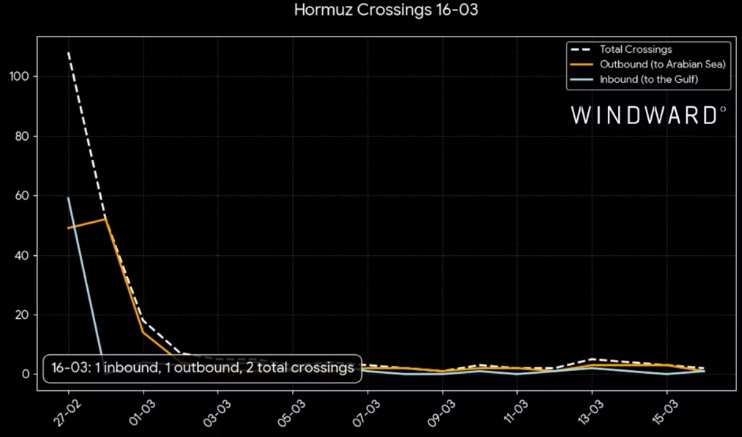
All identified vessels were bulk carriers, both flagged to Panama. Overall traffic levels remain approximately 97% below normal, reinforcing the continued near-closure of the waterway to standard commercial shipping.
At the same time, routing behavior is shifting. Between March 15 and March 16, at least five bulk carriers were observed exiting the Gulf via routes within Iranian territorial waters, sailing along the Iranian coastline instead of standard navigation channels.
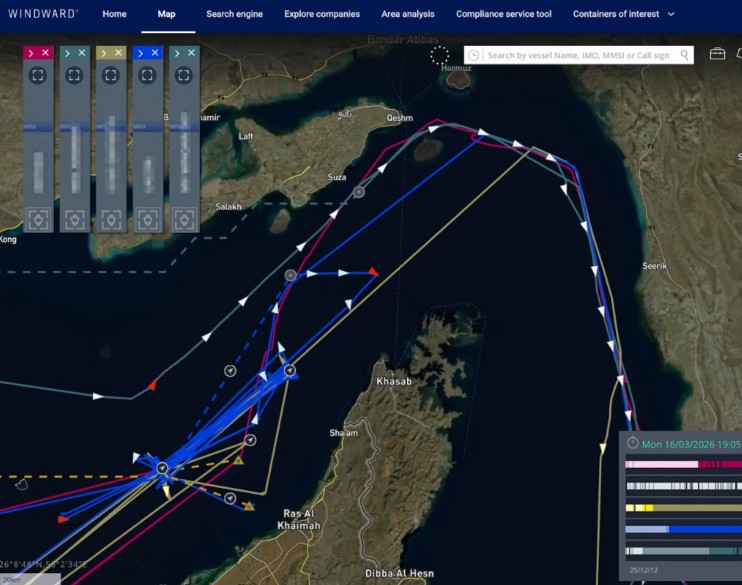
(Source: Windward Maritime AI™ Platform)
Iranian Crude Oil Export via Kooh Mobarak Terminal
A significant shift in Iranian export behavior has been identified at the Kooh Mobarak terminal, located east of the Strait of Hormuz.
On March 8, a sanctioned VLCC departed the terminal carrying approximately 1.77 million barrels of Iranian Heavy Crude, bound for Dalian, China. The vessel has remained in a 15+ day AIS blackout following departure.
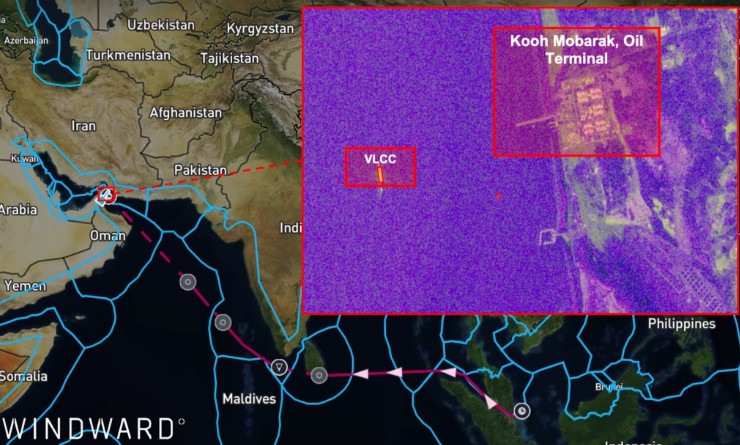
Remote Sensing Intelligence confirmed the presence of a VLCC-class vessel at the terminal on March 7, consistent with the loading timeline.
This marks the first recorded export from Kooh Mobarak in 2026, following only a single shipment in 2025, indicating historically minimal usage of the terminal.
The terminal’s location enables Iran to bypass the Strait of Hormuz entirely, reducing exposure to transit restrictions and naval threats. The activity suggests a deliberate effort to diversify export routes and sustain crude flows under constrained maritime conditions.
Maritime Security Incident
A maritime security incident was reported 23 nautical miles east of Fujairah, UAE, involving a tanker struck by an unknown projectile while at anchor.
The vessel sustained minor structural damage, with no reported injuries or environmental impact. Authorities are currently investigating the incident.
Windward was unable to definitively identify the vessel due to the presence of a GPS jamming zone in the area, which limited tracking and attribution.
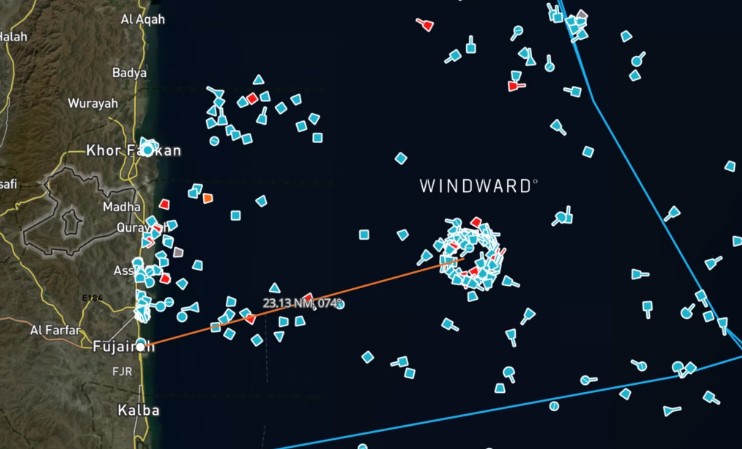
This event reinforces the continued presence of low-intensity, high-frequency threat activity in proximity to key Gulf anchorage areas.
Dark Vessel Activity
SAR imagery collected on March 16 identified an OFAC-sanctioned vessel operating without AIS transmission on the western side of the Strait of Hormuz.
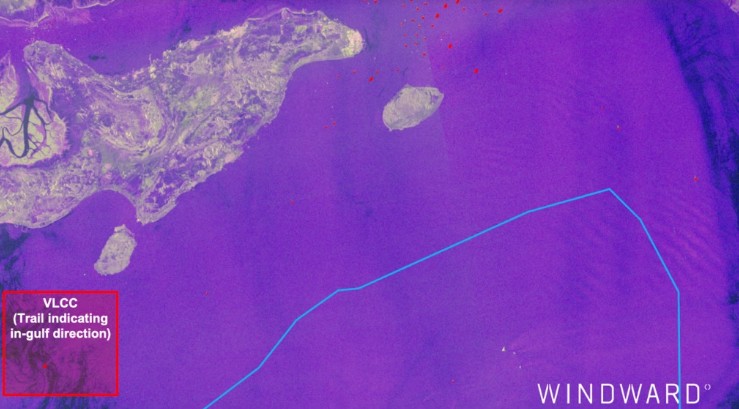
Analysis indicates the vessel was underway and entering the Arabian Gulf, consistent with ballast status data. The vessel last transmitted AIS on March 13 near Khor Fakkan before going dark.
The vessel is associated with sanctioned networks and fraudulent flag registration, highlighting the continued use of AIS suppression and identity obfuscation to enable movement under heightened monitoring conditions.
Port Operations Disruptions
Operational patterns across regional ports indicate continued volatility, with mixed signals between disruption and localized easing.
Inside the Gulf, Umm Qasr recorded two transshipment-delay cases, with no change from the previous day and no deviation from the 7-day average.
Outside the Gulf, Karachi recorded two port-of-loading late departures, up 100% day-on-day, alongside seven rollovers, remaining unchanged from the previous day but up 1,125% compared to the 7-day average.
Salalah recorded eleven transshipment rollovers and nineteen delay cases, both showing sharp declines compared to the previous day and below the 7-day average.
The data suggests a temporary easing at Salalah, while disruption persists in Karachi, reflecting uneven pressure across alternative logistics hubs.
Bandar Abbas Activity
Satellite imagery indicates a complete absence of observable activity at Bandar Abbas as of March 15.
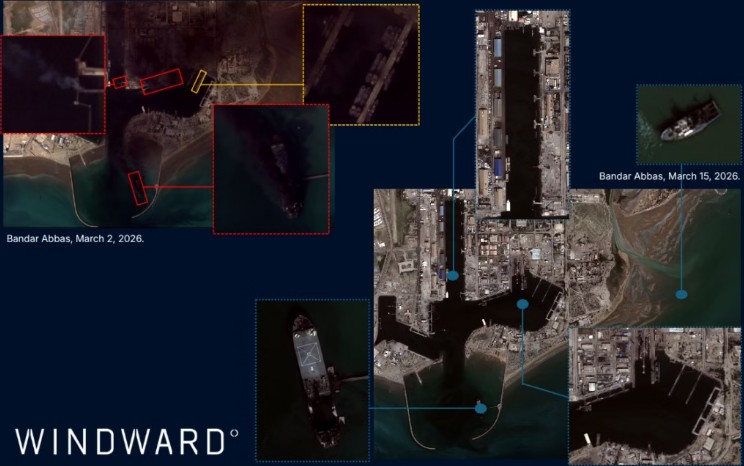
At the commercial dock, five vessels were present on March 2, compared to none on March 15. At the military dock, seventeen vessels were observed on March 2, with no vessels detected on March 15.
This sharp reduction suggests a temporary drawdown or redistribution of both commercial and military maritime presence at one of Iran’s primary port facilities.
Anomalous AIS Behavior
The Russia-linked tanker Sea Horse continues to exhibit anomalous AIS behavior in the Atlantic.
Since February 25, the vessel has remained in the Atlantic while continuously broadcasting a “Not Under Command” status, with no clear progression toward its previously declared destination in Cuba.
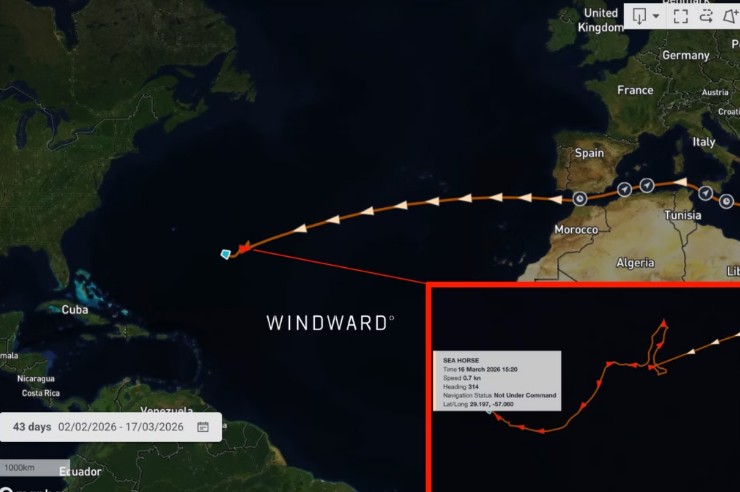
The prolonged stationary pattern and inconsistent movement signals suggest potential AIS manipulation or operational disruption, though the exact cause cannot be confirmed.
This behavior aligns with earlier indications of dark tanker activity near Cuban crude terminals, suggesting that opaque maritime logistics networks may still be facilitating energy flows despite reduced visible traffic.
Outlook
The March 17 operating picture reflects a maritime system operating under severe constraint, with the Strait of Hormuz effectively restricted and commercial traffic remaining near-zero.
At the same time, adaptive behaviors are emerging. Selective routing through Iranian territorial waters, alternative export pathways such as Kooh Mobarak, and shifting port activity patterns indicate that both state and commercial actors are adjusting to sustained disruption.
Maritime security risk remains active within the Gulf, with continued incidents near key anchorage areas, alongside ongoing dark vessel activity and AIS suppression.
Beyond the region, the confirmed tanker strike in the Black Sea and anomalous vessel behavior in the Atlantic point to a broader, multi-theater risk environment.
In the near term, maritime activity is likely to remain defined by restricted transit through Hormuz, controlled movement under selective access conditions, and continued redistribution of trade flows across global maritime corridors.