
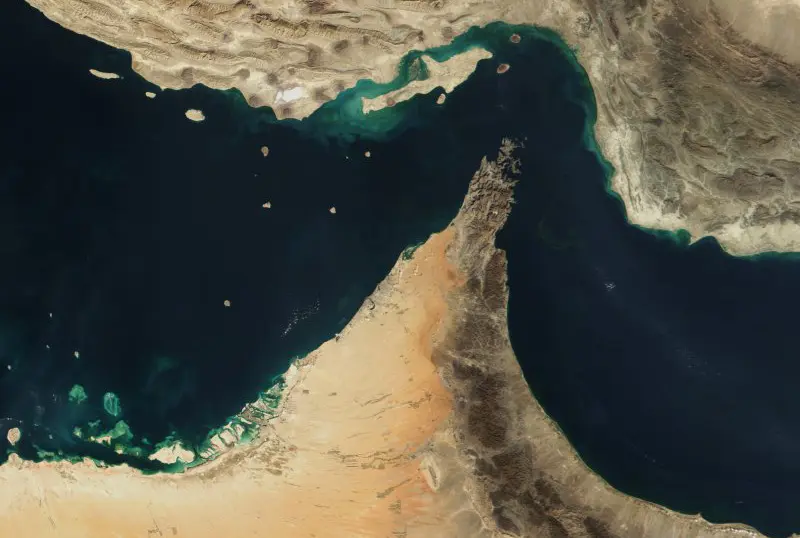
The Strait of Hormuz does not need to close for Iran to shift the balance of power. In the current crisis, Tehran’s ability to generate uncertainty around the chokepoint is already reshaping Europe’s energy posture, strengthening Russia’s leverage ahead of the 2027 gas contract deadline, and complicating Washington’s efforts to keep its allies aligned. This is not a story about missiles or maritime interdictions; it is a story about how threat elasticity and strategic coupling between the Gulf and Europe’s energy system create a new vulnerability in the Western security architecture. Hormuz has become a pressure point that reverberates far beyond the Middle East — and Iran knows it.
Verified Facts and Operational Realities
Iran has intensified its rhetorical and military signaling in the Gulf, emphasizing its ability to influence traffic through the Strait of Hormuz. Naval movements and public statements have increased, but Tehran has taken no steps toward a formal closure of the chokepoint. Iran has also denied responsibility for the recent attacks in Azerbaijan and Cyprus, and no authoritative source has confirmed Iranian involvement. At this stage, there is no verified pattern linking Tehran to those incidents.
Russia is approaching a critical deadline: the transit agreement for gas deliveries to Europe via Ukraine expires in 2027. President Vladimir Putin has publicly stated that Moscow is considering ending supplies earlier than the contractual date and may continue deliveries only to “reliable” partners, explicitly naming Slovenia and Hungary. These statements mark a shift from commercial logic to political signaling.
Europe remains exposed to instability in the Gulf. Despite diversification efforts, the EU still relies heavily on Middle Eastern oil and LNG, making it sensitive to any disruption — or perceived disruption — around Hormuz. European officials are now debating whether to extend gas arrangements with Russia beyond 2027, a discussion driven in part by concerns over the security of Gulf energy flows. Internal divisions persist, with member states holding divergent positions on Russian energy and on the pace of decoupling.
The United States continues to serve as the primary security guarantor for maritime routes in the Gulf, maintaining naval deployments to protect commercial shipping. Washington has a strategic interest in preventing Europe from drifting back toward Russian energy dependence. Balancing deterrence against Iran with the need to maintain cohesion among European allies has become increasingly complex, especially as Moscow seeks to exploit divisions within the EU.
The recent attacks in Cyprus and Azerbaijan remain unattributed. No verified evidence links these events to Iran, and they cannot be used to infer a coordinated campaign. For now, they remain isolated incidents without confirmed authorship.
Emerging Lines of Tension
The current crisis reveals several converging lines of tension that connect the Gulf to Europe’s energy posture and to the broader Western security architecture. The first is the growing sensitivity of European markets to instability around Hormuz. Even without a formal disruption, the perception of risk is enough to influence pricing, supply expectations, and political decision-making. This creates a form of energy psychology in which Europe reacts not only to events, but to the possibility of events — a dynamic that Iran can modulate at will.
A second line of tension emerges from Russia’s positioning ahead of the 2027 gas deadline. Moscow’s signals about potentially ending supplies early, and about privileging “reliable” partners, introduce a political dimension into what was once a commercial relationship. This shift intersects directly with Europe’s concerns about Gulf stability, creating a strategic coupling between two crises that were previously treated as separate: the security of maritime flows in the Gulf and the future of Russian gas in Europe.
A third tension point involves the United States, which must manage deterrence toward Iran while preventing Europe from drifting back toward Russian energy dependence. Washington’s dual role — security guarantor in the Gulf and political anchor for European cohesion — becomes harder to sustain as both theaters exert pressure simultaneously. The more volatile Hormuz becomes, the more leverage Russia gains in its dealings with Europe, and the more difficult it is for the United States to keep its allies aligned.
Finally, the absence of confirmed attribution for recent attacks in Cyprus and Azerbaijan adds a layer of ambiguity that reinforces the overall sense of instability. Even without evidence linking these incidents to Iran, their proximity to the broader crisis contributes to an environment in which uncertainty itself becomes a strategic asset.
Strategic Interpretation
The emerging dynamics around Hormuz reveal a form of leverage that does not rely on escalation. Iran’s ability to generate uncertainty — without closing the Strait or engaging in direct confrontation — creates a strategic environment in which Europe, Russia, and the United States are forced to react to signals rather than actions. This is the essence of threat elasticity: Tehran can expand or contract the perceived level of risk through rhetoric, posture, or limited military signaling, shaping Western behavior without crossing thresholds that would trigger a direct response.
This elasticity becomes more consequential when combined with the strategic coupling now linking the Gulf to Europe’s unresolved energy dependence on Russia. Instability around Hormuz, even at the level of perception, increases Europe’s anxiety about the reliability of Gulf supplies. That anxiety strengthens Moscow’s position as it approaches the 2027 gas deadline and considers whether to terminate deliveries early. Iran does not need to coordinate with Russia for this effect to materialize; the structural interaction between the two crises produces leverage for both.
For Europe, this creates a dilemma rooted in energy psychology. The EU’s reaction is shaped not only by actual disruptions but by the fear of potential disruptions. As long as Hormuz remains volatile, European policymakers face pressure to keep Russian gas as an option — even if politically undesirable. This psychological dimension amplifies the impact of Iran’s signaling and gives Russia an opportunity to reassert influence over European energy decisions.
For the United States, the strategic picture is equally complex. Washington must deter Iran in the Gulf while preventing Europe from drifting back toward Russian energy dependence. These objectives are mutually reinforcing in theory but increasingly difficult to pursue simultaneously in practice. The more Iran raises uncertainty around Hormuz, the more Russia benefits in its dealings with Europe, and the more the United States must invest political and military capital to maintain cohesion among its allies.
In this environment, ambiguity becomes a force multiplier. The lack of confirmed attribution for recent attacks in Cyprus and Azerbaijan contributes to a climate in which uncertainty itself has strategic value. Iran does not need to be responsible for these incidents to benefit from the broader sense of instability. The mere possibility of escalation — even if remote — is enough to influence Western calculations.
Core Thesis
Iran’s leverage in Hormuz does not destabilize only the Middle East; it reshapes the energy balance between the United States, Russia, and the European Union. By manipulating uncertainty rather than escalating militarily, Tehran exploits a structural vulnerability at the heart of Europe’s energy posture and amplifies Russia’s ability to pressure the EU ahead of the 2027 gas deadline. This dynamic forces Washington into a strategic tradeoff: contain Iran in the Gulf or prevent Europe from drifting back toward Russian energy dependence. The crisis around Hormuz is therefore not a regional issue but a systemic one — a pressure point that reverberates across the Western security architecture and alters the strategic calculus of all three actors.
Conclusion
For U.S. policymakers, the dynamics unfolding around Hormuz demand attention not because they signal an imminent crisis, but because they expose a structural vulnerability that adversaries can exploit without firing a shot. Iran’s ability to manipulate uncertainty in the Gulf intersects directly with Russia’s leverage over Europe’s energy future, creating a strategic environment in which two separate theaters reinforce each other in ways that complicate U.S. objectives. The United States can deter Iran, support European diversification, or counter Russian influence — but it cannot assume that actions in one arena will remain isolated from the others. Hormuz has become a systemic pressure point, and its effects travel through markets, alliances, and political decisions faster than military assets can respond. Recognizing this interdependence is essential for any strategy aimed at preserving Western cohesion in the years ahead.