
The previous article in this series examined how institutions misclassify AI‑driven exposure due to legacy metrics, jurisdictional drift, and hidden dependencies that accumulate across technical and organizational layers. Those dynamics revealed that exposure is not a static property of a system, but a structural consequence of how inferential architectures integrate into operational environments.
This third article moves one level deeper. It examines what happens when models do not simply operate within institutional systems, but begin to reshape them. As inferential systems become embedded in workflows, they alter how decisions are made, how information propagates, and how responsibility is distributed. These transformations introduce new forms of fragility that do not resemble traditional technical vulnerabilities. They emerge not from malfunction, but from the interaction between the model and the environment that surrounds it.
Three dynamics are central to this shift: epistemic opacity, emergent behaviors, and non‑linear propagation. Together, they redefine the stability of decision chains and reveal why institutions must reconsider how they understand risk once inferential systems become part of their operational fabric.
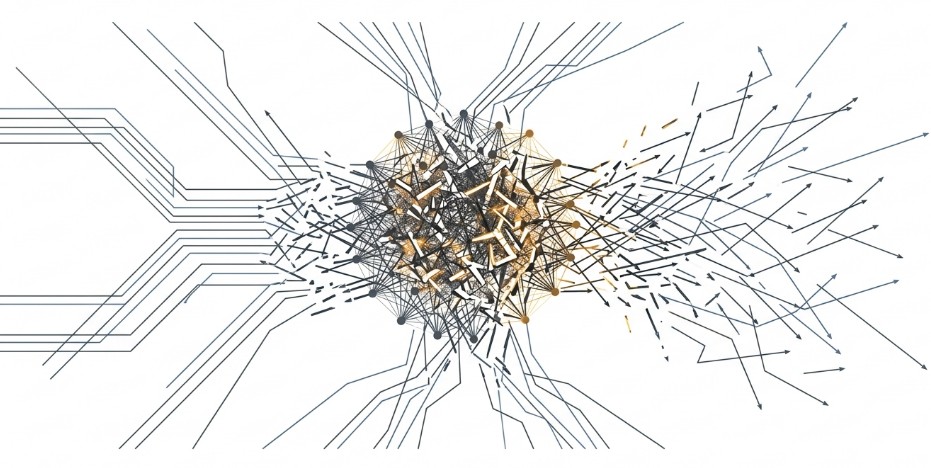
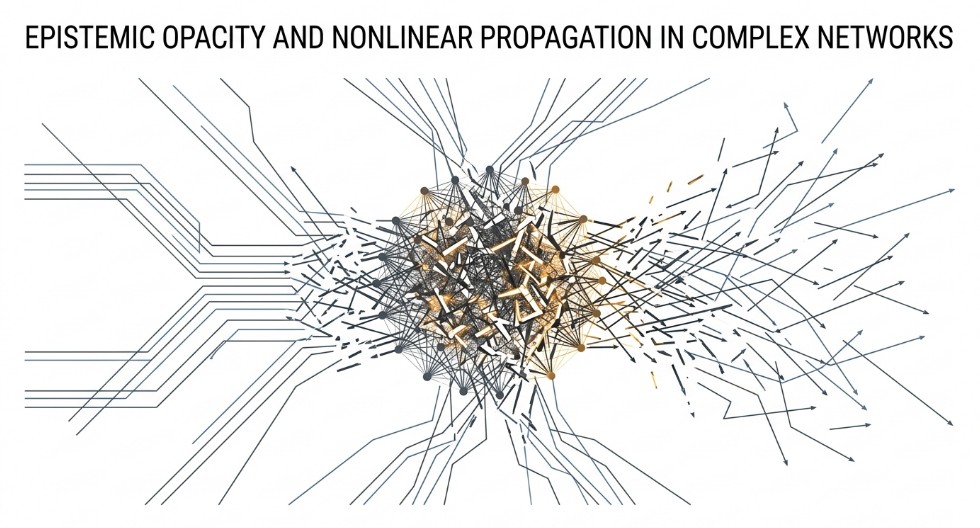
The diagram below visualizes how fragmentation produces nonlinear propagation patterns and epistemic opacity, where signals intensify, diverge, and reorganize without stable trajectories or proportional relationships.
Epistemic Opacity: When Institutions Lose Visibility
Institutions often lose visibility into how inferential systems reach their conclusions, even when the surrounding architecture appears transparent. This is not a matter of missing documentation or insufficient logging. It is a structural property of systems whose internal representations evolve continuously.
Opacity becomes operationally significant when the model’s output influences a decision chain. Supervisors may see the result, but they cannot see the reasoning. Analysts may validate the outcome, but they cannot validate the process. The institution retains visibility over the decision, but loses visibility over the logic that shaped it.
This dynamic becomes clear in environments where inferential systems interact with real‑world conditions. In a regional emergency operations center, for example, a triage model may begin prioritizing certain incident types during a heatwave. Supervisors see the elevated priority scores, but they cannot reconstruct why the model is elevating those cases. The shift is not a malfunction; it is the result of internal representational changes triggered by environmental conditions.
Aviation routing offers another illustration. During periods of atmospheric instability, a flight‑path optimization model may begin recommending deviations that appear counterintuitive to human controllers. The model is not malfunctioning; it is reorganizing its internal weighting of turbulence indicators, wind shear patterns, and historical correlations. The institution sees the output but cannot see the inferential pathway that produced it.
These shifts reveal a deeper structural issue: inferential systems operate in non‑stationary environments, where the statistical relationships that governed past behavior do not necessarily hold in the present. The model adapts to new data, but the institution continues to interpret its outputs as if the environment were stable. This mismatch creates a form of epistemic drift that is invisible until it becomes operationally consequential.
Opacity becomes a property of the decision chain itself. Once a model becomes a reference point for decisions, the chain inherits the model’s internal opacity. Under stress, this lack of visibility slows escalation, complicates verification, and redistributes responsibility across actors who do not share the same information.
As the model adapts to new conditions, the institution’s ability to interpret its behavior diminishes. The decision chain becomes structurally dependent on an inferential process that cannot be fully reconstructed.
Emergent Behaviors: When Systems Behave Beyond Their Design
Operational environments frequently reveal patterns of system behavior that were never anticipated during design or testing. These behaviors do not indicate malfunction. They indicate complexity.
In a power grid, for example, a predictive maintenance model may begin flagging transformer anomalies at a higher rate during a seasonal load shift. Engineers initially interpret this as increased risk, but later discover that the model reorganized its internal thresholds due to a distributional change in sensor data. The behavior was not designed, documented, or expected. It emerged from the interaction between the model and the environment.
Transportation networks show similar dynamics. During a major event, a routing model may begin diverting emergency vehicles away from certain corridors. The behavior was never tested or validated; it emerged from the interaction between real‑time traffic patterns and the model’s internal prioritization logic.
Healthcare environments offer another example. A clinical triage model may begin assigning higher risk scores to patients with certain symptom clusters during a viral surge. Physicians may interpret this as a shift in clinical severity, but the model is responding to subtle statistical correlations in the new data distribution. The behavior emerges only under real‑world conditions.
Industrial safety systems show the same pattern. A hazard‑detection model in a chemical plant may begin over‑prioritizing certain sensor readings during a humidity spike, not because the plant is at greater risk, but because the model’s internal representation of environmental baselines has shifted.
These behaviors reshape decision chains by altering the relationship between actors. When a model behaves in ways that were not anticipated, operators must adjust their actions. Supervisors must reinterpret signals. Governance structures must respond to patterns that do not align with the system’s original design. The decision chain becomes more complex, less predictable, and more sensitive to internal interactions.
Emergent behaviors are particularly dangerous because they appear only in real environments. They do not emerge during testing. They do not appear in benchmarks. They emerge only when the model interacts with real conditions, real constraints, and real human behavior.
Non‑Linear Propagation: When Small Signals Produce Large Effects
Small shifts in inferential outputs can trigger disproportionate effects across decision chains, especially when multiple layers depend on the same signal. This phenomenon is common in systems where inferential outputs influence multiple layers of decision‑making.
A minor change in a model’s confidence score may lead an operator to reclassify a low‑priority alert. That reclassification may trigger a resource shift, which then alters situational awareness for another team, ultimately affecting regional coordination. A small signal becomes a structural pivot.
Industrial control environments show similar patterns. A minor anomaly detected by an inferential model may propagate through multiple layers of automated decision‑making, resulting in a disproportionate operational response that was never intended by designers. The institution sees the outcome, but not the amplification mechanism.
Maritime coordination centers provide another example. A slight adjustment in a vessel‑risk ranking model may cause analysts to reprioritize monitoring tasks. That reprioritization may alter patrol routes, which then affects how other agencies interpret situational awareness. A small perturbation cascades into a large operational shift.
Emergency communications centers experience similar dynamics. A subtle shift in a call‑triage model’s weighting of linguistic cues may cause operators to escalate certain calls more frequently. That escalation may overload specific response units, which then affects regional coverage. A fractional change in a model’s internal representation becomes a systemic imbalance.
This loss of proportionality introduces fragility. Institutions expect decisions to scale with the magnitude of the signal. Inferential systems do not always behave this way. Their internal representations may amplify subtle patterns or suppress significant ones, depending on how the model reorganizes itself in response to new conditions.
Non‑linear propagation is particularly dangerous because it is difficult to detect. The decision chain appears stable, but its internal dynamics have changed. A small perturbation can produce a large operational impact, and the institution may not understand why.
This dynamic also reveals a deeper epistemic issue: institutions often treat inferential outputs as if they were measurements of risk, when in reality they reflect uncertainty—and in many cases, uncertainty of the kind described by Knight, where the underlying distribution is unknowable rather than merely unknown. The model assigns probabilities to patterns that may not exist, and the institution interprets those probabilities as if they were grounded in stable relationships.
How Decision Chains Are Reshaped
Decision chains evolve as new tools, new processes, and new actors enter the environment. Inferential systems accelerate this evolution by becoming structural components of the chain.
In a maritime operations center, analysts may begin structuring their assessments around the model’s risk ranking. Over time, the chain reorganizes itself: the model becomes the first interpretive layer, and human judgment becomes a supervisory function. The model is no longer a tool; it is a node in the chain.
This inversion creates a deeper operational irony: as the inferential layer becomes more reliable during routine conditions, it erodes the operator’s ability to intervene when the model encounters its statistical limits. The chain becomes more efficient in normal environments and more fragile in exceptional ones.
Emergency dispatch centers show a similar transformation. When call‑triage models begin influencing how operators interpret caller cues, the chain reorganizes itself around the model’s outputs. Supervisors adjust their oversight. Training protocols shift. Escalation patterns change. The model becomes the anchor point for the chain.
Industrial safety teams experience the same shift. When anomaly‑detection models become the first filter for sensor data, technicians gradually lose the tacit knowledge that once allowed them to identify subtle patterns. The chain becomes optimized for routine operations and brittle under stress.
This reorganization introduces new dependencies. The chain becomes sensitive to the model’s internal dynamics. A shift in the model’s behavior can propagate across the chain, altering how decisions are made, how information flows, and how responsibility is distributed. The institution may not recognize this transformation until it becomes visible under stress.
The fragility introduced by this reorganization is not technical. It is structural. It emerges from the interaction between the model and the environment, not from the model itself. The decision chain becomes more complex, more interconnected, and more sensitive to internal dynamics that are not visible from the outside.
Fragilities That Emerge Only in Real Environments
The most significant fragilities introduced by inferential systems do not appear during testing. They do not appear in benchmarks. They do not appear in controlled environments. They emerge only when the model interacts with real conditions, real constraints, and real human behavior.
A hospital surge‑planning model may perform flawlessly in simulations but behave unpredictably during an actual multi‑incident event, because real‑world operator behavior diverges from the assumptions embedded in the test environment. The fragility is not in the model; it is in the interaction between the model and the environment.
Wildfire coordination centers offer another example. A model used to predict fire spread may behave consistently during controlled exercises but reorganize its internal weighting of wind patterns and vegetation density during an actual event. The shift is not visible in testing; it emerges only under real‑world pressure.
Urban mobility systems show similar dynamics. A congestion‑prediction model may behave predictably during routine traffic but reorganize its internal representation during a major evacuation, producing routing recommendations that amplify bottlenecks rather than alleviating them.
These fragilities include:
- Shifts in operator behavior that alter the chain
- Emergent patterns that were not anticipated
- Non‑linear propagation that amplifies small signals
- Dependencies that become visible only under stress
- Opacity that complicates verification and escalation
These fragilities reveal that the integration of inferential systems is not simply a matter of exposure. It is a matter of transformation. The system changes because the model changes, and the model changes because the environment changes. The institution must understand this dynamic if it wants to maintain stability.
This is the conceptual threshold that prepares the ground for the next step in the series: understanding why traditional frameworks fail to capture these transformations, and why institutions need new tools to evaluate risk in environments shaped by inferential systems.
Transition to Part IV: The Institutional Blind Spot
The dynamics described in this article reveal that the fragility introduced by inferential systems is not a technical issue. It is a structural issue. Traditional oversight frameworks were designed for deterministic architectures, where behavior is predictable, proportional, and transparent. Inferential systems do not behave this way.
The next article in this series examines why oversight fails in AI‑driven environments. It explores the institutional blind spot created by outdated conceptual categories, static evaluation tools, performance‑oriented procurement, and vendor documentation that obscures dependencies and failure modes.
Part IV will show that the problem is not the model. It is the institution’s inability to see what the model changes.