
For many Coast Guard members, the promise of “digital transformation” can sound like an abstract concept that might never impact their day-to-day work.
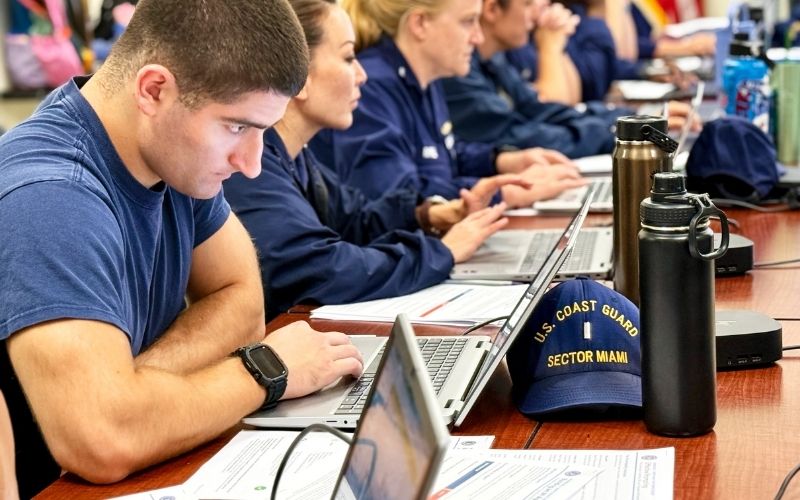
Personnel from the Coast Guard Technology Readiness Directorate (CG-TECH) set out to change that in early June with the first Digital Transformation (DTX) Workforce Engagement Tour stop in Miami.
Over the course of five days, CG-TECH provided hands-on AI training, process automation support, and collaborative problem-solving sessions with personnel in the Southeast District to build digital skills and identify opportunities for innovation across the workforce.
“Successful digital transformation starts at the deckplate,” said Lindsay Abbott, Technical Readiness Transformation office chief. “The people doing the mission every day know where the friction exists. When we give them the knowledge, tools, and confidence to address those challenges, that’s when DTX becomes real. It starts with one idea, one workflow, and one person willing to try something new, and scales from there.”
From Awareness to Action
Chief Warrant Officer 2 Richard Picone, a marine inspector assigned to Sector Miami, was one of those people.
Picone’s experience with AI was limited – he had occasionally used it for simple tasks like conducting research or refining his writing but had not explored how it could support his operational tasks. He signed up immediately when he learned about the AI training being offered.
Throughout the course, participants like Picone explored practical ways to use AI and automation to solve real-world challenges. Rather than focusing on theory, CG-TECH instructors encouraged attendees to think about their own workflows and identify opportunities to eliminate repetitive tasks, improve access to information, and streamline mission support activities.
For Picone, one challenge stood out: commercial vessel operators occasionally miss required inspection windows, creating last-minute scheduling demands for both operators and Coast Guard inspectors. During the workshop, he began developing an AI agent to more effectively track and manage inspection timelines.
“The agent I tried to create is one that can review all the vessels in our area of responsibility that are required to be inspected, schedule them out proportionately for the year, and generate a calendar with the dates accordingly,” he explained.
Although the tool remains under development, the exercise demonstrated how quickly workforce members can move from learning about AI to using it to address operational challenges.
“Participants really seemed to like the hands-on learning,” said Lauren Eberly, AI program manager for the Office of Data and AI. “When they are able to apply AI to realistic Coast Guard scenarios, they move beyond simply learning about the technology to understanding how it can help them solve problems and accomplish the mission more effectively. Seeing their excitement and confidence build throughout the training has been incredibly rewarding.”
Returning Minutes to Mission
While AI trainers led the workshops, another team of CG-TECH specialists worked with units in Miami to identify repetitive, time-consuming processes that could be streamlined through automation, improved data access, and modern digital tools. The goal was simple: reduce administrative burden and put more minutes on mission.
By the end of the week, CG-TECH completed 10 automation requests, accepted 13 additional projects for follow-on development, and helped four local Service members build automations of their own.
Among them was Information Systems Technician 3rd Class Enzo Rabiller, an information technology specialist assigned to Electronic Systems Support Detachments (ESD) Miami Beach. With the help of the CG-TECH experts, Rabiller modernized a routine process that relied on an outdated paper form for personnel to acknowledge receipt of their workstation.
Rather than requiring users to complete and return the form manually, which often led to missing forms and the need for continuous follow-up, Rabiller developed an automated application that sends each user a link to electronically acknowledge receipt of their workstation. If a user doesn’t respond, the system automatically sends reminder notifications and provides administrators with a real-time view of outstanding acknowledgments.
The automation eliminates a cumbersome administrative process while making accountability easier to manage across the command. Applied to approximately 1,500 workstations at Sector Miami, the solution is expected to return an estimated 90,000 minutes to mission by reducing manual tracking and follow-up.
“We know some of the best ideas are going to come from the people doing the work every day,” Abbott said. “Our goal is to give them the tools and support to turn those ideas into solutions. When someone like IT3 Rabiller can take a frustrating administrative task and build an automation that returns thousands of minutes back to the mission, that’s exactly the kind of momentum we’re trying to create.”
Coming Soon: A Workforce Engagement Near You!
The Miami engagement marked the first stop in a broader CG-TECH initiative to modernize the Coast Guard. Over the next nine to 12 months, the team plans to visit all nine Coast Guard districts, partnering with local commands to bring digital transformation to the deckplate.
This article by the Coast Guard Technical Readiness Transformation Office was originally published on MyCG